“I'm his father and he's my son and if there's something bigger than that I'll put a bullet in my head!”
— Joe Keller's desperate defense of his son Chris against accusations related to the defective parts.

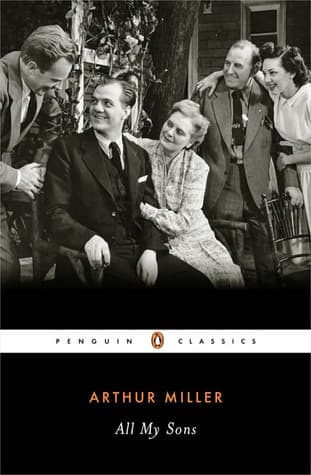
Sign in to track this book
A prosperous post-war family's facade crumbles when a son's love for his disgraced partner's daughter forces a devastating confrontation with his father's buried wartime guilt and the deadly cost of his success.
The play starts on a Sunday morning in the backyard of the Keller home in a Midwestern American town. Joe Keller, a successful businessman, reads the newspaper while his neighbor, Frank Lubey, tries to calculate Larry Keller's horoscope, believing Larry, missing in action for three years, might still be alive. Chris Keller, Joe's surviving son, is there. Kate Keller, Joe's wife, still grieves Larry's presumed death, hoping he will return. A young apple tree, planted for Larry, blew down in the night, which Kate sees as a bad sign. Ann Deever, Larry's former fiancée and the daughter of Joe's ex-business partner, Steve Deever, is expected to visit.
Ann Deever arrives, and it quickly becomes clear she and Chris Keller are in love. Chris proposes marriage, but Ann hesitates, knowing Kate Keller's strong belief that Larry is still alive and that Ann is 'Larry's girl.' Ann also reveals that her father, Steve Deever, imprisoned for selling cracked cylinder heads to the military during the war, has written to her, wanting to make amends. Joe Keller, who was cleared in the same scandal, tries to stop Ann from seeing her father, pointing out the shame Steve brought on their families. Despite the problems, Chris is set on marrying Ann, seeing her as a chance for a new life.
Kate Keller strongly opposes Chris and Ann's marriage, stating that if Larry is truly dead, then Ann belongs to Chris, but if Larry is alive, then Ann is still his fiancée. Her refusal to accept Larry's death comes from a deep need to believe in moral order, which would break if Joe's involvement in the cylinder head scandal was fully known. Joe, trying to calm Kate and help Chris, tells a partial truth: he admits knowing the cylinder heads were faulty but claims Steve Deever, his partner, ordered them shipped, making Steve solely responsible and himself a victim of circumstances and Steve's poor judgment.
George Deever, Ann's brother and a lawyer, arrives unexpectedly. He just visited his father, Steve, in prison. George is bitter and suspicious, having heard his father's story for the first time in years. He says Steve claimed Joe Keller was equally responsible for the faulty parts and convinced him to cover them up. George is determined to expose the truth and stop Ann from marrying Chris, believing the Kellers caused his family's ruin. His arrival creates tension in the Keller home, threatening to expose Joe's carefully built image of innocence.
George confronts Joe directly, questioning his role in the cylinder head scandal. He points out inconsistencies in Joe's story and notes that Joe was sick on the day the faulty parts were shipped, suggesting Joe couldn't have truly been unaware of the decision to ship them. Joe tries to dismiss George's claims, portraying Steve as a weak and easily manipulated man. However, George's persistent questions and his retelling of his father's desperate plea for help from Joe on that day start to break Joe's composure, making him visibly uncomfortable and defensive. Kate, sensing danger, tries to step in and change George's questions.
During the confrontation between George and Joe, Kate, trying to defend Joe and stop George from digging further, accidentally makes a key slip. She exclaims that Joe 'never was sick in his life,' directly contradicting Joe's earlier claim that he was home with the flu on the day the faulty parts were shipped. This reveals Joe's lie and destroys his alibi. Chris, who always believed in his father's innocence, is devastated and horrified by this proof of Joe's involvement in the crime that killed twenty-one pilots. The truth begins to come out before their eyes.
Chris, shaken by Kate's accidental revelation, confronts Joe with deep disillusionment and moral outrage. He cannot understand how his father, whom he admired, could have knowingly allowed faulty parts to be shipped, leading to the deaths of fellow soldiers, possibly including his own brother, Larry. Chris struggles with the weight of his father's guilt, feeling that his entire life and the values he believed in were a lie. He struggles to reconcile the loving father he knows with the man who put profit over human lives, feeling betrayed and having a crisis of conscience.
As tension builds, Ann, wanting to bring resolution and force Chris to face the truth, reveals a letter she received from Larry before his death. The letter clearly states Larry's despair upon learning of his father's and Steve Deever's conviction for shipping faulty parts. Larry expresses shame and an inability to live with the knowledge that his father was responsible for the deaths of his fellow pilots. He indicates his intention to commit suicide by crashing his plane, making it look like a combat death. This letter confirms Larry's death was not an accident of war but a deliberate act, a result of his father's actions.
After reading Larry's letter, Joe Keller must face the full extent of his responsibility. He finally understands that "all my sons" refers not just to Larry, but to all the soldiers who died because of his defective parts. The realization that his actions directly led to Larry's suicide, and the immense moral weight of his crime, finally breaks him. Overwhelmed by guilt, shame, and the irreversible damage he caused, Joe goes into the house and shoots himself. His suicide is a final, tragic act of atonement, ending the family's long denial and the play's escalating conflict.
After Joe's suicide, Kate and Chris are left to deal with the profound consequences. Kate is shattered by her husband's death, but also by the definite proof of Larry's death and Joe's guilt. Chris, though heartbroken, also faces the burden of his father's actions and the moral implications of his own role in letting Joe's lies continue for so long. The family is broken, forced to confront the harsh realities of their past and the moral compromises that led to such a tragic end. The play closes with the characters facing a future forever changed by the truth.
The Protagonist/Antagonist
Joe's arc moves from self-deception and denial to a devastating realization of his universal culpability, culminating in his suicide.
The Supporting
Kate's arc is defined by her gradual, painful acceptance of Larry's death and Joe's true guilt, which shatters her carefully constructed reality.
The Protagonist
Chris's arc is a journey from naive idealism and filial loyalty to a crushing disillusionment and moral awakening, forcing him to confront uncomfortable truths.
The Supporting
Ann's arc moves from escaping her past to actively confronting it, ultimately revealing the decisive evidence that shatters the Keller family's denial.
The Supporting
George's arc involves his determined pursuit of the truth behind his father's conviction, leading to the initial unraveling of Joe's deception.
The Mentioned
Larry's arc is revealed posthumously, from a missing war hero to a disillusioned son who chose suicide due to his father's guilt.
The Supporting
Frank's arc is static, serving more as a thematic device and a source of comic relief than a character undergoing significant change.
The Supporting
Lydia's arc is static, she serves as a contrasting figure to the Keller family's internal struggles.
The Supporting
Jim's arc is mostly static, though he becomes more openly critical of Joe as the truth is revealed.
The Supporting
Sue's arc is static, serving as an external voice of judgment and pragmatic realism.
The play explores the corrupted American Dream, where the pursuit of wealth and success, seen in Joe Keller, overrides ethics and human life. Joe shipped faulty parts to keep his factory running and provide for his family, believing financial security was the ultimate good. This theme appears when Chris confronts Joe, saying, "There's a universe of people outside and you're responsible to it." The play argues that this narrow, self-serving dream leads to moral decay and, ultimately, tragedy.
“I'm not a red-hot momma, but I think a man is a fool who doesn't mind his business. And a man who is a fool in business... is a fool.”
A central theme is the complex and often destructive relationship between fathers and sons, and the weight of family responsibility. Chris Keller idolizes his father, Joe, and struggles greatly when confronted with Joe's guilt, feeling betrayed and questioning his own identity. Larry Keller's suicide is a direct result of his shame over his father's actions, showing the deep impact a father's choices have on his sons. The play challenges the idea that a father's responsibility is only to his immediate family, arguing that a father's actions have wider societal implications that affect his children.
“I'm his father and he's my son, and if there's anything bigger than that I'll put a bullet in my head!”
The play is a relentless uncovering of truth from layers of denial and guilt. Joe Keller lives in self-deception, convincing himself his actions were justified and he is innocent. Kate Keller actively participates in this denial, hoping Larry will return to avoid facing Joe's guilt. The gradual revelation of Joe's lie, first through Kate's slip, then George's accusations, and finally Ann's letter, forces the characters to face uncomfortable realities. The play shows how denial can prolong suffering and how suppressing truth ultimately leads to catastrophic results, as seen in Joe's suicide.
“It's all right, Joe. Just be your own self. She thinks so much of you.”
Arthur Miller contrasts the American ideal of individualism with the need for social responsibility. Joe Keller believes his main duty is to his family, leading him to justify actions that harm the wider community. Chris, having seen wartime camaraderie, believes in a broader responsibility to humanity: "We were all responsible to each other." The play argues that true individual well-being is tied to the well-being of the group, and that ignoring this social contract results in moral bankruptcy and personal devastation. Joe's final realization, "They were all my sons," sums up this theme.
“I don't understand why nothing has an end, and no one ever makes a mistake, and all the innocent people suffer.”
A symbolic omen foreshadowing tragedy and the shattering of illusions.
The apple tree, planted in memory of Larry Keller, falls in a storm at the beginning of the play. This serves as a powerful symbol and a foreshadowing device. For Kate, it is a bad omen, reinforcing her superstitious belief in Larry's continued existence. More profoundly, it symbolizes the fragility of the Keller family's carefully constructed peace and the imminent collapse of their illusions. Its destruction foreshadows the shattering of the family's denial regarding Larry's death and Joe's guilt, signaling that the truth, like the storm, will violently uproot their false foundations.
A crucial piece of evidence that reveals the ultimate truth and catalyzes the climax.
Larry's letter, held by Ann Deever, is the ultimate plot device that brings about the play's tragic climax. Its existence is hinted at, but its contents are withheld until the opportune moment. When Ann finally reveals the letter, it provides irrefutable proof of Larry's suicide and his motivation – his shame over his father's actions. This revelation forces Joe Keller to confront the full, devastating scope of his responsibility, not just for the pilots' deaths but for his own son's. The letter serves as the final, undeniable piece of truth that shatters all remaining denial and directly leads to Joe's suicide.
An accidental revelation that cracks Joe's alibi and accelerates the truth's emergence.
Kate Keller's inadvertent slip of the tongue, where she blurts out that Joe 'never was sick in his life,' is a pivotal plot device. It directly contradicts Joe's long-held alibi that he was home with the flu on the day the faulty cylinder heads were shipped, thus shifting the blame entirely to Steve Deever. This accidental revelation is the first significant crack in Joe's carefully constructed facade of innocence. It immediately alerts George and Chris to the possibility of Joe's deeper culpability, driving the dramatic tension and accelerating the play's movement towards the full exposure of the truth.
A pervasive backdrop that highlights moral compromises and the cost of human life.
The backdrop of World War II is a crucial plot device, even though the play takes place after its conclusion. The war serves as the context for Joe Keller's crime, making his actions of shipping faulty parts morally reprehensible against the backdrop of soldiers fighting and dying. It also shapes Chris's idealism and his sense of collective responsibility, contrasting sharply with his father's narrow self-interest. The war elevates the stakes of Joe's actions, transforming a business decision into an act that directly leads to the deaths of 'all my sons,' emphasizing the universal cost of individual moral failure.
“I'm his father and he's my son and if there's something bigger than that I'll put a bullet in my head!”
— Joe Keller's desperate defense of his son Chris against accusations related to the defective parts.
“There are no islands in the world anymore. We're all in it together.”
— Chris Keller's plea to his father about the importance of social responsibility beyond immediate family.
“Once and for all you can know that there's a universe of people outside and you're responsible to it.”
— Chris Keller confronting his father about the wider implications of his actions.
“He's not coming back. We all know it. I resent you for making me deny it.”
— Kate Keller's bitter words to Chris about Larry's disappearance.
“It's what you do to people. It's what I do to people. What the hell did I work for?”
— Joe Keller's anguished realization of the consequences of his actions, particularly on his sons.
“I'm not a murderer. I'm a businessman.”
— Joe Keller attempting to justify his actions by separating them from moral culpability.
“I'm going to make a fortune here!”
— Frank Lubey's optimistic, albeit naive, outlook on business and life.
“Because he's not dead, Chris. He's been killed.”
— Kate Keller distinguishing between death and murder, hinting at the truth about Larry's fate.
“You don't want to be the man your father is.”
— Chris Keller expressing his internal conflict and desire to be different from Joe.
“A man can't be a Jesus in this world.”
— Joe Keller's cynical view of idealism and the compromises one must make in life.
“He folded up like a handkerchief.”
— Joe Keller describing Steve Deever's reaction to being accused of the defective parts.
“I want to get married, I want to have children, I want to build a house, I want to make a future.”
— Ann Deever expressing her desire for a normal life and future with Chris.
“The world is an alley, and you either lick 'em or join 'em.”
— Joe Keller's harsh, survivalist philosophy of life and business.
“Every time I reach out for somebody I end up with my finger in somebody's eye.”
— Jim Bayliss's cynical observation about human interaction and the difficulty of truly connecting.
Ready to see how well you understood this book? Take our interactive quiz with 10 questions.
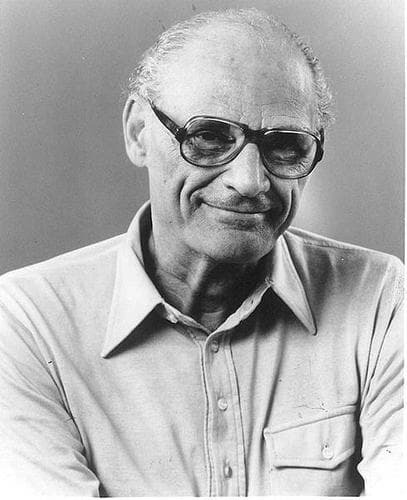
Arthur Asher Miller was an American playwright, essayist and screenwriter in the 20th-century American theater. Among his most popular plays are All My Sons (1947), Death of a Salesman (1949), The Crucible (1953), and A View from the Bridge (1955). He wrote several screenplays and was most noted for his work on The Misfits (1961). The drama Death of a Salesman is considered one of the best American plays of the 20th century.

Ashley Antoinette
4.6

Mark McDonald
4.4
Luo Guanzhong
4.4

Mia McKenzie
4.3

Dorothy Parker
4.3

Joaquim Maria Machado de Assis
4.3

James Thurber
4.2

Terry Kay
4.2