“I will love you and you will not die.”
— Yolandi's internal mantra about Elfreida.

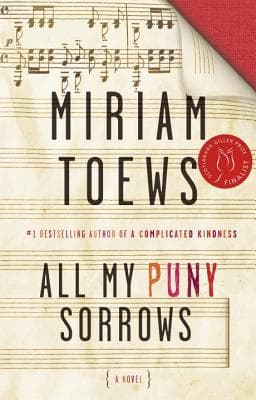
Miriam Toews (2014)
Genre
Literary Fiction / Psychology
Reading Time
6-7 hours
Key Themes
See below
Sign in to track this book
A darkly humorous and moving story about two sisters: one a celebrated pianist who wants to die, and the other a chaotic mess determined to save her. It shows the complex dance between love, grief, and the will to live.
Yolandi 'Yoli' Von Riesen rushes to the hospital in Winnipeg after her older sister, Elfrieda 'Elf' Von Riesen, a famous concert pianist, attempts suicide again. Elf is recovering from an overdose and is under psychiatric care. Yoli finds Elf clear-headed but determined to die, expressing deep despair despite her successful career, loving husband, and seemingly perfect life. Elf immediately asks Yoli to help her travel to Switzerland, known for its assisted suicide clinics. Yoli finds this request both horrifying and heartbreaking. This first talk sets up the novel's main conflict: Yoli's desperate efforts to keep her sister alive against Elf's firm wish for death.
As Yoli spends time with Elf in the psychiatric ward, she often thinks about their past, especially their Mennonite upbringing in a small, isolated community in Manitoba. She remembers their artistic parents and the lasting impact of their father's suicide years ago. This shared trauma of their father's death weighs heavily on both sisters, subtly affecting Elf's current struggles and Yoli's strong resolve to prevent a similar outcome. Yoli also remembers their mother, Lottie, and her strength, as well as their brother, Joe, who lives in Europe. These memories show the family's complex history with mental illness and loss, explaining Elf's deep sadness.
Elf's wish to go to Switzerland becomes a constant demand, putting great pressure on Yoli. Elf carefully researches Dignitas and other clinics, showing Yoli brochures and arguments for her right to choose her own death. Yoli is torn between her love for her sister and her moral opposition to assisted suicide. She tries to reason with Elf, reminding her of her talent, her husband Nic, and the joy she brings to others. But Elf remains unyielding, describing her pain as unbearable and constant. This ethical dilemma forces Yoli to confront her own beliefs about life, death, and the limits of love and help.
Elf's loving husband, Nic, a kind and devoted man, visits her in the hospital. He is clearly upset and exhausted by Elf's ongoing depression and repeated suicide attempts. Nic expresses his deep love for Elf and his desperate wish for her to live, but also his growing helplessness. He tries to talk to Elf about her upcoming international piano tour, hoping to rekindle her passion for music, but Elf shows little interest. His visit highlights the deep pain Elf's condition causes those who love her, and the limits of their ability to 'fix' her illness, leaving Yoli feeling even more alone in her struggle.
Amidst the crisis with Elf, Yoli's own life continues its chaotic path. She is a divorced mother of two teenagers, Nora and Lou, struggling financially and dealing with a series of less-than-ideal romantic relationships. Her children are a constant source of worry and joy, and her ex-husband, Jake, calls frequently. Yoli's personal struggles—her own loneliness, her search for love, and her attempts to keep some order—contrast sharply with Elf's polished, outwardly successful life. These distractions show Yoli's resilience and her ability to find humor even in the darkest times, but also highlight the immense burden she carries.
Lottie, Yoli and Elf's mother, visits the hospital, bringing her usual mix of stoicism, practical advice, and dark humor. Having lost her husband to suicide and faced many hardships, Lottie has a deep, if sometimes unsettling, acceptance of life's tragedies. While she deeply loves Elf and wants her to live, she also seems to understand Elf's pain in a way Yoli struggles with. Lottie's presence gives Yoli both comfort and a challenging perspective, making Yoli consider that Elf's desire for death might be a choice born of unbearable suffering, rather than just an illness to be cured.
Driven by her firm wish to end her life, Elf tries to leave the psychiatric ward. Yoli, who often sleeps in the room or nearby, is briefly absent, allowing Elf to attempt her escape. She is quickly caught by hospital staff and brought back, further confirming the doctors' assessment of her severe suicidal intent. This incident shows how serious Elf's determination is and the constant watch needed to keep her safe. It also deeply upsets Yoli, making her feel the weight of responsibility even more and highlighting how futile her efforts are if Elf is so determined.
The medical team treating Elf, especially Dr. Schwartz, deals with the ethical complexities of her case. While they recognize Elf's deep depression, they also acknowledge her intelligence and her clear arguments for her right to die. The idea of 'capacity'—whether Elf is truly capable of making such a decision given her mental state—becomes a main point of discussion. The doctors hesitate to release her due to her high risk of suicide but also recognize the limits of involuntary treatment. This mirrors Yoli's own internal conflict, as she sees Elf's clarity alongside her despair.
There are brief, touching moments where the sisters connect through shared memories, humor, and their deep bond. They talk about books, music, and their childhood. Yoli holds onto these moments, seeing them as proof that Elf is still 'there' and has reasons to live. However, these glimmers of hope are always short-lived. Elf inevitably returns to her sole focus on dying, often with renewed intensity. Each return to despair crushes Yoli's spirit, making her question her efforts and the chance of ever truly saving her sister from her deep sadness.
As Elf's condition remains unchanged and her resolve to die grows stronger, she makes a final, heartbreaking plea to Yoli to help her go to Switzerland. She argues that true love means respecting her independence and ending her suffering. Yoli is pushed to her absolute limit, facing the most terrifying decision of her life. She struggles with the idea of betraying her sister by keeping her alive against her will, versus the unimaginable grief of helping her die. The novel ends with Yoli's agonizing internal debate, leaving her on the edge of a choice that will forever change her life and the memory of her sister.
The story moves to Yoli's life after Elf's eventual death by suicide. While the exact details of Elf's final moments are left somewhat unclear or happen off-page, Yoli is left to deal with the deep emptiness her sister's absence creates. She continues to raise her children, navigate her own relationships, and tries to make sense of the grief and the choices made. Yoli carries her sister's memory, her wit, and her struggles with her, finding ways to include the loss into her ongoing life. She reflects on love, sorrow, and the lasting bond between sisters, even in death.
After Elf's death, Yoli continues her journey, finding moments of lightness and connection amidst her sorrow. She reflects on life's absurdity, the beauty of everyday moments, and human resilience, often through her sister's sharp wit and their shared humor. Yoli learns to live with the unanswered questions and the lasting mark Elf left on her. She continues to write, to mother her children, and to engage with the world, showing how one can carry on with hope and love even when grief weighs on the heart, embodying the very meaning of the novel's title.
The Protagonist
Yoli begins as a desperate savior but evolves to confront the limits of her love and control, ultimately learning to accept the autonomy of another's suffering while carrying her grief with resilient humor.
The Antagonist (to life) / Protagonist (of her own suffering)
Elf's arc is tragic and internal, as she steadfastly pursues her desire for death, challenging conventional notions of 'healing' and the right to choose, ultimately finding peace in her own terms.
The Supporting
Lottie's arc is one of sustained resilience, demonstrating how one can live with profound loss and sorrow while maintaining a sense of self and humor.
The Supporting
Nic's arc is one of enduring love and escalating helplessness, as he grapples with the limits of his ability to save his wife.
The Supporting
Nora's arc is one of growing awareness of adult struggles, particularly her mother's grief and the complexities of mental illness.
The Supporting
Lou's arc is one of youthful innocence gradually encountering the shadows of adult life and family sorrow.
The Supporting
Dr. Schwartz's arc is more situational, representing the professional's struggle within an ethical quagmire, forced to confront the limitations of medicine in the face of profound existential suffering.
The Mentioned
Jake's presence remains largely static, serving as a consistent background element of Yoli's personal life and responsibilities.
This is the novel's main conflict, shown through Elf's firm wish to die and Yoli's desperate attempts to keep her alive. The book explores the ethical and moral difficulties of assisted suicide, asking if love means preserving life at all costs or respecting a person's choice when facing unbearable suffering. Elf's clear arguments for her right to choose, contrasted with Yoli's gut-wrenching pleas, make the reader confront difficult truths about mental illness, personal freedom, and the limits of intervention. The family's history of suicide further complicates this theme, suggesting a generational struggle with life's value amidst pain. For example, Elf's careful research into Swiss clinics shows her logical approach to an emotional decision.
““I hate life, Yoli. I hate it. I hate it, I hate it, I hate it.””
Grief fills the novel, not only in the immediate context of Elf's coming death but also in the lingering shadow of their father's suicide. Yoli feels anticipatory grief, mourning her sister while she is still alive, and later deals with the deep emptiness left by her absence. The book explores the many sides of grief—its numbness, its sudden sharp pains, its absurdity, and its eventual place in daily life. The family's shared history of loss shapes how they each cope, with Lottie's stoicism contrasting with Yoli's more open, humorous, yet deeply pained processing. This theme is clear in Yoli's thoughts about their father's death and her determination to prevent a similar outcome for Elf.
““All my puny sorrows,” I said. “They are so puny compared to yours.””
Despite the great pain and the basic disagreement about Elf's wish to die, the bond between Yoli and Elf remains the novel's emotional heart. Their love is fierce, unconditional, and deeply rooted in shared history, humor, and understanding. Yoli's willingness to sacrifice her own well-being and face her deepest fears for Elf shows the deepness of this connection. Even in their darkest moments, their shared language, inside jokes, and mutual affection shine through, showing that love can last even when facing overwhelming despair and seemingly impossible differences. This is clear in their shared childhood memories and how they communicate through subtle hints.
““I would have gone with her, to the end of the world, if she had asked me to stay.””
Miriam Toews expertly weaves dark humor and wit throughout the story, even in the most tragic situations. Yoli uses humor as a shield, a weapon, and a way to connect, both with Elf and with the reader. This gallows humor helps the characters deal with the unbearable weight of Elf's depression and their family's history of loss. It highlights the absurdity of life and death, providing moments of lightness that make the deep sorrow more bearable and relatable. The sisters' shared wit shows their bond and is a strong tool for survival, as seen in their banter inside the psychiatric ward.
““I’m not trying to be dramatic, Yoli, but I’m going to die.” She said. “And I’m going to take you with me.””
The novel explores the limits of what love can achieve when faced with severe mental illness. Yoli's love for Elf is endless, yet it cannot 'cure' her sister's despair or change her will. The book asks how much one can—or should—intervene in another's suffering, and when love must become acceptance, even of a painful choice. This theme is shown in Yoli's agonizing internal struggle and the helplessness felt by Nic and Lottie, highlighting that some battles, especially against deep internal suffering, cannot be won by external love alone. This is clear in Yoli's final realization that she cannot force Elf to live.
““Maybe it was impossible to love someone out of their suffering.””
The story is told entirely through the subjective, witty, and deeply emotional perspective of Yolandi.
Yoli's first-person narration is crucial to the novel's impact. Her distinctive voice—characterized by its self-deprecating humor, raw honesty, and profound love—draws the reader intimately into her experience of caring for a suicidal sister. This subjective lens allows for direct access to her internal conflicts, her memories, and her attempts to make sense of the senseless. It also creates a sense of immediacy and personal connection, making the reader a confidante in her desperate struggle and ethical dilemma, ensuring the emotional weight of the story is fully felt through her eyes.
Interspersed memories of the sisters' childhood and family history.
The narrative frequently shifts between the present-day hospital setting and Yoli's vivid recollections of her and Elf's upbringing in a Mennonite community, their eccentric parents, and their father's suicide. These flashbacks provide essential context for Elf's current state and the sisters' deep bond. They reveal the family's history with mental illness, their unique cultural background, and the shared experiences that shaped them. This device deepens the reader's understanding of the characters' motivations and the generational patterns of sorrow and resilience, showing how past traumas continue to influence present choices.
The use of comedic dialogue and internal monologue amidst tragic circumstances.
Despite its heavy subject matter, the novel is infused with dark humor, particularly through Yoli's witty observations and the sisters' banter. This device serves multiple functions: it acts as a coping mechanism for the characters, allowing them to momentarily escape the gravity of their situation; it provides much-needed emotional relief for the reader; and it underscores the absurdity and paradoxes inherent in life and death. The humor prevents the narrative from becoming solely bleak, highlighting the resilience of the human spirit and the ways people find light even in the darkest corners of existence, making the sorrow more poignant by contrast.
Elf's persistent desire to travel to Switzerland for assisted suicide.
The repeated mention of Switzerland and its assisted suicide clinics functions as a powerful, ever-present symbol of Elf's unwavering resolve and the ethical dilemma facing Yoli. It is not just a geographical location but a conceptual destination representing freedom, control, and the ultimate escape from suffering. This motif constantly reminds the reader of the central conflict and the profound choice Elf is demanding. It underscores the rational, almost bureaucratic, approach Elf takes to her death, contrasting sharply with Yoli's emotional resistance and highlighting the stark realities of end-of-life choices.
“I will love you and you will not die.”
— Yolandi's internal mantra about Elfreida.
“The problem with having a sister is that you're stuck with someone who knows all your secrets, even the ones you haven't told her yet.”
— Yolandi reflecting on her relationship with Elfreida.
“There are some things you just can't fix, no matter how much you want to.”
— Yolandi's realization about Elfreida's depression.
“When you're a child, you think your parents are everything. When you're an adult, you realize they're just people, and sometimes they're broken people.”
— Yolandi's evolving understanding of her parents.
“How do you explain to someone who has never been there that the world is a different colour when you are depressed?”
— Elfreida's struggle to articulate her illness.
“Maybe the only way to really love someone is to let them be who they are, even if it breaks your heart.”
— Yolandi's internal conflict about Elfreida's desire to die.
“We are all just trying to make it through, hoping for a little grace.”
— A general reflection on the human condition.
“Grief is a house with a thousand rooms, and you can get lost in any one of them.”
— Yolandi describing the overwhelming nature of grief.
“The world keeps turning, even when you wish it would stop.”
— Yolandi observing the relentless passage of time despite personal tragedy.
“Sometimes the only thing you can do for someone is to hold their hand and sit with them in the dark.”
— Yolandi's quiet support for Elfreida.
“You can't save someone who doesn't want to be saved.”
— A harsh truth Yolandi confronts about Elfreida.
“There's a difference between wanting to die and not wanting to live.”
— Elfreida trying to explain the nuance of her suicidal ideation.
“We were sisters, and that meant we were always connected, no matter what.”
— Yolandi's deep understanding of the unbreakable bond with Elfreida.
“I think maybe the only courage we ever really need is the courage to be ourselves, even when we're falling apart.”
— A broader philosophical reflection from Yolandi.
Ready to see how well you understood this book? Take our interactive quiz with 10 questions.

Biography coming soon.