“For half a century the good women of Pont-l'Évêque had ceased to mention her. And here she was, risen from the dead, like a saint.”
— Introducing Félicité's obscurity and the sudden rediscovery of her story.


Gustave Flaubert (2020)
Genre
Fiction
Reading Time
60 min
Key Themes
See below
Sign in to track this book
This story follows a devoted servant woman whose life, marked by loss and an enduring search for love, subtly challenges the realism Flaubert so skillfully created.
Félicité, a young woman from Pont-l'Évêque, has a difficult youth marked by poverty and heartbreak. Her fiancé, Théodore, leaves her for a wealthier woman. Despite her sorrow, Félicité stays strong. At eighteen, she becomes a maid for Madame Aubain, a widow with two young children, Paul and Virginie. She quickly proves to be a diligent, honest, and frugal servant, dedicating herself to the household. Her arrival begins a lifelong commitment to Madame Aubain and her family, bringing Félicité a sense of stability she had lacked.
Félicité's days are full of work for Madame Aubain. She manages the household efficiently and selflessly, often sacrificing her comfort for the family. She cares for Paul and Virginie, teaching them catechism and looking after them with maternal affection. When Paul goes to school in Caen, Félicité feels sad but understands it is for his education. His departure leaves a void, and she misses his lively presence, showing her deep emotional connection to the children.
Virginie, a delicate child, develops a chest ailment. Félicité nurses Virginie with tenderness and vigilance. She sits by her bedside, giving medicine and comfort. Despite Félicité's efforts and prayers, Virginie's condition worsens. The doctor confirms her illness is fatal. Virginie dies, deeply affecting Félicité, who had cared for her like her own child. This event is a significant sorrow for Félicité, adding to the theme of loss in her life.
Years later, Félicité's sister dies, leaving an orphaned son named Victor. Félicité, despite her small wages, takes Victor in, bringing him to Madame Aubain's house. She dotes on him, seeing in him a new object for her affection. Victor often wanders off, and Félicité searches for him, showing her fierce protectiveness. She teaches him, cares for him, and cherishes him, finding renewed purpose and joy in this family connection. Victor represents a brief period of happiness and family love for Félicité.
As Victor grows older, he wants to become a sailor. Félicité, though worried about the sea's dangers, supports his decision, understanding his need for independence. She bids him a tearful farewell as he leaves on his first voyage. His departure leaves Félicité with worry, and she waits for news of him, writing letters and praying for his safe return. This separation highlights her vulnerability to loss and her selfless love, as she puts Victor's desires before her own comfort.
One day, a letter brings news that Victor has died of yellow fever in Havana. Félicité is heartbroken. The news shatters her, and she isolates herself in grief, finding it hard to cope with another loss. Madame Aubain, though sympathetic at first, grows tired of Félicité's long mourning. Victor's death is a profound blow, taking away one of the last objects of her affection and deepening her solitude and sorrow.
Madame Aubain's son, Paul, gives his mother a green parrot named Loulou. Madame Aubain finds the parrot's squawking annoying and gives Loulou to Félicité. Félicité, with her affection, quickly forms a deep bond with the bird. She talks to Loulou, teaches him phrases, and cares for him with the same devotion she showed Virginie and Victor. Loulou becomes her constant companion, filling the void left by her many losses and giving her comfort and purpose.
One day, Loulou escapes his cage and flies away. Félicité is distraught, fearing she has lost another companion. She searches frantically, calling his name. Her distress is immense, showing her emotional investment in the bird. After a tense search, Loulou is found and returned to Félicité, bringing her great relief and strengthening her attachment to him. This incident shows her vulnerability and the depth of her affection for the parrot.
As years pass, Félicité's health fails. She becomes frail, losing her hearing and sight. Her world narrows, centering almost entirely on her duties and Loulou. Madame Aubain, now an old woman, also declines. Eventually, Madame Aubain dies, leaving Félicité alone in the house. This event marks the end of Félicité's long service and the loss of her main human connection. She is left to manage the house alone, her solitude deepening as her physical abilities wane.
Loulou, now old and ailing, dies. Félicité is devastated by this final loss. She has the parrot stuffed and places him on her mantelpiece, continuing to speak to him as if he were alive. Her mental and physical state worsens. She becomes weaker and more isolated, finding solace only in her memories and the stuffed parrot. The house falls into disrepair, reflecting her own decline. Her life, marked by continuous loss, now nears its end, with Loulou being her last and most cherished companion.
The Fête-Dieu (Corpus Christi) procession is being prepared, and Félicité, despite her extreme weakness, insists on contributing. She offers Loulou, the stuffed parrot, to adorn the altar. As the procession passes her window, Félicité lies on her deathbed. With her last breath, she has a vision: Loulou, transfigured, appears to her as the Holy Spirit. In this final moment, her simple, pure heart, full of selfless love and devotion, finds its ultimate spiritual fulfillment, going beyond the earthly losses she endured.
The Protagonist
Félicité's arc is less about transformation and more about endurance, as she consistently offers unconditional love despite continuous loss, culminating in a spiritual transcendence.
The Supporting
Madame Aubain remains largely static, experiencing life's challenges from a more privileged and emotionally reserved standpoint.
The Supporting
Virginie's arc is brief and tragic, serving primarily as a catalyst for Félicité's profound grief and an example of her capacity for love.
The Supporting
Paul moves away from the central narrative, symbolizing the transient nature of Félicité's human attachments.
The Supporting
Victor's arc is short and tragic, serving as another profound loss that shapes Félicité's capacity for enduring grief.
The Supporting
Loulou transitions from a simple pet to a profound spiritual symbol in Félicité's final moments, representing her ultimate connection to the divine.
The Mentioned
Théodore's brief appearance serves as a formative experience of betrayal for young Félicité, not a developed arc.
The main theme is Félicité's boundless and selfless capacity for love and devotion, given to everyone and everything in her life, regardless of how it was returned or how long it lasted. From her heartbroken love for Théodore, to her maternal care for Virginie and Victor, and finally to her deep attachment to Loulou the parrot, Félicité's heart remains open and giving. Her tireless nursing of Virginie, her frantic search for Victor, and her careful care for Loulou all show this. It culminates in her vision of the parrot as the Holy Spirit, symbolizing the purity of her devotion. Her love is her defining characteristic, a constant in a life of change and loss.
“Her heart was simple, and the animals of the good Lord were not less important than men.”
Félicité's life is a series of losses: her first love, her parents, Virginie, Victor, Madame Aubain, and finally Loulou. Each loss causes deep pain, yet Félicité meets each with quiet resignation. She grieves deeply but never becomes bitter or cynical. This theme highlights life's harsh realities and the human ability to endure sorrow without losing the ability to love again. Her acceptance of these inevitable losses, without complaint, shows her simple faith and belief in a divine order, as when she attributes Victor's death to God's will.
“And her heart, though it was full of sorrow, was calm.”
Félicité embodies a deep simplicity, not foolishness, but a lack of worldly complexity or intellectual pretense. Her piety is equally simple and heartfelt, rooted in direct experience and emotional connection rather than theological dogma. She finds spiritual meaning in everyday life and in her attachments, blurring the lines between the sacred and the mundane. Her connection with Loulou, ending in her vision of him as the Holy Spirit during the Fête-Dieu procession, shows how her simple faith transforms her mundane affections into spiritual transcendence. Her life suggests that true piety comes from purity of heart and selfless love.
“She was so simple that she thought she saw the Holy Ghost in the parrot.”
The novella subtly explores social class by showing the largely invisible and unappreciated life of a servant. Félicité's existence is one of constant labor and self-sacrifice, taken for granted by her employers. Her joys and sorrows, though deep, are often unnoticed or dismissed by those around her, especially Madame Aubain. Her life highlights the contrast between the emotional depth and inner world of a 'simple' person and the often superficial concerns of the bourgeois class. Flaubert gives voice and dignity to a life that would typically be overlooked, making a statement about human worth beyond social standing. Her quiet suffering and unwavering dedication define her worth.
“For fifty years she had been scouring the floors of the Aubain household, and her mouth was always shut.”
The parrot represents Félicité's evolving capacity for love and her spiritual fulfillment.
Loulou the parrot serves as a potent symbol throughout the novella. Initially, he is a simple pet, but he quickly becomes a substitute for all the human affections Félicité has lost. He embodies her loneliness and her profound need to love. As Félicité's health declines and her world shrinks, Loulou becomes her sole companion and the ultimate object of her boundless devotion. In her final moments, Loulou is transfigured in her dying vision into the Holy Spirit, symbolizing the culmination of her simple, pure faith and the spiritual transcendence of her earthly love, suggesting that her capacity for unconditional love was, in itself, a form of divine grace.
A linear progression of events emphasizes the accumulation of Félicité's experiences and losses.
The story is told in a straightforward, chronological manner, tracing Félicité's life from her youth to her death. This linear structure allows Flaubert to meticulously document the passage of time and the cumulative effect of Félicité's experiences, particularly her repeated losses. By presenting events sequentially, the reader witnesses the gradual erosion of Félicité's human connections and her increasing isolation, which makes her eventual attachment to Loulou and her final spiritual vision all the more poignant. The steady progression underscores the relentless nature of life and the quiet endurance of the protagonist.
The 'simple heart' is both a literal description and a profound statement on spiritual depth.
The title, 'A Simple Heart,' functions with a subtle irony. On one level, it literally describes Félicité's unpretentious, uneducated, and uncomplicated nature. However, it also ironically highlights the profound spiritual depth and unwavering capacity for love that reside within this 'simple' individual, often overlooked by the more complex, worldly characters. Her simplicity is not a flaw but a source of her enduring goodness and ultimate spiritual insight. The title challenges the reader to look beyond superficial appearances and recognize the extraordinary virtue in an ordinary life, suggesting true richness can be found in the purity of one's affections rather than worldly success or intellect.
Objective, detailed narration creates a sense of authenticity and allows the reader to draw their own conclusions.
Flaubert employs a highly realistic and often detached third-person narration, characteristic of his literary style. The narrator observes Félicité's life with meticulous detail, presenting facts, actions, and observations without overtly intruding with emotional commentary or judgment. This objective approach creates a sense of authenticity and allows the reader to infer Félicité's inner world and emotional depth through her actions and reactions to life's events. The realism grounds the story in the everyday, making Félicité's quiet suffering and eventual spiritual transcendence resonate more powerfully, as it emerges organically from her mundane existence.
“For half a century the good women of Pont-l'Évêque had ceased to mention her. And here she was, risen from the dead, like a saint.”
— Introducing Félicité's obscurity and the sudden rediscovery of her story.
“She was one of those women who are always running errands, always busy, always working.”
— Describing Félicité's inherent industriousness and humble nature.
“Her heart was always open, and she lived only for others.”
— Summarizing Félicité's selfless devotion to those she served.
“She never complained.”
— A concise observation of Félicité's stoicism and endurance of hardship.
“Her whole life was a kind of martyrdom, endured with a gentle smile.”
— Reflecting on the continuous suffering Félicité experiences, yet faces with grace.
“She had known only poverty and neglect, but she had never felt sorry for herself.”
— Highlighting Félicité's lack of self-pity despite a difficult life.
“She gave without counting, and received without expecting.”
— Describing Félicité's pure generosity and lack of expectation for return.
“And her love was immense, even for a parrot.”
— Referring to her deep affection for Loulou, emphasizing her capacity for love.
“She saw in him her child, her lover, her God.”
— Félicité's profound attachment and projection of her lost loved ones onto Loulou.
“She would wake with a start, thinking she heard his voice, and then remember that he was gone.”
— Illustrating Félicité's lingering grief and the pain of Loulou's absence.
“She believed that the Holy Ghost was the parrot, and the parrot the Holy Ghost.”
— Félicité's ultimate spiritual vision, merging Loulou with the divine.
“A blue vapor escaped from her lips. And in it, the Holy Ghost, like a gigantic parrot, hovered above her.”
— Félicité's final moments, experiencing her ultimate spiritual transcendence.
“She had never learned to read, but she knew the language of the heart.”
— Emphasizing Félicité's innate emotional intelligence over formal education.
“She was a simple soul, and her life was a simple story.”
— A summary of Félicité's character and the nature of her narrative.
Ready to see how well you understood this book? Take our interactive quiz with 10 questions.
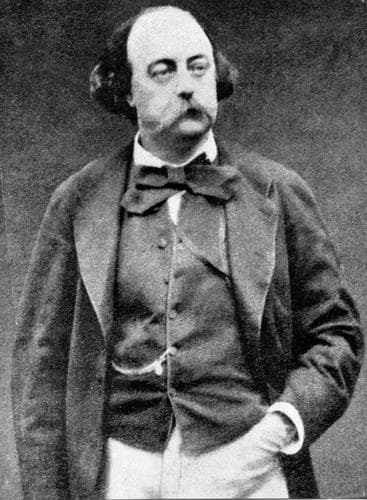
Gustave Flaubert was a French novelist. He has been considered the leading exponent of literary realism in his country and abroad. According to the literary theorist Kornelije Kvas, "in Flaubert, realism strives for formal perfection, so the presentation of reality tends to be neutral, emphasizing the values and importance of style as an objective method of presenting reality". He is known especially for his debut novel Madame Bovary (1857), his Correspondence, and his scrupulous devotion to his style and aesthetics. The celebrated short story writer Guy de Maupassant was a protégé of Flaubert.

Ashley Antoinette
4.6

Mark McDonald
4.4
Luo Guanzhong
4.4

Mia McKenzie
4.3

Dorothy Parker
4.3
Joaquim Maria Machado de Assis
4.3

James Thurber
4.2

Terry Kay
4.2