“The fog, when it came, was not a gentle drift but a deliberate, suffocating blanket.”
— Describing the oppressive weather in London, setting a somber tone.

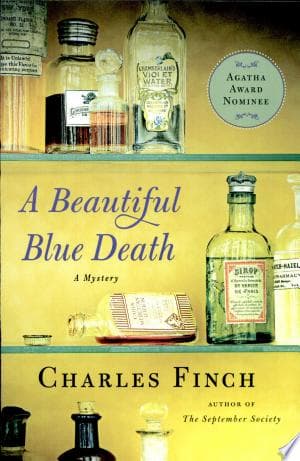
Charles Finch (2007)
Genre
Fiction
Reading Time
360 min
Key Themes
See below
Sign in to track this book
In Victorian London, a charming gentleman detective trades his life of leisure for the pursuit of a rare poisoner, untangling a web of forbidden passions and deadly secrets among the city's elite.
The novel opens with Charles Lenox, a Victorian gentleman, enjoying his life in London. His quiet is interrupted by a visit from his friend, Lady Jane Grey, who is upset. Jane tells Lenox that Prudence Smith, a former maid she had helped get a job with the wealthy Ashton family, has died. The official ruling is suicide by laudanum overdose. However, Jane, knowing Prudence, suspects foul play and asks Lenox to investigate, believing Prudence would not take her own life. Lenox, seeing a challenge and loyal to Jane, agrees to discreetly look into the matter, setting aside his usual routines for a genuine mystery.
Lenox begins his inquiries at the grand Ashton estate, where Prudence worked. He speaks with various members of the household, including Mr. and Mrs. Ashton, their son William, and other servants. He learns that Prudence was known for her beauty and charm, suggesting possible romantic affairs. Lenox observes the family dynamics and the servants' reactions, noting unease and a reluctance to speak openly about Prudence. He quickly finds differences in the accounts of Prudence's final hours and the discovery of her body, strengthening his suspicion that her death was not self-inflicted but murder, perhaps by a subtle poison.
Driven by his intuition, Lenox consults his friend Dr. Sidney, a respected physician, about a poison that could mimic a laudanum overdose. Dr. Sidney, after hearing the details Lenox has gathered and the unusual symptoms, confirms Lenox's hunch. He suggests a rare and potent poison, one that would leave few traces and could easily be mistaken for natural causes or an overdose. This medical confirmation solidifies Lenox's belief that Prudence was murdered and narrows his investigation, now focusing on who would have access to such a specific substance, and why.
Lenox begins to reconstruct Prudence Smith's life, especially her romantic affairs. He finds that Prudence had many admirers, both within the Ashton household and outside it. He learns of a secret affair with William Ashton, the family's son, kept hidden from his parents. He also discovers that Prudence had a previous relationship with Mr. Ashton's coachman, and that she had recently broken off an engagement to a young man named Mr. Finch. Each of these relationships presents a possible motive, from jealousy and betrayal to a desire to hide a scandalous affair, making the list of suspects grow.
The investigation takes a turn during a ball hosted by Lady Catherine. Amidst the London season, another body is discovered – Mr. Finch, Prudence's jilted fiancé. His death is similar to Prudence's, suggesting the same killer and poison. This second murder elevates the case to a high-profile scandal. Lenox realizes the killer is not afraid to strike again, even in public, and that the motive is deeper and more complex than he first thought, possibly involving a wider conspiracy or an attempt to silence witnesses.
With two victims, Lenox increases his efforts, now searching for a link between Prudence Smith and Mr. Finch beyond their romantic past. He revisits their lives, seeking common threads. Through careful questioning and observation, Lenox discovers that both Prudence and Mr. Finch knew a significant secret involving the Ashton family. This secret, if revealed, could harm the Ashtons' reputation and social standing. Lenox begins to suspect that the murders are not crimes of passion but calculated acts to protect a larger, darker secret, and that the killer is likely someone within the Ashtons' inner circle or someone with an interest in their affairs.
As Lenox nears the truth, he realizes the killer is systematically eliminating anyone who knows or could expose the Ashton family's secret. This realization alarms him, as Lady Jane Grey, his friend, placed Prudence with the Ashtons and has been involved in the investigation. The danger is no longer distant; it is close to home, threatening those he cares about most. Lenox understands he must act quickly, not just to solve the murders, but to protect his friends from becoming the killer's next victims, increasing the urgency and personal stakes of his pursuit.
Through diligent investigation, piecing together information, and deductions, Lenox uncovers the Ashton family's grave secret. It involves a hidden past, a scandalous affair, and a child born out of wedlock, meticulously concealed to protect the family's social standing and inheritance. Prudence Smith had stumbled upon this secret, and Mr. Finch, her fiancé, had also become aware of it, perhaps through Prudence herself or through his own connections. This revelation provides the motive for the murders: a desperate attempt to prevent the truth from coming to light and destroying the Ashton family's carefully constructed image.
Armed with the full truth, Lenox arranges a confrontation, bringing together the key people. He lays out the evidence, motives, and method of the murders, revealing the killer to be Mrs. Ashton. Driven by a desire to protect her son, William, and the family's reputation and fortune from the scandal of the illegitimate child, she resorted to murder. She had access to the rare poison through her connections and skillfully administered it to Prudence and Mr. Finch. Faced with Lenox's logic and evidence, Mrs. Ashton confesses to the crimes committed to protect her family.
With Mrs. Ashton's confession, the mystery of the beautiful blue death is solved. The Ashton family is shattered, their secrets exposed. Justice is served. Lenox, having solved the network of deceit and murder, returns to his quiet life. The experience leaves a lasting mark on him. He reflects on the darker aspects of Victorian society, the lengths people will go to protect their image, and the tragic results of hidden truths. The case solidifies his reputation as a keen amateur detective and leaves him with a new appreciation for his peaceful existence, along with a deeper understanding of human nature.
The Protagonist
Lenox transitions from a detached observer to a deeply invested seeker of justice, solidifying his role as a respected amateur detective.
The Supporting
Jane's initial distress evolves into a determined pursuit of justice, reinforcing her trust in Lenox's abilities.
The Victim
Though deceased, her character arc is revealed through the investigation, showing her transition from a hopeful young woman to an unwitting possessor of a dangerous secret.
The Supporting
Dr. Sidney consistently provides reliable medical insights, reinforcing his role as a steady and knowledgeable ally.
The Antagonist
Her character arc reveals her transformation from a seemingly respectable woman into a calculating murderer driven by fear and desperation.
The Supporting
William remains largely static, a figure whose actions unintentionally contribute to the tragic events, but who shows little growth.
The Victim
His death serves to escalate the stakes and broaden the scope of the investigation, confirming the presence of a targeted killer.
The Supporting
Mr. Ashton remains largely static, a representative of patriarchal authority who is ultimately blindsided by the devastating revelations within his own family.
This theme explores the extreme lengths people in Victorian society would go to protect their public image and social status. The Ashton family's hidden secret – an illegitimate child – is deemed so devastating that Mrs. Ashton resorts to murder to prevent its exposure. Prudence Smith and Mr. Finch become victims not due to personal animosity, but because they threaten this carefully constructed facade. The novel shows how the rigid social hierarchy and strict moral codes of the era could drive individuals to desperate and criminal acts, sacrificing lives for appearances, as seen in Mrs. Ashton's calculated murders to protect her son's inheritance and the family name.
“''In this society, a stain on one's name could be more ruinous than a bullet through the heart.''”
The novel is built on hidden lives and closely guarded secrets. Prudence Smith's romantic affairs, especially with William Ashton, are kept hidden. More significantly, the Ashton family harbors a deep, old secret involving an illegitimate child, which is the motive for the murders. Lenox's investigation unearths these concealed truths, showing how individuals, even in the same household, can lead separate, unknown lives. The theme highlights the hypocrisy and complexity beneath the polished surface of Victorian society, where public decorum often masked private turmoil and illicit affairs.
“''Every grand house, Lenox mused, held its own labyrinth of unspoken truths.''”
This theme examines the tension between achieving justice and maintaining the established social order. Lenox, as an amateur detective, works outside the formal police structure, allowing him to pursue truth without the bureaucratic or social pressures that might influence official investigations. The killer's motive is to preserve the social order for the Ashton family, even if it means sacrificing innocent lives. The resolution of the case, while bringing the killer to justice, also shatters the Ashton family's world, highlighting the destructive power of truth when it clashes with deeply held societal expectations.
“''The law, Lenox knew, was often a blunter instrument than the truth.''”
Deception is present throughout the story in various forms. From the initial misdirection of Prudence's death being ruled a suicide, to the lies spun by the killer and the Ashton family, Lenox must navigate through falsehoods. Characters deceive others about their relationships, their knowledge of events, and their true intentions. The rare poison itself is a form of deception, designed to mimic natural causes. Lenox's skill is his ability to see through these layers of deceit, to distinguish between genuine emotion and performance, and to uncover the hidden truths that others desperately wish to keep secret, revealing the widespread nature of human duplicity.
“''Trust, Lenox often thought, was a fragile commodity, easily shattered by the slightest whisper of a lie.''”
A gentleman of leisure who applies his intellect to solving crimes.
Charles Lenox embodies the classic amateur detective archetype. Unburdened by the constraints of official police work or the need for financial gain, he pursues cases out of intellectual curiosity and a strong sense of justice. This allows him greater freedom to investigate, interview suspects across social strata, and employ unconventional methods. His amateur status also provides a crucial narrative function, allowing the reader to experience the investigation through an intelligent, yet relatable, observer who isn't bound by procedural rules, making his deductions feel more personal and insightful.
A limited group of suspects, often within a contained setting.
The primary setting for the initial investigation is the Ashton estate, effectively creating a 'closed circle' of suspects among the family members and their immediate servants. This device intensifies the psychological drama, as the killer is almost certainly known to the victims and the other characters. It heightens the tension by creating an atmosphere of suspicion and distrust within a confined social environment. While the investigation later expands, the core of the mystery remains rooted in the intimate relationships and secrets within this initial, limited group, focusing the reader's attention on subtle interactions and hidden motives.
A specific, unusual method of murder that provides a key clue.
The use of a rare and subtle poison is a critical plot device. It immediately distinguishes the deaths from common suicide or murder methods, indicating a killer with specific knowledge or access. This choice of weapon provides an early clue to Lenox, allowing him to challenge the initial ruling of suicide and driving him to consult Dr. Sidney. The specificity of the poison narrows the field of potential suspects to those who might have known about or acquired such a substance, making its identification a crucial turning point in the investigation and adding an element of scientific intrigue to the mystery.
Misleading clues or suspects designed to divert the reader and detective.
Throughout the investigation, several characters and circumstances serve as red herrings, diverting Lenox's attention and the reader's suspicions. Prudence's various romantic entanglements, for instance, initially suggest a crime of passion, leading Lenox to explore multiple potential jealous lovers. The initial focus on William Ashton as a primary suspect, due to his secret affair with Prudence, is another example. These misleading clues are expertly woven into the narrative, creating suspense and making the true killer's identity more surprising when finally revealed, challenging both Lenox and the reader to look beyond obvious motives.
“The fog, when it came, was not a gentle drift but a deliberate, suffocating blanket.”
— Describing the oppressive weather in London, setting a somber tone.
“There are some truths, I find, that are best approached from an angle, like a shy horse.”
— Charles Lenox reflecting on how to uncover difficult or hidden information.
“Money, for all its power, rarely purchases contentment, only a more elaborate form of discontent.”
— Lenox observing the wealthy characters and their personal struggles.
“The past, like a persistent ghost, always finds a way to haunt the present.”
— A recurring theme as past events influence the current murder investigation.
“One must always listen to what is not said as carefully as to what is.”
— Lenox's advice on discerning the truth from witnesses.
“London, in its own way, was as much a character as any human being, with its moods and secrets.”
— Narrator's reflection on the city's pervasive presence in the story.
“Grief, I have learned, is not a simple path, but a tangled forest where one can easily become lost.”
— Lenox contemplating the emotional state of a bereaved character.
“Every secret, no matter how deeply buried, leaves a trace, a faint echo in the air.”
— Lenox's belief in the discoverability of hidden information.
“The human heart, for all its supposed fragility, can harbor a remarkable capacity for darkness.”
— Lenox's realization about the potential for evil in seemingly ordinary people.
“Justice, when it finally arrives, is rarely a swift stroke, but a slow, grinding inevitability.”
— Lenox's perspective on the process of solving a crime and bringing a culprit to justice.
“A good book, even a tragic one, offers its own peculiar comfort.”
— Lenox finding solace in literature amidst the grim realities of his work.
“The greatest deceptions are often those we tell ourselves.”
— Lenox pondering the self-delusions of certain characters.
“One cannot escape the consequences of one's actions, no matter how far one travels or how long one waits.”
— A reflection on the inescapable nature of fate and responsibility.
Ready to see how well you understood this book? Take our interactive quiz with 10 questions.

Ashley Antoinette
4.6

Mark McDonald
4.4
Luo Guanzhong
4.4

Mia McKenzie
4.3
Dorothy Parker
4.3

Joaquim Maria Machado de Assis
4.3
James Thurber
4.2

Terry Kay
4.2