“The future isn't a single path; it's a branching tree of possibilities, each shaped by the choices we make today.”
— Opening reflection on the nature of time and decision-making.

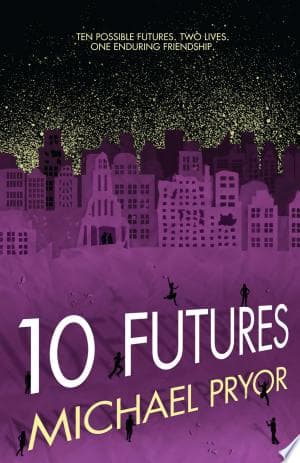
Michael Pryor (2012)
Genre
Science Fiction
Reading Time
360 min
Key Themes
See below
Sign in to track this book
From AI-managed lives with micropets to post-plague survival and genetically-matched dating, two friends navigate a century of researched, often terrifying, potential futures shaped by today's trends.
In a future where 'genetic matching' determines romantic compatibility, Sam is drawn to Tara, despite their genetic profiles suggesting they are only 47% compatible. Society is obsessed with finding 'The One' through genetic testing, making casual dating almost obsolete and creating pressure to conform. Sam's attempts to ask Tara out are filled with anxiety, as he fears rejection based on their low compatibility score. He sees others struggling with the system, like his friend who is constantly searching for a better match. The story explores the social effects of this technology, showing how it can both simplify and complicate human relationships, ultimately questioning what true connection is beyond biological markers.
This story depicts a future where resources are scarce, leading to strict rationing of water, electricity, and even internet access. Sam and Tara live in a world of cold showers, limited data allowances, and constant awareness of their environmental footprint. They find comfort in each other's company, sharing stories and coping strategies. The narrative shows their resilience and the strength of their friendship in the face of hardship. It explores themes of sustainability and resource management, showing how societal changes force individuals to adapt and find new ways to connect and find joy amidst deprivation. Their bond is tested but strengthened by their shared struggles.
In a highly organized future, an advanced Artificial Intelligence system, 'The Organiser,' manages almost every aspect of people's lives, from scheduling to resource allocation. Personal freedom is subtly limited in favor of societal efficiency. At the same time, a widespread craze for 'micropets' – tiny, often virtual or robotic companions – has swept society, becoming a social status symbol. Sam and Tara discuss the effects of this hyper-regulated existence and the superficiality of the micropet trend. The story questions the balance between convenience and autonomy, and how technology can both enhance and diminish human experience, especially in the context of genuine connection versus manufactured companionship.
A catastrophic plague has wiped out most of humanity, leaving Sam and Tara as part of a small, scattered group of survivors. They must navigate a desolate landscape, scavenge for resources, and contend with the constant threat of disease and desperation. Their friendship becomes their primary source of strength and hope in a world stripped bare of its former comforts and certainties. The story focuses on themes of survival, loss, and the human spirit. It explores the ethical dilemmas that arise when humanity is pushed to its limits, and the fundamental question of what it means to be human when civilization collapses around you, emphasizing their reliance on each other.
Sam is in a chilling scenario where he is interrogated by 'The Inquisitor,' a figure representing an authoritarian regime. He is presented with an impossible choice: betray someone he knows to save another, or refuse and face dire consequences for both. The Inquisitor manipulates Sam, forcing him to confront the complex nature of loyalty, morality, and self-preservation. This story explores the psychological toll of living under oppressive rule and the ethical questions that arise when personal values clash with survival instincts. Tara's fate or a similar difficult choice is implied to be linked to Sam's decision, showing the impact on their relationship.
In this future, the English language has undergone significant evolution, with new slang, grammatical structures, and semantic shifts making older forms of communication almost unintelligible. Sam and Tara discuss these linguistic changes, sometimes struggling to understand historical texts or even each other's slightly different generational nuances. The story explores how language shapes thought and culture, and how constant evolution can create both barriers and new forms of expression. It reflects on the dynamic nature of human communication and the challenges of maintaining connection across linguistic divides, even within the same culture. Their conversations show the humor and frustration of this linguistic drift.
This scenario presents a future where virtual reality (VR) technology has become so advanced and pervasive that it is almost impossible to distinguish from physical reality. People spend significant portions of their lives in immersive virtual worlds, leading to questions about identity, authenticity, and the nature of experience. Sam and Tara debate the merits and dangers of this blurring of worlds, discussing whether the virtual can ever truly replace the real. The story explores the psychological impact of constant immersion and the potential for escapism to overshadow genuine human connection, making them question their own perceptions and experiences.
In this future, humanity has developed a 'Collective Mind,' a neural network that links individuals, allowing for shared thoughts, experiences, and knowledge. While offering benefits in terms of efficiency and understanding, it also poses a threat to individual autonomy and unique identity. Sam and Tara explore the implications of this collective consciousness, grappling with the idea of losing their distinct selves to a larger entity. The story explores philosophical questions about consciousness, free will, and the value of individuality in a world where everyone is connected, questioning if their friendship can survive the erosion of their personal identities.
Climate change has reshaped the Earth, leading to widespread environmental collapse and mass migrations. Sam and Tara are among the millions of 'climate refugees,' constantly moving in search of habitable land, resources, and safety. They face harsh conditions, political instability, and the emotional toll of displacement. The story shows the human cost of environmental degradation and the resilience required to survive in a world irrevocably altered by ecological disaster. Their journey shows the importance of community and adaptability in the face of existential threats, as they rely on their bond to navigate a world in constant flux.
This story envisions a future where urban environments have evolved into sentient entities, 'Smart Cities' with their own forms of consciousness and agency. These cities interact directly with their inhabitants, providing services, managing resources, and even expressing preferences. Sam and Tara live within one such city, exploring the implications of coexisting with an intelligent urban ecosystem. The narrative questions the nature of intelligence, the boundaries between artificial and natural environments, and the potential for a symbiotic relationship between humans and their constructed worlds. They navigate the unique challenges and benefits of living in a city that is not just a place, but a living, thinking entity.
The Protagonist
Sam's arc is less about personal transformation within a single narrative and more about demonstrating humanity's adaptability and capacity for connection across vastly different possible futures.
The Protagonist
Like Sam, Tara's arc highlights the strength of human connection and adaptability, showcasing how friendship can anchor individuals through radical societal and environmental shifts.
The Antagonist/Supporting
The Organiser's 'arc' is static, representing a fully realized technological system and its impact on human agency.
The Antagonist
The Inquisitor remains a static symbol of power and moral coercion, serving to test the protagonist's ethical boundaries.
The Plot Device/Supporting
As a system, it doesn't have an arc but serves as a constant, influential force in the lives of the characters in its respective story.
The Supporting/Symbolic
Micropets serve as a cultural artifact rather than a character with an arc, representing a societal trend.
The Supporting/Setting
The Sentient City is a static, fully realized entity, forming the intelligent backdrop for the characters' lives.
Across multiple futures, Sam and Tara grapple with what it means to be an individual when external forces—be it genetic matching, AI control, or a collective mind—seek to define or merge their identities. In the 'Genetic Matching' story, Sam struggles with his attraction to Tara despite a low compatibility score, questioning if his identity is reducible to data. In the 'Collective Mind' scenario, the very concept of individual consciousness is challenged. These stories explore the resilience of the self and the human need for autonomy and unique experience amidst overwhelming societal or technological pressures.
““Did the numbers define who you were, or did you define the numbers?””
The friendship between Sam and Tara is the central thread connecting all ten disparate futures. Whether facing a devastating plague, extreme rationing, or the isolating effects of virtual reality, their bond remains a constant source of support, comfort, and shared humanity. Their interactions show how connection transcends technological advancements, societal collapse, and even fundamental changes to human existence. The book consistently shows that genuine relationships are vital for survival, emotional well-being, and maintaining a sense of purpose in any conceivable future.
““Sometimes, the only thing you had left was each other.””
Many stories pose ethical dilemmas arising from scientific and technological progress. The 'Genetic Matching' story questions the morality of outsourcing personal choice to algorithms. The 'AI Control' scenario examines the trade-offs between efficiency and freedom. Most starkly, 'The Inquisitor' forces Sam to confront betrayal and the cost of survival under an oppressive regime, directly challenging his moral compass. These narratives consistently ask 'What if this continues?' and explore the unforeseen consequences and moral complexities inherent in humanity's pursuit of innovation and control.
““When everything is managed, what room is left for choice?””
Several futures directly address the consequences of environmental neglect and the necessity of sustainability. The 'Rationed Life' depicts a world grappling with severe resource scarcity, forcing cold showers and limited internet. The 'Climate Refugees' scenario portrays a future where ecological collapse has driven mass migrations and constant struggle for survival. These stories are cautionary tales, showing the impact of human actions on the planet and the potential for a future defined by scarcity, displacement, and the desperate search for habitable environments.
““The planet had given us a bill, and we were paying with cold water and empty screens.””
One story directly explores a future where the English language has undergone significant evolution, showing how linguistic shifts can create both barriers and new forms of expression. Sam and Tara navigate new slang, grammatical changes, and semantic drifts that make understanding past texts or even nuanced contemporary conversations challenging. This theme extends to other stories, where new technologies like virtual reality or collective minds introduce entirely new modes of communication and understanding, forcing characters to adapt their ways of interacting and interpreting the world around them.
““Words were like rivers, always flowing, always changing their banks.””
Ten distinct short stories linked by the same two protagonists.
The book employs an anthology structure, presenting ten independent short stories. However, unlike a typical anthology, each story features the same two protagonists, Sam and Tara, existing in vastly different potential futures. This device allows the author to explore a wide range of 'what if' scenarios without the need for a single overarching plot, while simultaneously providing a consistent emotional anchor through the enduring friendship of the main characters. It highlights the universality of human experience and connection across diverse circumstances, making each future feel more personal and relatable.
Each story extrapolates current trends into plausible future realities.
This is the core narrative engine of the entire collection. Each story begins by taking a current societal trend, scientific development, or cultural phenomenon (e.g., genetic testing, AI, climate change, virtual reality) and extrapolating it into a fully realized, plausible future. This device allows the author to explore the logical, and sometimes extreme, consequences of these trends without relying on fantastical elements, grounding the science fiction in relatable contemporary concerns. It makes each future feel authentic and thought-provoking, prompting readers to consider the trajectory of their own present.
Situations forcing characters to make difficult choices with no easy answers.
In almost every story, Sam and Tara, or society at large, are confronted with profound moral and ethical dilemmas. These range from personal choices, like Sam's struggle with genetic matching, to existential ones, such as the Inquisitor's demand for betrayal or the implications of a collective mind. This device serves to deepen the thematic exploration of each future, forcing characters (and readers) to consider the human cost and moral compromises inherent in technological advancement, societal change, and survival under extreme conditions. It adds layers of psychological depth to the otherwise high-concept scenarios.
The future realities are revealed primarily through character interactions and internal monologue.
Instead of lengthy exposition dumps, the unique aspects of each future are subtly revealed through Sam and Tara's conversations, their reactions to their environment, and their internal reflections. For instance, the rules of rationing are understood through their daily routines, and the complexities of evolving language are shown through their struggles to communicate. This device makes the world-building feel organic and immersive, inviting the reader to discover each future alongside the characters, and emphasizing the personal impact of these larger societal shifts.
“The future isn't a single path; it's a branching tree of possibilities, each shaped by the choices we make today.”
— Opening reflection on the nature of time and decision-making.
“In a world of perfect automation, we must ask: what does it mean to be human when machines do everything?”
— From a story exploring a fully automated society.
“Memory is the anchor of identity, but in a digital age, even that can be rewritten.”
— Discussed in a narrative about memory manipulation technology.
“The stars are not just points of light; they are destinations, waiting for us to reach out.”
— Character's motivation during a space exploration tale.
“Fear of the unknown often blinds us to the beauty of what could be.”
— A lesson learned by a protagonist facing an alien encounter.
“In every future, there is a thread of the past, weaving through our decisions like a silent guide.”
— Philosophical musing on history's influence.
“When resources are scarce, cooperation becomes not just a virtue, but a necessity for survival.”
— Set in a post-apocalyptic scenario with dwindling supplies.
“Artificial intelligence may mimic thought, but can it ever truly understand a sunset?”
— Debate between characters about consciousness and AI.
“The greatest journeys are not measured in light-years, but in the changes they bring to our souls.”
— Reflection after a character returns from a long space voyage.
“In a universe of infinite possibilities, the most dangerous one is the future we refuse to imagine.”
— Warning from a wise character about narrow-minded planning.
“Technology can connect us across galaxies, yet it cannot replace the warmth of a hand held in silence.”
— Observation in a story about advanced communication tech.
“Every ending is a beginning in disguise, if only we have the courage to see it.”
— Closing thought in a tale of societal collapse and renewal.
“The echoes of our actions ripple through time, touching lives we will never meet.”
— Moral lesson about responsibility and legacy.
“To explore is to embrace uncertainty, and in that embrace, we find our true selves.”
— Inspired by a character venturing into uncharted territory.
Ready to see how well you understood this book? Take our interactive quiz with 10 questions.