“I want to do with you what spring does with the cherry trees.”
— A passionate expression of desire for transformative love.

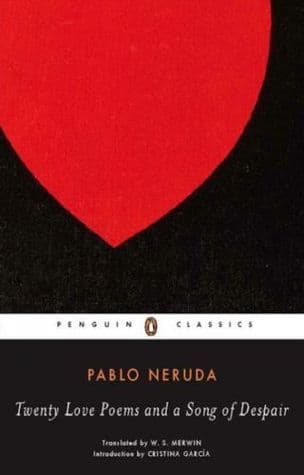
Pablo Neruda (2020)
Genre
Romance
Reading Time
30 min
Key Themes
See below
Sign in to track this book
Neruda's classic collection of love poems, in a bilingual edition, still moves readers worldwide, nearly a century after its debut.
The speaker begins by describing his lover's body using natural images: white hills, a world, and a yielding shape. He compares her to hunger, a furrow, and a land of white hills, linking her physical presence to nature's vastness and fertility. He states that his 'savage peasant's body' works her and makes her grow from the earth. The poem declares his possession and admiration for her body, emphasizing their raw, earthy connection and her deep impact on his view of the world.
The speaker addresses his beloved, saying he writes poems for her to hear him, as the wind carries his words. He remembers her eyes, sometimes still or bright, and her lips, full of kisses. He describes her as a vessel of endless tenderness and a distant, quiet figure. The poem conveys longing and a struggle to connect with a lover who seems increasingly far away. He regrets the absence of her voice and presence, highlighting the loneliness he feels despite his poetic attempts to reach her.
The speaker vividly recalls his lover's past self, especially her eyes and voice, which he compares to an autumn twilight. He remembers her as a graceful, quiet woman, often wearing a beret. He says that leaves fell in her soul, creating a sad feeling. Her presence was tied to autumn, and he remembers their intertwined arms. The poem conveys deep nostalgia for a love that has faded or changed, contrasting vibrant memories with current emptiness. It emphasizes the passage of time and the pain of lost connection.
The speaker describes himself leaning into the afternoons, casting nets of his sad eyes toward the sea. He sees gulls, the burning sun, and ships, all seeming to carry his grief. He feels desolate, comparing himself to a 'sad pier' that holds his longing. The poem evokes deep sadness, mixing the external landscape with his inner emotional state. The vastness of the sea and the fading light reflect his own sense of loss and the quiet despair in his observations.
The speaker describes his lover appearing 'almost out of the sky,' like a white ship. He sees her as profoundly beautiful and mysterious, comparing her to twilight and a 'sad vine' that entwines his life. He feels her presence among the vast night and the stars, which he sees as 'cold and blue.' His own heart is a 'mad mill,' grinding shadows. The poem conveys awe and wonder mixed with deep, personal sadness, as he sees her against a backdrop of cosmic indifference and his own inner turmoil.
The speaker expresses his preference for his lover's stillness, saying her silence is beautiful, like she is absent. He compares her to a distant, silent star, and her words to a butterfly. He feels her silence is a form of presence, and her eyes are like the sea. He finds comfort in her quietness, which lets him see her more deeply. The poem suggests that true connection can exist beyond spoken words, and that the beloved's silence can be a powerful and intimate way to communicate, allowing for deeper thought and connection.
The speaker describes himself thinking, intertwining his hands, and remembering time passing. He recalls his lover's eyes, which he calls 'sad.' He feels loss and the weight of memory, as if his words are falling like leaves onto her. He links his feelings to the vastness of the sea and life's fleeting nature. The poem expresses deep sadness, a contemplation of love's impermanence, and how memories linger even as the present moment changes. It is a bittersweet thought about what was and what remains.
The speaker declares his love in a specific setting, where 'pines are green' and the 'wind sings.' He describes the moon as a 'broken wheel' and the sea as 'murmuring.' He feels his love intertwined with nature, but also acknowledges deep sadness. He sees her as a 'sad rose' and himself as 'a 'dark tunnel.' The poem is a poignant declaration of love that is both beautiful and sad, suggesting that even in deep connection, a sense of loss or coming sorrow is present, mirroring nature's brief beauty.
The speaker famously says, 'Tonight I can write the saddest lines.' He thinks about losing his beloved, whom he loved 'sometimes, and she loved me sometimes too.' He remembers holding her 'on nights like this one,' but now she is gone. The night is 'enormous' without her, and he feels the pain of her absence. He questions if she is still his, accepting that love is short and forgetting is long. Writing becomes a way to process his grief, even as it deepens his sorrow, making his lost love live on in verse.
The 'Song of Despair' is a long, final lament where the speaker is completely taken over by the loss of his beloved. He describes a desolate landscape of 'sad islands' and 'bitter light,' reflecting his inner state. He recalls his lover's body, her eyes, her voice, and their shared closeness, but these memories are now filled with immense pain. He feels utterly alone, lost in sorrow, unable to escape her memory. The poem is a raw outpouring of grief, resignation, and a lasting feeling of emptiness, marking the end of his romantic idealization and his descent into deep sadness.
The Protagonist
The speaker begins with passionate idealization and physical desire, gradually transitioning to deep melancholy, profound loss, and ultimately, despair over a love that has faded or ended.
The Object of Affection
Initially a vibrant, physically present figure who inspires passionate adoration, she gradually becomes a silent, distant memory, and finally, a source of profound absence and longing.
The main theme explores romantic love, from its first intense passion to its painful end. The poems clearly show the joy of physical intimacy and emotional connection (e.g., Poem 1, 'Body of a Woman'), but increasingly move to the pain of separation and memory (e.g., Poem 20, 'Tonight I Can Write'). The book is a journey through a love affair, ending in deep sadness over what is lost, suggesting that love's beauty is tied to its briefness.
“Love is so short, forgetting is so long.”
Nature is not just a setting but a strong mirror and amplifier of the speaker's inner feelings. The beloved's body is described as a 'world' of 'white hills' (Poem 1), while the speaker's sorrow is reflected in the 'sad pier' and 'nets of my sad eyes' cast into the sea (Poem 7). Changing seasons, the vast ocean, stars, and wind all show and deepen feelings of love, longing, and despair, making the personal universal.
“Leaning into the afternoons I throw my sad nets to that sea that is thrashed by your oceanic eyes.”
Memory is key, as the speaker constantly revisits past intimate and happy moments, comparing them with his current loneliness. These memories are often bittersweet, tinged with the pain of what is no longer present (e.g., Poem 6, 'I Remember You As You Were'). Remembering becomes a source of both comfort and torment, highlighting the lasting power of past experiences even when they are absent now. The poems show how memory shapes identity and keeps both love and sorrow alive.
“I remember you as you were in the last autumn. You were the grey beret and the still heart.”
The poems explore the speaker's attempt to use language to connect with his beloved and express his overwhelming emotions. He writes 'so that you will hear me' (Poem 5), suggesting a desperate effort to communicate across a growing distance. Yet, there is also an acknowledgment of language's limits; the beloved is often silent, and the ultimate despair ('The Song of Despair') hints at feelings that are hard to put into words. The act of writing itself is a form of release, a way to hold onto a fleeting love, even as it emphasizes its loss.
“Tonight I can write the saddest lines. I loved her, and sometimes she loved me too.”
Extensive use of nature to symbolize emotions and physical attributes.
Neruda employs rich and pervasive natural imagery throughout the collection. The beloved's body is a 'world' of 'white hills' and 'furrows,' her eyes are 'oceanic,' and her voice is compared to the wind. The speaker's emotions are mirrored by the sea, the stars, the autumn leaves, and the twilight. This device grounds the intense, often abstract emotions in tangible, universal experiences, creating a vivid sensory landscape that enhances the poems' emotional depth and resonance.
Recurrent phrases and structures to emphasize themes and create rhythm.
The repetition of certain phrases or grammatical structures, particularly at the beginning of lines or stanzas (anaphora), is a key device. For example, 'Tonight I can write the saddest lines...' in Poem 20 is a powerful recurring thought. This repetition creates a hypnotic rhythm, reinforces key emotional states, and builds intensity, allowing the speaker's obsessive thoughts about his beloved and his sorrow to resonate more profoundly with the reader, echoing the cyclical nature of grief and memory.
Attributing human qualities to inanimate objects or abstract concepts.
Neruda frequently personifies elements of nature and abstract concepts to deepen their emotional impact. The wind 'sings,' the night is 'enormous,' and the sea 'moans.' This device imbues the natural world with a living, feeling presence that actively participates in the speaker's emotional drama. It blurs the line between the internal and external, making the environment a direct reflection and even an active participant in the speaker's love and despair, enhancing the lyrical and subjective quality of the poems.
Comparing disparate things to reveal deeper meanings.
The collection is replete with striking metaphors and similes that forge unexpected connections and enrich the poems' emotional and sensory texture. The beloved's silence is 'like a lamp,' her voice 'like a butterfly,' and the speaker's heart is a 'mad mill.' These comparisons allow Neruda to express complex feelings and abstract ideas in concrete, imaginative ways, creating vivid images that resonate with the reader and convey the depth of the speaker's passion and sorrow.
“I want to do with you what spring does with the cherry trees.”
— A passionate expression of desire for transformative love.
“Tonight I can write the saddest lines. Write, for example, 'The night is starry and the stars are blue and shiver in the distance.'”
— The opening lines of 'A Song of Despair,' setting a melancholic tone.
“I like for you to be still: it is as though you are absent and you hear me from far away and my voice does not touch you.”
— Expressing a complex appreciation for a lover's quiet presence.
“My body, a portion of the earth, will find its way in your body.”
— A deeply physical and elemental connection between lovers.
“From the south, like a ship, you arrived, bringing the south with you.”
— Describing the arrival of the beloved, associating her with a specific region.
“Ah, the vastness of the sea that you poured into my soul!”
— Reflecting on the overwhelming emotional impact of the beloved.
“I have gone marking the white hot summer with your absence.”
— The painful experience of summer days without the loved one.
“My soul is not content with having lost her.”
— A direct and poignant statement of grief and loss.
“You are like the night, with its stillness and constellations.”
— Comparing the beloved to the serene and mystical qualities of the night.
“The wind of the night spins in the sky and sings.”
— A poetic description of the natural world, often reflecting internal states.
“I no longer love her, that's certain, but maybe I love her. Love is so short, forgetting is so long.”
— A famous line from 'A Song of Despair,' encapsulating the struggle with past love.
“Naked you are simple as one of your hands; smooth, earthy, small, transparent, round.”
— A tender and detailed description of the beloved's naked form.
“What does it matter that my love could not keep her?”
— A rhetorical question in 'A Song of Despair,' lamenting the inability to hold onto love.
“Always, always, you are in my eyes, in my words, in my thoughts.”
— An affirmation of the beloved's constant presence in the speaker's mind.
Ready to see how well you understood this book? Take our interactive quiz with 10 questions.
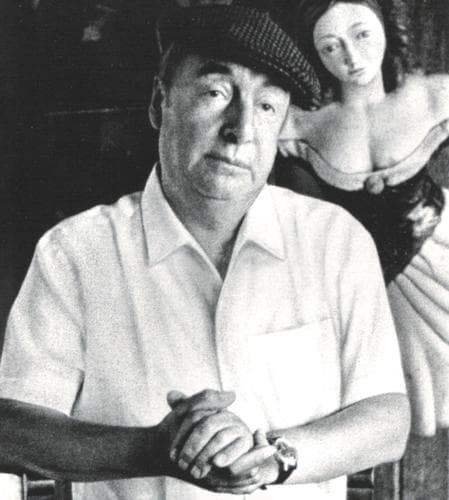
Pablo Neruda (born Ricardo Eliécer Neftalí Reyes Basoalto; 12 July 1904 – 23 September 1973) was a Chilean poet-diplomat and politician who won the 1971 Nobel Prize in Literature. Neruda became known as a poet when he was 13 years old, and wrote in a variety of styles, including surrealist poems, historical epics, political manifestos, a prose autobiography, and passionate love poems such as the ones in his collection Twenty Love Poems and a Song of Despair (1924).