“For though I might a thousand fairer see, Yet had I lever have no more but thee.”
— Troilus's declaration of his unwavering love for Criseyde.

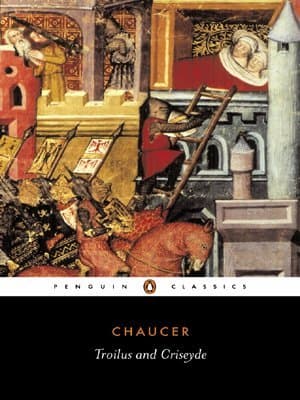
Geoffrey Chaucer (1483)
Genre
Romance
Reading Time
12-15 hours (based on 368 pages)
Key Themes
See below
Sign in to track this book
During the siege of Troy, a prince's love for a forsaken woman blooms with his uncle's help, only to be tragically lost to fate and war.
During a festival for Palladion in Troy, Prince Troilus, a skilled warrior who scorns love, goes to the temple. He watches the crowd, especially the women, and silently mocks those in love. But as he looks, he sees Criseyde, a beautiful widow in black, with her ladies. Her beauty and grace immediately capture him, and he falls deeply in love, giving up his former cynicism. He realizes the irony of mocking the very emotion that now controls him and begins to suffer from unrequited love, keeping his feelings secret.
Troilus's secret love for Criseyde causes him to withdraw and suffer, affecting his health and mood. His close friend, Pandarus, who is Criseyde's uncle, notices Troilus's change and asks him about his sorrow. After much hesitation and fear of rejection, Troilus admits his overwhelming love for Criseyde. Pandarus, a clever and experienced man, is amused by Troilus's sudden change from cynic to lover. He decides to act as a go-between, promising to use his cleverness and influence to help Troilus win Criseyde's affection, despite social difficulties and Criseyde's cautious nature.
Pandarus visits his niece Criseyde, who lives a quiet life because her father, Calchas, deserted to the Greek camp. He subtly praises Troilus, talking about his bravery in battle and his noble character. He also hints at a secret admirer who is suffering from love. Criseyde, at first careful about her reputation, becomes interested in Pandarus's descriptions. He eventually reveals Troilus's deep love and despair, appealing to her pity and compassion. Though she worries about the dangers of love and scandal, Pandarus's convincing arguments and vivid descriptions of Troilus's suffering begin to soften her heart, making her consider his feelings.
Pandarus plans to bring Troilus and Criseyde together. He arranges for Criseyde to stay at his house during a rainy night. Then, pretending to worry about Troilus's health, he brings the prince to the house. Pandarus carefully sets up the situation, creating a private and opportune setting. After much gentle persuasion and a shared understanding of their feelings, Troilus and Criseyde finally meet in secret. They declare their love and become intimate, beginning a period of intense joy and hidden closeness, believing their love will last forever during the Trojan War.
After they become intimate, Troilus and Criseyde experience intense joy and devotion. Pandarus, their confidant, helps them with their secret meetings. Troilus, once sad, now has new energy and excels in battle, inspired by Criseyde's love. Criseyde also finds great happiness and fulfillment in their relationship, enjoying her intellectual and emotional connection with Troilus. They exchange gifts and spend their nights together, believing their love is a private haven amid the war's chaos, a perfect union that will last forever.
The happy time of Troilus and Criseyde's love is suddenly threatened by the Trojan War. A Trojan parliament meets to discuss a prisoner exchange with the Greeks. Calchas, Criseyde's father, asks the Trojan council to send his daughter to him in the Greek camp in exchange for the captured Trojan warrior Antenor. Despite strong opposition, including from Hector, the parliament agrees to the exchange, wanting to get back a valuable warrior and grant Calchas's request. This seals Criseyde's fate and leaves Troilus in despair.
News of the exchange devastates both Troilus and Criseyde. Troilus is overwhelmed by grief and considers desperate actions. Criseyde is equally distressed, fearing for her safety and the loss of her beloved. They share a heartbreaking farewell, full of tears and vows of eternal love. Criseyde promises Troilus she will find a way to return to Troy within ten days, suggesting various escape plans from the Greek camp. Troilus clings to her promises, left with fragile hope, as Criseyde leaves Troy, escorted by Diomede, a Greek warrior, leaving Troilus in deep sorrow.
Upon arriving at the Greek camp, Criseyde is greeted by her father Calchas. She struggles with her divided loyalties and the immense pressure of her new surroundings. Diomede, a bold and persuasive Greek warrior, immediately pursues Criseyde. He courts her subtly, then more openly, stressing that her loyalty to Troy and Troilus is pointless and that aligning with the victorious Greeks has advantages. Criseyde, isolated and vulnerable, is increasingly swayed by Diomede's arguments and attention. The promised ten days for her return to Troy pass without her attempting to escape or contact Troilus.
Back in Troy, Troilus anxiously awaits Criseyde's promised return. Each day without her arrival increases his despair and doubt. He often visits the city gates and walls, hoping to see her. He shares his grief with Pandarus, who tries to comfort him but also begins to doubt Criseyde's loyalty. Troilus has troubling dreams, especially one where he sees a boar tearing at Criseyde's heart. He interprets this as a sign of her betrayal, deepening his agony and foreshadowing the sad truth of her changing affections.
Troilus's worst fears are confirmed when he gets clear proof of Criseyde's infidelity. Hector's brother Deiphobus captures a Greek warrior in battle, who wears a cloak Troilus gave Criseyde as a love token. More damningly, he finds a brooch Troilus also gave her, now pinned to the Greek's armor. Recognizing these items instantly, Troilus is overcome with agonizing heartbreak and rage. The truth of Criseyde's betrayal, her new relationship with Diomede, shatters his world, confirming his dream and ending all hope for their love. His grief turns into a strong desire for revenge against Diomede.
Filled with a desire for revenge, Troilus focuses entirely on fighting the Greeks, specifically looking for Diomede on the battlefield. His former love now fuels a powerful, destructive rage. He fights with great ferocity and bravery, causing significant damage to the Greek forces. Though he often meets Diomede in combat and wounds him, he never kills him. Eventually, in a heroic but futile act against his fate, Troilus is confronted by the powerful Greek warrior Achilles and is killed. His soul ascends to the heavens, where he looks down on the vanity of earthly love.
After telling of Troilus's death and the Greeks' ultimate victory, the narrator, Chaucer, offers a philosophical and moral conclusion. He reflects on how fleeting earthly love is, contrasting it with divine love. He advises young women to learn from Criseyde's example, not to trust in men's temporary affections, but to turn their hearts toward God and eternal spiritual love. This epilogue highlights the story's tragic nature, not just as a tale of lost love, but as a broader comment on human weakness, the unpredictability of fate, and how spiritual devotion is better than worldly passions.
The Protagonist
Troilus transforms from a cynical bachelor to a devoted, suffering lover, and finally to a vengeful warrior before his tragic death.
The Co-protagonist/Tragic Figure
Criseyde moves from cautious widow to a loving partner, then to a conflicted figure, and finally to a pragmatic survivor who betrays her love.
The Supporting/Instigator
Pandarus remains largely static, consistently serving as the enabler and commentator on the lovers' fate, though he experiences increasing despair for Troilus.
The Antagonist/Rival
Diomede remains a static character, a symbol of pragmatic and opportunistic love, successfully achieving his goal.
The Supporting/Catalyst
Calchas's actions set the initial conditions for Criseyde's vulnerability and directly trigger her separation from Troilus.
The Supporting
Hector remains a symbol of Trojan nobility and justice, his actions consistent with his established character.
The Mentioned/Antagonist
Achilles serves as the ultimate instrument of fate, bringing Troilus's story to its tragic conclusion.
This theme runs through the story, showing how human affection is changeable and fate is unpredictable. Troilus and Criseyde's love, at first seeming eternal, is destroyed by outside events (war, the exchange) and inner weaknesses (Criseyde's fear and practicality). The narrator often mentions Fortune's wheel, which raises people only to bring them down. Troilus's final ascent to the eighth sphere, where he scorns 'this wrecched world, and held al vanite,' captures this theme, emphasizing how quickly worldly pleasures and passions fade compared to eternal truth. The contrast between their initial happiness and tragic separation shows how quickly joy can turn to sorrow.
“For of fortunes sharp adversitee / The worst kind of infortune is this, / A man to have been in prosperitee, / And it remembred when it passed is.”
Betrayal is central to the tragedy. Troilus shows unwavering loyalty, staying devoted to Criseyde even after she leaves and clinging to her promises. Criseyde, however, breaks her vows due to fear, vulnerability, and Diomede's influence. Her change in affection shows how fragile human commitment is under pressure. The poem explores the pain of betrayal, seen in Troilus's deep suffering, and the complex reasons behind it, showing Criseyde as a product of her circumstances rather than simply malicious. Pandarus's initial betrayal of Criseyde's trust to bring her to Troilus also hints at the larger betrayal.
“O, fie on the, and on thy double herte! / For love of God, for whom artow so fals?”
Chaucer considers whether human actions are decided by fate or by individual choice. Calchas's prophecy and the ongoing war suggest an unavoidable destiny for Troy and its people. However, characters like Criseyde also make choices that directly affect their fate, especially her decision to stay with Diomede. The narrator often refers to 'destiny' or 'Fortune's wheel' to explain events, yet also gives characters agency. Troilus's death by Achilles, a fated event in Trojan War myths, reinforces destiny's power, while Criseyde's choice to betray him highlights free will, creating an unresolved tension.
“But, O, Fortune, executrice of wierdes, / O, inconstant world, that nevere art in oon!”
The poem explores different kinds of love. Troilus represents ideal courtly love: passionate, spiritual, self-sacrificing, and lasting, even in despair. Criseyde, while capable of deep affection, ultimately chooses a more practical and self-preserving love, seeking security and a new relationship with Diomede when separated from Troilus. Diomede's courtship is entirely practical and opportunistic, lacking the emotional depth of Troilus's love. The story compares these ideals, questioning if courtly love can last in a harsh, realistic world and examining the compromises people make when facing difficult choices.
“For love is fre, and foleweth his desir, / As dooth the sonne his cours, and is not bounde.”
Pandarus is key to this theme. He acts as the ultimate go-between, arranging every meeting, delivering messages, and manipulating events to bring Troilus and Criseyde together. His role highlights the social customs and careful negotiations often needed in medieval courtly love affairs. He is not just a messenger but an active agent, shaping the story and influencing the characters' decisions. His presence suggests that love, especially early on, often needs outside help and strategic planning, rather than simply happening spontaneously.
“And with that word he gan to hym to preye, / To telle hym al the cause of his tristesse.”
A character who facilitates communication and meetings between lovers.
Pandarus serves as the archetypal go-between, a pivotal figure who not only carries messages but actively engineers the entire relationship between Troilus and Criseyde. He uses persuasion, deception, and elaborate schemes (like the feigned illness and the rainy night) to overcome obstacles and bring the lovers together. His role is crucial in driving the plot forward, embodying the intricate social dynamics and strategic maneuvering often involved in medieval courtly love. He is the engine of their romance, making their secret affair possible.
Symbolic events or dreams that hint at future tragic outcomes.
Chaucer frequently employs foreshadowing, particularly through Troilus's dreams and his internal premonitions. The most prominent example is Troilus's dream of the boar tearing at Criseyde's heart, which clearly foretells her betrayal with Diomede. These dreams and omens serve to heighten the tragic atmosphere and create a sense of inevitable doom, preparing the reader for the heartbreak to come. They also reflect the characters' anxieties and the narrator's commentary on the unpredictable nature of fate, showing that even with warnings, tragedy cannot always be averted.
A political decision that directly causes the lovers' separation.
The decision by the Trojan parliament to exchange Criseyde for Antenor is a crucial plot device that directly precipitates the central tragedy of the poem. It is an external, political force that disrupts the personal happiness of the lovers, demonstrating the vulnerability of individual lives to the larger forces of war and statecraft. This event acts as the turning point, moving the narrative from a blissful romance to one of separation, doubt, and ultimately, betrayal. It underscores the theme of fate and the inability of individuals to control their destinies in times of conflict.
Objects exchanged between lovers that later serve as proof of betrayal.
The brooch and cloak that Troilus gives to Criseyde as tokens of his love are powerful symbolic devices. Initially, they represent their bond and fidelity. However, when these very items are later discovered on Diomede, they become irrefutable proof of Criseyde's betrayal and Troilus's worst fears. These tokens transform from symbols of love into instruments of heartbreak and confirmation of infidelity, making the revelation of Criseyde's new love undeniably clear and deeply painful for Troilus.
“For though I might a thousand fairer see, Yet had I lever have no more but thee.”
— Troilus's declaration of his unwavering love for Criseyde.
“Of Prolixity and of the craft of love.”
— A chapter heading, signaling a focus on the art and extended nature of love's pursuit.
“O blisful light, of which the bemes clere Adorneth al the paleys eterne of love!”
— Troilus's joyful address to Venus after Criseyde finally accepts his love.
“And from the deth to lyf he gan to ryse, And with a sorweful herte, and glad visage, He kiste hire, and took his leve at hire.”
— Troilus's emotional departure from Criseyde, highlighting his mixed feelings.
“For trewely, if I shal not lye, I have a thousand tymes thought to dye.”
— Criseyde reflecting on the intensity of her emotional turmoil and despair.
“And in that tyme, so fer forth as he mighte, He made his wo to Criseyde for to shewe.”
— Troilus trying to convey the depth of his suffering to Criseyde.
“For evere it was, and evere it shal be so, The worldes joye is evere intermedled with wo.”
— The narrator's philosophical reflection on the cyclical nature of joy and sorrow.
“And with that word, he gan to sigh as sore As though his herte wolde breste in twaye.”
— Troilus's intense emotional reaction, illustrating his profound sadness.
“For though I have, alas, a thousand fold Moore cause than a wight for to be cold, Yet in my bed my love I shal not withholde.”
— Criseyde's internal struggle and ultimate decision to yield to love.
“O lady myn, that called art Criseyde, That art my sorwe, and art my blisse al so!”
— Troilus's conflicted address to Criseyde, acknowledging her as both his joy and his pain.
“She was not with the leste of hir stature, But all hir membres so wel answerynge Weren to womenhod, that for hir feature, It semed she was made for to be a quene.”
— A description of Criseyde's physical beauty and regal presence.
“And for to speke of love, ywis, it is a game.”
— Pandarus's pragmatic view on love, often seen as manipulative or strategic.
“And if I hadde, o God, a thousand lyves, And al a thousand tymes I sholde dye, I wolde hem alle yeve for to dye with thee.”
— Troilus's extreme expression of devotion, wishing to die with Criseyde.
“Go, litel bok, go, litel myn tragedye!”
— The narrator's farewell to his work, acknowledging its tragic nature.
“Ne nevere moore shal swich a cas betide.”
— A statement reflecting the unique and perhaps unrepeatable nature of the events.
Ready to see how well you understood this book? Take our interactive quiz with 10 questions.
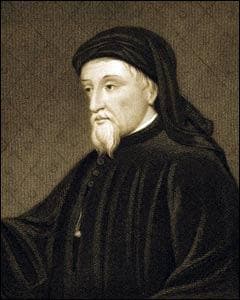
Geoffrey Chaucer was an English poet, author, and civil servant best known for The Canterbury Tales. He has been called the "father of English literature", or, alternatively, the "father of English poetry". He was the first writer to be buried in what has since come to be called Poets' Corner, in Westminster Abbey. Chaucer also gained fame as a philosopher and astronomer, composing the scientific A Treatise on the Astrolabe for his 10-year-old son Lewis. He maintained a career in the civil service as a bureaucrat, courtier, diplomat, and member of parliament.