“He knew that one day he would be a man and that he would be able to make the world his own. But he also knew that he would never be able to make her his own.”
— Shinji's early musings about Chiyoko, hinting at his future with Hatsue.


Yukio Mishima (1984)
Genre
Romance
Reading Time
180 min
Key Themes
See below
Sign in to track this book
In a remote Japanese fishing village, a young fisherman and the wealthiest daughter fall in love, overcoming village gossip and class differences.
Shinji, an eighteen-year-old fisherman on Uta-jima, lives a simple, hardworking life with his widowed mother and younger brother, Hiroshi. One evening, returning from fishing, he sees an unfamiliar girl by the lighthouse. He is immediately taken by her calm beauty and wonders who she is. Later, his mother tells him she is Hatsue, the daughter of Terukichi Miyata, the village's wealthiest man, who has returned from Osaka to be his heir. Shinji is shy and has not been interested in girls before, but Hatsue's presence stirs new feelings, making him feel a sense of destiny and a wish to be worthy of her.
A strong storm makes Shinji and Hatsue seek shelter in the village's watchtower. At first, they keep a polite distance, but the shared experience of the storm, the fire Shinji builds, and their innocent shyness bring them closer. Hatsue, feeling cold, asks Shinji to warm her hands. Their hands touch, and a spark of mutual affection starts. Shinji then offers to show her his fishing boat. On the boat, Hatsue, on impulse, unbuttons her blouse to show him her bare breasts. Shinji is overwhelmed with awe and shyness. Despite his strong desire, he does not touch her, respecting her innocence. This pure encounter confirms their unspoken love, making both aware of their deep connection.
After their watchtower meeting, Shinji and Hatsue start meeting secretly at a secluded spring on the island. These meetings show their innocent affection, shared silences, and growing understanding. They are both pure-hearted and respectful of each other. During one meeting, Hatsue gives Shinji a small, wrapped package of dried cuttlefish, a traditional sign of affection. These secret meetings are full of simple joys and their love quietly growing, untouched by the complexities of the adult world. They spend hours together, talking about their lives and dreams, or just enjoying each other's presence among the island's natural beauty, strengthening their bond away from prying eyes.
Chiyoko, a girl who likes Shinji and studies in Tokyo, visits Uta-jima. She is observant and quickly notices a change in Shinji and his secrecy. Meanwhile, Yasuo Kawamoto, a proud and strong but weak-willed fisherman, also wants Hatsue. He sees Shinji as a rival. Driven by jealousy and his own failed attempts to get Hatsue's attention, he spreads rumors about Shinji and Hatsue being intimate in the watchtower. This gossip quickly spreads through the small village, reaching Terukichi Miyata and causing a scandal that threatens the young lovers' reputation and future.
The widespread gossip about Shinji and Hatsue's alleged behavior in the watchtower reaches Terukichi Miyata, Hatsue's powerful and respected father. Angry about the damage to his daughter's honor and his authority, Terukichi strictly forbids Hatsue from ever seeing Shinji again. He confines Hatsue to their home, limiting her movements and making sure she has no contact with Shinji. This order makes both Shinji and Hatsue despair. Their innocent love is publicly condemned, and their future together seems impossible, threatened by strict social rules and village opinion.
Despite his heartbreak, Shinji continues to work hard, showing his natural purity and strength. Terukichi, a man who values hard work and character, decides to test the young men of the village, including Shinji and Yasuo. He sends them on a fishing trip on his freighter, the Utajima-maru. During a severe typhoon, a rope breaks, endangering the ship. Shinji, without hesitation, bravely climbs the mast in the storm to secure the rope, risking his life to save the vessel. Yasuo, however, is paralyzed by fear and cannot act. Shinji's courage, physical ability, and sense of duty impress the ship's captain and crew, proving his worth and true character.
News of Shinji's heroic actions during the typhoon reaches Terukichi Miyata. The captain of the Utajima-maru, deeply impressed by Shinji's bravery, personally speaks for his character. Terukichi, a man who respects true strength and honesty, re-evaluates his earlier judgment. He realizes that Shinji has the qualities of a good man and a worthy husband for his daughter, far surpassing Yasuo's superficial confidence. Recognizing Shinji's pure heart and demonstrated courage, Terukichi decides to lift the ban and gives his full blessing to Shinji and Hatsue's marriage, acknowledging their love is pure and meant to be.
As a sign of his approval, Terukichi Miyata promotes Shinji to second mate on his new freighter, the Taihei-maru. This promotion means Shinji moves up professionally and gets a stable, respectable income, making him able to provide for Hatsue. Shinji and Hatsue are now free to be together, their love publicly recognized and blessed by the community and, most importantly, by Terukichi. Their future together on Uta-jima is secure, promising a life of shared work, simple joys, and lasting love, rooted in their island home's traditions and natural rhythms.
The Protagonist
Shinji grows from a shy, unproven young man into a respected and acknowledged figure, proving his worth through courage and hard work.
The Protagonist
Hatsue navigates the challenges of village gossip and her father's disapproval, emerging with her love for Shinji intact and her future secured.
The Supporting
Terukichi moves from initial anger and suspicion to ultimately recognizing and rewarding Shinji's true worth.
The Antagonist
Yasuo fails to achieve his desires due to his own moral failings, serving as a cautionary figure.
The Supporting
Her primary role is supportive, maintaining the family home and offering guidance to Shinji.
The Supporting
Chiyoko grapples with her unrequited love and feelings of inadequacy, eventually showing a moment of kindness.
The Supporting
His primary role is to observe and report Shinji's heroic actions, acting as a catalyst for Terukichi's change of heart.
The Supporting
Hiroshi remains a consistent, supportive presence, embodying youthful innocence.
The novel celebrates Shinji and Hatsue's innocent, pure, and deeply emotional first love. Their relationship shows mutual respect, shyness, and a strong emotional connection rather than physical desire. Their early meetings, like in the watchtower where Shinji does not touch Hatsue despite her exposed breasts, highlight this purity. Their love is shown as a natural, almost sacred, force that overcomes societal judgments and gossip, winning through its goodness. Mishima portrays their simple affection as a deep, sacred bond.
“What Hatsue had done was to lay herself bare to Shinji, not with any coquetry or cunning, but with an almost religious solemnity. And in that instant Shinji had felt a pure, clear joy, like the taste of spring water.”
The connection between people and nature, especially the sea, is central. Shinji's strength, purity, and bond with the sea are always present. His identity is tied to his life as a fisherman, and his values are those of the natural world: honesty, hard work, and resilience. The typhoon scene is an example where Shinji's bravery against nature proves his worth. The island's beauty and the sea's power reflect and test the characters, suggesting that true goodness fits with the natural order.
“He loved the sea, and he loved ships, and he loved to work. He was in his element on the Utajima-maru, strong and serene.”
While not the main conflict, hints of the modern world appear, mainly through Chiyoko's education in Tokyo and Hatsue's return from Osaka. However, the novel mostly supports the traditional values of the remote fishing village: hard work, community, respect for elders, and a simple, honest life. Shinji shows these traditional virtues, and his eventual success reinforces their importance. The island is a place where old customs and clear morals can thrive, in contrast to the complexities of city life.
“The island was a tiny dot in the vast expanse of the sea, yet it had its own clear values, its own moral rectitude, against which all else was judged.”
Village gossip and its effect on individual lives is a theme. Yasuo's rumors about Shinji and Hatsue's alleged behavior cause a major problem, leading to Terukichi forbidding their relationship. This shows how a small community's social rules and fear of dishonor can threaten even the purest intentions. The lovers must overcome this social barrier, and Shinji proves his character through action, showing that true worth can overcome false accusations and restore honor.
“The villagers' tongues were like a pack of hunting dogs, baying at the heels of the young lovers.”
A sense of destiny runs through the story, especially in Shinji's early feelings for Hatsue. He sees their connection as something meant to be, a 'heaven-sent' match. Despite the obstacles from gossip and Terukichi's initial disapproval, their love ultimately succeeds, suggesting that some bonds are simply meant to be. The ending, where Terukichi recognizes Shinji's true worth and blesses their marriage, supports the idea that their love was destined to overcome challenges, fitting with the natural order of things.
“He felt that this was Hatsue, the girl he was destined to marry, the girl he had been waiting for.”
A symbol of hope, guidance, and the initial spark of love.
The lighthouse serves as a significant symbolic setting where Shinji first encounters Hatsue and where their shared experience during the storm deepens their connection. It represents a beacon of hope and guidance, illuminating their path toward each other. In a broader sense, it symbolizes clarity and truth in a world prone to darkness and false rumors. Its solitary, enduring presence mirrors the pure and steadfast nature of Shinji and Hatsue's love, standing firm against the turbulent 'waves' of village gossip and societal judgment.
A dramatic test of character and a catalyst for change.
The typhoon is a crucial plot device that serves as a dramatic test for Shinji and a turning point in the narrative. It provides an opportunity for Shinji to demonstrate his true courage, physical strength, and selflessness in the face of extreme danger. By contrasting Shinji's heroic actions with Yasuo's cowardice, the typhoon clearly distinguishes their characters for Terukichi Miyata. It acts as a powerful external force that directly influences the resolution of the conflict, allowing Shinji to prove his worth beyond mere words or rumors, thus clearing the path for his union with Hatsue.
A place of innocent intimacy and later, the source of malicious gossip.
The watchtower is a dual-purpose setting. Initially, it provides a secluded, intimate space where Shinji and Hatsue's innocent affection blossoms during the storm, marked by their chaste encounter. However, it later becomes the focal point of Yasuo's malicious gossip, transforming a moment of pure connection into a source of public scandal. This device highlights the contrast between the purity of the lovers' intentions and the corrupting power of rumor, making the watchtower a symbol of both their burgeoning love and the societal judgment they face.
A pervasive symbol of life, destiny, and the natural order.
The sea is not merely a setting but a powerful, ever-present symbol throughout the novel. It represents life, sustenance, and the cyclical nature of existence for the islanders. For Shinji, the sea is his workplace, his identity, and a source of spiritual strength. It embodies the natural order and purity that Mishima associates with Shinji and Hatsue's love. The 'sound of waves' itself is a constant, soothing presence, suggesting the enduring, timeless quality of their bond and the natural rhythm of destiny that guides them, ultimately washing away human-made troubles like gossip.
“He knew that one day he would be a man and that he would be able to make the world his own. But he also knew that he would never be able to make her his own.”
— Shinji's early musings about Chiyoko, hinting at his future with Hatsue.
“The sea was a friend, and a stern father, and a beautiful, cruel mother.”
— A description of the islanders' relationship with the ocean.
“He felt as if he had been born again, into a world where everything was fresh and new and filled with the promise of happiness.”
— Shinji's feelings after his first meaningful encounter with Hatsue.
“There was no need for words. Their hearts were speaking to each other.”
— A quiet moment shared between Shinji and Hatsue.
“True happiness, he thought, was to be found in the simple things: in the warmth of the sun, in the taste of fresh water, in the feel of a loved one's hand.”
— Shinji's reflection on what truly matters in life.
“The sea, which he had always thought of as a friend, now seemed to mock him with its indifference.”
— Shinji's despair when his relationship with Hatsue faces obstacles.
“He knew that he must work hard, not only for himself but for her, for the life they would build together.”
— Shinji's resolve to prove his worthiness to Hatsue's father.
“The island was a small world, but it was a world complete in itself.”
— Describing the isolated yet self-sufficient nature of Uta-jima.
“The sound of waves was the sound of life itself, endlessly repeating, endlessly changing.”
— A recurring motif throughout the novel, symbolizing the cyclical nature of existence.
“Courage, he thought, was not the absence of fear, but the triumph over it.”
— Shinji's internal thoughts as he faces a dangerous task on the sea.
“Their love was like the tide, ebbing and flowing, but always returning.”
— A poetic description of Shinji and Hatsue's enduring affection.
“He felt a great peace descend upon him, a sense of belonging that he had never known before.”
— Shinji's feelings of contentment when he is finally with Hatsue.
“The future stretched before them, as vast and as promising as the sea itself.”
— The closing sentiment of the novel, looking towards Shinji and Hatsue's future.
“It was not a love that sought to possess, but a love that sought to understand.”
— Describing the mature and respectful nature of Shinji and Hatsue's relationship.
“The stars were like diamonds scattered across a velvet cloth, each one a tiny world of its own.”
— A beautiful description of the night sky, often observed by the characters.
Ready to see how well you understood this book? Take our interactive quiz with 10 questions.
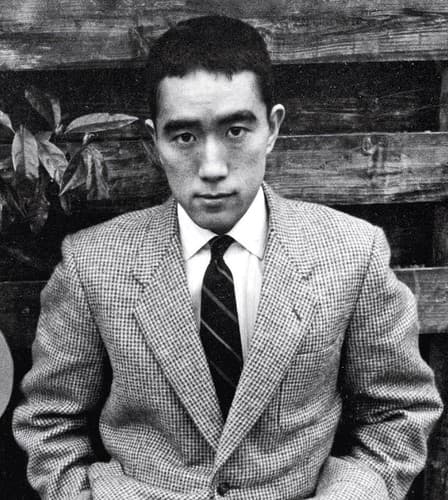
Kimitake Hiraoka , also known as Yukio Mishima , was a Japanese author, poet, playwright, actor, model, Shintoist, nationalist, and founder of the Tatenokai , an unarmed civilian militia. Mishima is considered one of the most important writers of the 20th century. He was considered for the Nobel Prize in Literature in 1968, but the award went to his countryman and benefactor Yasunari Kawabata. His works include the novels Confessions of a Mask and The Temple of the Golden Pavilion , and the autobiographical essay Sun and Steel . Mishima's work is characterized by "its luxurious vocabulary and decadent metaphors, its fusion of traditional Japanese and modern Western literary styles, and its obsessive assertions of the unity of beauty, eroticism and death", according to author Andrew Rankin.