“It is not possible to be a little bit in love. It is like being a little bit pregnant.”
— Don Tillman's logical, yet ultimately flawed, understanding of human emotion.

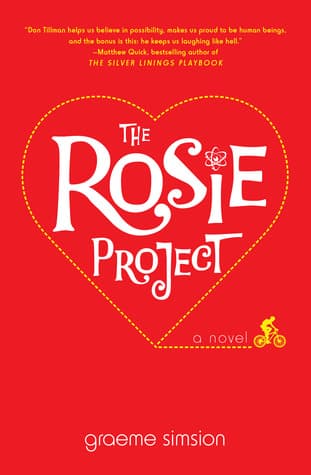
Graeme Simsion (2013)
Genre
Romance
Reading Time
350 min
Key Themes
See below
Sign in to track this book
A genetics professor, whose life is run by algorithms, searches for his ideal wife, only to have his world upended by a woman who defies his planned parameters.
Don Tillman, an intelligent but socially awkward genetics professor in Melbourne, lives by a strict schedule and logical principles. After realizing his difficulty in forming lasting romantic relationships, Don decides to start 'The Wife Project.' His goal is to find a compatible partner using a questionnaire to filter out unsuitable candidates. The questionnaire details preferences for punctuality, rationality, health, and many other traits, specifically excluding smokers, drinkers, and latecomers. He believes that by using logic, he can bypass the emotional aspects of courtship and find his ideal mate, ensuring a successful marriage.
Don's structured world changes when he meets Rosie Jarman, a bartender and genetics PhD student, who arrives late for their first meeting (which Don mistakenly thinks is a date setup by his friend Gene). Rosie is the opposite of everything on Don's Wife Project questionnaire: she smokes, drinks, is often late, and is emotionally expressive. Despite her failing all his criteria, Don is interested in her sharp mind and personality. Rosie needs Don's genetics knowledge to help her find her biological father, whom she believes is one of her mother's medical school classmates from twenty years ago, a quest she calls 'The Father Project.'
Don, a logical problem-solver, is interested in the challenge of Rosie's 'Father Project.' He agrees to help her, seeing it as a complex genetic puzzle, and temporarily puts aside his Wife Project. Their work involves unconventional methods to collect DNA samples from Rosie's mother's past classmates. This includes creating disguises, arranging 'accidental' encounters, and even manipulating social events, often with humorous and awkward results. Don finds himself increasingly involved in Rosie's chaotic world, making him change his routines and embrace spontaneity, much to his surprise and the amusement of his friends, Gene and Claudia.
Their search for Rosie's father leads them on elaborate and comical adventures. Don creates a system to narrow down the list of potential fathers, based on Rosie's mother's memories and secret DNA collection missions. They crash a university reunion, where Don tries to gather hair samples from discarded combs. They also hold a 'cocktail party' at Don's apartment to collect DNA from a selected group of candidates by having them unknowingly contribute to a 'scientific experiment' involving their saliva. These escapades push Don outside his comfort zone, forcing him to engage in social interactions he would normally avoid and to improvise when his plans go wrong, often with Rosie's more intuitive suggestions.
As Don and Rosie spend more time together on the Father Project, a deep bond forms between them. Don, despite his logical approach, finds himself enjoying Rosie's company and even changing his routines for her. He experiences new emotions, though he struggles to identify or express them in a way Rosie understands. Their close work, however, leads to misunderstandings, especially about their relationship. Rosie, frustrated by Don's lack of emotional clarity and his continued pursuit of The Wife Project, sometimes feels like just another scientific problem to him, causing tension and arguments.
Through their efforts, Don identifies Rosie's biological father: Phil, a man who had been a close friend to Rosie's mother for years. The revelation shocks both Rosie and her mother, who genuinely believed Phil was not the father. Rosie is initially overwhelmed by the news, grappling with the implications for her identity and her relationship with her mother. Afterwards, an argument happens between Don and Rosie. Rosie feels that Don, in his scientific detachment, did not understand the emotional weight of her quest, and she is hurt by his inability to show his feelings for her, leading her to distance herself from him.
Rosie decides to move to New York to pursue her academic career, leaving Don feeling a sense of loss. Her departure causes Don's emotional awakening. He realizes that his logical world is incomplete without her and that his feelings for Rosie are beyond any statistical analysis. With help from Gene and Claudia, Don starts to process his emotions, recognizing that he is in love with Rosie. He understands that love is not about perfect compatibility on paper, but about their unique connection. This realization prompts him to make a grand, uncharacteristic gesture to win her back.
Determined to win Rosie back, Don sells his apartment, buys new clothes, and flies to New York, completely changing his planned life. He finds Rosie at a scientific conference and, in a moment of emotional vulnerability, declares his love for her. He explains that she has changed him, making him realize that his previous definition of a 'perfect' partner was wrong and that she, in her imperfection, is the only woman he wants. This public, heartfelt confession, a complete change from his usual reserved manner, moves Rosie, who finally sees the depth of his feelings.
Rosie, touched by Don's gesture and recognizing his sincerity, returns his feelings. They reconcile, acknowledging their love and commitment. Don, having changed, is now more open to spontaneity and emotional expression, while Rosie has found a sense of belonging and acceptance with Don. They decide to move forward together, embracing their individual quirks and the unconventional nature of their relationship. The novel ends with them starting their life together in New York, looking forward to a future where logic and love can exist, in a messy and unpredictable way.
The Protagonist
Don transforms from a rigid, emotionally detached individual into someone capable of deep love and emotional expression, learning that true connection transcends logic.
The Love Interest / Co-protagonist
Rosie finds her biological father and, through her relationship with Don, learns to appreciate a different kind of love and acceptance, discovering that emotional connection can exist alongside intellectual compatibility.
The Supporting
Gene's character serves more as a foil and catalyst for Don, his own struggles with fidelity highlighting the complexities of relationships that Don initially tries to avoid.
The Supporting
Claudia's arc is less central, but she provides a consistent voice of emotional wisdom, showing resilience in her own difficult marriage while offering vital support to Don's growth.
The Supporting
Phil's arc involves the surprising revelation of his paternity, leading to a new, unexpected family connection with Rosie.
The Supporting
Julia's arc is centered around the revelation of a long-held secret, leading her to re-evaluate her past and her relationship with her daughter.
The Mentioned
Not applicable, as a minor character.
The novel explores how individuals define themselves and find who they are, often through unexpected relationships. Don, initially defined by his logical approach to life, changes, realizing his identity includes emotions he previously ignored. Rosie's 'Father Project' is a literal search for her biological identity, which helps her understand her place in the world. Both characters' journeys show that identity changes through experience and connection, challenging old ideas of self.
““I had been living a life of my own design, and it had been a good life. But it was no longer enough.””
A main theme is the conflict and eventual joining of logical reasoning and emotional experience, especially in love. Don's 'Wife Project' tries to apply logic to finding a partner, believing love can be measured. Rosie, with her chaotic and emotional nature, directly challenges this idea. The story shows that while logic can solve problems, love works differently, requiring vulnerability, acceptance of imperfection, and emotional intelligence that goes beyond science. Don's journey proves that true love often defies logical categorization.
““Love is not a statistical phenomenon.””
The book explores the challenges faced by people who do not fit typical social norms, especially through Don's likely undiagnosed neurodivergence (often seen as Asperger's Syndrome). Don carefully observes and tries to follow social rules, often failing humorously due to his literal interpretation and lack of intuitive understanding of human emotion. The story shows the difficulties of navigating a world built on unspoken social cues and empathy, and how different ways of thinking can lead to misunderstandings and unique strengths. Rosie's acceptance of Don's quirks is important for his integration.
““I am not good at reading social cues, but I am excellent at reading data.””
The idea of family, both biological and chosen, is explored through Rosie's 'Father Project' and Don's changing relationships. Rosie's quest reveals that biological ties can be unexpected and complex, challenging her long-held assumptions about her family history. At the same time, Don finds a sense of 'family' with Rosie, Gene, and Claudia, even though they are not biologically related. The book suggests that family is not just defined by genetics but also by the bonds of love, support, and shared experiences that people choose to build, showing the importance of emotional connection over pure biology.
““Perhaps the greatest scientific discovery of all is that there is no formula for happiness.””
A detailed questionnaire designed to find Don's ideal partner based on objective criteria.
This elaborate, multi-page questionnaire is Don's primary tool for selecting a compatible partner. It details highly specific requirements and exclusions (e.g., non-smoker, punctual, logical, non-barmaid). The questionnaire serves as a central plot device by immediately setting up the conflict when Rosie, who fails every criterion, enters Don's life. It highlights Don's logical, analytical approach to relationships and provides a humorous contrast to the messy reality of human connection. Its ultimate failure to identify Don's true love underscores the novel's theme that love defies pure logic.
Rosie's quest to find her biological father, which drives the main plot and brings her and Don together.
The Father Project is Rosie's personal mission to identify her biological father from a pool of her mother's former medical school classmates. This project serves as the primary catalyst for Don and Rosie's interaction and the development of their relationship. It provides a structured, scientific challenge that appeals to Don's logical mind, allowing him to engage with Rosie without immediately confronting romantic feelings. The various schemes they devise to collect DNA samples generate much of the comedic action and force Don out of his comfort zone, accelerating his personal growth and their bond.
The story is told entirely from Don Tillman's unique, highly logical, and often literal viewpoint.
The novel is narrated exclusively by Don Tillman, providing readers with direct access to his internal monologue, his logical deductions, and his struggle to understand social norms and emotions. This narrative choice is crucial to the book's humor and its thematic exploration of neurodiversity. It allows the audience to experience the world through Don's unique lens, appreciating his intellect while also understanding the challenges he faces in social interactions. It creates empathy for Don and highlights the gap between his logical interpretations and the emotional reality of situations, particularly in his relationship with Rosie.
The central romantic relationship is built on the stark contrast between the two protagonists.
The 'opposites attract' trope is a fundamental plot device, central to the romantic comedy aspect of the novel. Don is meticulously organized, logical, and socially awkward, while Rosie is spontaneous, chaotic, emotional, and socially adept. Their contrasting personalities create inherent conflict, humor, and ultimately, a powerful attraction. Their journey together demonstrates how two vastly different individuals can complement each other, with Rosie helping Don to embrace emotion and spontaneity, and Don providing Rosie with stability and intellectual support. This dynamic reinforces the idea that love isn't about finding an identical match, but someone who broadens one's world.
“It is not possible to be a little bit in love. It is like being a little bit pregnant.”
— Don Tillman's logical, yet ultimately flawed, understanding of human emotion.
“The problem with people who have no imagination is that they are unable to imagine what it is like to have no imagination.”
— Don reflecting on the differing perspectives of himself and others.
“I am not a person who is easily swayed by emotion. I am a person who is easily swayed by data.”
— Don explaining his decision-making process, highlighting his reliance on rationality.
“I have a theory that the best way to get to know someone is to observe them in a crisis.”
— Don's unusual approach to assessing potential partners for his 'Wife Project'.
“Love is not a checklist. It is a feeling.”
— Rosie challenging Don's overly structured and logical approach to finding a partner.
“I am an academic. I am paid to think.”
— Don justifying his analytical and sometimes overly intellectual approach to everyday life.
“My genetic material is excellent. My social skills are, perhaps, not so excellent.”
— Don's self-assessment, recognizing his strengths and weaknesses.
“Sometimes the most logical thing to do is to be illogical.”
— Don beginning to understand the complexities of human behavior and relationships.
“I was about to embark on a project that would change my life. The Wife Project.”
— Don's initial, highly systematic plan to find a suitable partner.
“The greatest danger in life is not taking risks. It is taking no risks at all.”
— Don's evolving perspective on life, moving beyond his comfort zone.
“I had established the protocols. I had designed the questionnaire. I had even prepared a preliminary schedule.”
— Don's meticulous preparation for his 'Wife Project' before meeting Rosie.
“Perhaps I was not designed for this. Perhaps I was designed for something else. Something more logical.”
— Don's internal struggle when faced with the unpredictable nature of love and Rosie.
“Love does not require a genetic match. It requires a human match.”
— Don's ultimate realization about what truly matters in a relationship, moving past his initial scientific criteria.
Ready to see how well you understood this book? Take our interactive quiz with 10 questions.

Biography coming soon.