“What if you knew that you’d never see someone again? What if you knew it was definitely the last time? How would you make the most of it?”
— Helen ponders the fleeting nature of encounters and the importance of savoring them.

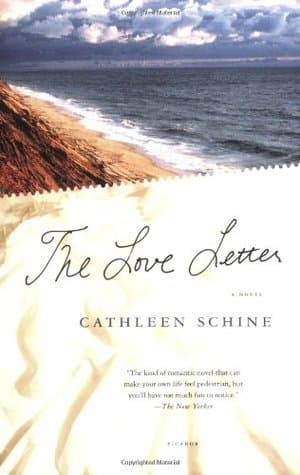
Cathleen Schine (1995)
Genre
Romance
Reading Time
257 min
Key Themes
See below
Sign in to track this book
A happily divorced bookstore owner in a charming New England town finds her content life upended by an anonymous, passionate love letter that sparks a town-wide quest for its secret author.
Helen MacFarquhar, the owner of a charming independent bookstore in a small New England town, begins her day like any other, surrounded by books and familiar faces. While sorting mail, she finds an envelope addressed only to her, with no return address. Inside, she finds a beautifully handwritten letter, filled with intense passion and declarations of love from an unknown admirer. The letter is personal, hinting at shared moments and intimate knowledge of her character. Helen is initially bewildered and amused, but the letter's sincerity and poetic language soon captivate her, sparking curiosity about its author.
After the initial shock, Helen speculates about the letter's sender. Her first thought is George, a handsome local carpenter and her sometime lover, but the letter's tone doesn't quite match his direct personality. She also considers Johnny, her younger, charming bookstore employee, but dismisses him as too immature for such sentiments. Other possibilities cross her mind: her ex-husband, a childhood friend, or even one of her more eccentric customers. The mystery adds an intriguing layer to her daily life, making her observe everyone with fresh eyes and a subtle suspicion. She shares the secret with her friend and confidante, Janet, who encourages her to enjoy the thrill of the unknown.
Helen's daughter, Louise, a sharp college student home for the summer, quickly becomes interested in the mystery of the love letter. Together, they examine the letter's wording, handwriting, and even the type of paper, looking for clues. Louise, with her youthful enthusiasm and logical mind, suggests a more systematic approach to identifying the author. Their shared investigation becomes a playful game, strengthening their close bond. They discuss potential candidates, analyze their behaviors, and discreetly try to gather handwriting samples. The letter, once a private enigma, becomes a shared adventure, bringing excitement to their quiet summer.
As Helen continues her search, she becomes convinced that one of her regular customers, a quiet man named Arthur, might be the secret admirer. His shy demeanor and intellectual interests seem to align with the letter's thoughtful prose. During a conversation in the bookstore, Helen subtly tries to gauge his reaction to romantic poetry and observes his handwriting. Her suspicions lead to an awkward interaction when she misinterprets one of his comments, almost revealing her knowledge of the letter. Arthur, oblivious to her internal struggle, simply continues discussing books, leaving Helen both embarrassed and amused by her own detective work.
Just as Helen begins to feel frustrated, a second anonymous letter arrives. This one is even more passionate and revealing than the first, describing intimate feelings and a longing that resonates deeply with Helen. The new letter confirms that the sender is still present and observing her. It also provides a few more subtle clues, though nothing definitive. The arrival of the second letter reignites Helen's excitement and reinforces her belief that the author is someone she knows well. The mystery shifts from a mere curiosity to a more profound emotional engagement, as Helen finds herself increasingly drawn into the romantic fantasy the letters create.
One afternoon, while working in the bookstore, Johnny, Helen's young employee, approaches her with an uncharacteristic seriousness. To Helen's astonishment, he confesses to being the author of the anonymous love letters. He explains that he wrote them out of a deep, unexpressed affection for her, inspired by her intelligence, kindness, and beauty. Helen is taken aback, not only by the confession but also by the depth of emotion Johnny reveals. While flattered, she grapples with the age difference and the professional boundaries between them. The revelation shifts her perspective, forcing her to see Johnny in a new light, and to confront her own feelings about the romantic ideal the letters had created.
After Johnny's confession, Helen feels a mix of emotions: surprise, flattery, and disappointment that the romantic mystery has been solved in such an unexpected way. She genuinely cares for Johnny but views him more as a son or a younger brother. She gently, but firmly, explains that while she appreciates his feelings, a romantic relationship between them is not possible. Johnny, though hurt, understands her position. The revelation, while a relief in some ways, also leaves Helen with a sense of the fantastical being replaced by reality. She contemplates how the anonymity of the letters allowed for a freedom of imagination that the truth now constrains.
The true, astonishing twist arrives when Louise, still intrigued by the letters' unique handwriting and turns of phrase, makes a startling discovery. While going through old family papers, she finds a collection of love letters written decades ago by her grandmother, Helen's mother, to Helen's father. The handwriting is identical, and the poetic style, vocabulary, and even specific phrases mirror those in the anonymous letters Helen received. Louise confronts Helen with the evidence, and together they realize the incredible truth: the letters were not written by Johnny, nor by any secret admirer in the present, but were a copy of her mother's passionate letters, perhaps re-sent by her mother as a way to express enduring love or as a playful, nostalgic gesture.
The revelation that her own mother was the true 'author' (or rather, re-sender) of the love letters is a profound moment for Helen. It completely recontextualizes the entire experience. She realizes that her mother, a woman she thought she knew well, possessed a deep, romantic side that she had never fully appreciated. The letters were not a romantic overture to Helen, but a beautiful, perhaps slightly mischievous, way for her mother to share a piece of her own enduring love story, or to remind Helen of the power of love itself. This understanding brings a new warmth and depth to Helen's relationship with her mother, allowing her to see her not just as a parent, but as a woman with a rich inner life and a timeless capacity for love.
Helen confronts her mother about the letters, not with anger, but with amusement and deep affection. Her mother, initially evasive, eventually admits to sending them, explaining that she found the old letters and, perhaps out of a whim or a desire to share beauty, decided to send them to Helen. Their conversation is tender and revealing, deepening their bond. Helen reflects on the nature of love – romantic, familial, and self-love. The experience has taught her that love can appear in unexpected forms and from surprising sources, and that the anticipation and mystery can be as fulfilling as the resolution. She embraces the complexity of her own feelings and the enduring power of connection.
With the mystery resolved, Helen finds a new sense of peace and clarity. The romantic fantasy of a secret admirer has been replaced by the comforting reality of her mother's love and the playful bond with her daughter. She continues her life in the bookstore, but with a heightened appreciation for the subtle joys and connections around her. Her relationship with George continues in its comfortable, on-again, off-again way, but she no longer feels the pressure of an unmet romantic ideal. The love letters, once a source of delightful confusion, become a cherished memory, a reminder of the multifaceted and often surprising ways love manifests in life. Helen embraces the present, content with the various forms of love that enrich her existence.
The Protagonist
Helen evolves from a woman intrigued by a romantic fantasy to one who understands the deeper, multifaceted nature of love, embracing both its mysterious and familial forms.
The Supporting
Louise helps unravel the mystery, ultimately discovering the true origin of the letters, and strengthens her bond with her mother through their shared adventure.
The Supporting
Her hidden romantic past is unveiled, revealing a deeper dimension to her character and enriching her relationship with Helen.
The Supporting
Johnny moves from being a secret admirer and false confessor to gracefully accepting Helen's decision, showing his maturity.
The Supporting
George remains a consistent, if casual, romantic presence, providing a contrast to the mystery and fantasy of the letters.
The Supporting
Janet serves as a stable, supportive presence throughout Helen's journey, reinforcing the theme of friendship.
The novel explores love in its various forms: romantic, familial, and self-love. The anonymous love letters initially represent an idealized, passionate romance, sparking Helen's imagination. However, as the mystery unravels, the narrative reveals that enduring love can manifest in unexpected ways, such as a mother's playful gesture or the comfort of a long-standing, casual relationship. The book suggests that love lies not just in grand declarations, but also in subtle connections and shared histories, as seen when Helen realizes the letters are from her mother's past.
“Perhaps the anticipation was the best part, the imagining, the freedom to create a lover in her mind.”
A central theme is the tension between the romantic fantasy sparked by the anonymous letters and the often less dramatic, but equally meaningful, reality. Helen's imagination runs wild, projecting various identities onto the unknown author, creating an idealized lover. The eventual revelation that the letters are from her mother, and are copies of her mother's own historical love letters, grounds the fantasy in a different, more profound reality. This theme highlights how imagination can enrich life, but also how reality, when understood deeply, can be even more surprising and fulfilling than imagined scenarios.
“The anonymous letter allowed for a freedom of invention, a boundless possibility that the truth often constrained.”
The entire plot hinges on the power of written words – specifically, a love letter. The elegant, passionate prose of the letters deeply affects Helen, stirring emotions and curiosity. The ambiguity of the letters' authorship allows for multiple interpretations and propels the narrative forward. The book also explores different forms of communication: the directness of George, the playful banter between Helen and Louise, and the eventual, tender conversation between Helen and her mother that clarifies the letters' origin. Words, both written and spoken, have immense power to connect, confuse, and reveal.
“It was the words themselves, the sheer beauty and sincerity of them, that had captured her.”
Through the process of trying to uncover the author of the love letter, Helen embarks on a journey of self-discovery. The letters force her to examine her own desires, her perceptions of romance, and her relationships with those around her. She learns about her own capacity for romantic longing and the importance of various forms of love in her life. The revelation about her mother's past also offers Helen a deeper understanding of her own family history and her mother's identity, which in turn reflects on her own. The experience ultimately brings her a greater sense of peace and self-awareness.
“She had been looking for a lover, but had found a deeper understanding of her own heart and her mother's.”
The central mystery that drives the entire narrative.
The anonymous love letter is the primary plot device, serving as the inciting incident and the engine of the story. Its anonymity creates intrigue, allowing Helen (and the reader) to project various possibilities onto its author. This ambiguity fuels Helen's detective work, introduces new characters as suspects, and explores themes of imagination versus reality. The letter's content, filled with passion and personal observations, deeply affects Helen, sparking her romantic curiosity and leading to her emotional engagement with the mystery. The ultimate revelation of its true origin provides the story's major twist and resolution.
Misleading clues or characters that divert the protagonist's investigation.
The novel employs several red herrings, most notably Johnny's confession to writing the letters. This false lead provides a temporary resolution, allowing Helen to process the idea of a younger, unexpected admirer. Other characters, like George and Arthur, are also briefly considered as potential authors, drawing Helen's attention and investigation in different directions. These red herrings effectively build suspense, complicate the plot, and highlight Helen's own biases and romantic projections, making the eventual true revelation even more surprising and impactful.
The past love story of Helen's mother parallels Helen's present search.
While not a full parallel narrative in the traditional sense, the discovery that Helen's mother's old love letters are the source of the anonymous letters creates a powerful implied parallel. The passionate sentiments expressed in the letters originally belonged to Helen's mother's past romance, mirroring Helen's current longing for love. This device allows the novel to explore themes of enduring love, legacy, and the cyclical nature of human emotion across generations, enriching Helen's understanding of her own mother and of love itself. It adds a layer of depth and historical resonance to Helen's contemporary romantic quest.
“What if you knew that you’d never see someone again? What if you knew it was definitely the last time? How would you make the most of it?”
— Helen ponders the fleeting nature of encounters and the importance of savoring them.
“You can never tell what’s going to happen. And that’s the wonderful thing about it, and the terrifying thing.”
— Helen muses on the unpredictable nature of life and love.
“It was a letter. A love letter. But to whom? And from whom?”
— Helen discovers the mysterious letter that sets the plot in motion.
“Perhaps the most romantic thing about a love letter is that it’s a secret, shared.”
— Helen reflects on the inherent intimacy and secrecy of a written declaration of love.
“She had always thought that love was a grand, sweeping gesture. Now she wondered if it was just a series of small, perfect moments.”
— Helen re-evaluates her understanding of love's manifestation.
“The past was not a foreign country; it was merely a room she hadn't visited in a while.”
— Helen considers her connection to her past experiences and memories.
“Sometimes the things you’re looking for are right in front of you, you just have to learn how to see them.”
— Helen realizes a truth about her own perceptions and desires.
“It’s amazing how a simple piece of paper can hold so much power.”
— Helen contemplates the profound impact of the love letter.
“She felt as if she were living in a story, and she was both the reader and the main character.”
— Helen immerses herself in the unfolding mystery and her own role within it.
“The world was full of secrets, and sometimes, if you were lucky, you stumbled upon one that made your own life more interesting.”
— Helen reflects on the allure of hidden truths and their impact.
“Love wasn’t about finding the perfect person, but about seeing an imperfect person perfectly.”
— Helen's evolving perspective on the nature of love.
“There was a quiet comfort in the rhythm of the days, even when they were filled with questions.”
— Helen finds solace in routine amidst her search for answers.
“Every person carries a hidden narrative, and sometimes, a single word can unlock it.”
— Helen considers the unspoken stories within individuals.
“The greatest adventures often begin with the smallest, most unexpected discoveries.”
— Helen reflects on how the found letter sparked her journey.
Ready to see how well you understood this book? Take our interactive quiz with 10 questions.

Cathleen Schine is a celebrated American author known for her witty and insightful fiction. Her novel, The Love Letter, was a New York Times bestseller and adapted into a popular film. Schine's writing often explores themes of relationships, identity, and the complexities of modern life with a sharp, humorous touch.