“The future is dark, which is the best thing the future can be, I think.”
— Katherine ponders the unknown future with a sense of quiet hope.

Virginia Woolf (1919)
Genre
Romance
Reading Time
992 min
Key Themes
See below
Sign in to track this book
Katharine Hilbery, caught between tradition and modern ideas, chooses between a pragmatic poet and a passionate suitor. She faces the complexities of love, expectation, and self-discovery, shaped by the feminist ideas and literary pursuits of the women around her.
The novel opens at the Hilbery family home in Chelsea. Katharine Hilbery, granddaughter of a famous poet, hosts an afternoon tea. Guests include Ralph Denham, a solicitor who writes essays, and William Rodney, a poet secretly in love with Katharine. Katharine, despite her beauty and social standing, feels detached and often works on astronomy in her private study. She observes social rituals and conversations with a critical eye. Denham is immediately drawn to her, while Rodney struggles to express his feelings. The evening shows the Hilberys' intellectual and social world, full of literary discussions and unspoken social pressures.
After several social events, William Rodney, with Mrs. Hilbery's encouragement, proposes marriage to Katharine. Katharine accepts, feeling a sense of family obligation and a desire for stability, though she has doubts and no strong feelings for him. Her acceptance is more about meeting expectations than declaring love. She tells her cousin, Cassandra Otway, about her engagement but finds it hard to explain her true feelings. Her family approves of the engagement, seeing Rodney as a good match that fulfills social expectations for a woman of Katharine's position.
Ralph Denham finds himself more and more interested in Katharine, despite her engagement to Rodney. He often seeks her out, engaging her in intellectual discussions that challenge her conventional views. Their talks often cover abstract ideas, unlike typical superficial social conversations. Meanwhile, Mary Datchet, a women's suffrage activist from a modest background, secretly loves Ralph Denham without success. She works hard for her cause, finding purpose in her activism, but her personal life remains lonely. Mary watches Denham's growing interest in Katharine with quiet sadness, seeing the social gap between herself and the Hilbery family.
The Hilbery family and their guests, including Ralph Denham and William Rodney, spend time at the Hilbery country house. During this time, Katharine and Denham's intellectual and emotional bond grows deeper. They take long walks and have serious discussions, exploring their inner thoughts and feelings, often talking about reality and individual consciousness. Katharine feels increasingly drawn to Denham's intensity and unconventional ideas, while Rodney, unaware of their growing connection, continues his work and shows his affection for Katharine in a formal way. The country setting provides a place for their developing, unspoken romance, showing the difference between social expectations and personal desires.
William Rodney, during his stay at the Hilbery country house, gradually shifts his affection towards Katharine's lively and more openly expressive cousin, Cassandra Otway. He finds Cassandra's energy charming and feels less intimidated by her than by Katharine's intellectual reserve. This change in Rodney's focus gives Katharine an unexpected sense of freedom. Sensing an opportunity, Katharine finally tells Ralph Denham that she does not truly love Rodney and feels trapped by their engagement. This confession marks a turning point, opening the way for a possible relationship between Katharine and Denham, but also creating social complications.
Empowered by his feelings for Cassandra, William Rodney formally breaks off his engagement with Katharine, which surprises and eventually relieves both families. He then proposes to Cassandra, who, after thinking it over and talking frankly with Katharine, accepts. This turn of events frees Katharine from a commitment she never wanted. Soon after, Ralph Denham, recognizing the depth of his feelings and Katharine's new availability, proposes marriage to her. Their proposal is less about social convention and more about a deep intellectual and emotional connection, though it remains somewhat quiet and unconventional.
Mary Datchet, who had hoped for a relationship with Ralph Denham, is deeply affected by the news of his engagement to Katharine. She faces the reality of her unrequited love and the social barriers that separate her from Denham's world. Though heartbroken, Mary finds new purpose and comfort in her work for women's suffrage. She dedicates herself more fully to her political activities, putting her emotional energy into a cause she believes in. This period marks a maturing for Mary, as she accepts her personal limits and chooses a path of independent action, finding fulfillment outside of traditional romantic expectations.
Katharine and Ralph Denham now have to tell their families about their unconventional engagement, especially Katharine's parents, Mrs. Hilbery and Mr. Hilbery. Mrs. Hilbery, busy with her biography of her father, is initially surprised by the sudden change in engagements but eventually accepts it, often seeing romantic situations through a romanticized, literary view. Mr. Hilbery, more practical, questions Denham's financial prospects and social standing. Denham, for his part, must deal with his own family's expectations, particularly his sister's, who views Katharine's upper-class background with some suspicion. The couple faces a period of adjustment and quiet social scrutiny.
Katharine visits Ralph Denham's family home in the suburbs, which is very different from her grand Chelsea residence. She meets his sister, Joan, and sees the more modest, practical, and less intellectual environment. This visit shows the significant class differences between Katharine and Denham, and the different worlds they live in. Katharine, used to a life of privilege and intellectual pursuits, feels somewhat out of place, yet she wants to understand Denham's background. Denham, in turn, knows about the social gap, and both struggle with how to bridge these differences in their upcoming marriage, recognizing that their union crosses social boundaries.
As the novel ends, the characters find some resolution. Rodney and Cassandra are happily engaged, their relationship based on more direct, less intellectual affection. Mary Datchet continues her work for women's rights, finding a new kind of fulfillment in her independence and activism. Mrs. Hilbery continues her work on her father's biography, always creating and recreating his memory. Katharine and Ralph Denham, having dealt with their personal and social challenges, decide to marry. Their union is shown not as a conventional romance, but as a partnership built on shared intellectual curiosity, mutual respect, and a deep understanding of each other's complex inner lives, promising a future that goes beyond traditional expectations.
The Protagonist
From a detached observer conforming to expectations, Katharine evolves into a woman who embraces her intellectual and emotional desires, choosing a partner based on genuine connection rather than social convention.
The Protagonist/Love Interest
Denham navigates his ambition and social discomfort to pursue a genuine intellectual and emotional connection, ultimately finding a partner who understands his complex inner life.
The Supporting
Rodney moves from a conventional engagement based on suitability to one driven by a more immediate, albeit less profound, attraction.
The Supporting
Mary confronts her unrequited love and, through resilience, finds a stronger sense of self and purpose in her political work.
The Supporting
Her arc is relatively static, as she remains absorbed in her literary past and social duties, serving as a foil to Katharine's quest for authenticity.
The Supporting
His character remains consistent, embodying a pragmatic intellectualism.
The Supporting
She moves from a carefree young woman to accepting a conventional marriage based on immediate attraction.
The Supporting
Her character remains largely consistent, providing a realistic, working-class perspective on the events.
The novel explores a person's search for identity, especially for women, amid social pressures. Katharine Hilbery struggles to balance her intellectual interests (astronomy, mathematics) with the expected role of a privileged woman. Her first engagement to Rodney is a compromise to this expectation, while her eventual choice of Denham shows her true self and her desire for intellectual partnership. Mary Datchet's journey, finding purpose in women's suffrage after unrequited love, also shows self-discovery through independent action, challenging traditional female roles.
“For the first time she was beginning to understand that the world was not a solid, fixed reality, but a fluid, changing thing, which she herself could help to mould.”
Woolf examines the nature of love and marriage, comparing conventional unions with relationships based on intellectual and emotional compatibility. Katharine's engagement to Rodney is a 'suitable' match, but it lacks real passion, reflecting social pressures. Her attraction to Denham, however, comes from deep intellectual conversations and a shared understanding of life's complexities, challenging superficial social norms. The changing engagements (Katharine-Rodney, Rodney-Cassandra) reveal how arbitrary such arrangements are when not based on real connection. Mary's unrequited love for Denham shows the pain of unfulfilled desires in a society that often limits women's romantic choices.
“It was not a question of love, but of necessity; a woman must marry, and she must marry someone.”
The novel criticizes the limits placed on women in early 20th-century society. Katharine's intellectual goals (astronomy, mathematics) are often seen as odd or secondary to her role as a hostess or potential wife. Mrs. Hilbery, though intellectual, is mostly defined by her social duties and her endless, romanticized biography. Mary Datchet directly confronts these limits through her activism for women's suffrage, offering an alternative path of independence and social involvement outside of marriage. The contrasting lives of Katharine, Mrs. Hilbery, and Mary show how women dealt with or challenged the expectations of their time.
“What was the good of thinking, unless you thought about something practical?”
Woolf explores the tension between intellectual pursuits and emotional experience. Katharine and Denham's relationship grows through their serious, abstract discussions, valuing mental connection as much as, if not more than, traditional romance. Katharine's private study of astronomy symbolizes her intellectual escape from emotional and social demands. Conversely, Rodney's precise but somewhat dry poetry, and his eventual shift to the more openly emotional Cassandra, shows the limits of purely intellectual or purely conventional approaches to life and love. The novel suggests a balanced integration of mind and heart for true fulfillment.
“The ardour of her mind burnt like a steady lamp, illuminating the dark places of her daily life.”
The novel shows the strict class differences in English society. The Hilbery family represents the upper-middle-class intellectual elite, with their grand house, literary connections, and social rituals. Ralph Denham, a solicitor from a more modest background, often feels out of place in their world, keenly aware of his social standing. His sister, Joan, further embodies the practical, working-class perspective, viewing the Hilberys with a mix of suspicion and respect. The class differences between Katharine and Denham, especially clear during Katharine's visit to his home, show the social barriers they must overcome to build a relationship.
“He was aware of a great gulf fixed between his world and hers.”
Exploration of characters' inner thoughts and perceptions.
While not as fully developed as in her later works, 'Night and Day' employs elements of stream of consciousness to delve into the characters' inner lives, particularly Katharine's and Denham's. Woolf frequently shifts from external narration to the characters' private thoughts, feelings, and philosophical musings, revealing their internal conflicts, doubts, and desires. This technique allows the reader to understand the complex mental landscapes of the protagonists, contrasting their rich inner worlds with the often superficial external social interactions. It emphasizes the subjective nature of reality and the unspoken depths beneath conventional behavior.
Represents Katharine's intellectual escape and search for universal truth.
Katharine Hilbery's secret study of astronomy and mathematics serves as a potent symbol throughout the novel. These abstract, logical pursuits represent her intellectual escape from the social obligations and emotional complexities of her daily life. They signify her desire for universal truths, order, and a sense of detachment from the chaotic human world. Her turning to the stars and mathematical problems highlights her yearning for a different kind of fulfillment than that offered by conventional romance or domesticity, embodying her intellectual independence and her quest for a profound, objective understanding of existence.
Highlights class differences and character development.
Woolf uses contrasting social settings to underscore character development and thematic concerns. The elegant, intellectual Chelsea home of the Hilberys, with its literary teas and constant flow of guests, represents a world of privilege, tradition, and intellectual discourse, albeit often superficial. In stark contrast, Ralph Denham's modest suburban home, with its more practical concerns and less intellectual atmosphere, highlights the class divide and the different realities that exist. Mary Datchet's suffrage office provides yet another setting, representing a world of work, political action, and independent female endeavor. These settings illuminate the various social and economic strata and the challenges characters face in navigating them.
A meta-commentary on truth, memory, and the creation of narrative.
Mrs. Hilbery's perpetually unfinished biography of her famous poet father acts as a significant plot device and a meta-commentary on the nature of truth, memory, and the creation of narrative. Her struggle to weave together facts, anecdotes, and personal recollections reveals the subjective and often romanticized way we construct the past. It mirrors the characters' own attempts to understand and define themselves and their relationships. The biography also symbolizes the weight of tradition and the past on the present generation, particularly for Katharine, who lives in the shadow of her illustrious grandfather, and the challenge of forging one's own authentic story.
“The future is dark, which is the best thing the future can be, I think.”
— Katherine ponders the unknown future with a sense of quiet hope.
“It is strange how little we know about the people we live with.”
— Ralph reflects on the hidden depths and unfamiliar aspects of those closest to him.
“To be oneself, and yet to be in perfect harmony with the world, that is the problem.”
— Katherine contemplates the struggle between individuality and societal expectations.
“What is the meaning of life? That is the simple question which has been asked by man since the beginning of time.”
— Mary Datchet grapples with profound philosophical questions during a discussion.
“We are all prisoners of our own experience.”
— Ralph considers the limitations imposed by individual perspectives and past events.
“The greatest happiness of life is the conviction that we are loved; loved for ourselves, or rather, loved in spite of ourselves.”
— A reflection on the profound joy of being truly accepted in love.
“It is only by being alone that one can discover what is one's own.”
— Katherine seeks solitude to understand her true desires and identity apart from others.
“The world is a looking-glass, and gives back to every man the reflection of his own face.”
— A metaphorical observation about how one's perception shapes their reality.
“The most important thing is to be honest with oneself.”
— Mary emphasizes the importance of integrity and self-awareness.
“What does it mean to be alive? To feel, to think, to love, to suffer.”
— A character muses on the multifaceted nature of human existence.
“One feels that one has a self, and then one feels that one is nothing but a mirror of other people's selves.”
— Katherine expresses the conflict between individual identity and external influences.
“It is a fact that the mind is a most capricious and ungovernable organ.”
— A character reflects on the unpredictable nature of human thought and emotion.
“The true delight of a book is to be found in the communication of mind with mind.”
— Katherine discusses the intellectual pleasure derived from reading and shared understanding.
“Love is not a feeling, it is an act.”
— A character's practical perspective on the nature of love, emphasizing action over mere emotion.
Ready to see how well you understood this book? Take our interactive quiz with 10 questions.
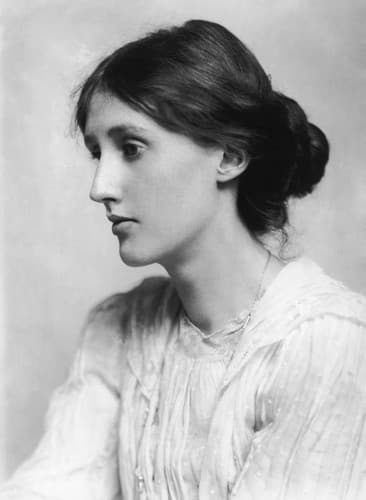
Adeline Virginia Woolf was an English writer. She is considered one of the most important modernist 20th-century authors and a pioneer in the use of stream of consciousness as a narrative device.