“You only get one life. It's actually your duty to live it as fully as possible.”
— Will Traynor's philosophy on life, shared with Louisa Clark.

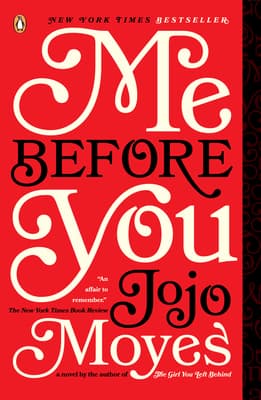
Jojo Moyes (2012)
Genre
Romance
Reading Time
7-8 hours
Key Themes
See below
Sign in to track this book
An ordinary woman's extraordinary efforts to show a quadriplegic man that his life is still worth living blossom into a heartbreaking love story that challenges the very definition of happiness and sacrifice.
Louisa 'Lou' Clark, a quirky twenty-six-year-old with an eccentric fashion sense, loses her job at The Buttered Bun cafe. Desperate for work to help support her struggling family in the small English town of Stortfold, she takes a six-month contract as a companion for Will Traynor, a wealthy, cynical quadriplegic man who was paralyzed two years prior in a motorcycle accident. Will, once a successful businessman and extreme sports enthusiast, is bitter and withdrawn, making Lou's initial days challenging. His primary caregiver, Nathan, a trained nurse, handles his medical needs, leaving Lou to provide companionship. Will often rejects her attempts at conversation and entertainment, being rude and dismissive.
Despite Will's difficult demeanor, Lou slowly begins to find small moments of connection. However, her world shatters when she overhears a heated argument between Will's mother, Camilla, and his sister, Georgina. She learns that Will has made a pact with his parents: he will endure six more months, and if his feelings about his life haven't changed, they will take him to Dignitas in Switzerland to assist him in ending his life. This revelation deeply impacts Lou, who is devastated and determined to change Will's mind within the allotted time, seeing it as her personal mission to show him life is still worth living.
Armed with her new, heartbreaking knowledge, Lou dedicates herself to creating experiences for Will, hoping to demonstrate the joy and beauty still available to him. She researches activities suitable for a quadriplegic and plans various outings, from a trip to the races and a classical music concert to a simple walk in a labyrinth and a visit to a butterfly house. Initially, Will is resistant and sarcastic, but Lou's persistent optimism and genuine care begin to wear down his cynicism. They start to share genuine laughter and conversations. Lou finds herself increasingly drawn to Will's intelligence and wit, while Will, in turn, is charmed by Lou's unique personality.
As Lou and Will spend more time together, their relationship deepens beyond caregiver and patient. They discuss their pasts, their dreams, and their fears. Lou learns about Will's adventurous former life, his travels, and his passion for extreme sports, which contrasts sharply with her own sheltered existence. Will encourages Lou to broaden her horizons, challenging her complacent relationship with her long-term, fitness-obsessed boyfriend, Patrick, and urging her to pursue her own ambitions. Lou, in turn, helps Will to reconnect with aspects of himself he thought lost, finding new ways to experience pleasure and connection despite his physical limitations. Their emotional intimacy grows, becoming the central focus of both their lives.
A moment arrives when Lou accompanies Will to his ex-girlfriend Alicia's wedding to his former best friend, Rupert. Seeing Will's emotional pain and the stark contrast with his past life, Lou instinctively reaches out and comforts him, leading to a deep moment of shared vulnerability. Following this, Lou plans a surprise holiday for Will, Nathan, and herself to Mauritius, a tropical island. This trip becomes the culmination of their blossoming romance. They share intimate moments, including a deep conversation on the beach where Will confesses his feelings for Lou, admitting she is the only reason he might reconsider his plan. They share a tender kiss, solidifying their unspoken love.
Despite the undeniable love that has developed between them and the joyous experiences they've shared, Will reveals to Lou that his fundamental desire to end his life has not changed. He explains that while he deeply loves her and cherishes their time together, he cannot reconcile himself to a future of dependence and physical limitation. He believes that living a life that is only 'half' a life for him is not fair to Lou, and he wants her to live fully. Lou is utterly heartbroken and devastated, feeling betrayed and unable to comprehend how he could choose to leave her after all they have shared. She accuses him of being selfish and leaves him, unable to accept his decision.
Lou returns home, reeling from Will's revelation. She struggles with her anger, grief, and the deep love she feels for him. Her family, particularly her mother, tries to comfort her, but Lou feels isolated in her pain. After much internal turmoil and agonizing over what Will truly wants, she receives a call from Camilla, Will's mother, who informs her that Will is already at Dignitas. Lou realizes she cannot let him face his final moments alone. She rushes to Switzerland, arriving just in time to be with Will. She holds his hand, sharing a quiet, tearful farewell, promising him that she will live a full life, as he always wished for her.
Following Will's death, Lou returns to Stortfold, heartbroken but determined to honor his memory. She receives a letter from Will, written before his death, along with a substantial financial inheritance. In the letter, Will expresses his enduring love for her and urges her to 'live boldly,' to travel, to embrace new experiences, and to pursue her dreams. He asks her to visit Paris, a city they had discussed, and to sit at a specific cafe. Lou, now free from the financial burdens of her family and inspired by Will's final wishes, begins to envision a life beyond the confines of her small village, ready to embark on the adventures he had always encouraged her to seek.
Louisa, following Will's instructions, travels to Paris. She sits at the specified cafe, reading his letter again, feeling his presence and love. The letter reminds her of his belief in her potential and his desire for her to experience everything life has to offer. This moment marks a turning point for Lou. With the inheritance providing her the means and Will's words providing the inspiration, she is finally able to break free from her past limitations and embrace a future filled with possibilities. She looks out at the bustling Parisian street, a symbol of the wider world she is now ready to explore, carrying Will's memory as a catalyst for her own bold new life.
The Protagonist
Louisa transforms from a complacent, small-town girl into a confident, independent woman ready to embrace the world, inspired by Will's love and final wishes.
The Protagonist/Love Interest
Will, initially withdrawn and determined to die, finds joy and love with Lou, but ultimately adheres to his decision to end his suffering on his own terms.
The Supporting
Patrick remains largely unchanged, serving as a representation of the life Lou leaves behind as she grows and transforms.
The Supporting
Nathan remains a consistent, supportive figure for Will and Lou, offering practical and emotional support.
The Supporting
Camilla struggles with her son's decision, eventually accepting it with profound sorrow and a quiet gratitude for Lou's efforts.
The Supporting
Steven remains a somewhat distant figure, accepting Will's decision with a quiet, resigned grief.
The Supporting
Katrina continues her education and parenting, providing a stable family presence for Lou.
The Supporting
Bernard's struggle with unemployment resolves as he finds a new job, allowing for family stability.
The Supporting
Josie remains a loving but sometimes critical figure, concerned for Lou's well-being and future.
This central theme explores the contentious debate surrounding assisted suicide. Will Traynor, a quadriplegic, firmly believes in his right to choose the time and manner of his death, viewing his life as no longer worth living due to his physical limitations. Lou, and by extension, society, struggles to accept this, believing that life, regardless of its challenges, is inherently valuable and worth fighting for. The narrative does not offer a simple answer but rather forces the reader to empathize with both perspectives, showing the personal struggle involved in such a decision and the heartbreak it causes loved ones, as seen in Lou's desperate attempts to change Will's mind and his unwavering resolve.
“"I know this isn't how you saw things playing out. But I want you to know, even though you might not understand, that I wouldn't have traded our time together for anything. But I can't live like this, Lou. I just can't."”
A significant theme is Lou's journey of self-discovery and Will's encouragement for her to 'live boldly.' Before meeting Will, Lou is content in her small, predictable life, lacking ambition and a sense of purpose beyond supporting her family. Will, despite his own despair, sees her potential and pushes her to explore the world, challenge her complacent relationship, and pursue higher education. His final letter and inheritance are a direct manifestation of this theme, empowering Lou to break free from her self-imposed limitations and embark on an adventurous life, fulfilling the dreams he can no longer pursue. This theme emphasizes the importance of seizing opportunities and not letting fear dictate one's choices.
“"Live boldly, Clark. Push yourself. Don't settle. Just live well. Just live."”
The novel explores the complex nature of love, particularly the idea of sacrificing one's own desires for the happiness of the person they love. Lou falls deeply in love with Will and desperately wants him to live, even if it means caring for him for the rest of her life. However, Will's love for Lou leads him to a different kind of sacrifice: choosing to end his life so that she is free to live a full, unburdened existence, rather than being tied to his care. This heartbreaking dilemma shows that true love sometimes means letting go and respecting the autonomy of the other, even when it causes immense pain, forcing Lou to confront the ultimate act of loving selflessness.
“"All I can say is that you make me... you make me want to be a man still. And that, in itself, is a lot to deal with. Because I am not a man."”
The book addresses the societal perception and prejudice surrounding disability. Will, despite his wealth and intelligence, is often treated with pity or as if he is less than whole. He struggles with people either ignoring him or talking over him, focusing solely on his physical limitations rather than his intellect and personality. Lou, initially clumsy in her interactions, learns to see beyond the wheelchair to the man within, challenging her own preconceived notions. The narrative emphasizes the importance of seeing the person, not just the disability, and shows the emotional and psychological toll of living in a body that no longer functions as one wishes.
“"You have no idea, Clark, how much I want to rip these walls apart. To get out of this chair and just… walk. Just walk."”
The story is primarily told through Louisa Clark's eyes, offering intimate access to her thoughts and emotions.
The novel is almost entirely narrated from Louisa Clark's first-person perspective. This allows the reader to deeply empathize with her journey, her initial reluctance, her growing affection for Will, and her profound heartbreak. By limiting the perspective, Moyes effectively builds suspense around Will's true intentions and feelings, as Lou (and the reader) must infer them from his actions and limited disclosures. This also highlights Lou's transformation, as her internal monologues evolve from self-deprecating observations to reflections of growing confidence and a wider worldview. The occasional, brief shifts to other characters' perspectives (like Nathan or Camilla) provide crucial insights into Will's condition and the family's struggles, offering a broader context.
A ticking clock device that creates dramatic tension and urgency.
The revelation of Will's pact with his parents – that he will give life six more months before going to Dignitas – serves as a powerful ticking clock plot device. This deadline immediately injects urgency and high stakes into Lou's mission. It frames every interaction, every outing, and every moment of connection between Lou and Will with a poignant sense of fleeting time. This device not only drives the plot forward but also intensifies the emotional impact, making Lou's efforts to change Will's mind feel desperate and her eventual failure all the more tragic. It forces both characters, and the reader, to confront the inevitability of Will's decision.
The stark differences in the characters' backgrounds and experiences highlight their individual growth and the impact they have on each other.
The novel effectively uses the stark contrast between Louisa's and Will's lives to drive their character development and the central conflict. Louisa comes from a working-class background, lives a small, provincial life, and has limited aspirations. Will, in contrast, comes from immense wealth, a privileged upbringing, and had a life filled with extreme sports, travel, and high-powered careers. This initial disparity emphasizes their 'unlikely pair' dynamic. Lou introduces Will to simple joys, while Will opens Lou's eyes to a world of possibilities, challenging her complacency. Their differences highlight what each character gains from the other, making their eventual parting even more poignant.
Physical movement (or lack thereof) symbolizes freedom, potential, and limitation.
Movement, or the lack thereof, is a pervasive symbol throughout the novel. Will's paralysis represents his complete loss of physical freedom and the stasis he feels trapped in, directly contrasting with his adventurous past. Lou's initial life is also one of emotional and geographical stasis, confined to her small town. Will, unable to move himself, becomes a catalyst for Lou's movement – encouraging her to travel, to learn, to 'live boldly.' His final gift to her is the means to move freely and explore the world, symbolizing his desire for her to embrace the freedom he has lost. The very act of assisted suicide is, for Will, a final choice of movement away from his confined existence.
“You only get one life. It's actually your duty to live it as fully as possible.”
— Will Traynor's philosophy on life, shared with Louisa Clark.
“Push yourself. Don't settle. Just live well. Just live.”
— Will's advice to Louisa about embracing life after his death.
“I will never, ever regret the things I've done. Because most days, all you have are places in your memory that you can go to.”
— Louisa reflecting on her experiences with Will.
“Some mistakes... Just have greater consequences than others. But you don't have to let the result of one mistake be the thing that defines you.”
— Louisa's realization about moving past errors.
“I thought, briefly, that I would never feel as intensely connected to the world, to another human being, as I did at that moment.”
— Louisa describing a profound moment with Will.
“You are scored on my heart, Clark. You were from the first day you walked in, with your ridiculous clothes and your complete inability to ever hide a single thing you felt.”
— Will's emotional letter to Louisa after his death.
“The thing about being catapulted into a whole new life—or at least, shoved up so hard against someone else's life—is that it forces you to rethink your idea of who you are.”
— Louisa's reflection on how Will changed her perspective.
“I know what it is to love someone and not be able to help them.”
— Louisa expressing the pain of loving Will while respecting his choices.
“Live boldly. Push yourself. Don't settle.”
— A recurring theme in Will's messages to Louisa.
“You cut yourself off from all sorts of experiences because you tell yourself you are 'not that sort of person'.”
— Will challenging Louisa's self-imposed limitations.
“I am conscious that knowing me has caused you pain, and grief, and I hope that one day you can forgive me for that.”
— Will's apology in his final letter to Louisa.
“All I can say is that you make me... you make me into someone I couldn't even imagine. You make me happy, even when you're awful.”
— Will expressing how Louisa transformed his life.
“I didn't know I could feel so much, before I met you.”
— Louisa acknowledging Will's impact on her emotional depth.
“We are all entitled to make decisions about our own lives.”
— A theme regarding Will's choice about assisted dying.
Ready to see how well you understood this book? Take our interactive quiz with 10 questions.
Biography coming soon.