“The less we love a woman, the easier 'tis to be liked by her.”
— Onegin's cynical advice to Lensky about love and relationships.

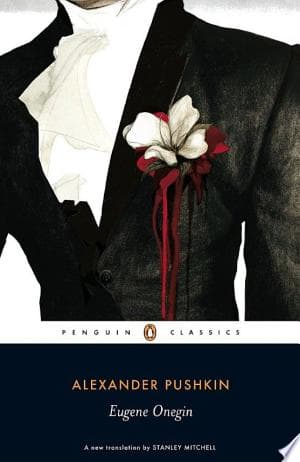
Alexander Pushkin (2008)
Genre
Romance
Reading Time
360 min
Key Themes
See below
Sign in to track this book
In 1820s Russia, a jaded dandy's rejection of love sets off a chain of tragic duels, unrequited passions, and societal disillusionment, all woven into a satirical verse novel.
Eugene Onegin, a wealthy young nobleman from St. Petersburg, leads a life of social events, balls, and theater. He quickly grows bored and cynical with how superficial it all is. When he inherits his dying uncle's estate in the countryside, he moves there, hoping for a quieter, more meaningful life. However, country life soon becomes equally boring. He tries to modernize the estate and help his serfs but soon gives up. He prefers to spend his days doing nothing, reading, and occasionally visiting neighbors. His reputation as an unusual and distant person quickly spreads among the local gentry.
Onegin's neighbor, Vladimir Lensky, a young, romantic poet recently returned from Germany, becomes his only friend. Lensky is in love with Olga Larin, the younger, cheerful, and traditional daughter of a local landowner. Through Lensky, Onegin meets the Larin family, including Olga and her older sister, Tatyana. Tatyana is a quiet, bookish, and thoughtful young woman. She is a dreamer who finds comfort in French novels and feels out of place in her country surroundings. Olga is a typical country beauty. Tatyana's unique, sad charm goes unnoticed by most, but she is immediately drawn to Onegin.
Inspired by the romantic heroes in her novels, Tatyana falls in love with Onegin. She sees him as the ideal man. Overwhelmed by her feelings, and against the customs of the time, she writes him a heartfelt, passionate letter. She confesses her love and vulnerability. Onegin, though somewhat touched by her honesty, is too jaded and self-absorbed to return such genuine affection. He meets her in the garden and gives a polite but firm speech. He explains that he is not suited for marriage and would only make her unhappy. He advises her to be more careful with her feelings, leaving Tatyana heartbroken and humiliated.
Months later, at Tatyana's name-day celebration, Onegin is bored and slightly annoyed by Lensky's constant efforts to get him to social events. He decides to subtly provoke his friend. He flirts openly and often with Olga, dancing with her repeatedly and ignoring Lensky. Lensky, a man of strong passion and romantic ideals, is overcome by jealousy and feels deeply betrayed by Onegin's actions. Humiliated and angry, Lensky confronts Onegin. In a fit of pride and youthful passion, he challenges him to a duel. He believes his honor has been permanently stained. Onegin, though he regrets his careless behavior, feels forced by social rules to accept.
Despite his inner doubts and knowing how foolish the situation is, Onegin feels trapped by societal expectations and cannot back down from the duel. The morning of the duel is cold and serious. Both men arrive with their seconds. Zaretsky, a former duelist, is Lensky's second. Onegin, unable to find a suitable second quickly, brings his valet, Guillot. This is a breach of etiquette. The duel happens. Onegin, with a steady hand, fires first. Lensky falls, fatally wounded. Onegin is horrified and immediately regrets his actions, but it is too late. Lensky dies, a promising young life ended by a senseless act of pride and social custom.
Lensky's death deeply affects Onegin, making him feel great despair and guilt. Unable to bear his actions and the country gossip, he decides to leave his estate and travel extensively. He wants to escape his past and find some meaning in his life. Meanwhile, Tatyana, still longing for Onegin and struggling with her unrequited love, visits his now-empty house. She walks through his rooms, looking at his books, personal items, and his notes. She hopes to understand the mysterious man who rejected her. This experience gives her new insights into his character, showing his complexities and perhaps his superficiality.
After Lensky's death and Onegin's departure, Tatyana continues to live a quiet life. But her family, worried about her future and her lack of eligible men, decides to take her to Moscow. There, she is introduced to high society. She is uncomfortable and out of place at first, but her quiet dignity, intelligence, and unique charm eventually get attention. She meets a respected and wealthy general, a kind and honorable man. Though not in love, she accepts his marriage proposal, doing her duty and securing her social standing. She changes from a shy country girl into an elegant and respected society lady, a princess.
After several years of restless travel, Onegin returns to St. Petersburg. He still suffers from his constant boredom and disappointment. He attends a grand ball and is surprised to see Tatyana, now a magnificent and dignified princess, the wife of a respected general. He barely recognizes her, so complete is her change. She moves with quiet authority and grace, earning respect and admiration. Onegin, who once dismissed her as an unsophisticated country girl, is now taken with her beauty, composure, and the air of inaccessible dignity she has. He finds himself drawn to her, feeling a strange mix of regret and new interest.
Struck by Tatyana's change and filled with a late, passionate love, Onegin begins to pursue her. He goes to every social event she does, tries to catch her eye, and eventually, like she did for him, writes her a series of fervent love letters. In these letters, he confesses his deep regret for his past coldness and declares his strong affection for her, expressing his pain and longing. Tatyana, however, remains outwardly calm and distant. She never acknowledges his advances or answers his letters, keeping her dignified appearance in society. This only increases Onegin's desire and frustration.
Unable to bear her silence any longer, Onegin forces a confrontation with Tatyana in her home. He finds her reading his letters, visibly upset but composed. She admits that she still loves him. She acknowledges that her feelings for him never truly went away. However, she firmly states that she will remain faithful to her husband, an honorable man to whom she has made her vows. She criticizes Onegin for his past blindness and for only seeing her worth after she became unavailable. With dignity and resolve, she tells him goodbye, leaving Onegin alone and defeated. He finally understands the true cost of his youthful cynicism and pride.
The Protagonist
From a cynical, self-absorbed dandy to a man consumed by regret and belated passion, ultimately left alone with his unrequited love.
The Protagonist
Transforms from an innocent, romantic girl into a dignified, principled woman who finds strength in her convictions, even as she denies her heart's desire.
The Supporting
A passionate, idealistic poet whose life is tragically cut short by a duel stemming from his own romantic pride and Onegin's thoughtlessness.
The Supporting
Remains largely static, a representative of conventional beauty and emotional adaptability, quickly recovering from tragedy.
The Supporting
Remains largely static, serving as Tatyana's steadfast and honorable husband.
The Supporting
Remains largely static, representing the societal expectations and norms of the provincial gentry.
The Supporting
Remains largely static, a facilitator of the tragic duel, representing rigid adherence to social codes.
The Supporting
A consistent, self-aware presence whose evolving relationship with his characters and his own creative process is part of the narrative.
The theme of ennui, a deep sense of boredom, is central to Eugene Onegin's character. His jaded outlook comes from a life of superficial pleasures in St. Petersburg. This leaves him unable to feel genuine emotion or find meaning. This disappointment causes him to reject Tatyana's sincere love and to act carelessly, which leads to Lensky's death. Even after years of travel, he returns still affected by this emptiness, showing how destructive unchecked cynicism can be and the search for purpose.
“But even passion's fitful rage / Could not withstand his tedious age.”
The novel explores different kinds of love: Tatyana's romantic, novel-inspired idealism; Lensky's passionate, poetic devotion; and Onegin's early cynicism followed by late, desperate infatuation. Tatyana's early love, though pure, is rejected by Onegin's jaded view. Lensky's idealized love for Olga and friendship with Onegin lead to tragedy when faced with reality. Tatyana chooses duty and honor over renewed passion, showing the conflict between romantic ideals and the realities of social obligations and personal growth.
“How many times I've heard the sigh / 'Alas, my heart will break and die!' / But no, it beats, and beats again...”
The strict societal rules and codes of honor are important, especially in the tragic duel. Onegin's flirtation with Olga, perhaps lighthearted, is seen by Lensky as a serious insult that requires a challenge. Both men, despite their personal doubts, feel forced by society's expectations to go through with the duel, which leads to Lensky's death. Tatyana's decision to stay faithful to her husband, despite her lingering love for Onegin, also shows the strong influence of social duty and marriage vows. It demonstrates how personal desires are often limited by outside pressures.
“He knew no fear, but felt the sting / Of silly gossip's venomous sting.”
The novel contrasts the traditional country life of the Larin family with the sophisticated, cynical city life Onegin represents. The countryside is shown as having simple charm but also stifling boredom, where rumors spread quickly and social rules are strictly followed. St. Petersburg offers intellectual stimulation but also superficiality and moral decay. Tatyana's journey from the countryside to Moscow, where she becomes an elegant society lady, shows how these different environments affect individual identity and values, though she never truly loses her country roots.
“The country! What can be more dull / Than country life, when one is full / Of wit and fashion's latest news?”
A novel-length work written entirely in verse, specifically using the 'Onegin Stanza'.
Pushkin's choice to write 'Eugene Onegin' as a verse novel, primarily in the unique 'Onegin Stanza' (fourteen lines of iambic tetrameter with a specific rhyme scheme: AbAbCCddEffEgg), is a central plot device. This form allows for a lyrical, poetic narrative that combines the scope of a novel with the intensity and musicality of poetry. It enables the narrator's frequent digressions, philosophical musings, and satirical observations, making the narrative voice a character in itself and adding layers of irony and emotional depth to the plot.
Frequent breaks in the narrative where the omniscient narrator addresses the reader, comments on the story, or shares personal anecdotes.
The Narrator is a distinct, self-aware character who frequently interrupts the plot to offer personal opinions, philosophical reflections, literary criticism, and autobiographical details. This meta-commentary creates a conversational tone, inviting the reader into a dialogue with the authorial voice. It allows Pushkin to explore various themes, satirize society, and even comment on the process of writing the novel itself. This device prevents the story from becoming overly sentimental and adds intellectual depth and ironic distance, shaping the reader's perception of the characters and events.
References to and playful imitation of contemporary literary trends, especially Romanticism.
Pushkin extensively uses literary allusions and parody, particularly targeting Romantic literature that was popular in his time. Tatyana's character is heavily influenced by the heroines of her French novels, leading her to idealize Onegin and write her passionate letter. Lensky embodies the archetypal Romantic poet, complete with melancholy and dramatic declarations. Onegin himself is a parody of the Byronic hero. These allusions serve to critique the excesses of Romanticism while also highlighting the innocence and naivety of characters who live by such literary ideals, often with tragic consequences when confronted with reality.
Tatyana's letter to Onegin and Onegin's later letters to Tatyana highlight crucial moments of miscommunication and missed chances.
The exchange of letters between Tatyana and Onegin serves as a pivotal plot device, marking moments of profound emotional significance and missed opportunities. Tatyana's heartfelt letter, an act of unprecedented courage for a young woman of her time, is met with Onegin's cold, didactic rejection, signifying his emotional immaturity. Years later, Onegin's desperate letters to Tatyana, born of his belated passion, mirror her earlier vulnerability but are now met with her dignified silence, demonstrating the irreversible consequences of his past actions and the tragic irony of their reversed positions. These letters underscore the theme of love's timing and the weight of past decisions.
“The less we love a woman, the easier 'tis to be liked by her.”
— Onegin's cynical advice to Lensky about love and relationships.
“I've lived to bury my desires, and see my dreams corrode with rust; now all that's left are fruitless fires that burn my empty heart to dust.”
— Onegin reflecting on his disillusionment and ennui.
“But I am not made for bliss; my soul is alien to its happiness.”
— Onegin rejecting Tatyana's love confession.
“Habit is given to us from above; it is a substitute for happiness.”
— Narrator's philosophical reflection on human nature.
“Love passed, the muse appeared, the weather of mind got clarity newfound; now free, I once more weave together emotion, thought, and magic sound.”
— Pushkin commenting on his creative process after a love affair ended.
“Thus young Tatyana loved with passion, and gave herself to love's sweet pain.”
— Description of Tatyana's deep and sincere feelings for Onegin.
“Who lived and thought can't help despising the people round him; who has felt is haunted ever by the ghost of days that could have been but weren't.”
— Onegin's bitter reflection on his wasted life and opportunities.
“The heart's a fickle thing, my friend, and love's a plant we can't command.”
— Narrator's observation on the unpredictability of love.
“I write for my own satisfaction; what care I for the public's praise or censure?”
— Pushkin asserting his artistic independence.
“Alas! The credulous are blind; but love, the young, the fair, the kind, to flattering hope their hearts resign.”
— Narrator lamenting how youth and beauty are often deceived by false hopes in love.
“We all aspire to be Napoleons; millions of two-legged creatures are for us but tools.”
— Onegin's cynical view of humanity and ambition.
“And happiness was so possible, so close!”
— Tatyana's regretful reflection on her lost chance with Onegin.
“The soul has its own hunger, and the mind its thirst.”
— Narrator's philosophical musing on human desires.
“Farewell, my friends! Farewell, dear shores! I shall remember you.”
— Lensky's melancholic farewell before his duel with Onegin.
Ready to see how well you understood this book? Take our interactive quiz with 10 questions.

Alexander Sergeyevich Pushkin was a Russian poet, playwright, and novelist of the Romantic era. He is considered by many to be the greatest Russian poet and the founder of modern Russian literature.