“Soldiering, my dear madam, is the coward's art of attacking mercilessly when you are strong, and keeping out of harm's way when you are weak.”
— Bluntschli's cynical view of war to Catherine.

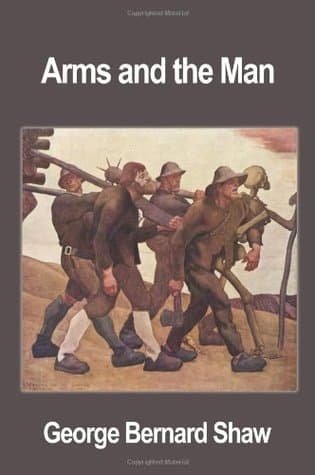
George Bernard Shaw (1898)
Genre
Romance
Reading Time
90 min
Key Themes
See below
Sign in to track this book
A pragmatic soldier, who prefers chocolate to glory, challenges a young woman's romantic ideas about love and war during the 1885 Serbo-Bulgarian War.
The play starts in October 1885, in the bedroom of Raina Petkoff, a young, romantic Bulgarian woman from a wealthy family. She loves Major Sergius Saranoff, a heroic officer in the Bulgarian army, who has just led a seemingly impossible cavalry charge against the Serbs. Raina learns of Sergius's victory and is happy, seeing him as a perfect hero. Suddenly, a disheveled Serbian mercenary, Captain Bluntschli, enters her window, looking for safety from Bulgarian soldiers. He is tired, hungry, and carries no ammunition, only chocolates, leading Raina to first think he is a coward. Despite her initial dislike, Raina, moved by his weakness and a bit of rebellious pity, hides him from the soldiers.
Raina, with help from her maid Louka, successfully hides Bluntschli from the Bulgarian officers searching her house. During their talk, Bluntschli breaks Raina's romantic ideas about war. He says Sergius's cavalry charge was a foolish, lucky mistake, explaining that Sergius's men won only because the Serbs had the wrong ammunition. Bluntschli says he prefers carrying chocolates over cartridges, earning him the nickname 'chocolate cream soldier' from Raina. She is shocked and interested by his cynical, practical view, which differs greatly from her own idealistic one. Despite her moral conflict, she feels a strange pull to his honesty and directness, finding herself drawn to his unheroic yet logical manner.
As morning nears, Bluntschli is still hiding in Raina's room, weak from exhaustion and hunger. Raina's mother, Catherine Petkoff, enters the room and finds Bluntschli. Initially shocked and worried about scandal, Catherine is convinced by Raina to help the soldier escape. They decide to disguise him and let him leave, but not before Raina, in a moment of tender impulse, gives him her father's old coat to wear. Inside the coat, unknown to them, is a photograph of Raina with an inscription. Bluntschli, still practical, notes the Petkoff's address, promising to return the coat and settle things after the war. He then escapes, leaving Raina with a sense of intrigue and a challenge to her ingrained romantic ideals.
Two weeks later, Major Petkoff, Raina's father, and Sergius Saranoff return home after a peace treaty is signed. Petkoff is a cheerful, somewhat naive man, proud of his military service. Sergius, still the dashing hero to Raina, is also shown as a man of dramatic gestures and high ideals, though he struggles with the realities of military life. He resigns his commission, finding the army too crude for his noble spirit. The household is busy preparing for Sergius and Raina's wedding. However, tensions exist: Sergius flirts openly with Louka, the maid, while Raina feels strangely disappointed by Sergius's dramatic behavior, comparing him unfavorably to the 'chocolate cream soldier' she harbored.
Major Petkoff is upset by the disappearance of his old coat, a comfortable garment he likes. He complains about it to Catherine and Raina. Meanwhile, Louka, who secretly dislikes Raina and Sergius, overhears conversations and starts to figure out the truth about Bluntschli's escape. She subtly provokes Sergius, hinting at Raina's secret. Bluntschli, true to his word, returns to the Petkoff house to give back the coat. His arrival causes immediate confusion. While discussing the coat, the photograph of Raina, which she had placed in the pocket, falls out, revealing her secret to Sergius and Major Petkoff. The inscription, 'To my chocolate cream soldier,' further complicates things, raising questions about Raina's loyalty.
The discovery of the photograph and Bluntschli's presence in Raina's room leads to confessions and arguments. Raina must admit she harbored Bluntschli, though she tries to say it was an act of pity. Sergius, angry at the apparent betrayal, challenges Bluntschli to a duel, but Bluntschli, always practical, refuses, seeing it as foolish. The situation gets more complicated when Louka, seeing her chance, reveals Sergius's flirting with her. This starts a furious argument between Sergius and Raina, showing the flaws in their idealized romance. The drama builds as the characters' carefully built images start to fall apart under the truth.
Louka, intelligent and ambitious, skillfully manipulates Sergius. She expresses her dislike for the social classes and her wish to rise above her position. She makes Sergius jealous by implying she has a suitor, and then skillfully gets him to propose marriage to her. Sergius, caught in a mix of emotions and an unexpected attraction to Louka's strong will, agrees to marry her, surprising everyone, especially Nicola, the sensible and loyal servant who also liked Louka. This sudden engagement further upsets the established order and exposes the hypocrisy of the aristocratic characters.
Amidst the chaos, Bluntschli reveals that he is not just a mercenary but a wealthy Swiss hotelier, having inherited a chain of hotels after his father's recent death. His practical nature and business skill are clear as he efficiently sorts out the Petkoff's messy military supply accounts. He then, with his usual directness, proposes marriage to Raina. He lists her good qualities and admits his affection, contrasting sharply with Sergius's romantic but often empty gestures. Raina, initially hesitant because Bluntschli lacks traditional heroic charm, is ultimately drawn to his honesty, intelligence, and practical kindness, realizing she prefers his down-to-earth nature to Sergius's showiness.
With Bluntschli's true wealth and social standing revealed, the Petkoffs, initially shocked by his proposal to Raina, quickly agree to the match. Major Petkoff is especially impressed by Bluntschli's business skill. Sergius and Louka's engagement is also confirmed, despite the social difference. The play ends with a complete change in romantic alliances and social expectations. Raina, giving up her romantic illusions, chooses the practical and honest Bluntschli, while Sergius, embracing a different kind of passion, chooses the ambitious and spirited Louka. The play concludes with ironic satisfaction, as the characters find their true partners, though not in the way society first expected.
The Protagonist
Raina transforms from a naive romantic into a more pragmatic and self-aware woman, choosing realistic affection over idealized heroism.
The Protagonist
Bluntschli remains consistent in his pragmatic nature, serving as a catalyst for others' development and ultimately finding love through his authentic self.
The Antagonist/Supporting
Sergius moves from a life of performative heroism and 'higher love' to accepting a more grounded, passionate relationship with Louka, acknowledging his own inconsistencies.
The Supporting
Louka successfully manipulates her way out of servitude and into a marriage with Sergius, achieving her desired social advancement.
The Supporting
Major Petkoff remains largely static, representing the conventional patriarchal figure who ultimately accepts the new order for practical reasons.
The Supporting
Catherine learns to adapt her social ambitions to the pragmatic realities of the new romantic pairings.
The Supporting
Nicola, though initially jilted by Louka, maintains his pragmatic outlook and continues on his path to financial independence.
Shaw carefully questions the romantic ideas of love and war common in 19th-century society. Raina's initial love for Sergius as a 'hero' and her big statements about 'higher love' are repeatedly undermined by Bluntschli's practical realism and Sergius's own inconsistent behavior, such as flirting with Louka. The play suggests that such idealism often hides vanity, self-deception, and a refusal to see the messy realities of human nature. The 'heroic' cavalry charge is shown to be a lucky mistake, and 'noble' love as just posing.
“''Oh, you are a chocolate cream soldier, a great baby!''”
This theme is central to the play, mainly shown by the contrast between Raina and Sergius's idealism and Bluntschli's pragmatism. Bluntschli consistently brings a dose of reality to every situation, whether it's about the practicalities of war, like carrying chocolates instead of cartridges, or the nature of human relationships. His directness and honesty, which Raina initially sees as unromantic, eventually win her over. The play ultimately supports a practical approach to life, suggesting that real happiness and success come from facing reality rather than escaping into fantasy.
“''I am a professional soldier. I fight when I am paid to, and I stop when I am not.''”
The play subtly explores the strict social classes of the time and the ambitions of those who want to move up. Louka, the maid, is a prime example. She dislikes her subservient position and skillfully manipulates Sergius to get a marriage that raises her status. Nicola, while loyal, also wants to open his own shop. Shaw questions the inherent superiority of the aristocracy, showing characters like Sergius and the Petkoffs as often foolish or hypocritical, while 'lower' class characters like Louka and Nicola show intelligence and drive.
“''I am a servant; but I can be a lady when I choose.''”
Shaw challenges traditional romantic ideas by showing a more realistic view of love. Raina's initial 'love' for Sergius is based on an idealized image rather than true understanding. Her attraction to Bluntschli, on the other hand, grows from their intellectual talks and his honest, unpretentious nature. The play suggests that true love is built on compatibility, mutual respect, and accepting each other's flaws, rather than on grand declarations or heroic posing. Sergius and Louka's relationship, though born from manipulation, also suggests a more passionate, if unstable, connection based on their shared strong wills.
“''You are a creature of the higher love. Well, of course, you know, I'm only a professional soldier. I am not a man for the higher love.''”
The audience knows more than the characters, creating humorous and critical insights.
Shaw frequently employs dramatic irony to highlight the characters' self-deception and the absurdity of their romanticized ideals. For instance, the audience knows Bluntschli is hiding in Raina's room while the Petkoffs search for him, creating tension and humor. The audience also understands Bluntschli's pragmatic view of Sergius's 'heroic' charge long before Raina does, making her pronouncements about heroism seem foolish. This device allows Shaw to subtly critique societal norms and character flaws without explicit authorial commentary.
A seemingly trivial object that serves as a catalyst for plot development and revelation.
Major Petkoff's old coat, given to Bluntschli by Raina, acts as a crucial plot device. Its disappearance and subsequent return drive much of the second act's action. More importantly, it contains Raina's inscribed photograph, which serves as the physical evidence that exposes her secret to Sergius and Major Petkoff. This seemingly mundane item becomes a symbol of the secrets and hidden truths that unravel the characters' carefully constructed facades, forcing confrontations and revelations that propel the plot towards its resolution.
A symbolic moniker that encapsulates the clash between idealism and realism.
Raina's initial sarcastic nickname for Bluntschli, the 'chocolate cream soldier,' becomes a recurring motif and a powerful symbol. It represents his non-heroic, pragmatic approach to war (preferring food to ammunition) and directly challenges Raina's romanticized image of soldiers. As the play progresses, the nickname evolves from an insult to a term of endearment, signifying Raina's shift from idealizing traditional heroism to appreciating Bluntschli's honest, practical nature. It embodies the play's central theme of disillusionment with romantic ideals.
Louka and Nicola serve as a grounded, critical perspective on the aristocratic characters.
The characters of Louka and Nicola, the Petkoff's servants, act as a kind of Greek chorus or a more grounded, critical lens through which to view the upper-class characters. They are privy to intimate conversations and observe the hypocrisy and follies of their employers with a detached, often cynical, understanding. Their directness and ambition, particularly Louka's, contrast sharply with the aristocratic pretensions, serving to highlight the artificiality of the Petkoffs' world and providing a realistic counterpoint to the romantic ideals being satirized.
“Soldiering, my dear madam, is the coward's art of attacking mercilessly when you are strong, and keeping out of harm's way when you are weak.”
— Bluntschli's cynical view of war to Catherine.
“Oh, you are a very splendid hero, aren't you?”
— Raina's sarcastic remark to Sergius.
“My rank is my bread and butter. But I am a professional soldier. I fight for money. I am a Swiss.”
— Bluntschli's pragmatic explanation of his profession.
“The world is a base, sordid, money-grubbing, low-minded, dog-eat-dog, devil-take-the-hindmost kind of a place.”
— Sergius's disillusioned view of the world.
“You never saw a soldier that was good for anything except killing, did you?”
— Bluntschli challenging Raina's romanticized view of soldiers.
“I am an old soldier. I am accustomed to tell women I love them.”
— Bluntschli's casual honesty about his past with women.
“I'm not a man, I'm a machine. I'm a machine for fighting.”
— Sergius describing his military persona.
“It's a pleasure, my dear, to be able to talk to a woman who understands a joke.”
— Bluntschli appreciating Raina's wit.
“I am a hero! I am a Bulgarian officer!”
— Sergius trying to assert his identity and status.
“It is a most unnecessary and uncomfortable thing to be a hero.”
— Bluntschli's pragmatic dismissal of heroism.
“You are a romantic idiot, Sergius. A romantic idiot!”
— Louka's blunt assessment of Sergius.
“I will never marry a man who is not a hero.”
— Raina's initial declaration about her romantic ideals.
“Which of us is the more real, I wonder? You, with your visions of a 'chocolate cream soldier,' or I, with my practical common sense?”
— Bluntschli questioning Raina's romantic illusions.
“He is a man, and I am a woman. That is the beginning and the end of it.”
— Louka's simple yet profound statement about attraction.
Ready to see how well you understood this book? Take our interactive quiz with 10 questions.
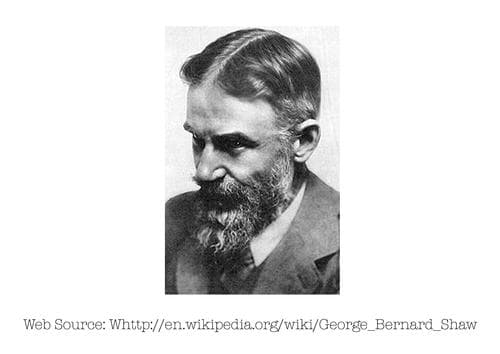
George Bernard Shaw, known at his insistence as Bernard Shaw, was an Irish playwright, critic, polemicist and political activist. His influence on Western theatre, culture and politics extended from the 1880s to his death and beyond. He wrote more than sixty plays, including major works such as Man and Superman (1902), Pygmalion (1913) and Saint Joan (1923). With a range incorporating both contemporary satire and historical allegory, Shaw became the leading dramatist of his generation, and in 1925 was awarded the Nobel Prize in Literature.