“He was born of the earth and the wind, of the sun and the rain, of the sea and the sky. He was the son of California.”
— Describing Diego's origin and his deep connection to his homeland.

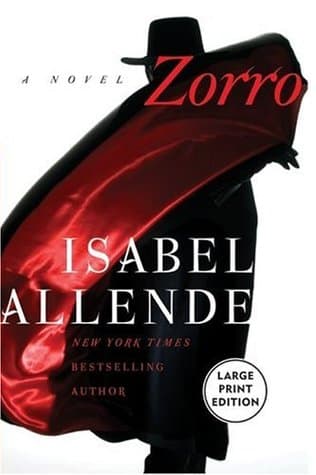
Isabel Allende (2005)
Genre
Historical Fiction / Romance
Reading Time
1130 min
Key Themes
See below
Sign in to track this book
From colonial California's haciendas to Spain's Napoleonic resistance, a young mestizo nobleman creates the masked Zorro, fighting injustice with a flash of steel and a defiant laugh.
Diego de la Vega is born in Alta California in 1795, the son of wealthy Spanish landowner Alejandro de la Vega and Toypurnia, a Shoshone warrior woman who becomes Regina, a Christianized native. He spends his childhood between his father's hacienda, where he learns fencing and horsemanship, and his mother's Shoshone ranchería, where his grandmother, White Owl, teaches him their customs, spiritual beliefs, and stealth. This upbringing gives him a deep respect for both cultures and an awareness of the injustices the indigenous people face under Spanish rule. He forms close bonds with his foster sister, Isabel, and his loyal servant, Bernardo, a mute boy who becomes his confidant.
At sixteen, Diego is sent to Barcelona, Spain, with Bernardo, to finish his education. The ocean journey is dangerous. Pirates, led by the Frenchman Captain Salomon, attack their ship. During the fight, Diego and Bernardo show their growing skills, fighting to defend the passengers. This experience is a turning point, as Diego sees his potential to protect the innocent. In Spain, he enrolls in a prestigious academy, but his restless spirit and growing sense of justice lead him to seek adventure outside the classroom, often clashing with the rigid social structures and corrupt authorities.
In Spain, Diego and Bernardo meet a group of Romani (gypsies) led by the charismatic Ana de la Madrid, also known as La Tala. With her and her skilled associate, the swordsman Captain Moncada, Diego improves his fencing, learns acrobatics, disguise, and misdirection. He also joins La Justicia, a secret underground resistance group protecting the poor and fighting against the oppressive Napoleonic occupation and corrupt Spanish officials. During this time, the idea of a masked vigilante begins to form in Diego's mind, a persona that can act where Diego de la Vega cannot.
Inspired by the injustices he sees and the teachings of La Justicia, Diego de la Vega fully embraces his alter ego: Zorro. He creates a distinctive costume, including a black mask, cape, and a rapier, and begins to perform daring acts of defiance against the corrupt Spanish authorities and French occupiers. His actions quickly become legendary among the common people, who see him as a symbol of hope and resistance. Bernardo, with his keen observation skills and loyalty, becomes Zorro's essential assistant, often acting as his eyes and ears, and sometimes a decoy, allowing Zorro to operate more effectively and secretly.
While operating as Zorro, Diego often meets Juliana de Romeu, a beautiful and spirited young woman from an aristocratic family. Juliana is independent and has a strong sense of justice, often disagreeing with society's expectations for her. She is captivated by the mysterious Zorro, drawn to his bravery and noble cause. Their encounters include playful banter and growing mutual admiration, though Juliana does not know Zorro's true identity as Diego de la Vega. Their dynamic adds a romantic and intriguing layer to Zorro's adventures, as he manages his personal feelings alongside his mission.
After years of fighting for justice in Spain, Diego de la Vega, with Bernardo and a small group of Romani allies, decides to return to Alta California. He wants to protect his homeland and the people he left behind. However, upon his arrival, he finds things have changed greatly. The region is under the tyrannical rule of Captain Rafael Moncada, a ruthless military officer who has taken power and is exploiting both the indigenous population and the Spanish settlers. Moncada's cruelty and corruption immediately make Diego determined to continue his fight as Zorro, but this time on familiar ground.
Diego returns to his family hacienda, which has fallen into disrepair under Moncada's oppressive rule. He pretends to be a foppish, seemingly uninterested gentleman, a stark contrast to his masked alter ego, Zorro. This disguise allows him to move freely and gather information while keeping his secret identity. From the hacienda, with Bernardo's help and his Romani companions, Zorro begins his campaign against Captain Moncada. He carries out daring raids, frees oppressed workers, and disrupts Moncada's plans, leaving his iconic 'Z' mark as a symbol of hope and a warning to his enemies.
The conflict between Zorro and Captain Moncada grows, becoming a personal vendetta. Moncada, obsessed with capturing Zorro, uses increasingly brutal tactics, endangering Diego's family and friends. Diego also faces challenges in his personal life, especially concerning his feelings for Juliana de Romeu, who has also returned to California. She is initially drawn to Diego's charm but remains fascinated by the elusive Zorro. Diego must manage the complexities of his dual identity, protecting those he loves while keeping his alter ego secret, even as Moncada closes in and the stakes rise for California's future.
As Moncada's tyranny peaks, Zorro realizes he cannot defeat him alone. He begins to inspire the local people, especially the indigenous and disenfranchised settlers, to rise up and reclaim their freedom. He plans events to expose Moncada's corruption and rally support for a coordinated resistance. The story builds to a confrontation where Zorro, with his allies and the newly brave community, makes a final stand against Captain Moncada. This struggle determines not only the fate of Diego's hacienda but the future of justice and liberty in Alta California.
In a thrilling climax, Zorro confronts Captain Moncada in a final duel. Using his superior swordsmanship, agility, and cunning, Zorro defeats Moncada, ending his tyrannical rule. Justice returns to Alta California, and the people are freed from oppression. While Diego de la Vega's identity largely remains a secret, the legend of Zorro is firmly established, becoming a symbol of hope for the downtrodden. Diego, having finished his mission, continues to embody the spirit of Zorro, ensuring justice prevails, and his adventures continue, cementing his place as an enduring hero in California's history.
The Protagonist
Diego transforms from a privileged but empathetic youth into a legendary masked hero, learning to balance his personal desires with his commitment to justice.
The Supporting
Bernardo develops from a traumatized child into Zorro's indispensable and courageous partner, finding his voice through action.
The Antagonist
Moncada rises to power through corruption and cruelty, only to be ultimately defeated and exposed by Zorro.
The Supporting
Juliana matures from a somewhat sheltered aristocrat into a woman who actively seeks justice and finds her voice, eventually recognizing the true hero.
The Supporting
Alejandro learns to reconcile his traditional values with the need for radical change, eventually understanding the necessity of Zorro's actions.
The Supporting
Toypurnia navigates the complexities of her dual identity as a Shoshone warrior and a Spanish wife, embodying strength and wisdom.
The Supporting
La Tala guides Diego's transformation into Zorro, ensuring he possesses both the skills and the moral compass for his mission.
The Supporting
White Owl serves as a consistent source of ancient wisdom and spiritual guidance, reinforcing Diego's connection to his Shoshone roots.
The Supporting
Isabel grows up within the de la Vega family, representing the domestic and familial aspects of Diego's life.
The main theme of 'Zorro' is the fight against injustice and social inequality. Diego de la Vega, as Zorro, champions the poor, the oppressed, and indigenous people against corrupt authorities, whether Spanish officials in California or Napoleonic forces in Spain. The story shows vast power imbalances and the exploitation of the vulnerable. Zorro's actions, from freeing prisoners to reclaiming stolen land, directly address these inequalities, showing that true justice often means defying corrupt systems. For example, his early experiences seeing the mistreatment of the Shoshone people greatly influence his later commitment.
“For the weak, the oppressed, the disenfranchised, Zorro was a whisper of hope, a flash of steel, a promise of retribution.”
The novel explores identity through Diego de la Vega's dual heritage and his creation of the Zorro persona. Diego is a 'child of two worlds,' balancing his Spanish aristocratic upbringing with his Shoshone roots. This internal duality shows in his alter ego: the foppish, seemingly indifferent gentleman Diego and the fearless, masked avenger Zorro. This theme looks at how heritage, circumstance, and choice shape identity, and how a hidden identity can be a powerful tool for change. His ability to move between these two roles allows him to gather information and act effectively.
“He was Diego, the elegant and indolent hidalgo, and he was Zorro, the vengeful spirit of justice, two halves of a single soul.”
The creation and lasting power of Zorro as a legend and a symbol is a central theme. Zorro is more than just a man; he becomes a myth, a symbol of hope for the common people, and a terrifying figure for his enemies. His iconic 'Z' mark, masked face, and daring actions are carefully made to inspire and instill fear. The novel shows how a symbol can unite people, fuel resistance, and go beyond individual actions, becoming a force greater than any single person. The widespread belief in Zorro gives him power even when he is not physically present.
“The legend was not merely a story; it was a weapon, a shield, and a banner under which the oppressed could rally.”
Love, in its various forms, and loyalty are important themes. The deep bond between Diego and Bernardo, formed in childhood and tested through adventures, shows loyalty. Bernardo's silent devotion and help are vital to Zorro's success. Romantic love appears through Diego's attraction to Juliana de Romeu, complicated by his dual identity. Also, familial love, between Diego and his parents, and his connection to his Shoshone heritage, underlies his motivations and values. These relationships add emotional depth and drive many of the characters' actions and sacrifices.
“His loyalty was a silent, unyielding force, a shadow that moved with his master, protecting him without question or reward.”
The novel examines the impact of Spanish colonialism on Alta California and its indigenous populations. It shows the exploitation of resources, the imposition of foreign rule, and the systematic oppression of native peoples. Zorro's fight is fundamentally a resistance against this colonial structure and its inherent injustices. The theme highlights the clash of cultures, the resilience of the colonized, and the struggle for self-determination. Diego's mixed heritage uniquely positions him to understand and fight the abuses of the colonial system, making his fight a nuanced act of resistance.
“The land groaned under the weight of foreign boots, but its spirit, like the wild mustang, could not be broken.”
Zorro's disguise allows him to operate outside the law and inspire hope.
The masked identity of Zorro is the central plot device. It allows Diego de la Vega to shed the constraints of his aristocratic persona and act as a vigilante. The mask provides anonymity, protecting his family and allowing him to move freely between social classes. More importantly, it transforms him into a symbol, making him larger than life and instilling both fear in his enemies and hope in the oppressed. This duality of identity is crucial for the plot's conflicts and the protagonist's personal journey, creating dramatic tension and opportunities for misdirection.
A hidden network that trains and supports Zorro's fight for justice.
La Justicia, the secret underground resistance movement in Spain, serves as a significant plot device. It provides Diego with training, resources, and a philosophical framework for his vigilante activities. This brotherhood connects him to a wider network of individuals fighting injustice, showing that his struggle is part of a larger, organized effort. It also introduces him to key mentors like La Tala and Captain Moncada (the Romani swordsman), who hone his skills and shape his understanding of social justice, preparing him for his return to California.
Zorro's rapier is both a weapon and a symbol of his skill and precision.
Zorro's rapier is more than just a weapon; it is an extension of his character and a key plot device. It symbolizes his skill, precision, and elegance in combat. The sword allows him to disarm opponents without necessarily killing them, reinforcing his moral code. Its use in carving the iconic 'Z' mark is a psychological tactic, a signature that strikes fear into his enemies and becomes a rallying symbol for the people. The mastery of the sword is a core aspect of his training and essential to his success in duels and skirmishes.
A characteristic that enables Bernardo to be Zorro's silent, indispensable partner.
Bernardo's muteness is a crucial plot device that enhances his role as Zorro's confidant and assistant. His inability to speak makes him seem innocuous and overlooked by enemies, allowing him to gather intelligence and move discreetly where others cannot. It also deepens his bond with Diego, as they communicate through a unique, non-verbal understanding. This characteristic makes Bernardo an invaluable spy and partner, able to witness and report on events without arousing suspicion, thus advancing the plot and often providing critical information to Zorro.
“He was born of the earth and the wind, of the sun and the rain, of the sea and the sky. He was the son of California.”
— Describing Diego's origin and his deep connection to his homeland.
“Justice, true justice, is not found in the law, but in the hearts of men.”
— Diego's developing philosophy on justice, going beyond mere legalities.
“A mask can hide a face, but it cannot hide a soul.”
— Reflecting on the nature of disguise and true character.
“Love is a battlefield, and sometimes the only way to win is to surrender.”
— Amidst the romantic entanglements and challenges faced by characters.
“The greatest freedom is to be yourself, without fear or apology.”
— Diego's journey to embracing his true self, both as Diego and Zorro.
“Revenge is a dish best served cold, but justice is a meal best served hot.”
— Contrasting the motivations for personal vengeance versus societal justice.
“Sometimes, the only way to find your path is to get lost.”
— Diego's experiences in Spain and away from California, which shape him.
“The world is full of shadows, but it is also full of light. It is up to us to choose which we will see.”
— A broader philosophical observation about perspective and outlook.
“A true hero does not seek glory, but justice for the voiceless.”
— Defining the essence of Zorro's heroism and his mission.
“Memory is a capricious thing; it can betray us, or it can save us.”
— Reflecting on the power and unreliability of memory in shaping narratives.
“Fear is a powerful weapon, but hope is even stronger.”
— The struggle against oppression and the resilience of the people.
“Every man has two lives, the one he lives and the one he imagines.”
— Exploring the internal world of Diego and the creation of Zorro.
“The future is not a gift, it is an achievement.”
— Encouraging active participation in shaping one's destiny and society.
“To be a hero, one must first be a human, with all the flaws and virtues that entails.”
— Highlighting the complexity of Diego's character, not just his heroic persona.
Ready to see how well you understood this book? Take our interactive quiz with 10 questions.
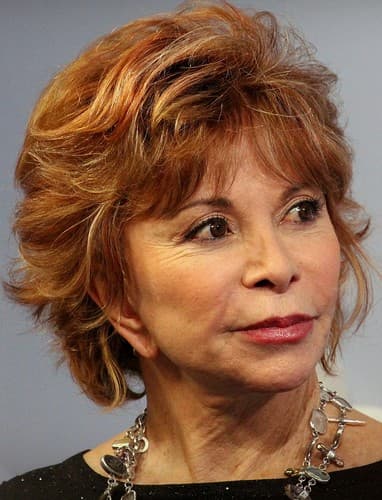
Isabel Angélica Allende Llona is a Chilean writer. Allende, whose works sometimes contain aspects of the genre magical realism, is known for novels such as The House of the Spirits and City of the Beasts, which have been commercially successful. Allende has been called "the world's most widely read Spanish-language author." In 2004, Allende was inducted into the American Academy of Arts and Letters, and in 2010, she received Chile's National Literature Prize. President Barack Obama awarded her the 2014 Presidential Medal of Freedom.







