“The wind was her father, the earth her mother, and the sky her brother.”
— Describing Zeely's connection to nature and her perceived lineage.

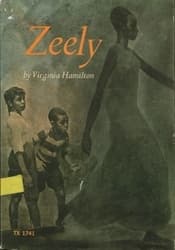
Virginia Hamilton (1967)
Genre
Children's / Historical Fiction / Young Adult
Reading Time
120 min
Key Themes
See below
Sign in to track this book
During a summer on her uncle's farm, a young girl finds an unforgettable friend in a regal, statuesque hog farmer who mirrors the image of an African queen.
Ten-year-old Geeder and her younger brother, Toeboy, are sent from their city home to spend the summer on their Uncle Miles's farm in the countryside. Geeder is initially bored and restless, finding the farm life slow and uneventful compared to the city. She wants adventure and a way to make the summer memorable. Toeboy, on the other hand, is more easily entertained by the simple pleasures of the farm, like exploring the woods and playing with the animals. Their arrival begins a summer that Geeder is determined will be extraordinary, even if she doesn't yet know how.
While exploring the farm's surroundings, Geeder and Toeboy find the neighboring property, where they see a strikingly tall, dark-skinned woman tending to her hogs. This woman is Zeely Tayber. Geeder is immediately captivated by Zeely's regal way of carrying herself, her immense height, and her unusual calmness. Zeely moves with a quiet dignity that sets her apart from anyone Geeder has ever met. The sight of Zeely, especially her physical resemblance to a Watutsi queen Geeder had once seen in a magazine, sparks Geeder's imagination and curiosity, hinting at the potential for the extraordinary summer she wants.
Inspired by Zeely's appearance and the lingering image of the Watutsi queen from the magazine, Geeder creates a vivid fantasy: Zeely Tayber is not just a hog farmer, but a real African queen who has come to live on the farm in disguise. She shares this elaborate story with Toeboy, who, despite his initial doubt, is gradually drawn into Geeder's imaginative world. Geeder's belief grows stronger with each observation of Zeely's graceful movements and serene manner, reinforcing her belief that Zeely possesses a hidden, royal identity. This fantasy becomes the main focus of Geeder's summer, changing the ordinary into something magical.
Driven by Geeder's belief that Zeely is a queen, the siblings begin to secretly watch Zeely's daily life. They watch her tending her hogs, moving with unusual grace and quiet efficiency. They notice her unique way of dressing, her dark skin, and her sharp, calm eyes. Geeder sees every action and detail as further proof of Zeely's royal lineage, weaving them into her elaborate story. Toeboy, while still grounded in reality, enjoys the game and the excitement of their secret missions. Their observations deepen Geeder's fascination with Zeely and fuel her imaginative storytelling.
After days of observation, Geeder and Toeboy finally gather the courage to approach Zeely directly. They introduce themselves, and Zeely, in turn, introduces herself and her hogs. Zeely is calm and welcoming, showing no surprise at their presence. Her voice is low and melodic, adding to her mystery for Geeder. This direct interaction, rather than stopping Geeder's fantasy, only strengthens her belief in Zeely's extraordinary nature. Zeely's gentle manner and the respect she shows to the children further endear her to Geeder, who sees it as another sign of her 'royal' character.
Geeder, fully in her fantasy, begins to share her story of Zeely the Watutsi queen with other children in the area. She tells detailed, exaggerated tales of Zeely's royal past and her present 'disguise' as a hog farmer. The local children, captivated by Geeder's vivid imagination and the appeal of such a grand secret, are drawn into the story. They start to look at Zeely with new eyes, some believing Geeder's stories, others simply enjoying the excitement of the shared secret. Geeder enjoys being the storyteller and the keeper of this extraordinary truth.
As Geeder's stories about the Watutsi queen spread, they eventually reach Zeely herself. Instead of being amused or angered, Zeely approaches Geeder with quiet seriousness. She explains that while she is indeed from a line of proud people, she is not a queen and that her family has been in America for generations. She gently corrects Geeder, stressing the importance of truth and respecting individual identity. This conversation is a key moment, as Zeely does not dismiss Geeder's imagination but subtly guides it towards a deeper understanding of self and heritage.
Zeely sits down with Geeder and shares parts of her family's history, revealing that her ancestors were indeed tall, proud people, but they were not 'Watutsi queens' in the way Geeder imagined. She explains that her unusual height and dignified bearing are simply part of who she is, a legacy passed down through her family. Zeely teaches Geeder about the strength and beauty of her own unique identity and the importance of being true to oneself. She explains that her composure comes from within, from knowing who she is and being at peace with it, not from a hidden royal title.
Through Zeely's gentle guidance and the revelation of her true story, Geeder begins to understand that Zeely's 'queenly' qualities come not from a fantastical royal lineage, but from her inherent dignity, self-possession, and quiet strength. Geeder realizes that Zeely's greatness is in her authenticity, her respect for herself and others, and her deep sense of identity. This realization shifts Geeder's perspective from external fantasy to internal truth, helping her to appreciate Zeely for who she truly is, rather than who Geeder imagined her to be. It is a moment of growth and maturity for Geeder.
Inspired by Zeely's example, Geeder begins to look inward and understand her own identity. She starts to appreciate her own unique qualities and the importance of being true to herself. The summer, which began with a search for adventure and an escape from her own perceived ordinariness, now becomes a journey of self-discovery. Geeder learns that she doesn't need to invent grand stories or pretend to be someone else to be special. She finds a new sense of confidence and belonging, realizing that her own identity, just like Zeely's, holds its own quiet power and beauty.
The remainder of Geeder's summer changes greatly. The initial boredom is replaced by a deeper appreciation for the farm, the people around her, and most importantly, herself. Her friendship with Zeely, now based on truth and mutual respect, becomes a main part of her experience. Geeder no longer needs to create elaborate fantasies to make her life interesting; she finds wonder in the real world and in the strength of her own character. The summer on Uncle Miles's farm, once dreaded, becomes a period of significant personal growth and a cherished memory.
The Protagonist
Geeder transforms from a child who seeks to escape her reality through elaborate fantasies into one who embraces her own identity and finds beauty and meaning in the truth.
The Supporting
Zeely remains steadfast in her identity throughout the story, serving as a catalyst for Geeder's growth rather than undergoing a personal transformation herself.
The Supporting
Toeboy's arc is less pronounced than Geeder's, primarily serving to support her journey and providing a relatable child's perspective.
The Supporting
Uncle Miles remains a consistent, benevolent background figure, representing stability and care.
The Mentioned
They serve as a sounding board for Geeder's stories, their belief (or lack thereof) influencing her sense of being a unique storyteller.
The central theme is Geeder's journey to understand who she is. Initially, she tries to define her summer and herself through an external, fantastical identity projected onto Zeely. She believes that for something to be special, it must be extraordinary or exotic. Through her interactions with Zeely, Geeder learns that true identity and worth come from within, from embracing one's unique heritage and personal qualities, rather than fabricating a grand narrative. Zeely's quiet self-possession teaches Geeder that authenticity is the deepest form of royalty. This is clear when Zeely gently corrects Geeder, explaining that her dignity comes from her family history and self-knowledge, not a hidden crown.
“You are yourself, and that is all you need to be.”
The novel explores the delicate balance between a child's imagination and the grounding force of reality. Geeder's summer is initially driven by her desire to escape the mundane through an elaborate fantasy about Zeely being a Watutsi queen. Her imagination allows her to transform the ordinary into the extraordinary, making her summer exciting. However, Zeely's gentle intervention teaches Geeder that while imagination is powerful, there is also great beauty and depth to be found in truth and reality. The story does not dismiss imagination but rather shows its proper place: as a tool for understanding and appreciating reality, not for escaping it. This is seen when Geeder realizes Zeely's true greatness is not in a fictional title but in her authentic self.
“It was as if she needed Zeely to be a queen, so she could be something special herself.”
The book celebrates the beauty found in individual uniqueness and quiet dignity. Zeely's striking appearance—her height, dark skin, and composed manner—sets her apart. Geeder initially sees these as signs of exotic royalty. However, the story ultimately reveals that Zeely's true beauty and 'queenliness' are in her steady self-possession, her deep connection to her heritage, and her inner peace. She shows a non-conformist kind of grace that doesn't need outside approval or a fantastical backstory. This theme encourages readers to appreciate differences and to find strength and beauty in being authentically oneself, regardless of societal norms or expectations, as Zeely does in her quiet life as a hog farmer.
“Zeely was beautiful. Not like anyone else. Just beautiful.”
The theme of heritage and ancestry is woven throughout the story, especially through Zeely's character. While Geeder imagines Zeely as a Watutsi queen, Zeely clarifies that her unique physical characteristics and proud bearing come from her own American family's long and dignified history. Zeely's explanation to Geeder about her ancestors being tall, strong, and proud people, who have been in America for generations, grounds her identity in a real, personal history rather than a fictional, exotic one. This theme highlights the importance of understanding and valuing one's true family roots and the quiet strength from that knowledge, suggesting that heritage offers a rich, personal 'royalty' that is more meaningful than any imagined crown.
“My people were always tall people. Always proud.”
An old magazine photograph that sparks Geeder's imagination.
The photograph of a Watutsi queen serves as a powerful catalyst for Geeder's initial fantasy about Zeely. It provides a visual template for Geeder's imagination, allowing her to project an exotic, royal identity onto Zeely based on a perceived resemblance. This device highlights Geeder's desire for the extraordinary and her tendency to romanticize. It is crucial in setting up the central conflict between Geeder's imagined world and Zeely's reality, ultimately leading to Geeder's deeper understanding of identity.
Geeder and Toeboy's clandestine watching of Zeely.
The children's secret observation of Zeely is a key plot device that fuels Geeder's fantasy and builds suspense. By watching Zeely from a distance, Geeder is able to interpret her actions and demeanor through the lens of her 'queen' narrative, reinforcing her belief without direct contradiction. This device allows Geeder's imagination to run wild, creating an idealized version of Zeely before the eventual confrontation with reality. It also symbolizes Geeder's initial superficial understanding of Zeely, which must be overcome through direct interaction and truth.
A generic, rural farm setting that allows for imaginative projection.
The rural, somewhat isolated, and unnamed farm setting where Geeder and Toeboy spend their summer acts as a canvas for Geeder's imagination. Its quiet simplicity and distance from city life initially bore Geeder, prompting her to create her own excitement. The lack of specific geographical markers gives the story a timeless and universal feel, allowing the focus to remain on the internal journey of self-discovery rather than external events. The setting underscores the idea that extraordinary experiences can be found in ordinary places, if one knows how to look.
“The wind was her father, the earth her mother, and the sky her brother.”
— Describing Zeely's connection to nature and her perceived lineage.
“She was a queen, and she knew it. It was in her eyes, in her walk, in her silence.”
— Geeder's early observations of Zeely, recognizing her regal bearing.
“Some folks believe in things you can't see, and some folks don't. It don't make either one right or wrong.”
— Zeely's philosophical take on different belief systems.
“It was just a story, but it was real. Real because someone believed it.”
— Geeder's understanding of the power of stories and belief.
“You got to make up your own mind about things. Don't let nobody tell you what's true for you.”
— Zeely encouraging Geeder to form her own opinions and truths.
“The night was a big, black quilt, tucked around the world.”
— A descriptive passage about the nighttime atmosphere on the farm.
“She was like a shadow, and yet she was more real than anyone Geeder had ever known.”
— Geeder's paradoxical perception of Zeely's elusive yet profound presence.
“Every person is a story, if you just listen close enough.”
— A reflection on the unique narratives embedded within each individual.
“The world ain't just what you see with your eyes, it's what you feel in your heart too.”
— Zeely imparting wisdom to Geeder about different forms of perception.
“Sometimes you got to leave a place to find out how much you belong there.”
— A theme of self-discovery through distance and perspective.
“She had eyes like the deep, still pools of water in a hidden forest.”
— A vivid description of Zeely's eyes, hinting at her depth and mystery.
“There was a kind of magic in the quiet, in the way the light fell, in the sound of the wind.”
— Highlighting the subtle enchantment of the natural world around the farm.
“Being different ain't a curse, child. It's a gift.”
— Zeely's reassurance to Geeder about embracing her unique qualities.
“A story ain't just words, it's a way of seeing.”
— Emphasizing the transformative power of narrative in shaping perception.
Ready to see how well you understood this book? Take our interactive quiz with 10 questions.
Biography coming soon.

Dan Gemeinhart
4.5

Kate O'Hearn
4.4

Jeanne Birdsall
4.4

Jen Wang
4.4

Wendelin Van Draanen
4.3

John Marsden
4.3

Chris Van Allsburg
4.3
Jennifer A. Nielsen
4.2