“He was a boy, and he was Lonigan. He was not going to be like the others. He was going to be better, and he was going to show them.”
— Early in the story, as young Lonigan reflects on his identity and aspirations.

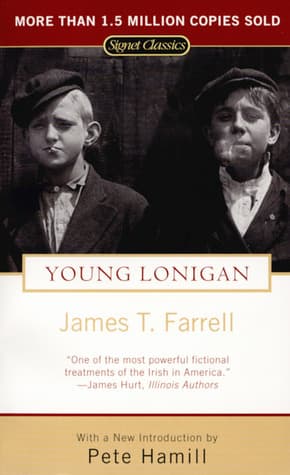
James T. Farrell (1932)
Genre
Young Adult
Reading Time
224 min
Key Themes
See below
Sign in to track this book
In 1910s Chicago, young William 'Studs' Lonigan navigates the confusion of adolescence and sexual awakening, a story that explores truth in a changing America.
The novel starts with William 'Studs' Lonigan getting ready for his First Holy Communion at St. Patrick's Church. Though he understands the religious meaning, Studs cares more about how he looks and the party afterward. He feels superior to some of his friends, especially Weary Reilly, whom he dislikes. After the ceremony, Studs joins his friends, including Paulie, Red O'Connell, and Kenny Killarney, in the streets. They do typical boyish things, like playing craps and talking about girls. A rivalry with the Twenty-Second Street gang, led by Davey Cohen, is set up, hinting at the conflicts that define much of Studs's early adolescence. Studs, though not always starting trouble, wants to prove his toughness and loyalty to his group.
As summer comes, Studs and his gang spend their days on the streets, playing baseball in empty lots, swimming in the lake, and hanging around. Studs becomes infatuated with Lucy Scanlan, a pretty neighborhood girl, often trying to get her attention and impress her with his boldness. His social standing among his friends is very important to him; he constantly seeks approval and fears being seen as weak or afraid. The boys discuss sex in crude and uninformed ways, showing their growing sexual curiosity and limited knowledge. Class differences, though rarely stated, are present, with Studs's family being stable working-class, while other families struggle more, which affects the boys' hopes and worries.
The growing tension between Studs's gang and Davey Cohen's Twenty-Second Street gang leads to a planned fight. Studs is nervous but determined to join and prove himself. The boys gather, and a chaotic brawl happens, with punching, grappling, and insults. Studs faces Davey Cohen directly. Though neither side clearly wins, Studs feels he held his own, which boosts his confidence and strengthens his place within his group. The fight, while violent, is also a rite of passage, reinforcing the boys' sense of belonging and their understanding of their street environment's harsh realities. Parents rarely get involved, leaving the boys to largely handle their own conflicts.
Studs attends St. Patrick's parochial school, where he is an average student. He finds the lessons boring and the teachers, especially the nuns, oppressive. His mind often wanders during class, focusing instead on street activities, girls, and future adventures. He often gets into trouble for small rule breaks, receiving punishments he resents but endures. This dislike for authority goes beyond school, as he often argues with his parents, particularly his father, who tries to teach discipline and responsibility. Studs's rebellious nature is a key part of his character, showing his wish to assert himself and create his own identity apart from adult and institutional expectations.
As Studs enters his mid-teens, he starts going to neighborhood dances and parties. These events are both exciting and anxiety-inducing for him. He is very self-conscious about his appearance, his dancing, and how he talks to girls. He often feels clumsy and unsure, despite his outward confidence. His crush on Lucy Scanlan grows stronger, and he tries to find the courage to talk to her or dance with her, often failing due to shyness or perceived competition from other boys. These social gatherings highlight Studs's inexperience with romance and his struggle to bridge the gap between his idealized ideas of love and the awkward realities of adolescent social interactions.
With school becoming even less interesting, Studs and his gang spend most of their time in pool halls and on street corners. Here, they can smoke cigarettes, play billiards, tell jokes, and discuss more 'adult' topics like sex, drinking, and future goals (or lack thereof). These places offer a sense of freedom and friendship away from parental supervision. The conversations often center on a crude understanding of masculinity and sexuality, shaped by their limited experiences and the social norms of their environment. This period marks a shift from innocent childhood play to a more aimless, yet equally important, adolescence spent on the edges of adult society.
Studs's sexual awakening is a main theme in the novel. His knowledge of sex comes mostly from whispered talks with friends, crude jokes, and the common, often distorted, information among adolescents. He struggles to balance his growing desires with the strict moral teachings of the Catholic Church. He feels a strong physical attraction to girls, especially Lucy Scanlan, but lacks the emotional maturity and understanding to form real romantic connections. His experiences are a mix of fascination, confusion, and some fear regarding the unknown aspects of sexuality, leading to both curiosity and apprehension about his developing body and desires.
The end of grade school is a big change for Studs and his friends. While some, like Paulie, plan to continue their education or learn stable trades, Studs is less sure. He has vague dreams of success and being 'somebody,' but lacks a clear plan or the discipline for formal education. His parents encourage him to consider high school, but Studs resists, preferring the freedom of the streets and his gang's company. This period has a growing sense of disappointment with traditional paths and a longing for a life that seems more exciting and less restricted, even if he doesn't fully understand what that life involves. The future looms large, filled with both possibility and an underlying sense of dread.
As they get older, Studs and his gang start to drink alcohol, usually in forbidden or semi-forbidden places. They sneak drinks, go to back rooms of saloons, or pool their money to buy beer. These early experiences with drinking often involve showing off, wanting to appear grown-up, and the thrill of breaking rules. The effects of alcohol are sometimes exaggerated, leading to loud behavior and a skewed sense of confidence. While not yet full-blown alcoholism, these first steps into drinking are another move towards a more adult world, often one of escapism and a lack of clear purpose, reflecting their community's broader social situation.
The novel ends with Studs Lonigan having just finished grade school, on the verge of high school, though his commitment to it is weak. He remains focused on Lucy Scanlan, his idealized crush, and the friendship of his street gang. His view of the world, shaped by the realities of South Side Chicago, Catholic teachings, and the masculinity of his peers, is largely set. He is a boy caught between childhood innocence and adult harshness, struggling to define himself amid conflicting desires and limited chances. The ending leaves Studs with an uncertain future, hinting at the challenges and disappointments that will define his later years as he continues to chase temporary pleasures and grapple with his identity.
The Protagonist
Studs begins as an impressionable boy and ends as a young man whose core identity, largely shaped by his environment and peer group, is already set, foreshadowing a life of unfulfilled potential.
The Supporting
Paulie remains a steadfast friend, his more practical nature contrasting with Studs's aimlessness, suggesting a divergence in their future paths.
The Supporting
Lucy remains an idealized figure for Studs, her true character less important than her function as a catalyst for his romantic and sexual awakening.
The Supporting
Red remains a consistent presence in Studs's immediate circle, solidifying the image of the loyal but rough-and-tumble street friend.
The Antagonist/Mentioned
Davey serves as an early antagonist, primarily existing to challenge Studs and his gang, and his role diminishes as Studs's focus shifts from street fights to other adolescent concerns.
The Supporting
Mr. Lonigan's character remains consistent as a figure of authority and traditional values, often clashing with Studs's burgeoning independence.
The Supporting
Mrs. Lonigan remains a constant source of maternal concern, her efforts to guide Studs often overwhelmed by his growing independence and street influences.
The Supporting
Kenny remains a supportive, if less developed, character within Studs's immediate social circle.
The novel tracks Studs's move from childhood innocence to a more cynical adolescence. His early religious enthusiasm is replaced by detachment, and his idealized view of the world is slowly worn away by the realities of street life, crude sexual awakening, and the limits of his social environment. This disillusionment shows as Studs rejects traditional paths like education and religion, finding them irrelevant or hypocritical compared to the immediate satisfaction and friendship of his gang. This theme is clear in Studs's change from valuing his First Holy Communion to seeing church as a chore and in his increasingly coarse talks about girls and sex, replacing childhood crushes with objectification. He struggles to find meaning beyond the fleeting thrills of the moment.
“He was just a kid then, a kid who had made his First Communion, and he believed in God. He believed in everything. But now... now it was different.”
Studs Lonigan's character is deeply shaped by his South Side Chicago neighborhood and the strong influence of his friends. The streets, pool halls, and empty lots are his real classroom, teaching him about toughness, loyalty, and the social hierarchies of his world. Peer pressure drives much of his behavior, from joining gang fights against Davey Cohen to using crude language and attitudes towards girls. He constantly seeks approval from his friends, often ignoring his own developing moral sense or his parents' advice. This theme highlights how the social environment can override individual goals and institutional teachings, solidifying a particular worldview and set of behaviors.
“He had to be tough. He had to show them he wasn't afraid. What would the guys think if he backed down?”
The novel explores Studs's early sexual awakening, showing it as a mix of intense curiosity, misinformation, and moral confusion. His understanding of sex comes mostly from crude jokes, whispered rumors, and the objectification of girls, rather than true emotional connection. He struggles with his physical desires, which conflict with the strict Catholic teachings he has received. This inner conflict is clear in his idealized crush on Lucy Scanlan, which exists alongside his participation in demeaning conversations about girls with his friends. The theme illustrates the difficulty of navigating growing sexuality in a restrictive, yet sexually charged, environment where accurate information and emotional maturity are missing, leading to bewilderment and frustration.
“He thought about girls, about Lucy, and a strange, hot feeling would come over him. But then he remembered what the nuns said, and he felt like a dirty sinner.”
Farrell subtly introduces the theme of the American Dream, or its failure, through Studs's character. Studs has vague hopes of being 'somebody' and succeeding, but these dreams lack clear form or the discipline needed to pursue them. His environment, marked by limited opportunities and a pervasive culture of aimlessness, actively works against traditional paths to success. Instead of education or hard work, Studs and his friends are drawn to the superficial signs of masculinity, immediate pleasures, and a sense of belonging within their street gang. The novel suggests that for many in Studs's social class, the American Dream remains an unreachable fantasy, replaced by a cycle of disappointment and stagnation. This is seen in Studs's disinterest in school despite his parents' encouragement, and his preference for loafing over planning for the future.
“He wanted to be a big shot, a regular fellow. He didn't know how, but he just wanted to be.”
A narrative technique that mirrors the unfiltered thoughts and perceptions of Studs Lonigan.
Farrell employs stream of consciousness to immerse the reader directly into Studs's mind, revealing his raw, often unarticulated thoughts, desires, and prejudices. This device allows for an intimate portrayal of Studs's internal struggles, his sexual confusion, his fears, and his unrefined understanding of the world. It often presents Studs's thoughts as fragmented, repetitive, and influenced by the slang and limited vocabulary of his environment. By showing rather than telling Studs's mental processes, Farrell emphasizes the character's immaturity and the formative, often chaotic, nature of his adolescent worldview, particularly regarding his infatuation with Lucy Scanlan and his anxieties about his social standing.
A literary movement focused on depicting the harsh realities of working-class life with unflinching accuracy.
The novel is a prime example of social realism, painstakingly detailing the everyday lives, language, and cultural norms of working-class Irish-Americans in 1910s Chicago. Farrell avoids romanticizing or moralizing, instead presenting the characters and their environment with stark, almost journalistic, authenticity. This device is evident in the detailed descriptions of street games, gang fights, family dynamics, and the specific slang used by the boys. The unflinching portrayal of violence, crude sexuality, and limited opportunities serves to highlight the socio-economic forces that shape Studs's destiny, arguing that his character is a product of his specific time and place rather than solely individual choice.
Hints and clues within the narrative that suggest future events or character developments.
Farrell frequently uses foreshadowing to hint at the bleak trajectory of Studs Lonigan's life. Studs's early disinterest in school, his aimless dreams, his reliance on superficial bravado, and his struggles with self-control all subtly suggest a future marked by unfulfilled potential and disappointment. The episodic nature of the plot, showing Studs's repeated mistakes and lack of growth in certain areas, builds a sense of inevitability about his later struggles. This device creates a sense of tragic irony, as the reader can often perceive the destructive path Studs is on, even as Studs himself remains largely oblivious to the long-term consequences of his choices, particularly regarding his health and relationships.
The streets of Chicago symbolize freedom, danger, and the primary 'classroom' for Studs's education.
The streets and their associated spaces (vacant lots, pool halls, corners) are central symbols in 'Young Lonigan.' They represent a realm of freedom and self-governance for the boys, a place where they can escape adult supervision and forge their own identities. However, the streets also symbolize danger, violence, and moral ambiguity, serving as the setting for gang fights, early sexual encounters, and the learning of crude, often destructive, lessons. For Studs, the streets are his true 'school,' shaping his values and worldview far more effectively than any formal institution, ultimately becoming a powerful, yet ultimately limiting, influence on his life's trajectory.
“He was a boy, and he was Lonigan. He was not going to be like the others. He was going to be better, and he was going to show them.”
— Early in the story, as young Lonigan reflects on his identity and aspirations.
“The streets of Chicago were his playground, and the city was his oyster, though he didn't know what an oyster was.”
— Describing Lonigan's perception of his urban environment.
“He wanted to be tough. He wanted to be a man. He wanted to be respected. He wanted to be feared.”
— Lonigan's internal monologue about his desires and image.
“Life wasn't a game. It was something serious, something that you had to fight for, something that you had to win.”
— Lonigan's developing understanding of the harsh realities of his world.
“The world was full of things he didn't understand, and he hated not understanding.”
— Lonigan's frustration with his limited knowledge and experience.
“He felt a vague sense of unease, a feeling that something was going to happen, something bad.”
— A premonition Lonigan experiences, hinting at future conflicts.
“He had to be strong. He couldn't let anyone see him weak. That was the rule.”
— Lonigan's adherence to the unspoken rules of his peer group and environment.
“The future stretched out before him, vast and unknown, and he was both excited and terrified.”
— Lonigan contemplating his coming-of-age and the uncertainties ahead.
“He didn't know what he wanted, but he knew he wanted it badly.”
— A common sentiment of youth, expressing an undefined yearning.
“The city never slept, and neither did the thoughts in his head.”
— Connecting Lonigan's restless mind with the bustling urban landscape.
“He was just a kid, but he felt like he had the weight of the world on his shoulders.”
— Lonigan's perception of the burdens he carries despite his young age.
“There was a fierce joy in fighting, a thrill in the risk, a sense of being alive.”
— Lonigan's experience during a physical confrontation.
“He sometimes wondered if he would ever truly understand the grown-ups, or if they would ever understand him.”
— Lonigan's reflection on the generational gap and lack of understanding.
“Every day was a new challenge, a new lesson, a new chance to prove himself.”
— Lonigan's daily approach to life in his environment.
Ready to see how well you understood this book? Take our interactive quiz with 10 questions.

James Thomas Farrell was an American novelist, short-story writer and poet.