“The secret is that the secret isn't what you think it is. And that's the secret.”
— The narrator's meta-commentary on secrets and the nature of the book's mystery.

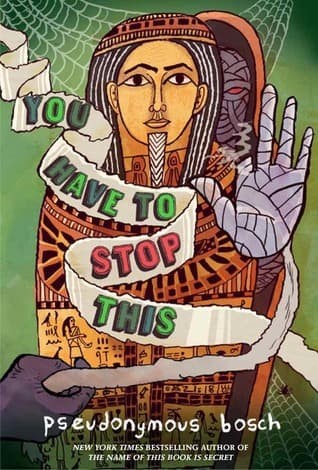
Pseudonymous Bosch (2011)
Genre
Fantasy / Children's / Mystery / Young Adult
Reading Time
350 min
Key Themes
See below
Sign in to track this book
During a class trip, Cass breaks a mummy's finger, pulling her and her friends into an ancient Egyptian mystery with priceless artifacts, walking dead, and a desperate search for the ultimate Secret before their chocolate and lives run out.
The story begins with Cass, Max-Ernest, and Yo-Yoji on a class trip to a natural history museum. Cass accidentally breaks a finger off a valuable mummy. This draws the attention of Dr. L and Dr. M, the museum's unusual curators, who are later revealed to be part of the evil Midnight Sun. To make up for the damage, the three children are forced into an 'internship' with the doctors, doing mostly small tasks and watching their strange behavior. This incident immediately puts them back into the world of the Secret, as the doctors seem more interested in something hidden in the museum than the mummy itself.
During their forced internship, Dr. L mysteriously disappears from the museum, leaving only a strange message and a trail of suspicion. Cass, Max-Ernest, and Yo-Yoji are immediately blamed for her disappearance, making them fugitives. This forces them to run, trying to clear their names and find out what happened to Dr. L, which they believe is connected to the larger Secret conspiracy. Their investigation leads them to think that the Midnight Sun is actively working against them, and that Dr. L may have been harmed by their plans.
Desperate for help and on the run, the children turn to the Whispering Society, a good organization that protects the Secret. They meet the Society's leader, Ms. Mauvais, and other members, including the mysterious Lord Pharaoh. With the Society, they learn more about the history of the Secret and the ongoing fight with the Midnight Sun. They also see familiar faces, including the bad Ms. Perumal, now a reluctant helper, and the ever-present Pseudonymous Bosch, who keeps narrating and giving strange warnings.
Following clues about the mummy and Dr. L's disappearance, the trio goes on a journey that seems to take them to Egypt. However, this journey is unclear, with signs that it might be a dream, a hallucination, or a clever trick. They find themselves in a land of pyramids, hieroglyphs, and ancient tombs, always chased by agents of the Midnight Sun. This 'Egyptian' setting serves as a symbolic place for their search to find the last parts of the Secret, making them question what is real and what the world around them is like.
In the 'Egyptian' setting, Cass, Max-Ernest, and Yo-Yoji encounter what seem to be living mummies and old, booby-trapped tombs. These meetings are both scary and confusing, further blurring the lines between real and imagined. They must use their intelligence and teamwork to get through these dangerous situations, all while trying to figure out the true meaning of the mummy's curse and its link to the Secret. These challenges test their bravery and show how much they depend on each other as they go deeper into the mystery.
As their 'Egyptian' adventure continues, the children slowly realize that their entire journey has been a complex trap, carefully planned by the Midnight Sun. They discover that the 'Egypt' they are in is not a real place but a very advanced, immersive illusion designed to get the Secret from them. Dr. M, now revealed as the true mastermind, controls their environment and what they perceive, using their own desire to find the Secret against them. This discovery is a turning point, changing their goal from finding out to escaping and resisting.
Through several reveals and a direct talk with Dr. M, the children finally begin to understand what the Secret really is. It is not a single object or piece of information, but a complex idea that includes the power of storytelling, the importance of imagination, and the subjective nature of truth. The Secret is a way of seeing the world, a method of understanding its mysteries through wonder and doubt. This deep understanding challenges what they previously thought and redefines their quest.
As the plot gets more intense and the children face their greatest danger, Pseudonymous Bosch, the narrator, becomes a more active, almost physical part of the story. He steps in directly, offering warnings, advice, and even physical help, blurring the line between author and character. His fight to stay anonymous and keep his chocolate becomes tied to the children's search. This meta-narrative element shows the power of storytelling and the author's role in shaping reality, especially since the Secret itself deals with the nature of stories.
The climax shows Cass, Max-Ernest, and Yo-Yoji directly confronting Dr. M, who reveals her full plan to control the Secret for her own evil goals. She plans to use the power of stories to manipulate reality and remove wonder and mystery from the world. The children must use all their combined intelligence, their understanding of the Secret, and unexpected help from allies to stop her. This battle is not just physical but also a clash of ideas: the Midnight Sun's desire for control versus the Whispering Society's protection of mystery.
In the end, Dr. M is defeated, and the immediate danger to the Secret is gone. The children, having faced their fears and understood the deep meaning of the Secret, choose to protect it by letting it remain a mystery. They realize that the Secret's true power is in its ambiguity and the endless possibilities it offers. They understand that the 'ending' is not a final conclusion but an ongoing journey of discovery and imagination, ensuring that the world stays a place of wonder and magic.
After the dramatic events, Cass, Max-Ernest, and Yo-Yoji return to their seemingly ordinary lives, but they are changed forever. They carry the knowledge of the Secret, understanding its importance and their role in protecting it. While the immediate danger has passed, they know that the world is full of hidden wonders and ongoing mysteries. Their bond is stronger than ever, and they are now more observant, imaginative, and appreciative of the subtle magic that exists just beneath the surface of everyday life, ready for whatever new adventures might come.
The Protagonist
Cass learns to trust her intuition more fully and accepts that not all mysteries need a definitive answer, embracing the power of the unknown.
The Protagonist
Max-Ernest learns to temper his need for definitive answers with an appreciation for ambiguity, understanding that some truths are best left as mysteries.
The Protagonist
Yo-Yoji fully embraces his unique perspective and artistic expression as a vital tool for understanding and protecting the Secret.
The Narrator/Supporting
Bosch moves from a distant, cautionary narrator to a more active, albeit still mysterious, participant in the story, ultimately accepting the necessary conclusion of his narrative.
The Antagonist
Dr. M's relentless pursuit of controlling the Secret ultimately leads to her downfall, as she fails to grasp its true, fluid nature.
The Supporting
Dr. L's disappearance and ambiguous loyalties serve as a catalyst for the plot, hinting at deeper conspiracies within the Midnight Sun.
The Supporting
Ms. Mauvais continues to guide and protect the Secret, reinforcing the importance of mystery and imagination.
The Supporting
Ms. Perumal fully transitions from an antagonist to a crucial, albeit eccentric, ally, demonstrating her complicated moral compass.
The Supporting
Lord Pharaoh continues to serve as a wise, almost mythical, figure, embodying the historical depth of the Secret.
This theme explores how stories shape our view of reality and how truth is subjective. The narrator, Pseudonymous Bosch, constantly reminds readers that the story is made up, blurring the lines between fiction and reality. The Secret itself is revealed not as a single fact, but as the power of stories and imagination. The 'Egyptian' journey, later shown to be an illusion, shows how strong stories can create their own reality. This theme encourages critical thinking about the information we take in and the stories we choose to believe, showing their power to both inform and mislead.
“A secret is meant to stay secret, after all. And now we've come to this: the fifth and final (I swear!) book in my saga of secrets.”
The book supports the value of imagination and keeping wonder alive in a world that often tries to label and explain everything. The Midnight Sun, especially Dr. M, represents the wish to control and remove mystery, reducing everything to cold facts. In contrast, the Whispering Society and the main characters fight to protect the unknown, understanding that it encourages creativity, curiosity, and a sense of magic. The children's ability to believe in the extraordinary, even when faced with logical explanations, is key to their success and their grasp of the Secret. This theme suggests that real understanding comes not just from knowing facts, but from embracing possibilities beyond them.
“Some things are better left a mystery. Not because they're dangerous, but because the unknown is where wonder truly lives.”
The strong bond between Cass, Max-Ernest, and Yo-Yoji is central to their ability to overcome challenges. Each character brings unique strengths to the group – Cass's intuition and practicality, Max-Ernest's intellect and imagination, and Yo-Yoji's calm observation and artistic insight. They constantly rely on each other, balancing their individual quirks and supporting each other through fear and doubt. Their combined abilities help them solve clues, escape traps, and ultimately understand the complex nature of the Secret. This theme highlights that working together and mutual respect are more powerful than individual genius, especially against overwhelming odds.
“Together, they were more than the sum of their parts, a living riddle that even the Midnight Sun could not solve.”
This theme explores the basic conflict between the Midnight Sun's desire for absolute control and the Whispering Society's commitment to keeping freedom and the natural order of things, including the freedom to wonder and imagine. Dr. M wants to impose a rigid, fact-based reality, getting rid of ambiguity and mystery, which she sees as chaos. The Whispering Society, however, understands that true order includes the unpredictable and the unknown, allowing for growth and discovery. The fight for the Secret is ultimately a battle over whether humanity will live in a world dictated by absolute truths or one enriched by endless possibilities.
“The Midnight Sun believes that all secrets must be revealed, controlled, and ultimately, destroyed. We believe they must be protected.”
The narrator directly addresses the reader, commenting on the story and his own role.
Pseudonymous Bosch, the narrator, frequently breaks the fourth wall, directly addressing the reader with warnings, pleas, and commentary about the narrative itself. This device serves multiple purposes: it adds a meta-fictional layer, reminding the reader that they are engaging with a story; it enhances the sense of mystery and danger, as Bosch often warns against uncovering the Secret; and it creates a unique, intimate relationship between the author and the audience. It also allows Bosch to inject his personality, humor, and chocolate-related anxieties directly into the narrative, blurring the lines between author and character.
Misleading clues or plot points designed to divert the reader's attention.
The narrative is replete with red herrings, particularly regarding the nature of the Secret and the location of the children's adventure. The 'Egyptian' journey is the most prominent example, initially presented as a real physical journey to Egypt, complete with ancient tombs and living mummies. This elaborate deception is later revealed to be a sophisticated illusion created by the Midnight Sun. These red herrings keep the reader guessing, mirroring the characters' own confusion and challenging their assumptions about what is real and what is not, reinforcing the theme of subjective truth and the power of narrative manipulation.
A plot device that drives the story forward, though its true nature is ambiguous.
The Secret itself functions as a MacGuffin for much of the series. It is the central object of desire and conflict for both the Whispering Society and the Midnight Sun, driving the plot and motivating the characters' actions. However, its true nature remains elusive and constantly redefined, especially in this final book. The Secret is not a tangible object or a simple piece of information, but rather a complex concept encompassing storytelling, imagination, and the unknown. This ambiguity allows the story to explore deeper philosophical themes about truth and wonder, rather than just focusing on a physical quest.
The narrator's credibility is intentionally questionable, adding to the mystery.
Pseudonymous Bosch is an inherently unreliable narrator. He constantly warns the reader not to read the book, expresses fear for his own safety and chocolate supply, and frequently interjects with personal opinions and dramatic pronouncements. His self-serving comments and occasional evasions make the reader question how much of what he says is true, or if he is intentionally obscuring facts. This device enhances the mystery surrounding the Secret and the events of the story, forcing the reader to actively interpret the narrative and consider alternative perspectives, aligning with the book's theme of subjective truth.
“The secret is that the secret isn't what you think it is. And that's the secret.”
— The narrator's meta-commentary on secrets and the nature of the book's mystery.
“There are some things in this world that are best left unknown, and then there are other things that are best left unknown until the exact right moment.”
— The narrator's justification for withholding information from the reader.
“Sometimes the best way to get to the truth is to follow the lies.”
— Cass pondering how to solve a puzzle or unravel a deception.
“It's a strange thing, a secret. It can feel like a burden, but it can also feel like a treasure.”
— The internal thoughts of a character dealing with a significant secret.
“The real magic, you see, isn't in what you find, but in what you're looking for.”
— A philosophical statement about the nature of quests and discovery.
“Every story has a beginning, a middle, and an end. But not necessarily in that order.”
— The narrator's playful approach to narrative structure.
“You can't truly understand something until you've tried to make sense of it yourself.”
— A character reflecting on the process of learning and understanding.
“Fear is a powerful ingredient. It can make you do things you never thought you'd do, and it can stop you from doing things you know you should.”
— A moment of reflection on the influence of fear on characters' actions.
“The world is full of things that seem impossible until someone does them.”
— A character expressing optimism and belief in overcoming challenges.
“Sometimes, the best way to hide something is to put it right out in the open.”
— A strategy for concealing information or objects, often employed by villains or clever characters.
“A good question is often more important than a good answer.”
— A character emphasizing the importance of inquiry and critical thinking.
“Even the most ordinary things can become extraordinary if you look at them the right way.”
— A moment where a character finds wonder in something mundane.
“The past isn't just something that happened; it's something that continues to happen.”
— A character contemplating the lasting impact of historical events or personal history.
“To truly know a story, you must not only read it, but also feel it, taste it, and perhaps, even smell it.”
— The narrator's immersive and sensory approach to experiencing a story.
Ready to see how well you understood this book? Take our interactive quiz with 10 questions.







