“You are special because I made you. And I don't make mistakes.”
— Eli the woodcarver reassures Punchinello of his inherent worth.

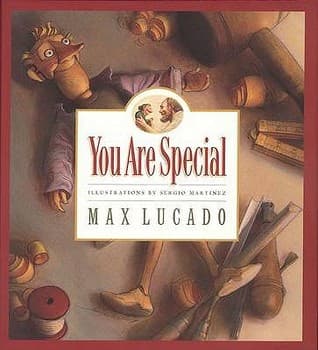
Max Lucado (1997)
Genre
Fantasy / Children's / Spirituality
Reading Time
15 min
Key Themes
See below
Sign in to track this book
In a village where wooden people are judged by stickers, a small Wemmick named Punchinello discovers his true worth through the love of his creator, Eli, proving that external opinions do not diminish inherent value.
In Wemmicksville, small wooden people called Wemmicks are made by a woodworker named Eli. These Wemmicks spend their days giving each other either gold star stickers for achievements and talents, or grey dot stickers for mistakes, clumsiness, or flaws. Punchinello, the main character, often gets grey dots. He isn't as shiny as some, his paint is chipped, and he often stumbles. Other Wemmicks, especially those with many stars, look down on him. Even Wemmicks with many grey dots tend to add more to Punchinello. He feels increasingly worthless and starts to believe he deserves the grey dots.
Days turn into weeks, and Punchinello is covered in grey dots. Every time he tries to earn a star, it seems to go wrong, resulting in more dots. If he tried to jump high like others, he would fall and get a dot. If he tried to sing, his voice would crack, earning another dot. Soon, he has so many grey dots that other Wemmicks avoid him, fearing they might 'catch' his dot-ness. He begins to believe the negative labels, feeling ugly and useless. He stops trying new things, preferring to stay home and avoid others' judgment. This only makes him feel more worthless and alone.
One day, Punchinello sees a Wemmick named Lucia. She has no stickers at all — no stars or dots. This puzzles Punchinello, as every other Wemmick he knows is covered in them. He watches her interact with other Wemmicks; when they try to give her stars, they fall off. When they try to give her dots, they also fall off. Lucia seems unaffected by what others think. She has a quiet confidence and peace that Punchinello deeply wants. He is curious and wonders how she stays unmarked.
Punchinello, feeling curious, asks Lucia how she manages to have no stickers. Lucia simply says she visits Eli every day. She explains that when she spends time with Eli, the stickers do not stick to her anymore. She encourages Punchinello to do the same, telling him that Eli loves him just as he is. This idea gives Punchinello a bit of hope. He has never thought about speaking directly to his creator, though he knows Eli exists. He is unsure but decides to take her advice, feeling he has nothing left to lose.
With Lucia's words in his mind, Punchinello starts his walk to Eli's workshop, a place high on a hill above Wemmicksville. He feels both worried and eager. The path is new to him, and his many grey dots make him feel more self-conscious as he walks. He wonders what Eli will think of him, a Wemmick covered in so many marks of failure. Despite his fears, the hope from Lucia's example pushes him on. He climbs the winding path, determined to find the reason for Lucia's peace and perhaps a way to escape his own burden of stickers.
Punchinello finally arrives at Eli's workshop. To his surprise, Eli, a large man with a long beard, greets him by name. Eli does not seem to notice Punchinello's grey dots, or if he does, he does not mention them. Eli expresses his happiness at Punchinello's visit, telling him he is glad to see him. Punchinello is surprised by Eli's warmth and acceptance. He tries to explain his problem with the stickers, but Eli gently stops him, already knowing the situation. This meeting is unlike any Punchinello has had in Wemmicksville, where judgment is constant.
Eli listens as Punchinello talks about his sadness over the grey dots and his inability to earn stars. Eli then tells Punchinello that the stickers do not matter to him. He explains that he does not care if Punchinello has stars or dots, only that Punchinello is his creation and that he loves him just the way he is. Eli says Punchinello's worth comes from being made by him, not from what other Wemmicks think. He tells Punchinello to ignore the stickers and to trust his creator's love, reminding him, 'You are special because I made you.'
As Eli speaks these words of affirmation and love, something happens. Punchinello notices a grey dot falls off his arm. Then another, and another. He is surprised. Eli explains that the stickers only stick when Punchinello believes what other Wemmicks say about him more than what Eli says. By choosing to believe Eli's truth — that he is special and loved — the stickers lose their power. Punchinello feels lighter than he has in a long time. The weight of judgment starts to lift, and he begins to understand the truth Eli is sharing with him.
Punchinello leaves Eli's workshop with a lighter step and fewer grey dots. He still has some, but they no longer feel heavy or define him. He understands that his worth is within him, given by his creator, and not based on the changing opinions of other Wemmicks. As he walks back into Wemmicksville, other Wemmicks try to give him stickers, but they do not stick as easily as before. He realizes that by focusing on Eli's love and visiting him often, he can stay free from judgment. Punchinello looks forward to returning to Eli's workshop, knowing he is truly special.
The Protagonist
From a self-conscious and burdened Wemmick, Punchinello transforms into a self-assured individual who understands his inherent worth.
The Supporting
Eli remains constant in his love and wisdom, serving as the unchanging source of truth for Punchinello's transformation.
The Supporting
Lucia serves as a stable, inspiring figure, showing Punchinello the path to self-acceptance and freedom.
The Supporting
They remain largely unchanged in their judgmental behavior, serving as a constant backdrop against which Punchinello's growth is measured.
The main theme is understanding one's value, separate from external opinions or achievements. Punchinello's journey shows how believing negative judgments from others can hurt self-esteem. Eli's message says the opposite, stating that true worth comes from being a loved creation, not from earning stars or avoiding dots. The falling stickers show the shedding of a false identity based on societal approval and the acceptance of an identity rooted in the creator's love. This theme encourages readers to look past surface evaluations to find their inherent specialness.
“'The stickers only stick if you let them. They only stick if you care what they think.'”
Eli's character shows love and acceptance. Unlike the Wemmicks who judge and label each other, Eli loves Punchinello just as he is, regardless of his clumsy nature or his many grey dots. His workshop is a safe place where Punchinello experiences grace and no judgment. This theme highlights the importance of a love that is not earned or based on performance. It offers comfort and reassurance that everyone is loved and valued by their creator, flaws and all. It contrasts with the conditional acceptance in Wemmicksville.
“'I'm glad you came... It doesn't matter to me what the other Wemmicks think of you.'”
The sticker system in Wemmicksville is a picture of how people seek validation from others and let external opinions define their self-worth. Punchinello's initial sadness comes from his reliance on stars and his fear of dots. Lucia's freedom from stickers and Eli's teachings show Punchinello how to break this cycle. The theme encourages readers to stop giving power to the 'stickers' others try to place on them. Instead, they should find their validation in a deeper, more reliable source, which helps build inner strength and peace.
“'The stickers only stick if you let them. The more you trust my love, the less you'll care about their stickers.'”
This theme explores the bond between a creator and their creation, saying that the creator's view is the final truth about the creation's value. Eli's love for Punchinello, simply because he made him, supports the idea that our worth is given by our maker, not by our performance or the world's judgment. It suggests a spiritual side where understanding and connecting with one's creator helps in finding self-acceptance and purpose, much like Punchinello's change happens only after he visits Eli.
“'You are special because I made you. And I don't make mistakes.'”
A symbolic system of judgment representing societal approval and disapproval.
The gold star and grey dot stickers are the central plot device, serving as a powerful metaphor for how society labels and judges individuals based on perceived achievements, talents, and failures. The stickers physically manifest the weight of external opinion on Punchinello, illustrating how such judgments can diminish self-worth and lead to despair. Their ability to stick or fall off directly reflects Punchinello's internal state and his belief in Eli's love versus the world's opinions, making them a tangible representation of emotional and spiritual burdens.
A sanctuary representing a place of truth, unconditional love, and spiritual connection.
Eli's workshop, situated high on a hill, functions as a sacred space, distinct from the judgmental environment of Wemmicksville. It is a place of refuge where Punchinello encounters truth and unconditional acceptance. The workshop symbolizes a spiritual 'safe space' or a connection with a higher power, where one can find solace, clarity, and reaffirmation of their inherent worth, free from the world's criticisms. It is the setting where Punchinello's transformation truly begins, guided by Eli's wisdom and love.
A living example and catalyst for Punchinello's journey to self-acceptance.
Lucia's unique state of being entirely free from stickers serves as a crucial plot device. She is not merely a character but a living demonstration of the possibility of living unburdened by external judgment. Her existence sparks Punchinello's curiosity and provides him with the concrete evidence that freedom from the sticker system is achievable. Her simple advice to 'go see Eli' directly propels Punchinello into the central conflict and resolution of the story, making her an indispensable guide and role model.
“You are special because I made you. And I don't make mistakes.”
— Eli the woodcarver reassures Punchinello of his inherent worth.
“The stickers only stick if you let them.”
— Eli explains to Punchinello that others' opinions don't define him.
“Who are they to give stars or dots? They're Wemmicks just like you.”
— Eli points out the hypocrisy of judging others.
“You matter to me.”
— Eli expresses his personal care for Punchinello.
“The more you trust my love, the less you care about the stickers.”
— Eli teaches Punchinello about the power of faith and acceptance.
“I made you, and I don't make mistakes.”
— A repeated affirmation from Eli to reinforce Punchinello's self-worth.
“Stars and dots, they all fall off in my workshop.”
— Eli shows Punchinello that labels lose meaning in his presence.
“You are special because you're mine.”
— Eli emphasizes Punchinello's unique relationship with him.
“The only way you can feel good about yourself is to forget what they think and remember what I think.”
— Eli advises Punchinello to focus on divine perspective over human opinion.
“I don't care how many stars or dots you have.”
— Eli dismisses the societal labels that trouble Punchinello.
“You are wonderfully made.”
— Eli celebrates Punchinello's creation and design.
“Come to me every day, and let me remind you how much I care.”
— Eli invites Punchinello to maintain a daily connection for reassurance.
“Remember, you are special because I made you.”
— Eli's closing reminder to Punchinello as he leaves the workshop.
Ready to see how well you understood this book? Take our interactive quiz with 10 questions.

Biography coming soon.







