“And so, in the Year of Wonders, we found our own ways to cheat death, if only for a season.”
— Anna reflects on the villagers' initial attempts to outwit the plague.

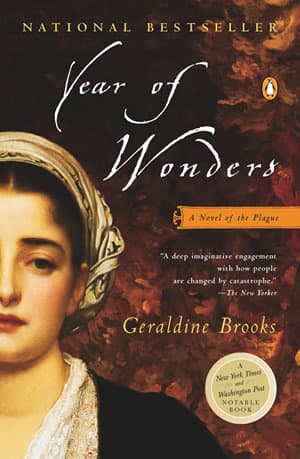
Geraldine Brooks (2001)
Genre
Historical Fiction
Reading Time
6-8 hours
Key Themes
See below
Sign in to track this book
In a 17th-century English village ravaged by plague, a housemaid named Anna Frith confronts the terrifying spread of disease, the hysteria of witch-hunts, and the disintegration of her community, transforming a year of catastrophe into one of personal growth.
In the spring of 1666, the village of Eyam, nestled in the Derbyshire Peak District, receives a bolt of cloth from London, sent to the tailor George Viccars. Viccars, a former apprentice to Anna Frith's late husband, is the first to fall ill, displaying the tell-tale buboes. Anna, a young widow and housemaid to the rector, Michael Mompellion, notices his strange symptoms. Soon after, others who came into contact with the cloth or Viccars begin to sicken and die. The village quickly realizes they are facing the dreaded 'Great Mortality,' the plague that has ravaged London. Panic begins as the first few deaths are recorded, disrupting the quiet rhythm of village life.
As the plague spreads, Rector Michael Mompellion, guided by his deep faith and a desire to protect surrounding communities, proposes an extraordinary and agonizing plan: the entire village of Eyam must quarantine itself. No one is to leave, preventing the disease from spreading further. He appeals to their Christian duty and promises that provisions will be left at the village boundaries. This decision meets with fear and resistance from some, but ultimately, the villagers, swayed by Mompellion's impassioned plea and the support of the influential Bradfords, agree to the self-imposed isolation. Anna Frith, though terrified, supports the rector's difficult choice.
The quarantine begins, and deaths mount rapidly. Anna Frith, having already lost her husband and two sons to a mining accident and the plague respectively, finds herself increasingly involved in caring for the sick and dying. She forms a close bond with Elinor Mompellion, the rector's wife, a learned woman with extensive knowledge of herbs and medicine. Together, they tend to the afflicted, lancing buboes, preparing remedies, and comforting the dying. Anna, initially a simple housemaid, discovers a surprising aptitude for healing and a resilience she never knew she possessed, often witnessing unspeakable suffering and loss.
As the death toll climbs relentlessly and hope dwindles, the villagers' faith is severely tested. Despair gives way to paranoia and superstition. The Gowdie family, particularly the elderly Mem, are targeted due to their knowledge of natural remedies and their independent lifestyle. Accusations of witchcraft begin to surface, fueled by ignorance and terror. The villagers, desperate for a scapegoat, turn on Mem Gowdie and her daughter Anys. Despite Anna and Elinor's attempts to intervene, the Gowdies are brutally murdered by a mob, showing the complete breakdown of community order and the erosion of Christian values under extreme duress.
The wealthy Bradford family, unable to endure the privations and terror of the quarantine, decide to break their vow and flee Eyam, believing their status will protect them. Their departure is a devastating blow to village morale and Mompellion's authority. Shortly after this betrayal, Elinor Mompellion contracts the plague. Anna nurses her devotedly, but despite their combined efforts, Elinor succumbs to the disease. Her death is a profound loss for Anna, who had found a mentor and friend in Elinor, and a crushing blow to Rector Mompellion, who is plunged into a deep, silent grief, further isolating himself from the suffering community.
After Elinor's death, Anna Frith fully embraces her role as the primary healer in Eyam, attending to the sick and performing the grim task of burying the dead. She helps deliver babies and brings what comfort she can to the dying, showing remarkable courage and practical skill. In the wake of their shared trauma and profound grief for Elinor, Anna and Rector Mompellion are drawn together. Their relationship, born of shared loss and extreme circumstances, becomes an illicit affair. This physical and emotional connection provides a temporary, desperate solace for both, a flicker of life amidst overwhelming death, though it is fraught with moral complexities.
As the year draws to a close, the plague's grip on Eyam finally loosens. The deaths cease, and the villagers, though decimated, begin to emerge from their homes, scarred but alive. In the aftermath, Anna makes a shocking discovery in Elinor's personal effects: a collection of letters revealing that Elinor had been forced into an arranged marriage with Michael Mompellion and had suffered deeply due to a past transgression. The letters hint at Michael's extreme, puritanical penance imposed upon Elinor, which included a strict denial of physical intimacy, a penance he believed was for her salvation, but which had caused her immense suffering.
Armed with the knowledge from Elinor's letters, Anna confronts Michael Mompellion. She accuses him of inflicting unnecessary suffering on Elinor, questioning his rigid interpretation of faith and penance. Michael, broken by grief and guilt, finally confesses the full truth: Elinor had been raped by her stepbrother and had subsequently given birth to an illegitimate child, who died. To 'purify' her and ensure her salvation, Michael had imposed a life of celibacy and constant penance upon her. His confession reveals the depth of his misguided zealotry and the tragic consequences of his actions, shattering Anna's idealized image of him.
After the confrontation and Mompellion's confession, Anna realizes she cannot remain in Eyam, burdened by the ghosts of the past and the complicated emotions surrounding her relationship with Michael. She discovers she is pregnant with Mompellion's child. Seeking a fresh start and a place where she can raise her child free from the shadow of the plague and the judgments of the village, Anna makes the courageous decision to leave Eyam. Her departure marks a definitive break from her past life and the community she served tirelessly, symbolizing her personal liberation and growth.
Anna, accompanied by her newborn daughter, travels to Bristol and manages to secure passage on a ship. Through a series of unexpected events, she eventually finds herself in a Muslim community in North Africa, where she is welcomed and finds a new home. Her medical skills, honed during the plague year, are valued, particularly her expertise in midwifery. She finds purpose and acceptance among people of a different culture and faith, free from the rigid doctrines and superstitions of her former life. She raises her daughter, Elinor, in this new environment, embracing a life of service and quiet contentment, proving that even from tragedy, new wonders can emerge.
The Protagonist
Anna transforms from a grieving, subservient housemaid into a courageous healer, an independent thinker, and ultimately, a woman who forges a new life for herself and her daughter beyond the confines of her village.
The Supporting/Antagonist
Mompellion descends from a respected spiritual leader into a broken, guilt-ridden man as the consequences of his actions and the plague's devastation challenge his faith and humanity.
The Supporting
Elinor's arc is largely revealed in retrospect, showing her as a woman who endured immense personal suffering with grace, leaving behind a legacy of knowledge and compassion for Anna.
The Supporting
Anys's life is tragically cut short by the villagers' fear and superstition, serving as a stark warning about the dangers of mob mentality.
The Supporting
Mem, like her daughter, suffers a tragic and unjust death at the hands of a fearful mob.
The Supporting
Josiah's character remains largely static, serving as a symbol of human depravity and the breakdown of moral order during the crisis.
The Supporting
Their arc highlights their descent from community pillars to symbols of selfish abandonment, underscoring the fragility of social contracts under extreme pressure.
The Mentioned
Viccars's brief presence initiates the central conflict of the novel, though he dies early in the story.
The plague year tests the villagers' faith, leading many to question God's will and the meaning of their suffering. Rector Mompellion's unwavering, yet sometimes misguided, faith is contrasted with Anna's more pragmatic and evolving spirituality. The devastating deaths, the witch hunts, and the sheer brutality of the disease force characters like Anna to seek solace not in dogma, but in human connection and practical action. The novel explores how faith can both inspire immense sacrifice (the quarantine) and lead to cruel judgment (Mompellion's treatment of Elinor, the witch hunts).
“What a strange thing it is, that a man can to a woman be so many things, good and bad. And how, in the end, for better or worse, one is left with nothing but the truth of him.”
The novel depicts the Eyam villagers' extraordinary decision to isolate themselves to protect others, showing both the strength and fragility of community bonds. While the quarantine initially creates unity and shared purpose, the prolonged suffering and fear eventually erode trust, leading to suspicion, witch hunts, and the breakdown of social order. The Bradfords' desertion highlights the class divisions and self-preservation that can fracture a community. Anna's eventual departure from Eyam represents her personal journey from communal belonging to self-imposed isolation, ultimately finding a new community elsewhere.
“We were not marked by God for wrath, but blessed by Him to make a choice. And we chose to remain, and die, for the sake of all those who might have followed us to a similar fate.”
The plague year is a setting for the clash between superstitious beliefs and early scientific understanding. As the disease ravages Eyam, many villagers resort to ancient folk remedies, charms, and scapegoating, culminating in the tragic witch hunts against the Gowdie women. In contrast, Anna and Elinor Mompellion represent a more rational approach, using herbs, lancing buboes, and observing the disease's patterns. Anna's journey is one of moving away from fear-based superstition towards practical, evidence-based healing, which ultimately serves her well in her new life.
“Ignorance and fear are a fertile ground for the seeds of evil.”
The novel highlights the limited roles available to women in the 17th century but also shows their resilience and strength. Anna, initially a grieving widow and housemaid, steps into the void left by the dying men, becoming a primary caregiver, healer, and even a midwife. Elinor Mompellion, despite her personal suffering, is a woman of intellect and knowledge. The independent Anys Gowdie challenges societal norms. Through Anna's journey, the novel explores themes of female agency, the power of women's work, and the unexpected paths to empowerment that can emerge from crisis, leading Anna to a life of self-sufficiency and respect.
“I had always thought that my life was a poor thing, to be endured. Now I knew that it was a gift, to be cherished.”
The central catalyst and driving force of the narrative.
The plague is not merely a backdrop but an active character in 'Year of Wonders.' It acts as the primary antagonist, driving the plot, forcing characters to make impossible choices, and revealing the true nature of humanity. It strips away societal norms, exposes prejudice, and catalyzes Anna's transformation. Its relentless progression creates intense suspense and dictates the pace and mood of the entire story.
Provides an intimate and immediate perspective on the unfolding events.
The story is told through Anna Frith's eyes, providing a deeply personal and emotional account of the plague year. Her voice allows the reader to experience the horror, grief, and small moments of hope directly. Her limited knowledge and evolving understanding mirror the villagers' own struggle to comprehend the inexplicable, making her a relatable and empathetic narrator. This perspective also highlights her growth from an ordinary woman to a wise and independent survivor.
A self-imposed isolation that creates intense pressure and moral dilemmas.
The decision to quarantine Eyam is a pivotal plot device. It creates a closed, high-stakes environment where characters are trapped with the plague and with each other. This isolation amplifies internal and external conflicts, forcing characters to confront their deepest fears, prejudices, and moral compasses. It serves as a powerful metaphor for sacrifice and community, but also for the destructive potential of human nature under extreme duress.
A posthumous reveal that uncovers hidden truths and reshapes understanding.
Elinor's hidden letters, discovered by Anna after Elinor's death, function as a delayed exposition device. They reveal the tragic secrets of Elinor's past and the true nature of her suffering at Michael Mompellion's hands. This discovery shatters Anna's idealized view of the rector, complicates their relationship, and provides the catalyst for Anna's final decision to leave Eyam, driving the resolution of her personal journey.
“And so, in the Year of Wonders, we found our own ways to cheat death, if only for a season.”
— Anna reflects on the villagers' initial attempts to outwit the plague.
“It was as if the world had shrunk, and all that mattered was the space between one breath and the next.”
— Anna describes the intense focus on immediate survival during the plague's height.
“Fear, you see, is a contagion. It spreads from mind to mind, and it is a sickness of the soul.”
— Mompellion reflects on the psychological impact of the plague on the community.
“We were not just dying; we were living in the shadow of death, and that was a different kind of dying.”
— Anna contemplates the prolonged suffering and psychological toll of the epidemic.
“For some, faith was a shield; for others, it was a sword, used to strike down those who faltered.”
— Anna observes the varied responses to religious belief during the crisis.
“I learned that there is a boundary to the grief I can feel, that it is not infinite.”
— After experiencing multiple losses, Anna discovers a limit to her capacity for sorrow.
“Sometimes, I think, we are so busy protecting ourselves from the darkness that we forget to look for the light.”
— Anna considers the human tendency to focus on danger rather than hope.
“The plague had stripped away all the pretense, all the niceties, and shown us what we truly were.”
— Anna reflects on how the epidemic exposed the true nature of people and society.
“It was not a year of wonders, as some would call it, but a year of grim realities.”
— Anna offers a cynical counter-perspective to the euphemism for the plague year.
“We were cut off, not just from the world, but from our own understanding of it.”
— Anna describes the isolation and confusion felt by the villagers quarantined from outside knowledge.
“How easily the things we think are solid can melt away.”
— Anna reflects on the sudden collapse of societal structures and personal certainties.
“I had walked the village of the dead, and I had come through.”
— Anna's realization of her survival and resilience after the worst of the plague has passed.
“What is a man’s life, when set against the infinite?”
— Mompellion ponders the insignificance of individual life in the face of widespread death.
“And in the end, it was not the pestilence that broke us, but the fear of it.”
— Anna's final reflection on the lasting damage caused by paranoia and division.
Ready to see how well you understood this book? Take our interactive quiz with 10 questions.

Biography coming soon.







