“We all have our secrets, and sometimes, you have to find out what they are.”
— Jamie's grandfather reflecting on secrets and discovery.

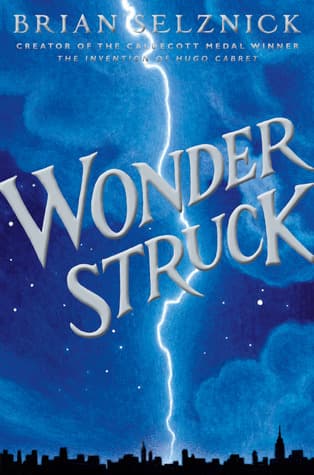
Brian Selznick (2011)
Genre
Children's / Historical Fiction / Mystery / Young Adult
Reading Time
1200 min
Key Themes
See below
Sign in to track this book
A deaf boy's search for his unknown father in 1977 connects with a runaway deaf girl's search for a silent film star in 1927, their journeys told through words and illustrations.
In 1977, ten-year-old Ben Wilson lives with his aunt and uncle in Gunflint Lake, Minnesota, after his mother, Elaine, died in a car accident. Ben is deaf in one ear and wants to know his biological father, a secret his mother kept. One night, a lightning strike hits their house, and Ben, trying to call for help, is deafened in his remaining ear, leaving him completely silent. While searching his mother's room for a book, he finds a bookmark with an inscription: 'Boy of the Stars, June 1977.' Inside the book, 'Wonderstruck,' he discovers a faded photograph of a woman with a similar inscription. This discovery makes him determined to find his father, believing the clues are connected.
Fifty years earlier, in 1927, a young deaf girl named Rose is confined to her strict father's house in Hoboken, New Jersey. She communicates through drawing and loves silent films, especially the actress Lillian Mayhew. Rose feels isolated. After a frustrating argument with her father, who forbids her from leaving the house, she secretly packs a bag and takes a ferry to New York City. She intends to find Lillian Mayhew, whom she idolizes and believes might offer her a sense of belonging in a world that seems to ignore her.
After the accident, Ben finds a matchbook from a bookstore in New York City, 'The Boy of the Stars.' Convinced this is connected to his father, Ben secretly takes money and runs away from home, boarding a bus to New York. His journey is difficult due to his deafness, making communication hard and leaving him disoriented in the bustling city. He carries the photograph and the book, his only links to his past and his quest. He arrives at the American Museum of Natural History, a place he believes holds further clues, as it was mentioned in his mother's belongings.
Rose arrives in New York City and immediately goes to the theater district, searching for Lillian Mayhew. She uses her drawings to ask for directions, her determination strong despite the overwhelming new environment. She eventually finds the theater where Lillian Mayhew is performing, but her attempts to meet the actress are stopped by stagehands and the actress's unapproachability. Rose is heartbroken to discover that Lillian Mayhew, her supposed mother, is not interested in connecting with her, leaving Rose feeling more lost and alone than ever.
Ben sneaks into the American Museum of Natural History, hoping to find answers. He hides overnight, exploring the vast halls. He is particularly drawn to a diorama of a wolf howling in the woods, which reminds him of his home in Minnesota. During his exploration, he meets a friendly museum employee, Jamie, who offers him food and comfort, recognizing Ben's distress. Jamie shows Ben a secret diorama of a small, isolated town, which Ben recognizes as Gunflint Lake, Minnesota, created by his mother, Elaine, revealing a deeper connection to the museum than he first realized.
After her disappointment with Lillian Mayhew, Rose is found by her older brother, Walter, who has been searching for her. Walter takes her to his apartment, providing her with a safe place. He introduces her to the deaf community in New York City, where Rose finally feels a sense of belonging. She learns American Sign Language (ASL) and begins to build a new life, finding comfort among people who share her experiences, a stark contrast to her previous isolation.
Jamie takes Ben to the archives of the American Museum of Natural History. There, Ben discovers a collection of his mother's work as a diorama artist, including sketches and models. He also finds a photograph of a woman with a familiar inscription. Jamie, through written notes, reveals that the woman in the photograph is Rose, Ben's grandmother, and that Rose worked at the museum as well. This discovery provides a key link in Ben's quest, shifting his focus from his unknown father to his grandmother's story.
The story shifts to Rose's adult life. She becomes a diorama artist at the American Museum of Natural History, creating detailed scenes. She marries and has a son, Ben's father. Rose's passion for her work is clear, and she puts her own experiences and observations into her creations. She also continues to value her connection to the deaf community, remaining a part of it while pursuing her artistic career and raising her family.
Jamie leads Ben to a small, hidden house near the museum. Inside, Ben finds an elderly woman surrounded by paper models and miniature worlds—Rose. Through drawings and notes, Rose reveals her life story, her deafness, her journey to New York, and her connection to Ben's mother, Elaine. She explains that Elaine was her daughter, Ben's mother, and that Ben's father was a man she met. Ben also learns that the book 'Wonderstruck' was a shared favorite between Rose and Elaine, and the 'Boy of the Stars' was a nickname for a diorama Elaine created.
Rose tells Ben about her life, and Ben shares his own story of loss and his journey to find his father. Rose, through her drawings, reveals that Ben's father was a kind man she met, but their relationship was brief, and he was unaware of Elaine's birth. The true 'Boy of the Stars' was a diorama of Ben's father created by Elaine for Rose. Ben realizes that his quest to find his father has instead led him to his grandmother and a deeper understanding of his mother's past. The shared experience of deafness and their connection through Elaine brings them comfort and a sense of belonging.
Ben spends time with Rose, learning about his family history and finding peace in his new understanding. Rose shares her passion for creating miniature worlds, which deeply resonates with Ben. He realizes that while he may never know his biological father, he has found a loving grandmother and a connection to his past through his mother's artistic legacy. The story concludes with Ben and Rose looking out at the city, a symbol of their shared journey and the wonder of their unexpected connection, ready to embrace a future together.
The Protagonist
Ben transforms from a grieving, isolated boy searching for an unknown father into a connected individual who finds family and belonging through his grandmother, Rose, and a deeper understanding of his mother's life.
The Co-protagonist
Rose evolves from an isolated, rebellious girl seeking an unattainable idol into a self-sufficient artist and a loving family matriarch, finding her true place and voice within the deaf community.
The Supporting/Catalyst
Though her arc is largely completed before the story begins, her legacy of art and hidden truths is revealed, culminating in Ben's understanding of his family.
The Supporting
Jamie serves as a compassionate guide for Ben, facilitating his discovery of his family history without undergoing a personal arc himself.
The Mentioned/Supporting
Lillian Mayhew serves as a catalyst for Rose's initial journey but ultimately proves to be a false hope, redirecting Rose towards her true family and community.
The Supporting
Walter acts as a supportive sibling, providing Rose with crucial assistance and connection to the deaf community, without a significant personal arc.
Both Ben and Rose embark on quests driven by a need for connection. Ben seeks his unknown father, a missing piece of his identity, while Rose, isolated by her deafness, yearns for someone who understands her, initially projected onto Lillian Mayhew. Their journeys show the human desire to find one's place and to be understood. Ben's arrival at the museum and his meeting with Rose, and Rose's discovery of the deaf community, are examples of this theme, as they both find solace and belonging in unexpected places.
“Maybe we all have a secret world in us. Maybe we all have a wonder. And maybe that wonder is what makes us whole.”
Art, in its various forms—drawings, dioramas, and the book's structure—is central to the narrative. Rose communicates through her drawings, which later become her career as a diorama artist. Elaine, Ben's mother, also uses dioramas to tell stories and leave clues. The very format of 'Wonderstruck,' with its alternating prose and illustrations, shows how different artistic mediums can convey powerful narratives and connect people across time and silence. Art becomes a language that transcends words and deafness, linking generations.
“A picture is worth a thousand words. But a story, a real story, is worth a million pictures.”
Deafness is a fundamental aspect of the characters' identities and experiences. Both Ben and Rose navigate a hearing world that often misunderstands them. The book portrays the isolation of deafness, especially before the widespread use of ASL. However, it also celebrates deaf culture and the ways deaf individuals communicate and connect. Rose's discovery of the deaf community and Ben's reliance on visual cues and written notes highlight the resilience in finding ways to bridge the communication gap.
“He was learning that silence had a language all its own.”
The novel weaves together two seemingly separate stories across fifty years, revealing their connection. Ben's quest in 1977 is directly linked to Rose's journey in 1927, and their lives converge through Elaine. This theme emphasizes how past events and family histories shape present lives. The clues left by Elaine, the museum's archives, and the shared experience of deafness create a family connection that spans generations, showing that even secrets from the past can lead to discovery and belonging.
“The past was always there, waiting to be discovered, waiting to connect to the present.”
Two parallel stories, one in prose and one in illustrations, unfold simultaneously.
The book employs a unique narrative structure, alternating between Ben's story told in prose (1977) and Rose's story told entirely through intricate pencil illustrations (1927). This device not only creates suspense as the reader tries to piece together the connection but also powerfully conveys the experience of deafness. Rose's silent world is mirrored by her visual narrative, while Ben's internal thoughts are expressed through words, even as his external world falls silent. This structural choice is central to the book's themes of communication and different ways of experiencing the world.
A central setting and a repository of clues and connections.
The museum serves as a pivotal setting for both Ben and Rose's stories, though at different times. For Ben, it's the destination of his quest, a place where his mother worked and left clues. For Rose, it becomes her workplace and a place of belonging and artistic expression. The museum acts as a metaphorical 'cabinet of wonders,' holding not just scientific exhibits but also the hidden histories and personal connections of the characters. Its vast archives and dioramas are instrumental in revealing the intricate links between Ben, Elaine, and Rose.
Miniature worlds that reflect and reveal character experiences and memories.
Dioramas are a recurring motif and a significant plot device. Both Rose and Elaine are diorama artists, creating detailed miniature scenes that capture moments, memories, and dreams. For Rose, dioramas are a form of storytelling and self-expression; for Elaine, they become a way to leave clues for Ben. The dioramas within the museum and in Rose's home serve as tangible representations of their inner worlds, their artistic legacy, and the interconnectedness of their lives, providing visual narratives that transcend spoken language.
A titular book and a cryptic message that initiate Ben's journey.
The book 'Wonderstruck' itself, found in Elaine's belongings, along with the inscription 'Boy of the Stars, June 1977,' acts as the primary catalyst for Ben's quest. It's a seemingly innocuous object that holds deep personal meaning and a hidden history. The inscription and the photograph found within the book are the initial breadcrumbs that lead Ben to New York City. This device highlights how small, personal objects can carry immense significance and propel a character's journey of discovery.
“We all have our secrets, and sometimes, you have to find out what they are.”
— Jamie's grandfather reflecting on secrets and discovery.
“Maybe the secret to life is to make a really good story.”
— Ben thinking about the narratives people create.
“Every object has a story, if you know how to look for it.”
— Rose's perspective on the significance of artifacts.
“The world is full of things you don't know, and that's okay.”
— A comforting thought amidst the mysteries Ben encounters.
“Sometimes you have to be quiet to hear the most important things.”
— Rose's experience as a deaf child, emphasizing non-auditory perception.
“Museums are places where time stops and stories begin.”
— Ben's realization about the power of museums.
“It's funny how you can live your whole life and not know something truly important about yourself.”
— Ben's internal monologue as he uncovers family history.
“A book is a world you can hold in your hands.”
— A general reflection on the immersive nature of reading.
“The universe is a pretty big place, and we're all just trying to find our way.”
— A moment of existential reflection for one of the characters.
“Silence can be a language all its own.”
— Rose's experience and understanding of communication beyond words.
“Sometimes you have to break the rules to find out what's real.”
— Ben's adventurous spirit leading him to uncover truths.
“The past isn't always gone; sometimes it's just waiting to be found.”
— A recurring theme as both protagonists delve into history.
“We are all connected, even across time and distance.”
— The overarching message of the book about interwoven lives.
“To be lost is to be found, in a way.”
— Ben's journey of being lost in New York leading to self-discovery.
Ready to see how well you understood this book? Take our interactive quiz with 10 questions.

Brian Selznick is a Caldecott Medal-winning author and illustrator celebrated for his unique blend of text and art. His notable works, including 'The Invention of Hugo Cabret,' 'Wonderstruck,' and 'The Marvels,' combine intricately illustrated narratives with compelling prose. Selznick's distinctive style bridges the gap between children's literature and fine art, captivating readers of all ages.

Dan Gemeinhart
4.5
Kate O'Hearn
4.4

Jeanne Birdsall
4.4

Jen Wang
4.4
Wendelin Van Draanen
4.3

John Marsden
4.3

Chris Van Allsburg
4.3
Jennifer A. Nielsen
4.2