“The way to a man's heart is through his stomach. The way to a woman's heart is through her ears.”
— Lucas Davenport reflecting on relationships and persuasion.

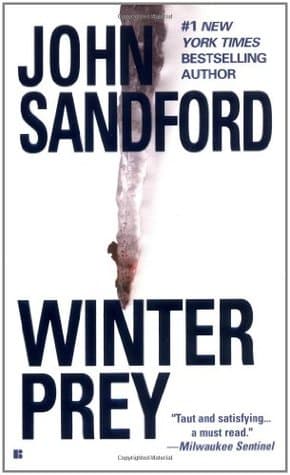
John Sandford (1993)
Genre
Thriller / Mystery
Reading Time
400 min
Key Themes
See below
Sign in to track this book
Detective Lucas Davenport hunts the 'Iceman,' a serial killer who anticipates his every move, turning the frigid north into a deadly game.
The book starts with the discovery of the Shrake family—father, mother, and two children—murdered in their isolated cabin near Siren, Wisconsin. The killer, named 'The Iceman' by the media, cleaned the scene carefully, leaving little evidence. The killings, done with a sharp knife to the throat, and the careful disposal of bodies in a frozen lake, point to a highly organized and ruthless person. Local police, overwhelmed, ask the Minnesota Bureau of Criminal Apprehension (BCA) for help, specifically requesting Lucas Davenport due to his reputation with complex serial killer cases. The initial investigation is difficult because of the remote location and the killer's thoroughness.
Lucas Davenport, a top BCA investigator, is sent to Siren, Wisconsin, to lead the Shrake murder investigation. He is immediately struck by the desolate, snow-covered land and the fear in the small community. Working with local Sheriff Roy Johnson and FBI agent Frank Johnson, Lucas examines the limited evidence, including the unusual use of a corn knife and the calculated body disposal. He quickly realizes this is not random violence but the work of an intelligent and methodical killer who seems to be one step ahead, almost anticipating their moves. Lucas feels an immediate, chilling connection to the killer's cold precision.
Before investigators can make much progress on the Shrake case, the Iceman strikes again, murdering the Delmonico family in a similar way in another remote cabin. This second attack confirms Lucas's fear that they are dealing with a serial killer who acts with chilling regularity. The pattern of targeting isolated families in winter in similar areas strengthens the profile of a predator familiar with the region and its harsh conditions. Pressure on Lucas grows as media arrives and the public demands answers. He becomes convinced the killer is not random but perhaps targets specific types of families or locations, though the motive remains unclear.
The Iceman escalates his psychological warfare by leaving cryptic notes at the second crime scene, seemingly for Lucas. These messages are not just taunts but hint at a close knowledge of police procedures and Lucas's own style. This suggests the killer is either very well-informed or has a personal connection to law enforcement or Lucas himself. Lucas sees these taunts as a deliberate attempt to engage him in a cat-and-mouse game, complicating the investigation and making it personal. The team tries to decipher the notes, hoping for a breakthrough, but they only deepen the mystery and tension.
Working with FBI profilers, Lucas and his team begin to build a psychological profile of the Iceman. They conclude the killer is likely local, or someone with extensive knowledge of the remote Wisconsin and Minnesota border area, given his ability to navigate harsh winters and choose isolated targets. The killer is likely intelligent, meticulous, and possibly has a severe personality disorder. The use of the corn knife, an older tool, also interests Lucas, suggesting a connection to rural life or specific skills. The profile helps narrow suspects, but finding a specific person remains a difficult task.
Frustrated by the lack of direct leads, Lucas decides to try a more aggressive tactic: he sets a trap. He leaks false information to the media about a potential witness or new evidence, hoping to provoke a reaction from the Iceman. He also strategically places undercover officers in areas he believes the killer might frequent or target next. The plan is risky, relying on the killer's ego and desire to stay ahead of the police. Lucas expects the Iceman to either verify the information or move against the perceived threat, thus revealing himself. This calculated gamble shows Lucas's willingness to bend rules to catch a killer.
The Iceman responds to Lucas's trap, not by falling into it, but by attacking the investigative team directly. One of Lucas's officers is attacked, barely surviving. This confirms Lucas's suspicion that the killer is not just watching them but actively studying their moves and plans. It also suggests a personal vendetta or deep hatred for law enforcement. The killer's ability to infiltrate their operations and strike so close sends a chilling message and raises the stakes. Lucas realizes the Iceman is not just a serial killer but a skilled opponent who sees the investigation as a personal challenge.
Through careful investigation, Lucas finally connects the clues, realizing the killer's precision, knowledge of police procedures, and specific weapon point to a former police officer. He discovers the Iceman is Richard 'Dick' LaChaise, a former officer forced out years ago due to psychological issues and violence. LaChaise harbors deep resentment against the system and those he feels wronged him. His familiarity with the terrain and ability to avoid capture are explained by his past training and local connections. This discovery makes the hunt even more personal and dangerous for Lucas.
Knowing the Iceman's identity, Lucas and a small team track LaChaise to a remote, fortified cabin deep in the Wisconsin wilderness. The harsh, snow-covered environment makes the approach difficult and dangerous. LaChaise, aware he's been found, has prepared for a final showdown, setting booby traps and defensive positions. Tension fills the air as Lucas leads his team through the frozen landscape, knowing they are walking into a deadly ambush. He understands LaChaise will not be taken alive easily and prepares for a brutal fight.
The confrontation turns into a deadly cat-and-mouse game in the snowy woods around LaChaise's cabin. LaChaise, a master of survival and ambush tactics, uses the terrain and his knowledge to his advantage, picking off members of Lucas's team. Lucas, in turn, uses his own tactical skills and understanding of criminal psychology to anticipate LaChaise's moves. The battle is physically and mentally exhausting, pushing both men to their limits in the freezing conditions. The stakes are incredibly high, as Lucas knows that failure means not only his own death but the continued terror of the Iceman.
In a final, brutal one-on-one fight, Lucas Davenport corners Richard LaChaise. The fight is intense and desperate, showing the personal nature of their conflict. Lucas, despite injuries and exhaustion, outwits and overpowers LaChaise, killing him. The victory is hard-won, leaving Lucas deeply affected by the violence and the psychological cost of facing such a formidable and disturbed opponent. The Iceman's death ends the terror, but the experience leaves a lasting mark on Lucas, reinforcing the dark realities of his job. He ensures LaChaise's body is identified, closing the case.
The Protagonist
Lucas confronts his most formidable and personal adversary yet, forcing him to rely on his instincts and resilience, further solidifying his reputation as a tenacious and effective hunter of killers.
The Antagonist
LaChaise escalates his reign of terror and psychological warfare, ultimately leading to his demise at the hands of Lucas Davenport, confirming his nature as an unredeemable force of destruction.
The Supporting
Johnson learns to trust and rely on Lucas's expertise, growing in his understanding of complex criminal investigations.
The Supporting
Johnson navigates inter-agency dynamics and contributes vital resources, learning to adapt his rigid approach for the unique challenges of the case.
The Supporting
Delaware remains a steadfast and reliable member of Lucas's team, demonstrating his continued commitment and competence.
The Supporting
Morrow consistently performs his duties effectively, highlighting the strength and dedication of Lucas's supporting cast.
The Mentioned
Their tragic deaths initiate the central conflict of the novel.
The Mentioned
Their deaths confirm the serial nature of the killer and intensify the investigation.
The novel explores the chilling and calculated nature of evil through Richard LaChaise, the Iceman. His careful planning, lack of empathy, and personal vendetta highlight a cold, almost inhuman capacity for violence. The murders of entire families, including children, show the horrific depths of his depravity. Lucas Davenport tries to understand this level of evil, not just to catch the killer, but to grasp the darkness that drives him. The theme appears in the contrast between the brutal acts and the killer's methodical, almost clinical execution, like the careful disposal of bodies in frozen lakes.
“He wasn't just a killer; he was a machine of death, cold and efficient.”
The remote, snow-covered landscape of northern Wisconsin and Minnesota serves as a powerful setting, emphasizing isolation and the vulnerability it creates. The Iceman targets families in secluded cabins, using their distance from help and the harsh winter conditions that make detection difficult. This geographical isolation mirrors the emotional and psychological isolation of the victims. Lucas Davenport feels a similar isolation as he enters the killer's world, realizing how few people truly understand the darkness he faces. The desolate setting increases the terror, making escape or intervention seem impossible for the victims.
“In the deep snow, nobody could hear you scream.”
This theme is central to the entire story, showing a relentless cat-and-mouse game between Lucas Davenport and the Iceman. Both are skilled predators, each trying to outwit the other. The Iceman's taunts and direct targeting of Lucas's team turn the investigation into a personal battle. Lucas, in turn, uses his own cunning and unconventional methods to track and corner the killer. The dynamic highlights the psychological warfare involved, where the investigator often has to think like the criminal to catch them. The climax in the snowy wilderness is the ultimate example of this theme, with Lucas becoming the hunter and LaChaise the cornered prey.
“He knew the killer was watching, waiting, playing his own game.”
The novel explores the blurred lines between justice and vengeance, especially through Lucas Davenport. While Lucas wants justice for the victims, his pursuit of the Iceman becomes increasingly personal, almost vengeful, especially after the killer targets his team. The Iceman himself is driven by a distorted sense of vengeance against a system he feels wronged him. This contrast forces Lucas to confront his own motivations and the potential for his methods to cross ethical boundaries. The brutal final confrontation raises questions about the cost of achieving justice against such an extreme evil.
“Sometimes, justice looks a lot like revenge.”
Misleading clues or suspects designed to divert the investigation.
Several red herrings are introduced throughout the investigation, particularly in the initial stages. The Iceman's meticulousness and deliberate cleaning of crime scenes, coupled with the remote locations, initially lead investigators down various dead ends, suggesting random violence or local disputes. These diversions serve to heighten the suspense and illustrate the killer's cunning, making Lucas's eventual breakthrough all the more impressive. They also highlight the challenges of real-world police work, where initial assumptions can be misleading and evidence scarce.
The killer's use of taunts and intimidation against the protagonist.
The Iceman engages in psychological warfare against Lucas Davenport and his team. This is evident through the cryptic notes left at crime scenes, which are specifically designed to provoke and taunt Lucas, showing an intimate knowledge of his methods and personality. The Iceman also targets members of Lucas's team, escalating the personal stakes. This device creates immense tension and makes the hunt a deeply personal and emotionally taxing battle for Lucas, forcing him to confront the killer not just physically but mentally, pushing him to his limits.
The harsh winter landscape acts as both a character and an obstacle.
The severe winter environment of northern Wisconsin and Minnesota functions as a significant plot device, acting almost as an additional character and a major obstacle. The deep snow, freezing temperatures, and isolated terrain provide cover for the Iceman, making his movements difficult to track and enhancing the vulnerability of his victims. It also poses significant challenges for Lucas and his team, slowing down their investigation and adding an element of physical danger to their pursuit. The environment amplifies the sense of dread and isolation, making the killer's actions seem even more chilling.
A unique weapon providing a distinct killer signature.
The specific use of a corn knife as the murder weapon is a crucial plot device. This unusual and somewhat archaic tool serves as a distinctive signature for the Iceman. It helps Lucas and his team to profile the killer, suggesting a connection to rural life, specific skills, or even a past profession. The uniqueness of the weapon helps narrow down the potential suspect pool and provides a tangible, if initially baffling, piece of evidence that eventually leads to the killer's identification. It's a small detail that holds significant investigative weight.
“The way to a man's heart is through his stomach. The way to a woman's heart is through her ears.”
— Lucas Davenport reflecting on relationships and persuasion.
“There are no atheists in foxholes, and no innocent people in police stations.”
— A cynical observation by Lucas Davenport about the nature of police work and guilt.
“The problem with being a cop is that you see too much of the bad in people, and not enough of the good.”
— Lucas Davenport pondering the psychological toll of his profession.
“Sometimes the only way to catch a monster is to think like one.”
— Lucas Davenport's internal monologue about the mindset required for hunting dangerous criminals.
“Fear is a great motivator, but it's a terrible guide.”
— Lucas Davenport considering the role of fear in the actions of both victims and perpetrators.
“The dead can't speak, but they tell stories if you know how to listen.”
— Lucas Davenport on the art of forensic investigation and understanding crime scenes.
“He knew that sometimes the most important thing a cop could do was simply show up.”
— Reflecting on the presence and impact of law enforcement in a crisis.
“There’s a thin line between genius and madness, and most of the people I deal with walk it every day.”
— Lucas Davenport's assessment of the criminals and sometimes even his colleagues.
“The wind howled like a banshee, tearing at the trees, a fitting soundtrack to the chaos.”
— Describing the harsh winter weather mirroring the tumultuous events.
“Every secret has a price, and some of them are paid in blood.”
— A reflection on the consequences of hidden truths in the investigation.
“He had a gut feeling, and Lucas had learned to trust his gut more than any computer printout.”
— Lucas Davenport relying on his intuition during the investigation.
“Justice wasn't always about the law; sometimes it was about making things right.”
— Lucas Davenport's personal philosophy on the broader scope of justice.
“The cold was a living thing, a predator in its own right.”
— Personifying the severe winter conditions as an additional antagonist.
“He preferred the messy reality of the streets to the sterile order of the office.”
— Lucas Davenport's preference for fieldwork over administrative tasks.
Ready to see how well you understood this book? Take our interactive quiz with 10 questions.

Biography coming soon.







