“History is not a story for the faint of heart. It is a chronicle of brutality, stupidity, and courage.”
— A reflection on the nature of the historical period being depicted.

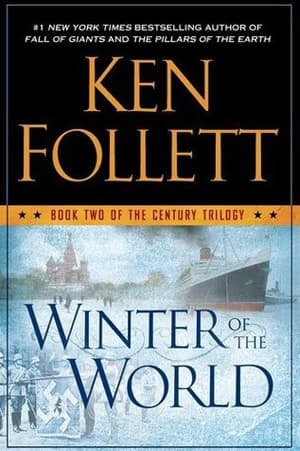
Ken Follett (2012)
Genre
Historical Fiction
Reading Time
25-30 hours
Key Themes
See below
Sign in to track this book
As the Third Reich rises and World War II begins, five families from America, Germany, Russia, England, and Wales navigate battlefields, politics, and personal sacrifices that define a generation caught between fascism, communism, and the atomic age.
In Berlin, 1933, Carla von Ulrich, daughter of German aristocrat Otto von Ulrich and Englishwoman Ethel Leckwith, sees the fast growth of Nazi power. Her brother Erik, a strong Nazi, argues with their father, who secretly opposes Hitler. Carla's Jewish friend, Werner Franck, and his family face increasing threats, leading to Werner's forced move. Carla herself is horrified by the book burnings and the SA's violence. Her boyfriend, Peter von der Helldorf, a journalist, uses his job to subtly resist the regime, while Carla joins a secret group helping Jews escape, risking her life.
Lloyd Williams, a Welsh socialist, goes to Spain to fight for the Republican cause against Franco's Fascists. He quickly becomes disappointed by the fighting among Republican groups, especially the Communists' harsh treatment of anarchists and Trotskyists. He meets Volodya Peshkov, a clever and cruel Soviet intelligence officer, who is in Spain to remove perceived enemies of Stalin within the Republican ranks. Lloyd sees the horrors of war and the moral compromises made by both sides, deeply changing his political beliefs and making him question any ideology.
In Washington D.C., Woody Dewar, son of Senator Gus Dewar, works as a legislative aide, seeing the political dealings around President Roosevelt's administration. He gets involved with Daisy Peshkov, Volodya's American cousin, a socialite more interested in status than politics. Meanwhile, Woody's brother, Chuck Dewar, a talented musician, struggles with alcoholism and secret homosexuality, which is a major social taboo at the time. As Europe goes to war, the brothers' paths split, with Woody drawn into political efforts to prepare America for conflict and Chuck facing his own personal struggles.
As World War II begins, London becomes a target for the Luftwaffe's bombing, the Blitz. Ethel Leckwith, now a Member of Parliament, works hard to support the war and help her constituents. Lloyd Williams, back from Spain, becomes an air raid warden, seeing the terror and strength of the British people. Daisy Peshkov, at first uninterested in the war, volunteers as an ambulance driver during the Blitz, seeing terrible injuries and finding a new sense of purpose and care, changing her shallow view.
Operation Barbarossa, the German invasion of the Soviet Union, devastates the Red Army. Volodya Peshkov, using his intelligence skills and ruthlessness, moves up in the NKVD, taking part in counter-espionage and political purges. He sees the huge amount of suffering and destruction on the Eastern Front, where millions die. Despite the Soviet regime's brutality, Volodya remains committed to its survival, believing it is the only way to defeat the Nazi threat, even if it means sacrificing many lives and personal morals.
Carla von Ulrich continues her dangerous work helping Jews and anti-Nazis. She falls in love with Peter von der Helldorf, who is also secretly involved in the German resistance. They marry, but their happiness is short-lived. Peter is involved in the July 20 plot to kill Hitler and is executed. Carla, pregnant with his child, is arrested and tortured by the Gestapo but refuses to betray her comrades. She endures great hardship in a concentration camp, showing courage and strength in the face of evil.
Chuck Dewar, looking for an escape and purpose, joins the U.S. Marines and is sent to the Pacific Theater. He experiences the brutal conditions of island hopping campaigns against the Japanese, seeing terrible violence and loss. In the Pacific, Chuck forms a strong bond with another marine, finding parts of his identity he had hidden. The war forces him to face his fears, his sexuality, and the real cost of conflict, changing his view on life and his place in the world.
Woody Dewar, now a key aide to President Roosevelt and later Truman, attends important wartime conferences like Yalta and Potsdam. He sees the complex and often tense talks between the Allied powers, especially the growing distrust between the Western democracies and the Soviet Union. Lloyd Williams, now a rising Labour politician in Britain, also attends these conferences, arguing for a post-war world based on social justice and international cooperation. Both men get a direct look at the power struggles that will shape the coming Cold War.
The development and use of the atomic bombs on Hiroshima and Nagasaki mark a terrifying shift in human history. Woody Dewar, aware of the discussions and decisions, struggles with the huge moral impact of this new weapon. Volodya Peshkov, tasked with getting atomic technology secrets for the Soviet Union, increases his spy efforts, seeing the strategic need to match American power. The bombings solidify the start of the Cold War, creating a world with two superpowers and the threat of nuclear war.
As the war ends, the characters deal with its lasting impact. Carla von Ulrich, having survived the concentration camp, works to expose Nazi crimes and rebuild Germany. Lloyd Williams works to create the National Health Service in Britain, driven by his socialist beliefs. Volodya Peshkov continues to rise in Soviet intelligence, becoming a key player in the Cold War. Woody Dewar, now a prominent American politician, faces the rise of McCarthyism and the challenges of a divided world, while Daisy Peshkov finds new purpose in journalism, covering the changing global situation.
The Protagonist
Carla transforms from an idealistic young woman into a hardened survivor and advocate, forever marked by the atrocities she witnesses but never broken in spirit.
The Protagonist
Lloyd evolves from an idealistic revolutionary into a pragmatic yet principled statesman, learning that achieving justice often requires navigating difficult political realities.
The Protagonist/Antagonist
Volodya steadily ascends the ranks of Soviet intelligence, becoming a powerful and morally compromised figure, shaping the Cold War landscape.
The Protagonist
Woody matures from a promising political staffer into a seasoned and influential politician, facing the challenges of a post-war world with a growing understanding of global power dynamics.
The Protagonist
Daisy undergoes a significant transformation from a shallow socialite to a compassionate, purposeful woman, finding her voice and independence through the crucible of war.
The Supporting
Chuck's journey is one of self-discovery and acceptance, as he confronts his inner demons and finds strength in his true identity amidst the crucible of war.
The Supporting
Ethel continues to serve as a steadfast political figure, navigating the complexities of war and post-war reconstruction with unwavering dedication.
The Supporting
Otto maintains his moral integrity and quiet defiance throughout the Nazi era, acting as a crucial, albeit covert, force of resistance.
The Supporting
Peter's arc is one of selfless sacrifice, choosing to fight for freedom even at the cost of his own life and future with Carla.
The novel shows how extreme ideas, both Fascism and Communism, can corrupt people and societies, causing great suffering and moral compromises. The rise of Nazism in Germany, seen through Carla von Ulrich's eyes, shows the systematic mistreatment of Jews and political opponents. Lloyd Williams's disappointment in the Spanish Civil War, seeing Communist purges, highlights how even movements fighting for freedom can become oppressive. Volodya Peshkov shows the ultimate corruption, giving up all morals for the Soviet state. The theme points out the danger of blindly following any single belief system, showing how it can justify terrible acts and suppress individual conscience.
“History is a merciless judge. It will judge us all.”
Despite the great power of totalitarian regimes, the novel celebrates the lasting human spirit of resistance. Carla von Ulrich's secret work helping Jews, her courage during Gestapo questioning, and her survival in a concentration camp are central to this theme. Peter von der Helldorf's part in the German resistance and his final sacrifice further show this. Ethel Leckwith's strong commitment to her constituents during the Blitz, and the everyday bravery of ordinary citizens, also highlight resilience. This theme emphasizes that even in the darkest times, people can choose to fight for their values, often at great personal cost, showing the strong will for freedom and justice.
“To give in to evil is to become evil yourself.”
The novel shows the devastating personal cost of World War II and the earlier political conflicts on its characters. Families are broken apart by differing ideas, like the von Ulrichs with Erik's Nazi beliefs. Love is lost, as seen in Carla's grief over Peter's execution. Characters suffer physical and mental trauma, from Chuck Dewar's experiences in the brutal Pacific Theater to Carla's torture and imprisonment. The constant threat of death, the loss of loved ones, and the destruction of homes and communities are always present. This theme stresses that behind the large historical stories are countless individual tales of suffering, sacrifice, and lasting change, leaving a deep mark on an entire generation.
“War takes everything, and gives nothing back.”
Winter of the World shows how personal stories and national events are connected globally. The families from different nations—Germany, Britain, America, Russia—find their lives crossing paths and directly affected by major historical moments. The rise of Nazism in Germany leads to global war, affecting soldiers in the Pacific and politicians in Washington. The Spanish Civil War serves as a testing ground for ideas that will clash in WWII. The atomic bomb's development by America immediately triggers a race for similar technology in the Soviet Union. This theme emphasizes that in the modern world, no nation or person exists alone; actions in one part of the world have effects across continents, shaping everyone's future.
“The world is a smaller place than we ever imagined. What happens in one corner affects us all.”
Many characters change personally because of the war and political unrest. Daisy Peshkov, at first a shallow socialite, is awakened by the horrors of the Blitz and finds purpose through her wartime service and later journalism. Chuck Dewar faces his hidden identity and finds strength amid the brutal realities of the Pacific Theater. Lloyd Williams's idealism is softened by the harsh realities of the Spanish Civil War, leading him to a more complex understanding of politics. These changes show how extreme situations can remove old ideas and force people to face their true selves, leading to unexpected growth and a new look at their values and priorities.
“Sometimes, you have to lose everything to find out who you really are.”
The story is told through the eyes of several interconnected families across different nations.
This device allows Ken Follett to provide a panoramic view of World War II and the Cold War's nascent years. By shifting perspectives between characters like Carla in Germany, Lloyd in Britain, Woody in America, and Volodya in Russia, the reader gains a comprehensive understanding of how the same historical events were experienced and interpreted differently across various cultural and political landscapes. It highlights the global reach of the conflict and the diverse human responses to it, fostering empathy for characters on all sides (except the truly villainous). This structure also effectively demonstrates the interconnectedness of their lives.
Fictional characters are deeply embedded in real historical events and interact with historical figures.
Follett seamlessly integrates his fictional narratives with meticulously researched historical events, such as the rise of Nazism, the Spanish Civil War, the London Blitz, the Eastern Front, the Pacific War, and the Yalta Conference. Characters like Woody Dewar interact directly with figures like President Roosevelt and Truman, while others like Carla and Lloyd are caught in the direct path of major historical currents. This device grounds the fiction in reality, making the historical context more accessible and engaging, and demonstrating how grand historical movements impact individual lives. It adds a layer of authenticity and educational value to the narrative.
The narrative follows the children of the previous generation from 'Fall of Giants'.
Building upon the first book in the century trilogy, 'Winter of the World' continues the stories of the families introduced previously, focusing on the next generation. This creates a sense of continuity and allows for the exploration of evolving political and social ideas across decades. The children inherit their parents' legacies, both positive and negative, and grapple with new challenges. This device enriches the character development by showing how historical events shape not just individuals but entire family lines and their collective destinies, creating a deeper, more resonant emotional impact over time.
Characters are frequently forced to make difficult ethical choices in extreme circumstances.
Throughout the novel, characters face profound moral dilemmas, often with no easy answers. Carla must choose between personal safety and resistance; Lloyd grapples with the ideological compromises of the Republican cause in Spain; Volodya makes ruthless decisions for the Soviet state; and Woody confronts the ethical implications of the atomic bomb. This device explores the complexities of human morality during wartime, showing how individuals are pushed to their limits and forced to redefine their ethical boundaries. It adds depth to the characters and provokes readers to consider what they would do in similar situations.
“History is not a story for the faint of heart. It is a chronicle of brutality, stupidity, and courage.”
— A reflection on the nature of the historical period being depicted.
“The greatest enemy of truth is very often not the lie—deliberate, contrived, and dishonest—but the myth—persistent, persuasive, and unrealistic.”
— Discussing the power of propaganda and national myths during wartime.
“Peace is not merely the absence of war, but the presence of justice.”
— A character's philosophical statement on the conditions necessary for true peace.
“Fear is a powerful weapon, and it can turn ordinary people into monsters.”
— Observing the psychological impact of totalitarian regimes and war on individuals.
“Love does not conquer all; it merely tries to survive all.”
— A poignant thought on the enduring but often struggling nature of love amidst global conflict.
“To be silent in the face of injustice is to side with the oppressor.”
— A character's moral imperative to speak out against atrocities.
“The past is never dead. It's not even past.”
— A character reflecting on how historical events continue to shape the present.
“Courage is not the absence of fear, but rather the judgment that something else is more important than fear.”
— Defining courage in the context of characters making difficult, dangerous choices.
“A man's greatest possession is his freedom. No government should ever take it away.”
— A character's strong belief in individual liberty against the backdrop of oppressive states.
“The world was a chessboard, and the pieces were people, moved by forces beyond their control.”
— A metaphor for the geopolitical struggles and the impact on ordinary lives during the war.
“There are no easy answers in a world gone mad.”
— A character grappling with the moral complexities and despair of wartime decisions.
“Even in the darkest times, humanity finds a way to endure, to hope, to fight for a better future.”
— An overarching theme of resilience and optimism despite immense suffering.
“Every generation thinks it's the last to face such a terrible struggle, but the struggle for decency is eternal.”
— A character reflecting on the cyclical nature of conflict and the ongoing fight for human values.
“The truth is a stubborn thing. It can be buried, but it always finds a way to surface.”
— A statement on the eventual revelation of facts, even after attempts to conceal them.
Ready to see how well you understood this book? Take our interactive quiz with 10 questions.

Kenneth Martin Follett, is a British author of thrillers and historical novels who has sold more than 160 million copies of his works.







