“There are three sides to every story: your side, my side, and the truth. And no one is lying. Memories get twisted by the human heart, no matter how pure its intentions.”
— A central theme of the book, reflecting the unreliable narration.

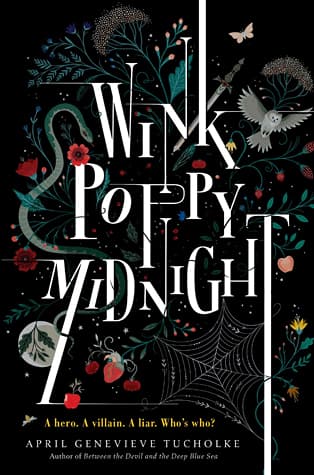
April Genevieve Tucholke (2016)
Genre
Thriller / Fantasy / Mystery / Young Adult / Romance
Reading Time
250 min
Key Themes
See below
Sign in to track this book
A wild-haired girl, a manipulative queen, and the boy caught between them create a dangerous web of secrets and lies in a story where everyone is both hero and villain.
The story introduces Wink, a whimsical, homeschooled girl living in a remote house with her family, who love telling stories. She believes in fairies and magic, often seeing the world through a magical lens. Next, we meet Poppy, the popular and manipulative queen bee of the local high school. She is used to getting her way and sees others as tools for her desires. Finally, Midnight, a quiet, thoughtful boy, is introduced. He is Poppy's current boyfriend but feels more and more uneasy with her behavior and power. Their lives are connected by living near each other and shared history in their small town, setting the scene for the mystery.
Poppy shows her cruel side when she decides to play a nasty trick on Athena, a new girl in town. Poppy, with her friends, lures Athena into the woods under false pretenses, planning to leave her there and scare her. Midnight is reluctantly part of this plan, feeling uncomfortable but unable to stand up to Poppy. The trick goes wrong, and Athena disappears, leading to a frantic search by the townspeople. Poppy, however, acts innocent and concerned, skillfully avoiding suspicion while secretly fearing what she has done.
As the search for Athena grows, Midnight feels more and more disgusted by Poppy's coldness and her seeming lack of regret. He starts spending more time away from her, often near Wink's house. Wink, with her unusual stories and viewpoint, is a sharp contrast to Poppy's shallow world. Midnight is drawn to Wink's genuine nature and her belief in things beyond the ordinary, finding peace and understanding with her that he lacks with Poppy. Their connection deepens as they talk about the missing girl and the strange things happening in their town.
Wink, unlike the practical townspeople, views Athena's disappearance through her family's elaborate stories and her belief in fairies and changelings. She doesn't immediately assume normal reasons, but instead considers that Athena might have been taken by magic, or changed. Her grandmother, a key figure in her life, strengthens these fantasy stories, blurring the lines between real life and myth for Wink. This makes her seem strange to others, but it also lets her notice details and make conclusions that more traditional thinkers might miss, though through a very personal filter.
Athena is eventually found, confused but alive, after being lost in the woods for several days. Her return brings relief but also deepens the mystery of her disappearance. As she slowly gets better, details start to appear, and the first idea that she simply got lost is questioned. Poppy, always manipulative, tries to shift blame and control the story, making herself seem like a worried friend. However, Midnight, who knows the truth about the trick, struggles with his conscience, while Wink, with her unique insights, starts to put together a different story about what really happened and who the true villain might be.
With Athena back and the truth threatening to come out, Poppy becomes more and more paranoid. She fears what she has done and the harm to her carefully built reputation. In her desperation, she starts to lash out, accusing Wink of being strange, manipulative, and even responsible for Athena's trouble. Poppy tries to turn the town against Wink, using her strange reputation and her family's isolated life. These accusations create more tension and division, making it hard for anyone to find the truth among the rumors and Poppy's planned lies, pushing Wink further into isolation.
Midnight is troubled by his part in Poppy's trick and his silence about the truth. He sees Poppy's manipulative behavior firsthand and feels deep guilt for not protecting Athena. His conscience weighs heavily on him, especially as he sees Wink becoming the target of Poppy's mean accusations. He knows he has to choose between protecting Poppy, his long-time girlfriend, and doing what is right. This inner conflict brings him closer to Wink, who offers him an unusual view on truth and consequences, urging him to find his own voice.
Wink, watching the subtle signs and contradictions in Poppy's story and others' reactions, begins to understand what happened. She doesn't rely only on common evidence but combines it with her intuition and her family's storytelling traditions, where 'villains' and 'heroes' are often not what they seem. She sees through Poppy's act and recognizes the underlying fear and manipulation. Her unique approach lets her connect different pieces of information, bringing her closer to the surprising truth about Athena's disappearance and the parts played by everyone involved.
The story reaches its peak when the truth about Athena's disappearance is finally revealed. It turns out that Poppy, wanting to frame Wink and keep her power, had planned a more complex scheme than first thought. Athena, it is revealed, was not just abandoned but also manipulated by Poppy, who wanted to use her as a pawn in her twisted game against Wink. The confrontation exposes Poppy's deep insecurities and her manipulative nature, showing her as the real antagonist. Midnight, finally finding his courage, helps confirm parts of the truth, shattering Poppy's carefully built image.
Afterward, the town deals with the shocking facts about Poppy. Her rule as queen bee ends, and she faces the results of her actions. Midnight is free from Poppy's influence, but he must deal with his own guilt and learn to forgive himself. Wink, once an outcast, earns a new kind of respect, her unique view now seen differently. The story ends with a sense of closure, though with remaining questions about truth, perception, and the stories we tell ourselves and others. The relationships between Wink, Poppy, and Midnight are permanently changed, moving past simple hero/villain/victim roles.
The Protagonist
Wink begins as an isolated, misunderstood girl and evolves into a quiet hero, using her unique perspective to uncover the truth and find her place.
The Antagonist
Poppy starts as an unchallenged manipulator and ultimately faces the downfall of her social empire as her true nature is exposed.
The Protagonist/Conflicted Love Interest
Midnight begins as a passive participant in Poppy's schemes and grows into a character who actively seeks truth and stands up for what is right.
The Supporting/Victim
Athena is a victim of a cruel prank and her experience reveals the true natures of those around her.
The Supporting
Her character remains consistent, serving as a grounding force and source of wisdom for Wink.
The novel constantly makes readers question what is real versus what people believe. Each character's story gives a personal truth, making the reader wonder who to trust. Wink sees fairies, Poppy sees a world to control, and Midnight tries to make sense of both. For example, Athena's disappearance is seen differently by all three: a prank gone wrong by Poppy, a supernatural event by Wink, and a moral problem by Midnight. This idea is key to the mystery, as the 'truth' is only found by putting together these different views.
“Every story needs a hero. Every story needs a villain. Every story needs a secret.”
The book explores how stories shape our understanding of the world and ourselves. Wink's family lives by a complex system of myths and folktales, which Wink uses to understand events. Poppy, on the other hand, constantly makes up her own story to manipulate others and control her image, effectively 'storytelling' her way out of trouble. The novel itself is structured as a series of individual stories, showing how each character's story adds to, and often twists, the overall truth. The ending involves unraveling these conflicting stories to find what truly happened.
“Some stories are meant to be believed. Some stories are meant to be told.”
Poppy shows the theme of manipulation, using her beauty, popularity, and social cleverness to control others. She manipulates Midnight, her friends, and even tries to manipulate Athena and the whole town. Her actions come from a deep need for control and a fear of losing her social status. The novel examines how power works in a small community and the psychological cost it takes on both the person doing the manipulating and the person being manipulated. Midnight's struggle to break free from Poppy's control is a key part of this theme, showing how hard it is to resist such influence.
“Poppy was beautiful, and beauty was power. She knew it. Everyone knew it.”
Each main character works to define themselves. Wink deals with her unique identity, caught between her family's magical world and the more normal society outside. Midnight struggles to find his own identity apart from Poppy's strong influence. Poppy, despite her outward confidence, is driven by a desperate need to keep a specific, powerful identity, fearing that her true, insecure self will be revealed. The town's isolation and the distinct social groups increase these struggles, as characters try to find where they truly belong.
“I was a secret. I was a whisper. I was a dream.”
The story is told from the alternating perspectives of Wink, Poppy, and Midnight.
This device is central to the novel's mystery and theme of perception vs. reality. By presenting the same events through three distinct and often contradictory viewpoints, the author forces the reader to question the reliability of each narrator and piece together the 'truth' from conflicting accounts. This structure highlights the subjectivity of experience and the way personal biases shape understanding. It also builds suspense, as the reader slowly gains information, often withholding crucial details until the very end.
Each character's perspective is colored by their biases, desires, and self-deception.
All three main characters, to varying degrees, serve as unreliable narrators. Wink's fantastical worldview sometimes obscures mundane facts, Poppy deliberately manipulates the truth to protect herself, and Midnight's guilt and fear influence his interpretations. This unreliability is key to the mystery, as the reader cannot fully trust any single account, constantly re-evaluating events as new perspectives are introduced. It directly supports the theme of perception vs. reality, making the reader an active participant in discerning the truth.
Subtle hints and ominous warnings are scattered throughout the narrative.
The novel uses foreshadowing to build suspense and a sense of impending doom. Early mentions of 'secrets,' 'villains,' and the mysterious nature of the woods hint at the darker events to come. Wink's fantastical stories about changelings and faeries, while seemingly whimsical, subtly foreshadow the manipulative and deceptive nature of the real-world 'villains.' These hints create an atmosphere of unease and prepare the reader for the twists and revelations that unfold later in the story, making the resolution feel both surprising and inevitable.
The isolated, often eerie, rural setting contributes to the mysterious and unsettling atmosphere.
The novel's setting in a small, isolated town surrounded by dense woods evokes a sense of rural gothic. The remote location, coupled with Wink's family's old, mysterious house and the general lack of external influence, creates an insular community where secrets fester and rumors thrive. The woods themselves become a character, a place of both enchantment and danger, where the prank occurs and Athena disappears. This setting enhances the mystery and the feeling of being cut off from conventional justice, allowing the characters' internal conflicts and manipulations to play out in a heightened, almost mythical, way.
“There are three sides to every story: your side, my side, and the truth. And no one is lying. Memories get twisted by the human heart, no matter how pure its intentions.”
— A central theme of the book, reflecting the unreliable narration.
“I was a story made of paper. I was a girl made of secrets.”
— Wink describing herself, highlighting her mysterious nature.
“Love is a maze, a puzzle, a trap. And I was in it, without a map, without a compass, without a clue.”
— One of the characters reflecting on the complexities of love and their feelings.
“Sometimes the most beautiful things are also the most dangerous.”
— A general observation that applies to various characters and situations in the story.
“The past is a funny thing. It’s always there, lurking, waiting to trip you up.”
— A character contemplating the inescapable influence of past events.
“We were all just playing parts in someone else's story, and we didn't even know it.”
— A realization about the manipulative nature of events and relationships.
“Fairytales don't always have happy endings. Sometimes they're just warnings.”
— A darker take on traditional fairytales, reflecting the novel's tone.
“Every secret has a shelf life. Eventually, it spoils.”
— A statement about the inevitable revelation of hidden truths.
“Some people are like stars. They burn so bright, but they burn out fast.”
— A poignant observation about the intensity and transience of certain individuals.
“The house had secrets, too. Old, dusty secrets that clung to the walls like cobwebs.”
— Describing the atmospheric and mysterious setting of the house.
“We were all tangled up, like a ball of yarn, each thread pulling at the others.”
— A metaphor for the interconnected and complex relationships between the main characters.
“Sometimes the monster isn't under the bed. Sometimes the monster is the one you love.”
— A chilling realization about betrayal and the nature of evil.
“Words are powerful things. They can build you up, or tear you down, or twist you into something you're not.”
— Reflecting on the impact of language and perception on identity.
“The truth was a wild thing, hard to catch, harder to hold.”
— A reflection on the elusive and subjective nature of truth in the narrative.
Ready to see how well you understood this book? Take our interactive quiz with 10 questions.

April Genevieve Tucholke is a notable author of young adult fiction, celebrated for her distinctive blend of dark fantasy and gothic romance. Her works, including the acclaimed "Wink Poppy Midnight," are known for their atmospheric prose and compelling, often morally complex characters. Tucholke's writing style has garnered attention for its lyrical quality and exploration of themes like identity and the supernatural.







