“People who claim that they're evil are usually no worse than the rest of us... It's people who claim that they're good, or any way better than the rest of us, that you have to be wary of.”
— Elphaba's reflection on morality and hypocrisy.

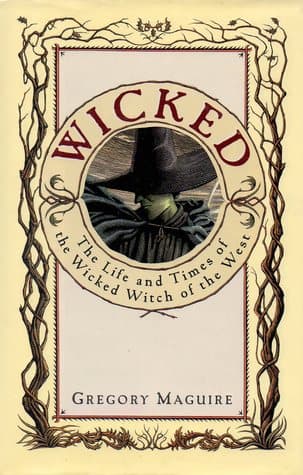
Gregory Maguire (1995)
Genre
Fantasy
Reading Time
10-12 hours
Key Themes
See below
Sign in to track this book
Before she was called wicked, a green-skinned girl named Elphaba lives in a politically charged Oz where talking animals fight for rights and good and evil are more complex than any yellow brick road suggests.
The story starts in the Quadling Country with Elphaba's unusual birth. Melena Thropp, a missionary's wife, has an affair with a mysterious man, implied to be the Wizard of Oz, though she believes it was from a 'green elixir' given by a salesman. Nine months later, in Munchkinland, she gives birth to Elphaba, a baby with emerald-green skin, sharp teeth, and a fear of water. Her father, Frexspar, a devout Unionist minister, struggles to accept her, though he tries to love her. Elphaba's younger sister, Nessarose, is born without arms, making Frexspar believe Elphaba is God's punishment. The family's life includes the challenges of raising Elphaba and the growing political unrest in Oz regarding Animal rights.
Elphaba, now a young woman, goes to Shiz University, a school in the Gillikin Country, with her younger sister Nessarose and their nanny, Madame Morrible. At Shiz, Elphaba is an outcast because of her green skin and sharp personality. She first rooms with Galinda, a popular and vain girl, and they form an unlikely, often difficult, friendship. Boq, a Munchkinlander, and Fiyero, a charming Vinkun prince, later join them; Fiyero becomes Elphaba's first love. Elphaba's intelligence and strong sense of justice become clear, especially her passion for Animal rights, a controversial topic at the university. She also meets Doctor Dillamond, a talking Goat professor, who becomes a mentor and a symbol of the Animals' struggle.
At Shiz, Elphaba sees the Wizard's oppressive government and his policies against Animals, which remove their civil rights and make them 'animals' without a capital 'A'. Doctor Dillamond, Elphaba's Goat professor, tries to research the Animals' origins, believing it holds the key to their future. His research ends when he is brutally murdered. This event deeply affects Elphaba and strengthens her belief in the Wizard's tyranny. The official story is that a mob attacked him, but Elphaba suspects the ruling powers, possibly Madame Morrible, who has become an advisor to the Wizard, orchestrated it.
After leaving Shiz, Elphaba and Fiyero move to the Emerald City, where Elphaba tries to confront the Wizard about his unfair treatment of Animals. She fails to meet him and becomes disappointed with direct political action. Fiyero, however, joins a secret resistance group working against the Wizard. Elphaba eventually joins him, becoming a known figure in the underground movement. Their relationship deepens, and they become lovers, even though Fiyero is married with children. This time marks a big change in Elphaba's life, as she fully accepts her role as an activist and rebel, strengthening her commitment to the Animal cause and her opposition to the Wizard's rule.
The Wizard's forces discover the resistance movement in the Emerald City. The Gale Force, the Wizard's secret police, capture and torture Fiyero to death, trying to get information about Elphaba and the other rebels. Elphaba sees his horrific death, which breaks her. This traumatic event is a turning point, pushing her further into despair and radicalization. Believing her actions have only caused suffering, she flees the Emerald City, seeking refuge and a new path, always haunted by Fiyero's sacrifice and the failure of their rebellion. She feels immense guilt and wants vengeance.
After Fiyero's death, Elphaba goes to a secluded monastery in the Quadling Country. She spends a long time there, trying to deal with her grief, guilt, and the failure of her political efforts. She studies religious texts and talks with the monks, especially the Abbot, seeking meaning and understanding in a world that seems increasingly cruel and unfair. During this time, she also studies magic and forgotten histories of Oz, hoping to find answers about good, evil, and her green skin. This time alone helps her reflect on her past and solidify her identity, though it is a darker one.
While Elphaba is in seclusion, her sister Nessarose becomes the governor of Munchkinland, taking their father's position. Nessarose, bitter about her lack of arms and her unrequited love for Boq, rules with an increasingly strict and tyrannical hand, enforcing harsh religious laws and persecuting the Munchkins. People often call her the 'Wicked Witch of the East' because of her harsh rule. Elphaba eventually returns to Munchkinland to confront her sister, hoping to reason with her and ease the Munchkins' suffering. Their reunion is full of tension and unresolved sibling rivalry, showing their very different paths and beliefs.
During Elphaba's visit with Nessarose, a cyclone carries a house from Kansas, landing on Nessarose and killing her instantly. This house belongs to Dorothy Gale. Elphaba arrives to find her sister dead and the Munchkins celebrating their freedom from Nessarose's oppressive rule. Dorothy takes the magical Silver Slippers, which Nessarose had worn and imbued with her power. Elphaba is devastated by her sister's death, feeling a deep sense of loss and injustice, despite Nessarose's cruelty. She tries to get the slippers back, believing they are her family's inheritance and hold powerful magic, but Dorothy and the Munchkins refuse.
After Nessarose's death, Elphaba travels to the Vinkus, the western region of Oz, seeking a new purpose. She settles in Fiyero's former castle, where she finds his surviving family, including his children and wife, Sarima. Elphaba takes on a motherly role, caring for Fiyero's disabled son, Liir, and becomes a guardian to the family, despite Sarima's initial dislike. She dedicates herself to scientific experiments, especially in genetics, trying to understand the origins of Animals and her green skin. She also continues to develop her magical abilities, becoming a strong, though solitary, figure known as the 'Wicked Witch of the West' because of her strange appearance and powerful magic.
The Wizard, wanting to get the Silver Slippers from Dorothy, tricks her into a quest to 'kill' the Wicked Witch of the West, Elphaba. Dorothy, with the Scarecrow (Fiyero's spirit, unknown to her), the Tin Woodman (Boq), and the Cowardly Lion, travels to the Vinkus. Elphaba, now isolated and increasingly bitter, confronts Dorothy, demanding the slippers back. She believes the slippers are the key to understanding her family's history and possibly the Wizard's true identity. During their confrontation, Dorothy, to defend herself, throws a bucket of water on Elphaba, causing her to melt. Elphaba's death is a tragic end to her life, marked by misunderstanding, political struggle, and personal loss, fulfilling the 'Wicked Witch' prophecy.
After Elphaba's death, the Wizard is revealed as a fraud, and the people of Oz start to question the official stories. Liir, Fiyero's son, takes on a bigger role, continuing Elphaba's legacy by seeking truth and justice in Oz. The book shows that Elphaba's actions, though often misunderstood and demonized, greatly affected many lives, including the Animals and the people of Oz. Her legacy is one of rebellion against tyranny, a search for identity, and the complexities of good and evil. The ending suggests that the story of Oz is more complicated and morally unclear than previously believed, leaving readers to think about what 'wickedness' and heroism truly mean.
The Protagonist
Elphaba transforms from a naive, intellectual student into a hardened activist and ultimately, a reclusive, powerful 'Witch' driven by grief and a desire for vengeance, constantly battling external prejudice and internal turmoil.
The Supporting
Fiyero evolves from a self-absorbed prince to a dedicated revolutionary and devoted lover, ultimately sacrificing his life for the cause he believes in and for Elphaba.
The Supporting
Galinda transitions from a self-absorbed student to a powerful and politically astute figure, learning to wield influence and navigate the complex moral landscape of Oz, ultimately becoming the Good Witch.
The Supporting
Nessarose transforms from a physically vulnerable and devout child into a hardened, authoritarian ruler, driven by her faith and personal frustrations, ultimately dying as the 'Wicked Witch of the East'.
The Antagonist
The Wizard maintains his deceptive facade and oppressive rule throughout the narrative, ultimately being exposed as a fraud after Elphaba's death, though his influence persists.
The Supporting
Madame Morrible transforms from a seemingly benign academic figure into a ruthless political operative, using her magical abilities and influence to serve the Wizard's oppressive regime.
The Supporting
Doctor Dillamond maintains his integrity and dedication to truth until his untimely death, serving as a martyr for the Animal rights movement.
The Supporting
Boq is transformed from a cheerful student into the tragic Tin Woodman, a victim of both unrequited love and the manipulative magic of Nessarose.
The Supporting
Frexspar remains a largely static character, clinging to his religious beliefs and struggling with his inability to fully accept Elphaba, serving as a symbol of societal judgment and patriarchal authority.
The Supporting
Melena lives a life marked by secret guilt and a quiet struggle with her circumstances, never fully escaping the consequences of her past choices.
The Supporting
Liir evolves from a silent, disabled child into a more aware and potentially influential figure, carrying the torch of Elphaba's truth and legacy.
The novel carefully breaks down the simple good and evil presented in Baum's original. Elphaba, called 'wicked,' is a complex character driven by justice, love, and grief. Seemingly 'good' characters like Glinda and the Wizard have their own moral failures and political manipulations. The book argues that 'wickedness' is often a label given to those who challenge the status quo or whose stories are not told. For example, Nessarose, the 'Wicked Witch of the East,' is wicked not from malice but from rigid, self-righteous piety and emotional abuse, showing that evil can come from various places.
“''The only 'wickedness' she had ever committed was to be born with green skin, and a mind that questioned everything.''”
Elphaba's green skin immediately makes her an 'other' in Oz, leading to lifelong prejudice and isolation. This physical difference represents any form of marginalization. Her journey is a constant fight to define herself against what society expects and the labels placed on her. She deals with her mysterious parents and her unique place in the world. The Animals, stripped of their capital 'A' and their rights, further show this theme, exploring how identity can be taken or suppressed by those in power, and how the 'other' is often demonized to keep control.
“''She was green. So what? Was it a sin to be green?''”
Maguire shows Oz as a corrupt and oppressive society, ruled by the Wizard, a manipulative dictator who uses propaganda and fear to keep power. The discrimination against Animals, the suppression of free thought, and the Wizard's hidden origins all show this theme. Elphaba's activism and rebellion are direct responses to this tyranny, even if her efforts fail. The political schemes of figures like Madame Morrible further show how power corrupts and how 'good' intentions can be twisted to gain control, revealing a darker, more cynical Oz than previously imagined.
“''The Wizard ruled by sleight of hand and clever words, making the people believe what he wanted them to believe, not what was true.''”
Elphaba's life includes many losses: her distant relationship with her parents, Doctor Dillamond's murder, and Fiyero's brutal death. These losses deeply scar her, fueling her rage, despair, and isolation. Her grief over Fiyero's death is a main reason for her withdrawal from the world and her transformation into the reclusive 'Witch.' Boq's unrequited love for Galinda, and Nessarose's possessive love for Boq, also show how love can lead to suffering and destructive actions, showing the emotional cost of human connections in a harsh world.
“''Grief was a terrible, insidious thing, like a disease that ate away at the soul.''”
The core of 'Wicked' is a new look at a classic story, questioning the established narrative of the Wicked Witch. Maguire purposefully re-examines the 'facts' of Oz, showing how history is written by the winners and how reputations can be deliberately damaged. The book constantly asks what is 'true' and what is propaganda, especially concerning the Wizard and Elphaba herself. This theme encourages readers to look past appearances and official stories, stressing the importance of different viewpoints and the often-unheard voices in history, ultimately suggesting that 'wickedness' is a construct.
“''Every story has two sides. What if the wrong side was told first?''”
Reinterpreting a classic tale from an antagonist's perspective
This is the primary plot device, taking the established narrative of L. Frank Baum's 'The Wonderful Wizard of Oz' and flipping it. By telling the story from the perspective of the 'Wicked Witch,' Maguire challenges readers' preconceived notions of good and evil, heroism and villainy. He fills in the gaps of Elphaba's backstory, motivations, and the political landscape of Oz, transforming a one-dimensional villain into a complex, sympathetic protagonist. This device forces a re-evaluation of the original story and its themes, making the reader question the nature of truth in popular narratives.
Oz as a metaphor for real-world political struggles
Maguire uses Oz as a thinly veiled allegory for real-world political and social issues. The oppression of the 'Animals' (capital 'A') mirrors racial discrimination, civil rights movements, and ethnic cleansing. The Wizard's manipulative regime and propaganda tactics reflect authoritarian governments and the dangers of unchecked power. Elphaba's activism and the resistance movement can be seen as representing historical and contemporary struggles against injustice. This device allows the author to explore complex moral and political questions within a fantastical setting, making the narrative resonate with contemporary societal concerns.
Elphaba's green skin as a symbol of otherness and identity
Elphaba's green skin is not merely a physical characteristic but a powerful symbol. It represents her 'otherness,' marking her as an outcast from birth and dictating how society perceives and treats her. It also symbolizes her unique identity, her connection to the land of Oz (often depicted as green), and potentially her magical abilities or a deeper, mystical heritage. The mystery of its origin (is it a curse, a result of the 'green elixir,' or a natural variation?) is a driving force in Elphaba's quest for self-understanding, making her greenness a central motif in her struggle with identity and acceptance.
A powerful, often unseen, force driving the plot
Initially presented as a mythical figure, the Wizard becomes the central antagonist and an unseen manipulator. His policies and actions, even when he is not physically present, directly influence the lives of Elphaba and all of Oz. He orchestrates events, uses propaganda, and creates a climate of fear that drives much of the plot. His mysterious identity and the eventual revelation of his true nature as a powerless man from Earth further emphasize the theme of deception and the power of illusion, making him a catalyst for Elphaba's rebellion and ultimate demise.
“People who claim that they're evil are usually no worse than the rest of us... It's people who claim that they're good, or any way better than the rest of us, that you have to be wary of.”
— Elphaba's reflection on morality and hypocrisy.
“Remember this: Nothing is written in the stars. Not these stars, nor any others. No one controls your destiny.”
— Elphaba's defiant statement about free will.
“The wicked are not so different from the rest of us, they're just unlucky.”
— A philosophical observation about the nature of wickedness.
“I don't cause commotions, I am one.”
— Elphaba's self-aware declaration about her disruptive nature.
“There is no such thing as a witch. There is only a girl.”
— A moment of vulnerability revealing Elphaba's humanity.
“The world is a complicated place. It isn't black and white. It's a million different shades of gray.”
— Commentary on moral complexity in Oz.
“To be feared is to be respected.”
— Elphaba's justification for her intimidating persona.
“Animals have souls, and they have rights. They are not ours to use and abuse.”
— Elphaba's passionate defense of Animal rights.
“Sometimes the best way to bring about change is to make people uncomfortable.”
— Elphaba's approach to social reform.
“I am not a monster. I am just misunderstood.”
— Elphaba's plea for understanding.
“Power is not given. It is taken.”
— A statement on political and personal empowerment.
“The truth is not always beautiful, nor beautiful words the truth.”
— Reflection on the nature of truth and appearance.
“We are all prisoners of our own perceptions.”
— Philosophical insight into human experience.
“Love is the most powerful magic of all, and the most dangerous.”
— Observation about the dual nature of love.
Ready to see how well you understood this book? Take our interactive quiz with 10 questions.

Biography coming soon.







