“I can't believe how much I miss you. It's like I'm walking around with a hole in my heart.”
— Minerva's internal thoughts early in the book, reflecting on her breakup with Ed.

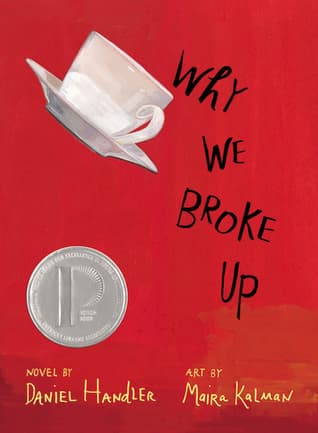
Daniel Handler (2011)
Genre
Young Adult / Romance
Reading Time
700 min
Key Themes
See below
Sign in to track this book
With a box full of evocative mementos, Min meticulously dismantles her first love for Ed, each object a poignant, illustrated autopsy of their doomed teenage romance.
Min Green, an artistic high school junior, starts a long letter to her ex-boyfriend, Ed Slaterton, explaining their breakup. The letter comes with a box of mementos from their relationship. Min introduces the first item: two bottle caps, one from soda, one from beer, symbolizing their early differences and the moment Ed first noticed her. She remembers their first talk at a party, where Ed, the popular basketball star, was with his friends, and Min felt like an outsider. The bottle caps show the unexpected spark that started their connection, despite their different social groups.
Min describes their first 'date,' a trip to the movies to see 'The Seventh Seal,' a film Ed clearly did not understand but pretended to like. She puts the movie ticket stub in the box. After the film, they get milkshakes, and Min notices Ed's casual dishonesty, especially his fake interest in the intellectual film to impress her. This early interaction shows a main difference in their personalities: Min's honesty versus Ed's habit of presenting a polished version of himself. Still, the shared experience and intimacy of the moment bring them closer, setting up their relationship.
The next item is a folded note, which Min says was their first communication, a simple 'Hi' from Ed passed in class. This note led to their first kiss, which happened suddenly in the school hallway. Min remembers the exciting feeling of the kiss and the quick change in their relationship from acquaintances to something more. This moment solidified their connection and marked the official start of their romance. The note, though seemingly small, holds the weight of that first, thrilling step into intimacy and the promise of a deeper bond.
Min includes a small box of matches, remembering a party at Ed's friend Al's house where she felt out of place. While Ed easily moved through his popular social circle, Min watched the superficial interactions and felt growing unease. The matches represent the short-lived, sometimes damaging, nature of the party scene and Min's difficulty connecting with Ed's world. She felt like an observer rather than a participant, a repeated theme where her artistic, thoughtful nature clashed with Ed's more outgoing, conventional popularity. This scene highlights their different values.
A protractor from Min's geometry class is a symbol of a rare moment of real connection. Ed, usually reserved, told Min about his struggles with a math problem, and Min, despite her artistic interests, helped him. This shared academic vulnerability allowed them to connect more deeply, beyond their usual social roles. For Min, it was a look at Ed's less confident, more human side, and for Ed, it was a moment of trusting Min with something personal. It shows the potential for a relationship built on mutual support and understanding.
Min includes several books she lent to Ed, which he never read or returned. These books — from classic literature to philosophy — represent Min's attempts to share her intellectual world with Ed and build a deeper connection through shared interests. However, Ed's lack of interest shows their intellectual difference. Min realizes that while she wanted to explore his world, Ed was less willing to explore hers. This item sadly illustrates Min's feeling of being intellectually alone in the relationship, despite her efforts.
A small toy truck, taken from a motel room, marks a spontaneous road trip they took together. This adventure, born from a desire to escape their daily lives, was a time of intense intimacy and freedom for Min. The truck symbolizes their shared journey and the moments of pure joy they experienced away from school and friends. During this trip, their physical and emotional bond grew stronger, making Min believe in the strength and uniqueness of their connection, despite the underlying differences she had started to notice.
Min includes a pair of 'ugly earrings' that Ed bought her, which she hated but wore to please him. These earrings symbolize Min's attempts to change her own identity and preferences to fit into Ed's world and meet his expectations. She felt pressured to change parts of herself, from her appearance to her interests, to keep his affection and approval. This item marks a point where Min starts to see the sacrifices she is making, showing the imbalance in their relationship and the loss of her self-worth.
A cheap comb from a motel room becomes a painful symbol of Ed's cheating. Min finds evidence of his betrayal during a weekend away, realizing he had been seeing other girls, specifically Al's girlfriend, Lauren. This discovery destroys Min's trust and forces her to face the truth of Ed's deceit. The comb represents all the small lies and inconsistencies she had ignored, bringing the full weight of his cheating and marking the point of no return for their relationship. This is the ultimate reason for the breakup.
The final items in the box—a dried flower, a crumpled note, and a photograph—represent the last parts of their relationship and Min's decision to end things. The dried flower might be from a bouquet he gave her, now withered, symbolizing their dying love. The crumpled note could be a final apology or part of a last argument. The photograph captures a moment of their past happiness, now spoiled by betrayal. These items show the pain of memory and the irreversible nature of their split, as Min finishes her letter, having revealed all the reasons 'why we broke up.'
The Protagonist
Min evolves from a starry-eyed, somewhat naive girl willing to compromise for love to a more self-aware individual who prioritizes her own integrity and emotional well-being.
The Antagonist/Love Interest
Ed remains largely static, representing the unreliability and superficiality that Min ultimately rejects, forcing her to grow while he stays the same.
The Supporting
Al remains a static character, primarily serving to represent the social environment that Min struggles to navigate.
The Mentioned
Lauren does not have a character arc within the narrative, serving primarily as a plot device.
The novel is structured around Min's subjective memories, each item in the box starting a specific recollection. This shows how memory is not a neutral record but is shaped by emotion, perspective, and the desire to understand a past event. Min's story is her attempt to build a clear account of their relationship, focusing on her feelings and observations. The letter itself is an act of processing and understanding a painful experience, showing that 'truth' in a relationship is often varied and personal.
““The truth is, you don’t know what is going to happen tomorrow. Life is a crazy ride, and nothing is guaranteed.””
A main theme is the clear contrast between Min's desire for authenticity and Ed's habit of performing or showing a curated version of himself. Min seeks genuine connection and intellectual honesty, seen in her appreciation for complex films and literature. Ed, however, often fakes interest, breaks promises, and ultimately deceives. This theme appears in scenes like Ed pretending to understand 'The Seventh Seal' or Min wearing the 'ugly earrings' to please him, highlighting the compromises made and the emptiness of a relationship built on pretense.
““I hated the earrings. But I wore them because you gave them to me.””
The novel explores the exciting highs and devastating lows of a first serious relationship. Min's story captures the initial excitement, intense intimacy, and deep emotional investment that mark young love. However, it also shows the deep pain of betrayal, disappointment, and heartbreak. Each item in the box, while recalling a sweet memory, is also filled with the sadness of its ending. The story is an honest portrayal of how deeply a first love can hurt and the difficult process of healing and moving on.
““I’m writing you this letter, Ed, because I’m going to break up with you. I’m going to break up with you, and I’m going to do it in person, and I’m going to do it with this box.””
While not directly stated as a class struggle, there is a tension between Min's artistic, intellectual identity and Ed's world of popular athletes and social conformity. Min often feels like an outsider at Ed's parties or among his friends, showing a clash of values and social circles. Her discomfort with his friends and her attempts to introduce him to her world (through books) highlight this divide. The novel suggests that these differences in identity and social standing contribute to their relationship's ultimate incompatibility.
““You were the star quarterback. I was the girl who sat in the back of the class and drew pictures in her notebook.””
A physical container holding symbolic items that trigger memories.
The box is the central structural device of the novel. Each item within it serves as a tangible anchor for Min's memories, allowing her to organize and narrate the story of her relationship with Ed chronologically and thematically. It functions as a 'memory palace,' where each object is a key to a specific scene, emotion, or turning point. This device allows for a fragmented, non-linear storytelling approach while still maintaining a cohesive narrative arc, mirroring the way memories often surface and connect.
The entire novel is presented as a long, unsent letter from Min to Ed.
The epistolary format provides an intimate and deeply personal perspective, allowing readers direct access to Min's thoughts, feelings, and analytical process. It creates a sense of direct address and confession, making Min a highly reliable (though subjective) narrator of her own experience. The act of writing the letter is itself a form of therapy and closure for Min, allowing her to meticulously dissect the relationship and articulate her reasons for the breakup, even if Ed never truly hears or understands it.
Early items subtly hint at future conflicts and the relationship's eventual demise.
Many items, even those from the early, happier stages of the relationship, contain subtle hints of the problems to come. For instance, the movie ticket for 'The Seventh Seal' highlights Ed's pretense, and the matchbox from Al's party underscores Min's discomfort with Ed's social world. This device builds a sense of inevitability, showing that the seeds of their breakup were present from the beginning, even if Min didn't fully recognize them at the time. It adds depth to the narrative by demonstrating that relationships often unravel due to inherent incompatibilities.
“I can't believe how much I miss you. It's like I'm walking around with a hole in my heart.”
— Minerva's internal thoughts early in the book, reflecting on her breakup with Ed.
“Every single thing in this box is a piece of evidence. A piece of a puzzle. A piece of you and a piece of me.”
— Minerva addressing the box of objects she's returning to Ed, explaining its contents.
“We were like two halves of a weird, beautiful whole. And then we broke.”
— Minerva reflecting on her relationship with Ed, using a metaphor for their connection.
“This isn't a story about how we fell in love. This is a story about how we broke up.”
— Minerva's opening statement, setting the premise for her letter to Ed.
“I don't think I ever told you how much I loved your hands. They were always doing something interesting.”
— Minerva reminiscing about specific physical details she admired about Ed.
“It's funny how you can live with someone for so long and still not really know them.”
— Minerva musing on the complexities of knowing another person, even in an intimate relationship.
“Sometimes I think the only way to get over someone is to write them a letter they'll never read.”
— Minerva's internal reflection on the therapeutic nature of her letter-writing.
“You were the first person who ever made me feel like I wasn't just a collection of flaws.”
— Minerva expressing how Ed's love impacted her self-perception.
“Maybe love is just a big, elaborate practical joke.”
— Minerva's cynical thought about the nature of love after her heartbreak.
“I wanted to be the girl who didn't care. But I did. Oh, God, I did.”
— Minerva admitting her true feelings despite trying to appear indifferent after the breakup.
“This isn't about blaming. This is about remembering. And figuring out where we went wrong.”
— Minerva clarifying the purpose of her letter, distinguishing it from an accusation.
“You can't just un-love someone. It's not a light switch.”
— Minerva expressing the difficulty of moving on from deep feelings.
“Every single one of these things, Ed, every single one, is a reminder of how much I loved you. And how much I still do.”
— Minerva's concluding statement, summarizing the emotional weight of the objects and her feelings.
Ready to see how well you understood this book? Take our interactive quiz with 10 questions.

Daniel Handler is a celebrated author known for his witty and often poignant young adult novels. His most notable work, 'Why We Broke Up,' earned critical acclaim and was a finalist for the National Book Award for Young People's Literature. Handler also writes for adults under the pseudonym Lemony Snicket, most famously for 'A Series of Unfortunate Events'.