“He was a wolf, and a chief wolf at that. He had seen many suns rise and set, and knew the ways of the wild.”
— Describing White Fang's father, One Eye, early in the story.


Jack London (2019)
Genre
Children's / Historical Fiction / Young Adult
Reading Time
270 min
Key Themes
See below
Sign in to track this book
White Fang, a wolf-dog, journeys from the brutal Yukon wilderness to human companionship, illustrating a primal story of survival, instinct, and the slow taming of a wild heart during the Klondike Gold Rush.
The story begins with Bill and Henry, two prospectors, enduring the brutal cold of the Yukon. They transport a coffin through the wilderness by dog sled. A relentless wolf pack, driven by starvation, begins to pick off their sled dogs, luring them away with a she-wolf named Kiche. Bill, desperate and hallucinating, eventually falls to the wolves. Henry continues alone, barely escaping with his life when a rescue party arrives.
After pursuing Bill and Henry, the story shifts to the wolf pack. Kiche, the she-wolf who led the pack in luring the sled dogs, mates with One-Eye, an old wolf. They make a den in a secluded cave, where Kiche gives birth to five pups. The harsh wild takes its toll, and only one pup, the strongest and most curious, survives. This grey pup is the story's main character, driven by instinct and a growing awareness of his surroundings.
The grey cub, still unnamed, slowly explores the world outside the den. His early experiences are marked by constant struggle and the development of his senses. He learns about hunger, the thrill of the hunt, and the pain of discipline from his mother. He observes nature's balance, where life preys on life and the strong survive. His instincts are sharp, and he quickly adapts to the brutal environment, developing caution and fierce independence.
Driven by curiosity, the young cub ventures farther from the den and, for the first time, encounters humans. This is a traumatic experience, filled with strange sights, sounds, and smells. He is overwhelmed by their power and unfamiliar presence. During this frightening encounter, a group of Native Americans, led by Gray Beaver, captures him. He discovers his mother, Kiche, is half-wolf, half-dog, and she recognizes Gray Beaver as her former master. This changes his view of his place in the world.
Gray Beaver names the cub White Fang, noting his sharp, white teeth. White Fang's life in the Native American camp is a constant challenge. He faces cruelty from other dogs, especially Lip-lip, and indifference from humans, who often beat him. He learns to fight to survive, becoming a formidable, solitary creature. He feels a deep sense of injustice and distrusts both humans and other dogs, yet he develops a grudging loyalty to Gray Beaver, who provides food and shelter, though through harsh discipline. This period shapes his aggressive and independent nature.
A severe famine strikes the Native American camp, testing White Fang's loyalty and survival instincts. Food becomes scarce, and both humans and animals suffer. White Fang, driven by hunger, becomes an even more efficient hunter, often bringing his kills back to Gray Beaver. Despite the harsh treatment, his bond with Gray Beaver deepens as he realizes his master is his source of food and protection. This period strengthens White Fang's understanding of the 'master' concept, reinforcing his submission to Gray Beaver while sharpening his predatory skills and ability to endure hardship.
Gray Beaver's gambling leads him to trade White Fang to a cruel man named Beauty Smith. Smith immediately sees White Fang's ferocity and exploits it for dog-fighting. White Fang is forced into brutal battles against other dogs, consistently winning and becoming a feared fighter. Smith's methods are torturous, keeping White Fang in a constant state of rage and fear, using whips and starvation. This is the darkest period in White Fang's life, removing any trust he had developed and pushing him to savagery.
White Fang's time as a fighting champion under Beauty Smith ends when he fights a powerful bulldog named Cherokee. The bulldog's low center of gravity and tenacious grip are a challenge. Cherokee locks his jaws onto White Fang's throat, refusing to let go, slowly suffocating him. White Fang faces defeat and death for the first time. As he is about to succumb, Weedon Scott, a kind mining engineer, intervenes, buying White Fang from Beauty Smith and saving his life. This marks a turning point in White Fang's journey.
Weedon Scott takes White Fang into his care, beginning the difficult task of taming the fiercely independent wolfdog. Scott uses a different approach than White Fang has ever known: kindness, patience, and understanding. He gradually earns White Fang's trust, showing that not all humans are cruel. White Fang, still wary, slowly responds to Scott's gentle hand, learning to accept and even return affection. This period shows the power of love and compassion in overcoming deep fear and aggression, as White Fang begins to shed his wild nature.
Weedon Scott decides to return to his home in California, taking White Fang. The transition is significant, as White Fang must adapt to a new environment, filled with unfamiliar sights, sounds, and domestic animals. He encounters chickens, cats, and other dogs, learning to suppress his predatory instincts. He becomes a devoted protector of Scott's family, especially his children. His loyalty is tested when a dangerous convict, Jim Hall, tries to rob the Scott family home. White Fang heroically defends them, getting severely injured but saving the family, proving his complete transformation.
After his heroic defense of the Scott family, White Fang recovers from his injuries and fully integrates into his new life in California. He forms a deep bond with the entire family, particularly with Scott's wife, Alice, and their children. He learns to play, accept affection, and live in harmony with other domestic animals. His wild instincts are not entirely gone, but love and loyalty now temper them. He finds contentment and peace by the fireside, a 'golden arrow' of the wild transformed into a cherished companion, symbolizing the triumph of domestication and love over savagery.
The Protagonist
White Fang transforms from a savage, distrustful wild animal into a loyal, loving, and domesticated companion, finding peace and belonging.
The Supporting
Scott demonstrates the profound impact of compassion, successfully transforming a wild, aggressive animal into a loving companion.
The Supporting
Gray Beaver's role is static, representing the harsh, transactional aspect of human-animal relationships in the wild.
The Antagonist
Beauty Smith remains a static character, serving as the embodiment of pure evil and a major antagonist in White Fang's journey.
The Supporting
Kiche's arc is limited to her role as a mother in the wild, her eventual departure signifying White Fang's growing independence.
The Supporting
One-Eye's arc is a representation of the natural cycle of life and death in the wild, serving his purpose as a progenitor.
The Supporting
Judge Scott's initial skepticism gives way to admiration and acceptance of White Fang as a family member.
The Supporting
Alice's kindness helps White Fang to further shed his wildness and embrace his domesticated role.
This theme appears in the novel's early parts, showing the brutal, survival-of-the-fittest mentality of the wild. Life is a constant struggle for food and dominance; only the strong survive. White Fang's early experiences, from competing with littermates to fighting other wolves and dogs, follow this unforgiving law. It means might makes right and trust is a weakness. This theme is clear in the wolf pack's hunting scenes and White Fang's dog-fighting days under Beauty Smith, where violence and aggression are the only ways to survive and gain power.
“''Life was a contest, and in that contest the weakest went down.''”
The novel explores whether an individual's inherent nature or their environment and upbringing primarily shapes them. White Fang is born with strong wild instincts (nature), but his experiences with different masters and environments (nurture) greatly change his behavior. His journey from a savage wolf to a loyal domesticated dog shows how adaptable his character is. Gray Beaver's harsh discipline and Beauty Smith's cruelty make him an aggressive fighter, while Weedon Scott's kindness eventually turns him into a gentle companion. This theme shows that even ingrained instincts can be reshaped by strong outside forces.
“''It was the change in his environment that had wrought the change in him.''”
This is the novel's main theme, tracking White Fang's difficult transition from a wild animal to a cherished member of a human family. The journey is not direct, with setbacks and moments where his wild instincts return. Each human interaction, from Gray Beaver's practical ownership to Beauty Smith's cruel exploitation, pushes White Fang further from his wild roots, though violently. Only through Weedon Scott's compassionate and patient approach does White Fang truly accept domestication, finding love, security, and belonging that overrides his primal instincts. This transformation highlights the capacity for change and adaptation.
“''He was a wolf, and yet he was not a wolf; he was a dog, and yet he was not a dog.''”
Though initially unfamiliar with these ideas, White Fang gradually learns the power of love and loyalty through his relationship with Weedon Scott. In the wild, loyalty often comes from fear or need, but Scott's unconditional kindness teaches White Fang a different kind of bond. White Fang's fierce protection of Scott and his family, ending with his heroic defense against Jim Hall, shows his deep devotion. This theme suggests that true love and loyalty are not innate but can be grown through patience, understanding, and mutual affection, leading to a more fulfilling life for both human and animal.
“''He was a god, a beneficent god, and White Fang was his worshipper.''”
The novel vividly shows the Yukon wilderness's dual nature: its harsh brutality and its stark beauty. The early chapters emphasize the constant struggle for survival, hunger, cold, and the endless cycle of predator and prey, showing nature's indifference to individual suffering. However, London also gives the landscape a sense of grandeur and wonder, describing its vastness, snow-covered forests, and its creatures' powerful instincts. This theme highlights that nature is both a source of great danger and profound wonder, demanding respect for its power and its complex, often violent, balance.
“''It was the law of the land, and it was a good law.''”
Attributing human thoughts and emotions to White Fang and other animals.
London frequently employs anthropomorphism, especially in depicting White Fang's internal thoughts and perceptions. While White Fang remains an animal, the narrative grants him complex emotions like fear, anger, curiosity, injustice, and even love. This device allows the reader to deeply empathize with White Fang's journey and understand his motivations from his unique perspective. For example, White Fang 'reasons' about the 'gods' (humans) and their power, or 'understands' the 'law of club and fang.' This technique bridges the gap between animal and human experience, making the animal protagonist relatable and profound.
The wilderness represents primal instincts and freedom, while civilization represents order and domestication.
The settings in the novel are highly symbolic. The vast, frozen Yukon wilderness symbolizes untamed nature, raw instinct, and the brutal 'law of club and fang.' It represents freedom but also constant danger and hardship. In contrast, the Native American camp and later Weedon Scott's California ranch symbolize varying degrees of civilization, order, and human influence. The ranch, in particular, represents domestication, security, and love. White Fang's journey from the wilderness to civilization is a symbolic transition from savagery to a more refined, albeit controlled, existence, highlighting the tension and interplay between these two forces.
Hints and clues about future events, particularly White Fang's development and encounters.
London uses foreshadowing to build suspense and hint at White Fang's evolving nature and future challenges. For instance, Kiche's mixed heritage subtly foreshadows White Fang's own capacity for domestication. The early struggles and lessons in the wild, such as learning to fight and survive, foreshadow his prowess as a dog-fighter and later his ability to protect the Scott family. The introduction of Beauty Smith's cruel character clearly foreshadows a period of intense suffering for White Fang. These narrative hints create anticipation and give depth to White Fang's character arc by suggesting his destiny is shaped by his inherent traits and early experiences.
A recurring phrase and concept representing the brutal survival code of the wild.
This phrase is more than just a thematic element; it functions as a recurring motif and plot device throughout the novel. It is explicitly stated and frequently referenced, serving as the governing principle of White Fang's early life in the wild and his experiences under Gray Beaver and Beauty Smith. It dictates that physical strength, aggression, and the ability to inflict pain are the ultimate arbiters of power and survival. The 'law of club and fang' is the framework through which White Fang interprets the world and his interactions, until Weedon Scott introduces a new 'law' based on kindness and love, directly contrasting the brutal reality White Fang has known.
“He was a wolf, and a chief wolf at that. He had seen many suns rise and set, and knew the ways of the wild.”
— Describing White Fang's father, One Eye, early in the story.
“For the first time in his life, he was a thing of the pack, a pack-animal, a creature of the herd, who ran with the wolves and was one of them.”
— White Fang's early days with the wolf pack, before encountering humans.
“Life was an arena, where all creatures strove, and where the strongest and the swiftest survived.”
— A philosophical observation on the harsh realities of the wild.
“He had learned the law of the club and the fang, and he knew that for the club there was no going back.”
— White Fang's brutal training under Gray Beaver, learning human dominance.
“Love, he had learned, was the one thing that was stronger than the club and the fang.”
— White Fang's eventual realization about the power of affection, particularly with Weedon Scott.
“He was a master-dog, and he knew it. He had fought his way up, and he was not afraid.”
— White Fang's confidence and dominance among other dogs in the Native American camp.
“He was a wolf-dog, and not a dog-dog, and the difference was a great one.”
— Highlighting White Fang's unique hybrid nature and how it sets him apart.
“Fear was the most terrible thing in the world, he knew, and it was a thing that could make the bravest heart quail.”
— White Fang's constant struggle with fear and its impact on his actions.
“He had found a god. He had found a master. He had found a law, and a purpose, and a place in the world.”
— White Fang's devotion to Weedon Scott, seeing him as a benevolent deity.
“The wild still lingered in him, a trace of the primitive, a hint of the untamed.”
— Even after domestication, White Fang retains aspects of his wild heritage.
“He was learning to love, and that was a new and wonderful thing.”
— White Fang's gradual acceptance and reciprocation of affection from Weedon Scott.
“He was a wolf, and he loved the bite of the wind and the sting of the frost.”
— Describing White Fang's inherent connection to the harsh northern environment.
“He had been a killer, a fighter, a lone wolf; now he was a protector, a companion, a friend.”
— Summarizing White Fang's transformation from a savage beast to a loyal domestic animal.
“The law of the land was the law of the strong, and White Fang knew it well.”
— A recurring theme throughout the book, especially in the wild and early human interactions.
Ready to see how well you understood this book? Take our interactive quiz with 10 questions.
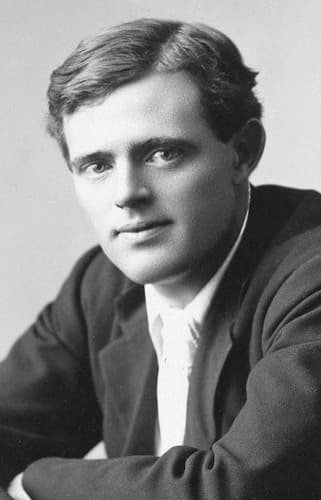
John Griffith Chaney, better known as Jack London, was an American novelist, journalist and activist. A pioneer of commercial fiction and American magazines, he was one of the first American authors to become an international celebrity and earn a large fortune from writing. He was also an innovator in the genre that would later become known as science fiction.

Dan Gemeinhart
4.5

Kate O'Hearn
4.4

Jeanne Birdsall
4.4

Jen Wang
4.4

Wendelin Van Draanen
4.3

John Marsden
4.3

Chris Van Allsburg
4.3

Jennifer A. Nielsen
4.2