“The dog was the first to go. He was a mutt, part terrier, part shepherd, with a little bit of something else thrown in.”
— The family is preparing to leave their home, and the father takes the dog to the pound.

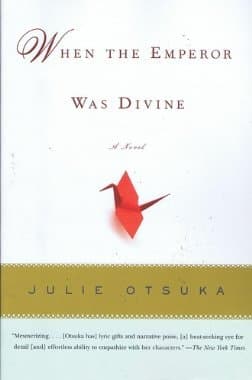
Julie Otsuka (2002)
Genre
Historical Fiction
Reading Time
120 min
Key Themes
See below
Sign in to track this book
A Japanese American family navigates internment during WWII, showing the quiet devastation of shattered lives through moments of forced displacement and the bitter aftermath of their return.
In Berkeley, California, a mother of two, whose husband has been taken by the FBI, sees a white dog watching her house. She gets a Civilian Exclusion Order, Public Proclamation No. 3, which says all people of Japanese ancestry must leave the West Coast. She has to get her family ready for an unknown place, selling or giving away most things, including their dog. They pack what they can carry into two suitcases each. The mother tells her children to act like 'good Americans' and not attract attention, trying to keep things normal despite the fear.
The family, now just the mother, daughter, and son, gets on a crowded train with other Japanese Americans, going inland. The daughter sees the changing scenery and armed guards through the window, feeling confused and afraid. She notices people avoiding eye contact and whispering, trying to understand what they did wrong. The train ride is long and uncomfortable, with the smell of urine and soldiers. They are taken to a former racetrack, the Tanforan Assembly Center, where they get a horse stall, still smelling of manure, as their temporary home.
The son describes life in the Topaz War Relocation Center in the Utah desert. Conditions are harsh: rows of barracks, communal bathrooms, constant dust storms, and no privacy. He goes to school, plays baseball, and sees the daily life of the camp, including food rationing and arbitrary rules. The children try to adjust, finding ways to entertain themselves, but the underlying tension and constant reminder of confinement are always there. He notices changes in his mother, who tries to stay dignified but grows tired and distant.
In the camp, the government gives a 'loyalty questionnaire' to all internees 17 and older. Questions 27 and 28, asking if they would serve in the U.S. armed forces and give up allegiance to the Japanese Emperor, cause deep disagreements. Many, especially older Issei, find the questions insulting or impossible to answer truthfully without betraying their heritage or risking statelessness. Some answer 'no-no,' becoming 'non-aliens' and facing more segregation. The mother, though not questioned directly, sees the conflict and division in the community as friends and neighbors argue over their answers.
As World War II ends, the internment camps close. The family gets notice of their release, but going home seems hard. They receive a small amount of money and a train ticket, but no real help to rebuild their lives. Many internees face hostility and discrimination when they return to their old communities, finding their homes vandalized or taken. The family struggles with deciding whether to go back to Berkeley or start somewhere new, dealing with fear of renewed prejudice and the loss of everything they had.
The family returns to their house in Berkeley, finding it ransacked and neglected. Their belongings are gone, replaced by strangers' furniture, and the garden is overgrown. Neighbors avoid them or look with pity. The children find it hard to go back to school, facing stares and whispers. The mother tries to bring back normalcy, but the trauma of internment has left a mark. They live with quiet watchfulness, always aware of their race and the chance of renewed prejudice, trying to reclaim their old lives in a society that now sees them differently.
After more than four years, the father is released and returns home. He looks different; he is thinner, older, and his eyes hold a deep, sad silence. He rarely talks about his experiences in the internment camps or the detention centers where he was held. His silence creates distance in the family. The children, now older, find it hard to connect with him, and the mother struggles to bridge the emotional gap. His presence is a constant reminder of their shared suffering, yet he remains a mystery.
The family tries to rebuild their lives in Berkeley, but the internment's effects are deep. The children grow up trying to erase their Japanese identity, using American customs and names, and avoiding anything that might remind people of their past. The mother works hard to keep the family going, but her spirit is subdued. The father stays mostly silent, his trauma showing in quiet habits and distant looks. The weight of their shared experience, though rarely talked about, shapes their every interaction and decision. This creates a lasting sense of loss, shame, and a struggle for identity in a country that betrayed them.
The Protagonist
She transforms from a hopeful homemaker to a weary survivor, silently bearing the weight of family responsibility and the trauma of internment.
The Supporting
He is absent for most of the story, returning as a profoundly traumatized and silent figure, symbolizing the lasting damage of internment.
The Protagonist
She evolves from an innocent, observant child to a young woman grappling with a lost identity and the trauma of her past.
The Protagonist
He adapts to the harsh conditions of the camp, but his childhood is irrevocably shaped by the loss of freedom and identity, leading to a desire to erase his past.
The Mentioned
Its presence marks the beginning of the family's ordeal and its forced departure symbolizes their loss of home and innocence.
The Supporting
Her brief appearance emphasizes the economic exploitation and lack of empathy faced by the Japanese American community during forced evacuation.
The Mentioned
They are a static representation of external power and the loss of freedom, a constant reminder of the family's imprisonment.
The Mentioned
Her death within the camp symbolizes the tragic human cost and the harsh realities of internment.
The Mentioned
His defiance against the loyalty questionnaire showcases the impossible choices and internal divisions within the internee community.
The novel shows how internment changes Japanese American identity. Characters struggle with their dual heritage, feeling neither fully Japanese nor fully American. The children change their names, try to erase their past, and distance themselves from their culture to fit in. This shows the psychological trauma of forced assimilation. The father's silence upon his return shows a loss of self that cannot be fully recovered. The mother's quiet endurance shows a different way of dealing with a fractured identity. The entire family struggles with who they are in a country that betrayed them.
“We were not Japanese. We were not white. We were, in the eyes of the government, 'non-aliens.'”
Loss is in every part of the family's experience, both physical and emotional. They lose their home, possessions, and security during evacuation. The internment camps are a physical displacement, but also an emotional and cultural one. The father's long absence and later silence show a loss of family unity and emotional connection. Even when they return, they find their home vandalized and their community changed. They lose trust in their country and their pre-war innocence. The book shows the lasting effect of these losses.
“We had been gone only three years but it was as if we'd been gone a lifetime. Nothing was the same.”
Silence is a main theme, showing the characters' difficulty and inability to talk about their trauma. The father's deep silence upon his return is the most striking example. It means his experience is too painful or complex to put into words. The mother often shows her feelings through actions, not words. The children learn to suppress their questions and emotions. This collective silence creates distance in the family and community. It suggests that the wounds of internment are so deep they defy language, leading to unspoken suffering and unresolved grief for future generations.
“He never spoke of the camps. He never spoke of his time away. He never spoke of anything.”
The novel explores racial prejudice and institutional discrimination. The evacuation order, based only on ancestry, is the most clear act of prejudice. The family experiences discrimination through hostile stares, low prices for their belongings, and being excluded when they return to Berkeley. The loyalty questionnaire further shows the government's discriminatory policies, forcing Japanese Americans to prove their allegiance in a way no other group had to. The book shows how deep prejudice can be, causing widespread suffering and taking away basic rights.
“We were the enemy. We were the face of the enemy. We were the yellow peril.”
Despite the great hardships, the characters show resilience and adaptability. The mother carefully prepares for evacuation, trying to give her children a sense of normalcy. The children, especially the son, find ways to adapt to the harsh camp environment, creating games and routines. When they return, the family tries to rebuild their lives, facing discrimination with quiet determination. Their ability to endure, even with injustice and loss, shows the strength of the human spirit. But this resilience often comes with a cost, like quiet suffering and suppressed feelings.
“You must be a good American. You must not do anything to make them notice you.”
Each chapter uses a different unnamed family member's 'I' voice.
Otsuka employs a unique narrative structure where each of the five chapters is told from the first-person perspective of a different, unnamed family member: the mother, the daughter, the son, and finally, a collective 'we' for the family's return and the father's perspective. This allows the reader to experience the internment from diverse angles, highlighting the individual and collective impact of the trauma. The lack of specific names universalizes their experience, making them representative of many Japanese American families, while the distinct voices offer intimate insights into their unique struggles and coping mechanisms.
The repeated use of phrases creates a rhythmic, incantatory effect.
Otsuka frequently uses anaphora, the repetition of a word or phrase at the beginning of successive clauses, and other forms of repetition. This creates a rhythmic, almost hypnotic quality to the prose, mimicking the monotonous and inescapable nature of camp life and the pervasive fear. For example, lists of things they did or saw, or questions they asked, often begin with the same phrase. This device emphasizes the collective experience, the sheer volume of indignities, and the way trauma can loop in the mind, reinforcing the sense of shared fate and the enduring psychological impact of internment.
The dog represents innocence, surveillance, and loss.
The white dog that watches the family's house at the beginning of the novel serves as a powerful symbol. It represents the watchful, often anonymous, gaze of the outside world on the Japanese American community, hinting at the surveillance and judgment they are about to face. The family's forced decision to give the dog away symbolizes the loss of their home, their possessions, their sense of normalcy, and their innocence. Its whiteness can also be interpreted as a symbol of the dominant white society from which they are excluded, despite their American citizenship.
A government document that creates deep divisions and moral dilemmas.
The loyalty questionnaire, particularly questions 27 and 28, functions as a critical plot device that exposes the impossible bind faced by Japanese Americans. It forces internees to choose between conflicting loyalties, effectively demanding they betray their heritage or face further punishment. This device highlights the absurdity and cruelty of the government's policies, as well as the deep divisions it created within the Japanese American community, leading to the designation of 'no-no boys' and further segregation. It underscores the theme of fractured identity and the systemic injustice of the internment.
The family members are referred to only by their roles (mother, daughter, son, father).
By not giving her characters individual names, Otsuka universalizes their experience. They become archetypes, representing not just one family but the countless Japanese American families who endured internment. This artistic choice emphasizes the collective trauma and the dehumanizing effect of being stripped of individual identity and reduced to a racial category by the government. It invites the reader to see them as 'everyfamily,' making the story's emotional impact broader and more resonant, highlighting that this could have happened to anyone in their position.
“The dog was the first to go. He was a mutt, part terrier, part shepherd, with a little bit of something else thrown in.”
— The family is preparing to leave their home, and the father takes the dog to the pound.
“They told us to bring only what we could carry. One suitcase each. No pets. No cameras. No radios. No Japanese-English dictionaries.”
— The family receives the Civilian Exclusion Order, detailing what they can and cannot bring.
“We were American citizens, but we were being treated like foreigners, like criminals.”
— The narrator reflects on the injustice of their situation.
“The wind never stopped. It blew across the desert, carrying dust and sand into our barracks, into our clothes, into our hair, into our food.”
— Describing the harsh environmental conditions of the internment camp.
“We were not allowed to speak Japanese. We were not allowed to sing Japanese songs. We were not allowed to read Japanese books.”
— Highlighting the suppression of Japanese culture within the camps.
“My father used to say that a man is only as good as his word. But his word meant nothing here.”
— The daughter reflects on her father's loss of dignity and agency in the camp.
“We learned to live with less. Less space. Less privacy. Less hope.”
— A concise summary of the deprivations experienced in the camps.
“After a while, we stopped looking in the mirror. We didn't want to see the strangers we had become.”
— The family experiences a profound change in their self-perception due to their circumstances.
“The war ended, but our war did not. Our war was just beginning.”
— Reflecting on the enduring impact of their internment even after the official end of WWII.
“We were supposed to forget. We were supposed to move on. But how could we forget when our lives had been turned upside down?”
— The struggle to reconcile with the past and the pressure to move forward.
“My mother never talked about it. My father never talked about it. My brother never talked about it. We just lived with it.”
— The family's silent coping mechanism with their traumatic past.
“Sometimes I think we were all just waiting. Waiting to be told what to do. Waiting to be told where to go. Waiting to be told who we were.”
— A reflection on the loss of autonomy and self-determination experienced by the internees.
“And when the emperor was divine, we were dirt.”
— The concluding thought, encapsulating the profound dehumanization and loss of status experienced by Japanese Americans.
Ready to see how well you understood this book? Take our interactive quiz with 10 questions.







