“The past is never dead. It's not even past.”
— A reflection on the enduring impact of historical events and personal trauma.

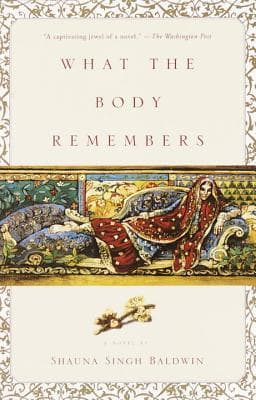
Shauna Singh Baldwin (1999)
Genre
Literary Fiction / Historical Fiction
Reading Time
500 min
Key Themes
See below
Sign in to track this book
In India's 1947 Partition era, two wives in a wealthy Sikh household, one barren and one young, navigate duty, desire, and destiny as their lives reflect the fracturing nation.
The novel starts in 1937, introducing Roop, a young Sikh girl from a poor village whose family owes a lot of money. Her father, facing poverty after his wife's death, agrees to marry Roop as a second wife to Sardarji, a rich landowner from Lahore. Sardarji's first wife, Satya, has not been able to have children after many years of marriage, making a second wife necessary for an heir. Roop is nervous about having a co-wife, but also excited about a better life away from poverty. She arrives at Sardarji's large estate, very different from her simple home, and begins her new life, aware of her main duty: to have a son.
When she arrives, Roop tries to connect with Satya, her co-wife, hoping for a friend and guide. Satya, an educated woman with strong spiritual beliefs, is at first welcoming but feels deep sadness and resentment about not being able to have children. She feels the pressure of social expectations and the shame of being replaced by a younger woman. While she teaches Roop about the household and customs, a tension and rivalry exist. Satya's emotional pain shows in small ways, making Roop, despite wanting harmony, feel constant pressure from her role and the unspoken competition for Sardarji’s attention and the family's future.
Roop quickly becomes pregnant, fulfilling her main duty to Sardarji. This happy news for the household is very upsetting for Satya. The initial friendliness between the two wives breaks as Satya deals with Roop having the heir she could not. Satya's grief and feeling of failure grow, causing her to withdraw from the family and spend more time in solitary prayer. Her relationship with Sardarji also suffers, as he, while caring for Satya, increasingly focuses on Roop and the coming child. Roop, despite her happiness, feels some guilt and sadness about Satya's suffering, but the social pressure to produce an heir is stronger than her personal feelings.
Roop has a healthy son, fulfilling the family's wish. Later, she has a second son. With the family line secured, Roop's position in the household improves. Satya, meanwhile, withdraws further, dedicating her life to spiritual practices and finding comfort in her faith. She spends time with scriptures, meditation, and charity, turning her personal sorrow into a path of spiritual growth. While she remains in the household, her role changes from wife and mistress to a respected, almost spiritual figure, observing the family from a distance and offering wisdom when asked, but no longer taking part in daily married life with Sardarji.
As years pass, the political situation in India intensifies with the growing demand for independence from British rule. Sardarji, a respected figure in Lahore, becomes involved in politics. He attends meetings, debates, and tries to understand what a divided India means for his Sikh community. He deals with the rising tensions between Hindus, Muslims, and Sikhs, and the idea of Partition, which could split his Punjab. His involvement means he is often away from home, and he tries to balance his personal loyalties with the larger political situation, often feeling caught between different ideas for India's future.
The discussions about Partition become more intense and violent, moving from abstract politics to a real threat to daily life. News of communal riots in other parts of India starts to reach Lahore, creating fear and uncertainty. Sardarji tries to protect his family, but the growing tensions are clear. Roop, at first protected from the deeper political issues, starts to understand how serious the situation is as her community faces losing their homes and lands, and their lives are threatened by the proposed division of Punjab based on religion.
In August 1947, the Partition of India is announced, and Lahore is made part of the new Pakistan. This news shatters the lives of Sardarji's family and many others. The city becomes chaotic, with widespread violence, looting, and mass displacement. Sardarji, despite his wealth, realizes he cannot protect his family in their ancestral home. With great pain, he decides to leave their estate, gathering his family, including Roop, their sons, and Satya, to join millions of refugees making the dangerous journey across the new border to India. The once-grand family becomes desperate migrants.
The journey for Sardarji's family is full of danger and suffering. They join large groups of refugees, enduring hunger, thirst, disease, and the constant threat of violence. The once-dignified Sardarji is humbled by the experience, losing his former status. Roop sees terrible acts, including kidnappings and murders, and struggles to protect her young sons. Satya, with her spiritual strength, becomes a quiet source of comfort amid the despair, offering prayers and support. The physical and emotional scars of the journey, losing their home, and seeing such widespread cruelty leave a lasting mark on each family member.
After reaching the safety of India, Sardarji and his family, like millions of others, begin the hard task of rebuilding their lives. Sardarji, though changed, uses his remaining resources and connections to establish a new home and business. Roop works hard to create a sense of normalcy for her children, but memories of the journey and the lost home stay with her. Satya continues her spiritual path, her wisdom now deepened by shared suffering. While they build a new life, the trauma of Partition remains, appearing in subtle ways and shaping their interactions and views on life, loss, and survival.
In their new life, Roop fully accepts her role as the mother of Sardarji's sons and the one who continues their family line. She becomes the main storyteller, making sure her children understand their Sikh heritage, the sacrifices made during Partition, and the importance of their roots, even in a new land. She carries the physical and emotional memories of her experiences, understanding how 'the body remembers' the joys, sorrows, and traumas it has lived through. Her strength becomes the foundation of their rebuilt family, securing a future for her sons while honoring the past that shaped them.
The Protagonist
Roop evolves from an innocent, obedient young wife into a resilient matriarch, finding her voice and strength through motherhood and survival.
The Protagonist/Supporting
Sardarji transitions from a powerful, traditional patriarch to a humbled refugee, forced to adapt and rebuild, losing his material wealth but retaining his commitment to family.
The Supporting
Satya transforms from a heartbroken, childless wife into a spiritually enlightened and resilient figure, finding purpose beyond societal expectations.
The Supporting
Ma remains a steadfast traditionalist, her arc centered on the preservation of family and lineage, adapting to new circumstances while holding onto her values.
The Supporting
Pishori Singh's arc reinforces his loyalty and resilience, adapting to the changing landscape while remaining dedicated to Sardarji's family.
The Supporting
Their arc is one of survival and being the recipients of the family's legacy and the memories of Partition.
The Mentioned
Amritsar's character remains static in the narrative, serving as a foil to Satya's life choices.
This theme explores how physical and emotional experiences, especially trauma, are held and shown by the body. Roop's body remembers the pain of childbirth, the exhaustion of the refugee journey, and the longing for her ancestral home. Satya's inability to have children shows her social burden, and her spiritual practices help her move past physical limits. The displaced Punjabi people carry the scars of Partition, affecting their identities and future generations. The novel suggests that memory is not just intellectual but deeply physical, shaping individuals and communities.
“What the body remembers is what it holds close, what it cannot forget, what it becomes.”
The novel shows the patriarchal structure of Sikh society in the 1930s and 40s, where a woman's worth often depends on her ability to have male heirs. Sardarji's decision to take a second wife, and Roop's main duty, are direct results of this system. However, within these limits, both Satya and Roop find ways to act. Satya finds power in spirituality and learning, while Roop, through motherhood and strength, secures her place and becomes the keeper of the family's future. Their struggles show how women navigate their roles and quietly resist or adapt in a male-dominated world.
“A woman who cannot give her husband a son is like a barren tree in the orchard. She takes up space but yields no fruit.”
The idea of identity is explored through individual characters and the Sikh community. Roop's identity changes from a poor village girl to a rich landowner's wife, then to a refugee. Sardarji loses his status and home, forcing him to redefine himself. The forced migration during Partition breaks the sense of belonging for millions, as their ancestral lands become a foreign country. The novel looks at the pain of losing one's home, the struggle to build a new identity in a new place, and the lasting power of cultural and religious identity when facing great loss. It asks what truly defines 'home'.
“How could a man lose his land and still be a man? How could a woman lose her home and still be a wife?”
Spirituality gives strength, especially to Satya. Faced with personal sorrow and social criticism for not having children, she turns inward, deepening her faith and finding purpose in meditation and devotion. During the horrors of Partition, her spiritual strength provides quiet comfort for the whole family. The novel shows how faith can be an anchor in times of chaos and loss, offering inner peace and a broader understanding of suffering. It highlights a different kind of power—spiritual power—that goes beyond physical and material losses.
“The body may break, the home may burn, but the soul, if it is true, remains whole.”
The novel connects the personal family story of Sardarji's two wives with the historical events of Indian independence and Partition. Political decisions made by distant leaders directly affect the lives and choices of Roop, Satya, and Sardarji. The search for an heir in the family reflects the struggle for national identity. The private sorrows and joys of the household are always affected by the threat of violence and the eventual forced migration. This theme shows that history is not abstract but personal, affecting every individual life.
“The lines drawn on a map were not just lines, they were lives, cut and bleeding.”
The story is primarily told through the alternating viewpoints of Roop and Satya.
The novel employs an alternating narrative structure, shifting between the perspectives of Roop and Satya. This allows the reader to deeply understand the inner lives, motivations, and emotional struggles of both women, even as they are often in conflict or emotionally distant. This device highlights the complexities of their shared situation, preventing either woman from being a simple villain or victim. It fosters empathy for both, revealing the nuanced ways they cope with their roles, societal expectations, and personal disappointments. It also underscores the theme that 'the body remembers' differently for each woman.
The ancestral home and the land represent identity, stability, and heritage.
Sardarji's grand ancestral home in Lahore and his fertile lands are powerful symbols throughout the novel. Initially, they represent his wealth, status, and the stability of his lineage. For Roop, the home signifies her ascent from poverty; for Satya, it is her domain and a place of quiet dignity. The eventual loss of this home and land due to Partition is a profound metaphor for the loss of identity, security, and heritage for the entire family and the millions of displaced people. Rebuilding a new home in India symbolizes the attempt to reclaim a sense of belonging and continuity amidst trauma.
A physical and symbolic space representing female domesticity, rivalry, and solace.
The 'wives' quarters' within Sardarji's large home serve as a significant symbolic space. It is where Roop and Satya primarily interact, where their initial attempts at friendship and subsequent rivalry unfold. It represents the confined world of women within a patriarchal society, yet also a space of female solidarity, quiet rebellion, or spiritual retreat. The arrangements within these quarters, from sharing a bed to separate rooms, reflect the shifting dynamics of their relationship and their individual journeys towards acceptance or spiritual isolation. It is a microcosm of their domestic struggles and triumphs.
The act of recounting personal and historical events reinforces the theme of memory and cultural transmission.
Oral storytelling and the act of remembering are crucial plot devices. Roop, in particular, becomes the keeper of the family's history and the memories of Partition for her sons. The narrative itself often feels like an oral account, rich in detail and emotion. This device emphasizes the importance of passing down experiences, both personal and collective, to future generations to ensure that the past is not forgotten. It reinforces the central theme of 'what the body remembers' by showing how these memories, even traumatic ones, are preserved and transmitted through narrative, shaping identity and understanding.
“The past is never dead. It's not even past.”
— A reflection on the enduring impact of historical events and personal trauma.
“Women learn to smile, and to hide their pain behind the smile.”
— Sarla's observation about the societal expectations placed on women in her culture.
“A woman's honor is in her body, and if that is stained, she is stained forever.”
— The harsh societal judgment faced by women, particularly in the context of the Partition.
“Sometimes, silence is the only language left to those who have lost too much.”
— Reflecting on the aftermath of violence and the inability to articulate profound grief.
“We carry our history in our bones, in our blood, in the way we breathe.”
— A powerful statement about intergenerational trauma and the physical manifestation of the past.
“Love is not always enough to heal the wounds of the past.”
— Sarla's realization about the limitations of personal affection in the face of deep-seated trauma.
“The Partition was not just a political division; it was a tearing of souls.”
— Describing the profound human cost and emotional devastation of the India-Pakistan Partition.
“To forget is to betray those who suffered.”
— The imperative to remember historical atrocities and the sacrifices made.
“How can you build a future when your past is still bleeding?”
— A character grappling with the difficulty of moving forward after experiencing immense suffering.
“The body remembers what the mind tries to forget.”
— The central theme of the novel, highlighting the somatic experience of trauma.
“Even in the deepest sorrow, there is a flicker of hope, a stubborn will to survive.”
— A testament to human resilience amidst widespread despair.
“A woman's worth was often measured by the sons she bore.”
— Reflecting on patriarchal societal values and the pressure on women to produce male heirs.
“The stories we tell, and the ones we don't, shape who we become.”
— Exploring the power of narrative and silence in forming identity and collective memory.
“Sometimes, the greatest strength lies in vulnerability, in allowing oneself to feel the pain.”
— A counter-narrative to the societal pressure to always be strong and stoic.
Ready to see how well you understood this book? Take our interactive quiz with 10 questions.







