“It was a town that had grown up around a single, terrible event, like a scar.”
— Describing the town of Hard Times and its origins.

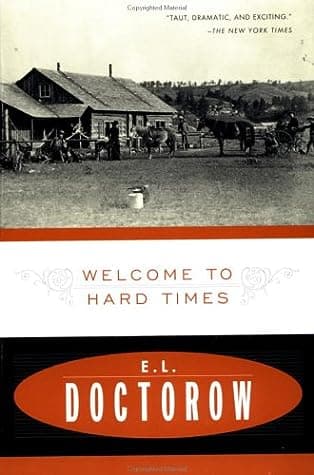
E.L. Doctorow (1960)
Genre
Literary Fiction / Historical Fiction
Reading Time
240 min
Key Themes
See below
Sign in to track this book
In the charred remains of a Dakota Territory town, a makeshift family rises from the ashes of a sociopath's rampage, rebuilding a community while a survivor's burning vengeance awaits the outlaw's return.
The story opens with the arrival of a menacing, nameless Kid in the new Dakota Territory settlement of Hard Times. The town, a collection of rough shacks and tents, is just beginning to form under the informal leadership of Blue, who keeps a journal documenting its fragile existence. The Kid immediately shows his violent presence, destroying property, burning buildings, killing settlers, and terrorizing the inhabitants. Among his victims is the prostitute Molly, whom he brutally rapes and leaves for dead. Blue, witnessing the carnage, is powerless to stop him. The Kid's rampage ends in the near-total destruction of Hard Times, leaving it a smoking ruin and its few survivors traumatized.
After the Kid's departure, Blue is among the few survivors of the massacre. He finds Molly, severely injured and traumatized by the Kid's brutality, and a young boy named Jimmy, who is mute and shell-shocked. Blue, feeling a deep sense of responsibility and a desire to impose order on the chaos, decides to stay and rebuild Hard Times. He takes Molly and Jimmy under his wing, forming an unlikely, temporary family unit. Despite the bleakness, Blue’s journal entries reflect an early hope for a new beginning, a determination to establish a proper town from the ashes, driven by his inherent need for structure and a community.
Blue begins his efforts to rebuild, clearing debris and preparing for new arrivals. The first to come are John and Ezell, a pair of drifters who help with the initial labor but prove unreliable. Soon after, a more substantial group arrives, led by the astute and entrepreneurial Isaac Kind, along with his wife and several workers. Kind immediately begins establishing businesses, including a saloon and a general store, bringing some economic activity and stability to Hard Times. His arrival marks a turning point, transforming the desolate wasteland into a budding community once more, though one still haunted by its violent past and Molly's growing desire for revenge.
As Hard Times slowly rebuilds, Molly remains deeply scarred by her ordeal. Her trauma turns into a strong desire for vengeance against the Kid. She becomes withdrawn and watchful, focused only on the potential return of her attacker. Blue, while sympathetic to her suffering, is primarily concerned with the safety and stability of the new town. He struggles to reconcile Molly's personal quest for revenge with his vision of a peaceful, law-abiding community. This internal conflict creates a growing rift between them, as Molly's single-minded purpose clashes with Blue's pragmatic leadership.
The population of Hard Times steadily increases, drawing diverse characters seeking opportunity or escape. Blue finds himself increasingly acting as a de facto mayor, settling disputes, maintaining order, and guiding the town's development. Isaac Kind's businesses thrive, and a sense of routine begins to take hold. Blue's journal entries detail the challenges of governing a frontier town, from establishing basic laws to managing the expectations and conflicts of its inhabitants. He grapples with the responsibility of creating a civilized society in a lawless land, often feeling the weight of the past and the uncertainty of the future.
A stranger named Major arrives in Hard Times, claiming to be an associate of the Kid. His presence immediately stirs unease and fear among the settlers, particularly Molly. Major's arrival is a chilling reminder of the violence that once ravaged the town and a sign of potential future danger. For Molly, it's a confirmation of her long-held fears and hopes for retribution. She observes Major closely, believing he holds the key to the Kid's whereabouts or, at least, a connection to him. Blue, recognizing the threat, tries to maintain order and protect the town from renewed chaos, but Major's presence unravels the fragile peace.
Convinced that Major is a direct link to the Kid, and unable to endure the waiting any longer, Molly takes decisive, violent action. She lures Major to her cabin and, in a moment of desperate resolve, kills him. The act, while a personal triumph for Molly, throws the new community into disarray. Blue is horrified by the vigilante justice and the breach of the fragile peace he has worked so hard to establish. The incident exposes the raw, untamed nature still lurking beneath the town's surface and forces Blue to confront the limits of his authority and the depth of Molly's trauma-driven vengeance.
As if drawn by the lingering violence or the town's growing prosperity, the Kid reappears in Hard Times. His return is swift and brutal, mirroring his initial rampage but with a more focused malevolence. He immediately targets Molly, seeking to reassert his dominance and finish what he started. The town is once again plunged into terror, its inhabitants scattering or hiding. Blue, despite his pacifist nature, is forced to confront the Kid directly, attempting to protect Molly and the few remaining townspeople. The stage is set for a final, desperate showdown that will determine the ultimate fate of Hard Times and its survivors.
The Kid's return leads to a devastating confrontation. He brutally assaults Molly again, leaving her mortally wounded. In a desperate attempt to protect Jimmy, Blue intervenes, but his efforts are largely in vain against the Kid's unbridled savagery. The Kid continues his rampage, killing more settlers and once again setting fire to the town. The violence is overwhelming, and Blue, recording the events in his journal, is a helpless witness to the destruction of everything he has painstakingly tried to build. The dream of a civilized Hard Times is shattered, replaced by the raw, brutal reality of the frontier.
Following the Kid's final, destructive visit, Hard Times is reduced to ashes once more. Molly succumbs to her injuries, and Jimmy is left orphaned and traumatized. Blue, the sole remaining chronicler, is left to pick through the ruins, both physical and emotional. His journal entries become more philosophical, grappling with the futility of his efforts to establish order and the inherent, cyclical nature of violence in the barren landscape. He reflects on the human capacity for evil, the fragility of civilization, and the enduring power of both hope and despair. The novel ends with Blue, alone, pondering the meaning of his experiences and the ultimate fate of humanity in such 'hard times'.
The Protagonist
Blue begins as an idealistic builder of a new society but ends as a disillusioned philosopher, grappling with the cyclical nature of violence and the fragility of human endeavor.
The Supporting
Molly transforms from a victim to an avenger, ultimately finding a tragic, violent end as she pursues retribution.
The Antagonist
The Kid remains a static force of destruction, embodying the persistent threat of lawlessness and evil.
The Supporting
Jimmy remains a symbol of lost innocence and potential, his fate mirroring the fragility of hope in Hard Times.
The Supporting
Kind successfully establishes himself as a pillar of the community's economy, demonstrating the resilience of commerce amidst hardship.
The Supporting
Major's arrival and death serve as a catalyst, pushing Molly's vengeance to a tragic climax and foreshadowing the Kid's return.
The Mentioned
They appear and disappear, demonstrating the transient nature of many frontier inhabitants.
The novel powerfully explores how easily civilization's thin layer can be stripped away, revealing brutal realities. Hard Times is repeatedly built up by Blue's earnest efforts, only to be violently torn down by the Kid. This cyclical destruction shows that order and law are precarious, constantly threatened by chaos and human depravity. The initial massacre, Molly's vigilante justice, and the Kid's final return all show how a community, no matter how diligently built, can be undone by the persistent forces of lawlessness and violence inherent in the frontier.
““For the life of me I don't know why I stayed. But I did. And the town began again.””
E.L. Doctorow presents evil not as a complex, motivated force, but as an almost elemental, inexplicable presence embodied by the nameless Kid. The Kid's actions are wanton, without clear motive or remorse, suggesting a primal, destructive impulse that exists simply for its own sake. This theme challenges the reader to grapple with the existence of pure malevolence, which cannot be reasoned with or understood, only endured or fought. The Kid's repeated returns emphasize the cyclical and persistent nature of this evil, always threatening to resurface and undo any progress toward peace and order.
““He was a boy, no more than that, but he was the devil himself.””
The conflict between Molly's raw, personal quest for vengeance and Blue's desire for a structured, lawful justice system is central to the novel. Molly's trauma fuels an all-consuming need for retribution, leading her to take violent action outside the bounds of any established law. Blue, on the other hand, strives to build a society where justice is administered through rules and communal agreement. Their opposing approaches highlight the moral ambiguities of the frontier, where formal justice is often absent, and personal revenge becomes a powerful, albeit destructive, alternative. Molly's actions ultimately undermine Blue's efforts to establish order, showing the corrosive power of unchecked vengeance.
““She had a thing in her mind, and nothing I could say or do would take it out.””
Blue's journal entries make up the entire narrative, making storytelling and the nature of historical record a significant theme. Blue's careful documentation is an attempt to impose order on chaos, to make sense of senseless violence, and to create a lasting memory of Hard Times. His subjective perspective shapes the reader's understanding, highlighting the power and limitations of individual narrative in constructing history. The journal is a testament to human resilience, an act of defiance against erasure, and a philosophical reflection on the events, even as Blue acknowledges the futility of his efforts to truly control or change the outcomes.
““I have written it all down, as it happened, so that it will not be lost.””
The entire story is told through Blue's journal entries.
The novel is presented as a series of entries from Blue's personal journal, offering an intimate, subjective, and immediate perspective on the events of Hard Times. This device allows the reader to experience the unfolding chaos and the rebuilding efforts through Blue's eyes, including his internal struggles, philosophical reflections, and attempts to make sense of the brutality. It also emphasizes the theme of the chronicler, the act of recording history as it happens, and the individual's attempt to impose order and meaning on a chaotic world. The journal entries give the narrative a raw, authentic, and reflective quality.
The primary villain is never given a proper name, emphasizing his archetypal role.
The Kid's lack of a proper name serves to universalize him, transforming him from an individual character into an allegorical representation of pure, unmotivated evil and lawlessness. He is not a person with a backstory or complex motivations, but rather a force of nature, a recurring menace that embodies the inherent brutality of the frontier. This namelessness makes him more terrifying, as he is not bound by human reason or identity, and highlights the arbitrary, senseless nature of the violence he inflicts upon Hard Times.
The town of Hard Times is repeatedly built up only to be destroyed again.
The repeated destruction and rebuilding of Hard Times serve as a powerful structural and thematic device. The town is first ravaged by the Kid, then painstakingly rebuilt by Blue and the settlers, only to be threatened again by Major and ultimately destroyed a second time by the Kid. This cycle underscores the fragility of civilization, the persistent nature of evil, and the Sisyphean struggle of humanity to create order and meaning in a chaotic world. It emphasizes that progress is not linear, and that the 'hard times' are a recurring condition rather than a temporary phase.
A silent survivor who symbolizes lost innocence and the vulnerability of hope.
Jimmy, rendered mute by the trauma of the Kid's initial attack, serves as a poignant symbol throughout the novel. His silence represents the unspeakable horror he has witnessed and the lasting scars of violence. As a child, he embodies innocence and the potential for a future, making him a focal point for Blue's protective instincts and a reason for the community to persevere. His vulnerability highlights the stakes of the conflict and the profound impact of the lawless frontier on the most innocent members of society. His eventual fate mirrors the ultimate destruction of Hard Times.
“It was a town that had grown up around a single, terrible event, like a scar.”
— Describing the town of Hard Times and its origins.
“Man is a creature that will go on living, no matter how much he has to lose.”
— Reflecting on the resilience and stubbornness of human nature.
“The past is never dead. It's not even past.”
— A character's rumination on how past events continue to influence the present.
“There was no law in Hard Times, only the swift justice of the hand.”
— Highlighting the lawlessness and brutal reality of the frontier town.
“Every man has his own wilderness to cross.”
— A metaphorical statement about personal struggles and challenges.
“Fear was a kind of currency here, spent freely and received with interest.”
— Describing the pervasive atmosphere of fear in Hard Times.
“Life had a way of grinding you down, like a millstone, until there was nothing left but dust.”
— A bleak observation on the harshness and futility of existence.
“He carried his guilt like a stone in his pocket, always there, always heavy.”
— Depicting a character burdened by their past actions.
“The sky was a vast, indifferent canvas, watching the small dramas of men unfold below.”
— A cosmic perspective on human struggles against a backdrop of nature.
“Hope was a dangerous thing in Hard Times, a flickering candle in a hurricane.”
— Emphasizing the fragility of hope in a brutal environment.
“The wind howled like a hungry wolf, tearing at the flimsy structures of their lives.”
— Using nature to reflect the destructive forces impacting the townspeople.
“They were all survivors of something, though they couldn't always say what.”
— A commentary on the collective trauma and resilience of the inhabitants.
“A man's worth was measured by what he could take, and what he could keep.”
— Reflecting the brutal, materialistic values prevalent in the frontier setting.
Ready to see how well you understood this book? Take our interactive quiz with 10 questions.

E.L. Doctorow was a celebrated American novelist known for his sweeping historical fiction that explored American identity and myth. His acclaimed works include "Ragtime," "The Book of Daniel," and "The March." Doctorow's writing often blended historical accuracy with fictional narratives, earning him numerous awards and critical recognition throughout his career.







