“We wanted to be good so bad, but we were just animals, and animals are messy.”
— The brothers reflect on their wildness and the desire to be 'good' for their mother.

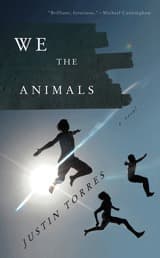
Justin Torres (2011)
Genre
Literary Fiction / Young Adult
Reading Time
90 min
Key Themes
See below
Sign in to track this book
Three brothers in a Brooklyn-Puerto Rican household grow up amid their parents' raw love and brutal chaos, forming fierce bonds and enduring betrayals on their way to a singular identity.
The novel opens with the three brothers, Manny, Joel, and the youngest unnamed narrator, living a wild life in upstate New York. Their days are full of impulsive games, often involving destruction and a connection to nature. They are always together, a unified group moving through their environment with a shared, animal-like energy. Their mother, Ma, is often absent due to her graveyard shift, leaving the boys to themselves, or under the supervision of their father, Paps. This early period establishes their intense bond and the chaotic, yet deeply felt, love that defines their family life, marked by fierce loyalty and underlying tension.
Paps and Ma's relationship is a central, often destructive, force in the boys' lives. Their love is intense and passionate, but often erupts into violent arguments that traumatize the children. The boys often hide or try to intervene, seeking to keep some peace. Paps, a Puerto Rican man from Brooklyn, works hard but struggles with his temper, while Ma, a white woman, is often tired and prone to emotional breakdowns. These domestic battles create constant uncertainty and fear, pushing the brothers into a tighter unit for mutual protection and understanding, and exposing them to the raw parts of adult love and conflict.
As the brothers grow, the unnamed narrator slowly begins to stand out from Manny and Joel. While they remain a close unit, the narrator shows a growing sensitivity and an internal world that sets him apart. He notices details, feels emotions more deeply, and starts to question the rough norms of their shared life. This emerging individuality is subtle at first, often expressed through quiet observations or a desire for different kinds of play. It marks the start of his coming-of-age, hinting at a future where he might not fit as well into the 'pack' as he once did, suggesting a split in their paths.
Paps sometimes takes the boys, especially Manny and Joel, to work with him. These experiences, often involving manual labor and long hours, are meant to teach them responsibility and the value of hard work. However, they also show the boys the harsh realities of their father's life and the struggles of the working class. The narrator, though sometimes present, often observes these scenes with a different view, perhaps less eager to copy the physical demands and more aware of the emotional toll. These work experiences solidify the older brothers' bond with Paps, while subtly widening the gap with the narrator's more thoughtful nature.
As they near adolescence, the brothers' sexual curiosities and urges begin to appear. These moments are often confused, experimental, and sometimes tinged with violence or discomfort, reflecting the raw environment where they are raised. The narrator, in particular, experiences a developing attraction to other boys, which he struggles to understand and reconcile with his family's masculine world. These private explorations and shared, often unspoken, experiences with sexuality become a source of both bonding and increasing isolation for the narrator, as he deals with desires that set him further apart from his brothers' more conventional understanding of masculinity.
The narrator's growing awareness of his own difference leads him to create a secret inner life. He holds feelings and desires, especially his homosexual inclinations, that he knows his family would not understand or accept. This secrecy creates a growing divide between him and his brothers, even as he continues to take part in their shared activities. He begins to observe his family from a slight distance, becoming an analyst of their dynamics rather than just an actor within them. This internal separation is a step in his individuation, marking his transition from a complete member of 'we' to a more solitary 'I'.
Manny, the oldest brother, begins to show more noticeable rebellious behavior. He often clashes with Paps, mirroring his father's temper and asserting his own will. His rebellions are often destructive and impulsive, showing deep anger and frustration with their situation. He starts to pull away from the close family unit, seeking independence and expressing his discontent through defiance. This shift in Manny's behavior adds another layer of tension to the already fragile family dynamic, forcing the narrator to observe how his brothers cope with their challenging upbringing.
Joel, the middle brother, struggles with his own identity among the strong personalities of Manny and Paps, and the narrator's emerging sensitivity. He often tries to mediate or adapt, but also experiences moments of confusion and anger. He is caught between the wildness of his childhood and the growing expectations placed on him as he matures. Joel's struggles are less outwardly rebellious than Manny's, but just as impactful, reflecting the complex internal world of a boy trying to find his place within a turbulent family. His internal conflicts often show up in quieter, more thoughtful moments, or in sudden bursts of frustration.
The narrator's internal separation eventually leads to a desire for physical and emotional escape. He starts to actively seek experiences outside the family unit, finding comfort in solitude, reading, or exploring his own developing identity. This growing distance is painful, as it means detaching from the fierce love and unity that defined his early life. He understands that to truly become himself, he must break free from the powerful, almost suffocating, bonds of his family, even if it means leaving behind the only world he has ever known and the brothers with whom he shared everything. This period marks his conscious effort to make an independent path.
As each brother matures and develops distinct identities, the once-unbreakable 'pack' begins to break apart. Manny's rebellions, Joel's quiet struggles, and the narrator's increasing introspection and secret life pull them in different directions. The shared understanding and fierce unity of their childhood gives way to individual paths and growing unspoken distances. This breaking is a painful, unavoidable result of their coming-of-age, as the boys shed their collective identity to become individuals. The narrator observes this disintegration with sadness and a sense of liberation, understanding it as a necessary step towards his own future.
The novel ends with the narrator's difficult, yet firm, departure from his family. He knows that to fully embrace his identity and pursue a different life, he must leave the intense, often destructive, environment of his home. This act is not one of rejection, but of self-preservation and the pursuit of authenticity. It is a painful severing of the primal bonds that shaped him, but also an essential step towards his own future. The ending is ambiguous, suggesting that while he leaves the physical space, the indelible marks of his family and childhood will forever be a part of him, moving him forward while anchoring him to his past.
The Protagonist
From a unified member of a 'pack' to an alienated individual, he ultimately finds his voice and path by leaving his family.
The Supporting
He transitions from a wild, unified brother to a more rebellious and increasingly alienated young man, clashing with his father.
The Supporting
He moves from an active participant in the 'pack' to a more introspective and conflicted individual, searching for his own identity.
The Supporting
Her character remains largely static, a constant force of both love and emotional instability, deeply impacting her sons.
The Supporting
His character remains a consistent, powerful, and sometimes intimidating force, embodying a specific form of masculinity and family head.
The novel shows childhood as a time of intense, often conflicting experiences. The boys' lives are full of wild, uninhibited play, a deep connection to nature, and an animal-like joy in their shared existence. Yet, this beauty is always contrasted with the brutality of their home life—the parents' violent arguments, the poverty, and the raw exposure to adult struggles. Scenes like smashing tomatoes or building kites from trash highlight the inventive joy, while hiding under beds during parental fights shows the constant fear. This theme explores how these dualities shape the children's understanding of the world and their place in it.
“We were so many boys then, and we did not yet know what we were.”
A main theme is the narrator's struggle to form an individual identity separate from his family's collective 'we.' At first, his identity is fully part of his brothers' 'pack' mentality. However, as he matures, his growing sensitivity, introspection, and developing homosexual desires create a strong sense of being alone. This theme is clear in his secret life, his observations of his family from a distance, and his eventual decision to leave. The novel explores the painful process of becoming an individual, the longing to belong, and the need to break away from primal bonds to become one's true self, even if it means profound loneliness.
“We were not gentle, and we were not kind, but we were ours. We were the animals.”
The book examines the complex, often destructive, nature of family love. Paps and Ma's relationship is a powerful, passionate force that is both deeply loving and intensely violent, creating a foundation of security and terror for their children. The brothers' bond is equally fierce—a primal, protective unity born from their shared experiences and mutual need for survival. The novel questions typical ideas of 'good' and 'bad' love, showing it as a raw, untamed force that shapes individuals completely. It suggests that even painful and chaotic love can be deeply formative and have its own kind of beauty and truth.
“Their love was a serious, dangerous thing that makes and unmakes a family many times.”
The novel explores different parts of masculinity within a working-class, Puerto Rican-white family. Paps embodies a traditional, often aggressive, form of masculinity, defined by hard work, stoicism, and a volatile temper. Manny and Joel largely copy this, engaging in rough play and struggling with their own expressions of anger and frustration. The narrator, however, is different, showing heightened sensitivity and a developing sexuality that challenges these established norms. This theme highlights the pressure to conform to specific masculine ideals and the vulnerability and isolation that can happen when one deviates, forcing the narrator to navigate a world that does not easily accept his true self.
“We wanted to be hard, but we were soft. We wanted to be men, but we were boys.”
The story is told from the 'we' perspective of the three brothers, then shifts to 'I'.
The novel masterfully employs a first-person plural narration ('we') in its early sections, creating an immediate and visceral sense of the brothers' unified, almost collective, identity. This 'we' underscores their intense bond, shared experiences, and the idea of them as an inseparable 'pack' or 'animals.' As the narrator begins his journey of individuation, the narration subtly shifts to a first-person singular ('I'), mirroring his growing sense of self and alienation from his brothers. This narrative device powerfully reflects the central theme of identity and the painful transition from collective belonging to solitary selfhood.
Animals and animalistic behavior are used to represent the characters' primal nature.
Throughout the novel, animals and animalistic imagery are used to symbolize the raw, untamed nature of the brothers' childhood and their family dynamics. The title itself, 'We the Animals,' sets this tone. Their play is often described in terms of packs, hunting, and primal urges. Their parents' volatile love is likened to a dangerous, natural force. This symbolism highlights the instinctive, uninhibited, and sometimes brutal aspects of their existence, suggesting that beneath the veneer of human society, there lies a more primal self. It also emphasizes the narrator's struggle to reconcile his sensitive nature with this wild, animalistic environment.
The story is told through a series of short, poetic vignettes rather than a linear plot.
The novel is structured as a series of short, lyrical, and often non-linear vignettes rather than a traditional continuous plot. Each vignette offers a snapshot or impression of a particular moment, memory, or feeling. This fragmented structure mirrors the chaotic and episodic nature of childhood memory and the narrator's internal, often disjointed, processing of events. It allows for intense focus on specific images, emotions, and sensory details, creating a deeply immersive and poetic reading experience that emphasizes the emotional truth of the narrative over strict chronological progression. This style also reflects the narrator's evolving perspective and his later role as an observer and interpreter of his past.
Rich, vivid descriptions appealing to all five senses create an immersive experience.
Torres employs exceptionally rich and visceral sensory language, immersing the reader directly into the boys' experiences. Descriptions often evoke touch, smell, taste, sight, and sound with intense detail—the feel of dirt, the smell of their mother's perfume, the taste of stolen food, the sounds of parental arguments. This device serves to ground the abstract themes of identity and family in a tangible, physical reality. It makes the world of the novel feel immediate and raw, reflecting the unfiltered way children experience their environment. This powerful imagery also allows the narrator to convey complex emotions and memories through concrete details.
“We wanted to be good so bad, but we were just animals, and animals are messy.”
— The brothers reflect on their wildness and the desire to be 'good' for their mother.
“I’m not a boy, I’m not a girl. I’m just me.”
— The narrator's internal struggle with gender identity and self-acceptance.
“Our father was a myth, a monster, a god. Our mother was a bird, a whisper, a song.”
— The narrator describes the contrasting and powerful presences of their parents.
“We were always running, toward something or away from something, but always running.”
— A recurring theme highlighting the restless and often chaotic nature of their childhood.
“The quietest moments were the most dangerous.”
— Reflecting on the tension and unspoken threats that often precede violence or upheaval.
“We were a pack, a gang, a pride. We were brothers.”
— Emphasizing the strong, almost primal bond between the three brothers.
“There was a wildness in us that couldn't be tamed, a hunger that couldn't be fed.”
— Describing the inherent, untamed nature of the children and their desires.
“Sometimes you just had to let the bad things happen, because trying to stop them only made them worse.”
— A resigned acceptance of the harsh realities and inevitable struggles they faced.
“Our bodies were maps of our lives, scarred and bruised and beautiful.”
— The narrator's poetic reflection on the physical marks left by their experiences.
“We lived in a house that was always falling apart, just like us.”
— A metaphor connecting the dilapidated state of their home to the family's internal struggles.
“Love was a thing with teeth, and it bit.”
— A stark and visceral depiction of love, acknowledging its pain alongside its power.
“My brothers were my shadows, my mirror, my constant reminder of who I was and who I wasn't.”
— The narrator's complex relationship with his brothers and their influence on his identity.
“We made our own rules, because the world outside didn't have any for us.”
— Highlighting the family's isolation and their creation of a unique, often chaotic, internal order.
“The world was a rough place, but we were rougher.”
— A defiant statement of resilience and the family's ability to withstand adversity.
Ready to see how well you understood this book? Take our interactive quiz with 10 questions.

Biography coming soon.







