“I like my sister Constance, and Mary Katherine, and the cat. Otherwise, I have no need of anyone.”
— Merricat reflecting on her family and her isolation before the villagers arrive.

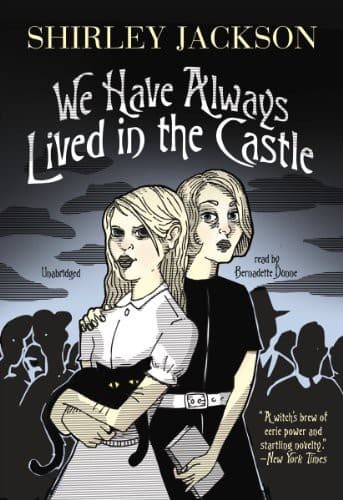
Shirley Jackson (2009)
Genre
Thriller / Mystery
Reading Time
180 min
Key Themes
See below
Sign in to track this book
Isolated in their crumbling mansion, the eccentric Blackwood sisters, one a suspected poisoner and the other a darkly protective recluse, must defend their peculiar sanctuary from an avaricious cousin and a prying world.
Mary Katherine 'Merricat' Blackwood, eighteen, lives in the secluded Blackwood family estate with her older sister Constance and their invalid Uncle Julian. Merricat often goes into the nearby village for groceries, enduring the villagers' ostracism and whispered accusations. She has a ritualistic routine, burying objects and following superstitions she believes protect her family and the house. Six years before, almost the entire Blackwood family died mysteriously from arsenic poisoning in their sugar bowl, but Constance was acquitted of the murders. Merricat cherishes their current isolated existence, a fragile world she tries to maintain against outside intrusion.
Through Uncle Julian's fragmented memories and Merricat's own recollections, the circumstances of the family's deaths are gradually put together. Six years ago, during a family dinner, arsenic was mixed into the sugar bowl, which was then passed around. Merricat, who disliked sugar, was sent to her room without dinner as punishment, saving her life. Constance, who also didn't take sugar, prepared the meal and served it, making her the prime suspect. Despite strong circumstantial evidence, Constance was acquitted, largely because Merricat would not testify clearly. The remaining family members, Merricat, Constance, and Uncle Julian, have since lived in almost complete isolation, haunted by the past.
The sisters' carefully guarded peace is shattered by the unexpected arrival of their cousin Charles Blackwood. Charles, a charming but manipulative man, immediately begins to assert his presence, subtly undermining Merricat's position in the household. He shows keen interest in the family's finances and the safe, which contains valuables. Constance, starved for outside company, is initially charmed by Charles, much to Merricat's dismay. Merricat sees Charles as a threat to her life with Constance and begins to plot ways to drive him away, feeling a growing sense of dread and possessiveness over her sister.
To rid their home of Charles, Merricat escalates her covert actions. She breaks his watch, spills water on his bed, and tries to make his room unlivable. Her efforts are meant to make Charles feel unwelcome and to protect Constance from his influence. However, Charles remains persistent, continuing to charm Constance and further alienate Merricat. Uncle Julian, in his clear moments, expresses his dislike for Charles, recognizing his opportunistic nature and his focus on the family's wealth. Merricat feels increasingly desperate as her attempts fail and Charles settles in further.
In a desperate attempt to scare Charles away permanently, Merricat sets fire to the wastebasket in his room, intending only a small disturbance. However, the fire quickly spreads, engulfing the Blackwood house. As the flames rise, the alarmed villagers, who have long resented and feared the Blackwoods, gather outside. They initially offer help but quickly turn into an angry mob, preventing Constance and Merricat from escaping safely and pelting them with stones and insults. Charles, attempting to rescue the safe, is injured and eventually flees the scene, abandoning the sisters.
Forced to flee the burning mansion, Merricat and Constance take refuge in the woods, watching their home burn and the villagers ransack what remains. The fire destroys much of the upper floors, including Uncle Julian's room, leading to his death from the smoke and shock. The sisters spend the night huddled together, their world changed. The villagers eventually leave, leaving the ruined house and the traumatized sisters. The event makes their isolation stronger, but also, strangely, strengthens their bond as they face the aftermath together, clinging to each other for comfort and survival.
In the days following the fire, Merricat and Constance return to their ruined home. The upper floors are uninhabitable, but the kitchen and a few other rooms on the ground floor are salvageable. They begin to clear the debris and create a new, simpler existence within the charred remains. The villagers, now guilt-ridden and somewhat afraid, leave food on their doorstep, an offering of atonement and fear. The sisters, however, refuse to interact with anyone, making their self-imposed isolation stronger. Their bond deepens, and they find a strange contentment in their new, more confined world.
As they rebuild their lives, Merricat finally tells Constance that she was the one who poisoned the sugar bowl six years ago, resulting in the deaths of their parents, aunt, and brother. She reveals her motive: a desire to stop a perceived punishment and to prevent changes to their family life, particularly the threat of Constance being taken away. Constance, who has always known Merricat was responsible, accepts her confession with a quiet understanding, reinforcing their unique and unbreakable bond. This revelation solidifies their shared secret and their commitment to each other, free from the outside world.
With the house partially restored and their secret shared, Merricat and Constance settle into a new, even more isolated routine. The villagers, now leaving offerings of food and goods, treat the Blackwood sisters with a mixture of fear and reverence, considering them a local legend or ghost story. The sisters embrace their roles as the strange, reclusive inhabitants of the burned house. Their life is simple, centered on each other and their shared rituals. Merricat continues her protective magic, and Constance finds peace in their quiet, undisturbed existence, forever bound by their past and present.
The Protagonist
Merricat begins as a seemingly innocent, albeit strange, young woman, and is revealed to be a calculating murderer who ultimately finds a perverse sense of peace in her isolation with Constance.
The Supporting
Constance maintains her gentle, domestic nature throughout, ultimately accepting her fate with Merricat and finding contentment in their shared, isolated world.
The Supporting
Uncle Julian remains trapped in his past until his death during the house fire, never fully understanding the truth of the poisoning.
The Antagonist
Charles arrives with intentions of financial gain, but is ultimately driven away by Merricat's actions and the house fire, failing to achieve his goals.
The Mentioned
Her character is static, serving as a victim in the past event.
The Mentioned
His character is static, serving as a victim in the past event.
The Mentioned
Her character is static, serving as a victim in the past event.
The Mentioned
His character is static, serving as a victim in the past event.
The Supporting
The villagers evolve from hostile and accusatory to guilt-ridden and superstitiously deferential towards the sisters.
The Blackwood sisters, especially Merricat and Constance, are isolated from society. This isolation is both self-imposed and enforced by the villagers' ostracism after the murders. Merricat actively creates this otherness through her rituals and dislike for the village, while Constance's agoraphobia keeps her confined. Their isolation becomes a sanctuary, a 'castle' against the perceived threats of the outside world, allowing them to exist in their unique and undisturbed dynamic. The burning of the house and the subsequent rebuild only deepens this theme, as they become truly mythical figures in their community.
“We have always lived in the castle. It was a very old castle, and we were its people.”
The novel explores the ambiguity of evil and sanity, primarily through Merricat's character. Her actions—the calculated poisoning of her family and the later arson—are destructive, yet her internal monologue presents them as logical, protective measures. The narrative challenges the reader to question whether Merricat is simply 'mad' or if her 'evil' comes from a twisted loyalty and desire for control. The villagers' fear and the family's past trauma create an atmosphere where conventional morality is distorted, making Merricat's motivations complex rather than purely malevolent.
“I could not help but think that I would be a good witch, and I would make them all happy.”
At the story's heart is the intense and unconventional bond between Merricat and Constance. Merricat's actions, including the murders, are driven by a fierce, possessive loyalty to Constance and a desire to preserve their specific way of life. Constance, in turn, silently protects Merricat, understanding her and accepting her without judgment. Their relationship is the sole anchor in their world, surviving tragedy, societal condemnation, and Charles's attempts to divide them. This theme explores the extreme lengths to which familial loyalty can extend, even into the pathological.
“I am so happy that you are here, my love. My only hope for the world.”
The novel is narrated entirely from Merricat's first-person perspective, making her an unreliable narrator. Her unique voice, superstitions, and selective memories shape the reader's understanding of events, especially the murders. The truth is gradually revealed through her fragmented recollections, Uncle Julian's confused memoirs, and the villagers' gossip. This unreliable narration shows how individual perspective can warp reality and how a story, once told, can become a 'truth,' regardless of its factual accuracy. The novel itself is a story crafted by Merricat, inviting the reader into her skewed world.
“I had often thought that if I had had to live in the village, I should have been a witch.”
Merricat's character is defined by her deep need for control and her desire to maintain a specific order within her world. Her rituals, superstitions, and acts of violence are all attempts to control her environment and protect her carefully constructed reality with Constance. The arrival of Charles directly threatens this order, prompting Merricat's increasingly desperate measures to restore it. Even the fire, though initially accidental in its scale, purges the house of outside influence and allows the sisters to rebuild their world entirely on their own terms, establishing a new, if charred, order.
“I used to think that the world was a very large place, and that I was very small. But now I know that I am the world, and that the world is very small.”
Merricat's first-person narration shapes and distorts the reader's understanding of events.
The entire story is told through the eyes of Merricat Blackwood, whose eccentricities, superstitions, and ultimately, her past actions as a murderer, make her a profoundly unreliable narrator. Her perspective is colored by her intense personal biases, her love for Constance, and her disdain for the outside world. This device forces the reader to constantly question what is true and what is Merricat's subjective reality, slowly revealing the horrifying truth behind the family's past and Merricat's disturbed psyche. It creates suspense and psychological depth, making the reader complicit in Merricat's skewed worldview.
The dilapidated Blackwood manor creates a sense of dread, isolation, and decay.
The Blackwood family home, a decaying mansion on the outskirts of an unwelcoming village, is a quintessential gothic setting. Its isolation, the pervasive sense of a dark past, and its eventual partial destruction by fire contribute significantly to the novel's eerie atmosphere. The house is almost a character itself, reflecting the psychological state of its inhabitants and serving as both a refuge and a prison. The decaying grandeur and the secrets it holds amplify the themes of isolation, madness, and the lingering effects of trauma, trapping the sisters within its walls and its history.
The sugar bowl represents domesticity, poison, and the family's destructive past.
The sugar bowl is a powerful symbol in the novel, serving as the instrument of the family's demise. Traditionally a symbol of hospitality and sweetness within a domestic setting, it becomes the vessel for arsenic, transforming it into a tool of death. This inversion highlights the perversion of domesticity within the Blackwood home and the dark secrets hidden beneath a veneer of normalcy. It is a constant, lingering reminder of the past tragedy, and its presence in Uncle Julian's fragmented memories underscores the traumatic event that defines the sisters' lives.
Merricat's elaborate rituals provide a coping mechanism and a means of control.
Merricat engages in numerous personal rituals and superstitions, such as burying objects, nailing things to trees, and assigning magical properties to certain words or actions. These acts serve multiple purposes: they are a coping mechanism for her anxiety and trauma, a way for her to exert a sense of control over her unpredictable world, and a means of protecting her and Constance from perceived threats (both real and imagined). These rituals highlight her unique, almost childlike, yet deeply disturbed inner world, blurring the lines between innocence and calculated malevolence.
The village and external characters represent an intrusive, judgmental force.
The novel consistently portrays the outside world—primarily represented by the villagers and Cousin Charles—as a hostile, intrusive, and threatening force. The villagers' gossip, stares, and eventual mob mentality during the fire symbolize societal judgment and the fear of the 'other.' Charles embodies the opportunistic and materialistic dangers of external influence, attempting to exploit the Blackwoods' vulnerability. This device reinforces the sisters' desire for isolation and justifies Merricat's extreme measures to protect their insular world, positioning their 'castle' as a necessary defense against perceived malevolence from beyond its walls.
“I like my sister Constance, and Mary Katherine, and the cat. Otherwise, I have no need of anyone.”
— Merricat reflecting on her family and her isolation before the villagers arrive.
“I have often thought that with any luck at all I could have been born a werewolf, because the two things I have always wanted to be were a werewolf and a vampire.”
— Merricat's dark fantasy about her true nature, revealing her disconnect from reality.
“The world was poisoned, and she knew it, and she would not let it touch her.”
— Describing Constance's perception of the outside world after the poisoning.
“We are home, Merricat. We are safe.”
— Constance reassuring Merricat after the fire, emphasizing their return to isolation.
“I meant to poison them all.”
— Merricat's direct confession about the murders, a stark revelation.
“On the moon we eat frogs, and we dance in the moonlight, and we are happy.”
— Merricat's fanciful description of her imagined life on the moon, a symbol of escapism.
“I was not afraid, but I was thinking, I am going to die.”
— Merricat's internal monologue during a moment of perceived danger or confrontation.
“I am almost eighteen years old, and I know everything.”
— Merricat's declaration of self-assurance, highlighting her youthful arrogance and distorted worldview.
“A ghost, I thought, a ghost in my house. But it was only Charles.”
— Merricat's initial reaction to seeing Charles, underscoring her aversion to outsiders.
“Our house was a museum where the living were the exhibits.”
— Merricat's metaphorical description of their isolated existence within the Blackwood house.
“The Blackwoods had always been a proud and ancient family, and they had always lived in the great house on the hill.”
— Narrator's introduction to the Blackwood family history and their prominent social standing.
“I did not want to touch his hand, I did not want to look at him, I did not want to be near him.”
— Merricat's strong aversion to Uncle Julian, reflecting her general discomfort with most people.
“We eat the food, and we are quiet, and we are happy.”
— Merricat describing the simple, contented routine she shares with Constance.
“I never liked the villagers. I always wished them ill.”
— Merricat's frank admission of her long-standing animosity towards the villagers.
Ready to see how well you understood this book? Take our interactive quiz with 10 questions.

Shirley Hardie Jackson was an American writer known primarily for her works of horror and mystery. Over the duration of her writing career, which spanned over two decades, she composed six novels, two memoirs, and more than 200 short stories.







