“I'm telling you a story, one I've been telling myself for years.”
— The opening line, setting the stage for the narrative.

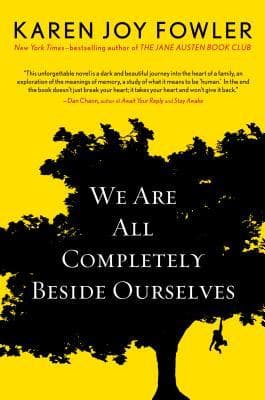
Karen Joy Fowler (2013)
Genre
Literary Fiction
Reading Time
6-8 hours
Key Themes
See below
Sign in to track this book
Rosemary Cooke's fractured family, haunted by her sister Fern's disappearance and an older brother's leaving, hides a secret that changed their ideas of family and humanity.
Rosemary Cooke, a college student at the University of California, Davis, has trouble with social interactions and is often quiet. She begins to tell her past, hinting at a secret in her family. She says she had a sister, Fern, who was taken from her at age five. This event, along with her older brother Lowell's later disappearance, has affected her family, leaving her parents distant and hurt. Rosemary's storytelling is conversational and indirect, purposefully holding back the main reveal about Fern's true nature, while emphasizing the emotional emptiness left by her absence and the breakdown of her family. She speaks of her own difficulty making connections, blaming it on her unusual upbringing.
Rosemary remembers her early childhood on a research farm in Bloomington, Indiana, where she and Fern were always together. She describes Fern as her constant companion, a sister with whom she shared everything. Their parents, a psychologist father and a linguist mother, were involved in their upbringing, creating an environment of curiosity and learning. The family seemed loving, though unusual because of their father's academic work. Rosemary remembers their house being busy, often with graduate students and researchers visiting. She points out Fern's distinctiveness, noting her unusual eating habits and non-verbal communication, which Rosemary, as a young child, thought was just 'Fern being Fern'.
Rosemary suddenly reveals the family secret: Fern was not a human girl, but a chimpanzee. This comes after much hinting, explaining earlier mentions of Fern's unique traits. Rosemary explains that Fern was part of a cross-fostering experiment her father, a psychologist, conducted to study language acquisition and human-animal bonding. Rosemary, as a human child, was raised with Fern as a sibling, learning sign language together. The family treated Fern as a daughter, dressing her, teaching her, and including her fully in their lives. This experiment, while new, caused great emotional stress on the family, especially Rosemary, who was too young to understand the scientific meaning of her sister's species.
At age five, Fern is suddenly removed from the Cooke home. Rosemary describes the event as traumatic and confusing, leaving her with a strong sense of loss and betrayal. She does not fully understand why Fern is gone, only that her parents' mood changes greatly. Her mother becomes withdrawn, and her father becomes distant and secretive. The house, once lively, becomes quiet and filled with unspoken sadness. Rosemary at first believes Fern has simply gone to live with other chimpanzees, but the emotional impact on her family is huge. This separation marks the end of Rosemary's carefree childhood and the start of her family's slow breakdown, as they struggle with the void left by Fern's absence and the ethical arguments around the experiment.
Lowell, Rosemary's older brother, becomes more rebellious and withdrawn after Fern's removal. He feels a strong sense of injustice and guilt about Fern's fate, believing she was unfairly taken. He tries to find Fern, searching for information and even trying to visit the facility where she was taken. His activism against animal experimentation grows, leading to fights with his father and authorities. Eventually, Lowell disappears from the family's life, leaving a note that he is going to help other chimpanzees. His disappearance adds to the family's grief and secrecy, leaving Rosemary as an only child and her parents even more isolated in their sorrow. Lowell's actions show the ethical complexities of the experiment and its lasting impact on the Cooke children.
After losing both Fern and Lowell, the Cooke family retreats into a deep silence. Rosemary, once a talkative child, learns to suppress her questions and memories, internalizing the family's unspoken grief. Her parents, consumed by their own sorrow and guilt, cannot openly discuss Fern or Lowell, creating an emotional gap in the home. Rosemary struggles with her own guilt, believing she might have caused Fern's removal by talking too much or acting wrongly. This period of silence shapes Rosemary's personality, making her reserved and socially awkward, as she carries the burden of her family's broken past and the secret of Fern's identity, which she feels she must protect.
At college, Rosemary meets Harlow, a former graduate student of her father's. Harlow, now a primatologist, gives Rosemary more details about Fern's life after she was taken from the Cooke family. Harlow reveals that Fern was placed in a research facility with other chimpanzees but struggled to adjust to a purely chimpanzee environment after being raised as a human. Fern developed self-harming behaviors and depression. Harlow explains the ethical debates around cross-fostering experiments and the long-term psychological damage they can cause to non-human primates. This information deeply upsets Rosemary, making her face the full, painful reality of Fern's suffering and the ethical implications of her father's work, challenging her idealized childhood memories.
Rosemary's mother, finally breaking her long silence, encourages Rosemary to find Lowell. She admits her own guilt and desire for her son, revealing that she has kept a box of Lowell's letters and postcards, hinting at his location. Inspired by her mother's new openness and her own desire for answers, Rosemary begins a journey to find Lowell. Her search takes her to various places connected with animal rights activism, following clues from Lowell's past. This quest shows Rosemary actively engaging with her family's broken history and trying to mend the relationships that have been broken by years of silence and secrets, seeking closure for herself and her parents.
Rosemary eventually finds Lowell at a secluded cabin in the Pacific Northwest, where he lives off the grid and is still involved in animal rights and rescue operations. Their reunion is tense at first, as Lowell is cautious and still resentful of their father and the experiment. He has dedicated his life to advocating for animal welfare, especially chimpanzees, to make up for Fern's suffering. Rosemary learns about Lowell's experiences, his commitment to his cause, and his sacrifices. This meeting allows them to start closing the gap of years of separation and unspoken pain, as they share their grief and their different views on Fern's life and their family's past.
Rosemary and Lowell decide to visit Fern at a chimpanzee sanctuary where she now lives. The sanctuary offers a more natural environment for chimpanzees rescued from research or entertainment. Seeing Fern again, after decades, is an emotional experience for both siblings. Fern is older, her behavior still showing the scars of her past, but she lives with other chimpanzees. Rosemary observes Fern's interactions with her own kind, recognizing the impact of her human upbringing and her struggle to integrate. This visit provides a form of closure, allowing Rosemary to directly face the reality of Fern's life and to acknowledge the complex legacy of her family's experiment, fostering a deeper understanding between her and Lowell.
After their visit to Fern, Rosemary and Lowell return to their parents, bringing a new openness to the family. They begin to openly discuss Fern, Lowell's activism, and the impact of the experiment on all of them. The long silence is finally broken, allowing for a painful but necessary process of reconciliation and forgiveness. Their parents, especially their father, begin to confront the ethical consequences of his work and the personal cost to his family. This period marks a turning point, as the family starts to heal, finding a way to acknowledge their shared history and the unique bond they all shared with Fern, moving towards a future based on honesty and mutual understanding.
With her family's secrets finally revealed and reconciliation begun, Rosemary finds her own voice. She continues her studies, now able to engage more genuinely with the world and her peers. She accepts her unique past, no longer burdened by silence or secrecy. Rosemary's story ends with hope and resilience, showing her growth from a withdrawn young woman to someone able to face difficult truths and form meaningful connections. She reflects on the lasting bond with her siblings, both human and chimpanzee, and the complex, beautiful, and sometimes painful nature of family love, accepting her identity shaped by extraordinary circumstances.
The Protagonist
Rosemary transforms from a silent, emotionally guarded young woman into someone who finds her voice, confronts her family's painful history, and ultimately embraces her unique identity.
The Central Figure
Fern's arc highlights the tragic consequences of being caught between two worlds, from a cherished 'human' child to a traumatized chimpanzee struggling for identity, eventually finding a measure of peace in a sanctuary.
The Supporting
Lowell's arc sees him transform from a protective older brother into a radical activist who sacrifices his family ties for his cause, eventually reuniting with Rosemary and beginning to heal.
The Supporting
Dr. Cooke's arc involves a slow, painful reckoning with the consequences of his scientific ambition, moving from intellectual detachment to a more emotionally aware understanding of his actions.
The Supporting
Mrs. Cooke's arc is one of re-emergence from a long period of grief and silence, finding the strength to reconnect with her children and confront the family's past.
The Supporting
Harlow's arc is less about personal transformation and more about her role as a catalyst for Rosemary's understanding and a voice for ethical treatment of animals.
The novel explores what makes a family and the limits of love. The Cooke family, with a chimpanzee sister, challenges usual definitions. Rosemary's bond with Fern, Lowell's protectiveness, and the parents' early devotion show that love goes beyond species. The family's breakdown after Fern's removal shows how losing a loved one, regardless of species, can shatter family structures. The eventual reconciliation emphasizes that shared history, grief, and facing painful truths are essential for rebuilding family bonds. The story suggests that love is about commitment and care, not biology.
““We are all completely beside ourselves,””
A main theme is the ethical problems of scientific experimentation, especially in animal research. Dr. Cooke's cross-fostering experiment, meant to advance understanding of language and development, causes suffering to Fern and devastates his family. The novel asks about the line between scientific curiosity and exploitation, and the responsibility researchers have to their subjects. Lowell's activism and Harlow's insights offer different views from Dr. Cooke's initial scientific detachment, making the reader consider the long-term emotional costs of such experiments, showing the changing understanding of animal awareness and welfare.
““The experiment was a failure, but the family was a success.””
The novel uses memory as a storytelling tool, with Rosemary's indirect narration showing her struggle to face painful truths. The family's silence after Fern's removal is a coping mechanism that ultimately causes more harm, creating a void of unspoken grief. Rosemary's journey is about breaking this silence, putting together fragmented memories, and facing the full truth about Fern's life and her family's past. The narrative structure itself reflects this theme, as Rosemary slowly reveals the main secret, showing how memory can be selectively held, distorted, and eventually, bravely faced for healing.
““I'm not saying I kept the secret. I'm saying I was the secret.””
The theme of identity is explored through Rosemary's struggle to define herself because of her unusual childhood. Being raised with a chimpanzee sister and then losing her, followed by her brother's disappearance, leaves Rosemary feeling disconnected from normal social rules. Fern's identity, caught between human and chimpanzee worlds, is central to this theme, showing the tragic results of not truly belonging anywhere. Lowell's identity as an activist comes from his love for Fern and his sense of injustice. The novel suggests that identity is complex, shaped by unique experiences, and that true belonging comes from accepting one's full, often unconventional, self and past.
““What is a sister? Is it a human being, or is it a feeling?””
The novel deeply examines the lasting effects of grief and trauma on a family. The loss of Fern, followed by Lowell's departure, causes deep trauma to each family member. Rosemary's parents become emotionally distant, while Rosemary herself develops social anxieties and a tendency toward silence. Lowell's activism is a direct response to his grief and guilt. The story shows how unprocessed grief can fester and create deep divisions within a family. The eventual healing process involves acknowledging the trauma, breaking the silence, and allowing each member to express their sorrow, showing that confronting grief, no matter how painful, is essential for recovery.
““Grief is a house that has been burned down. Love is the ashes.””
Rosemary deliberately withholds crucial information, shaping the reader's perception.
Rosemary's narration is highly subjective and deliberately circuitous. She withholds the central revelation that Fern is a chimpanzee for a significant portion of the book, using hints and misdirection. This technique creates suspense and allows the reader to experience Rosemary's own journey of remembering and confronting the truth. It also forces the reader to question their own assumptions about family and species, mirroring the confusion and secrecy Rosemary experienced as a child. Her unreliability is not malicious but a reflection of her own trauma and the family's long-held silence.
The story jumps between past and present, reflecting Rosemary's fragmented memory.
The novel's plot does not unfold chronologically. Rosemary frequently jumps between her childhood with Fern, her college years, and the period immediately after Fern's removal. This non-linear structure mirrors the way memory works, particularly when dealing with trauma, where recollections are often fragmented and resurface out of order. It also allows the author to gradually reveal information, building suspense and reflecting Rosemary's own struggle to piece together her past and come to terms with the full story, rather than presenting a straightforward account.
Silence represents the family's grief, secrets, and inability to cope.
Silence is a pervasive motif and plot device. After Fern's removal and Lowell's disappearance, the Cooke family retreats into a profound silence, a coping mechanism for their grief and guilt. Rosemary, once talkative, becomes silent and withdrawn. This silence prevents healing, perpetuates secrets, and creates emotional distance. The breaking of this silence, first by Mrs. Cooke and then by Rosemary's narrative itself, is a crucial step towards reconciliation and recovery, symbolizing the family's willingness to confront their painful past and begin communicating honestly.
The delayed revelation of Fern's species is a powerful narrative twist.
The most significant plot device is the delayed revelation that Fern is a chimpanzee. This twist is meticulously set up through Rosemary's ambiguous descriptions and the reader's inherent assumptions about a 'sister.' When the truth is revealed, it retroactively recontextualizes all prior information, forcing the reader to re-evaluate their understanding of the characters, their relationships, and the ethical dilemmas presented. This device not only generates surprise but also immerses the reader in Rosemary's perspective, highlighting how easily one can misinterpret information based on ingrained biases and expectations about family.
“I'm telling you a story, one I've been telling myself for years.”
— The opening line, setting the stage for the narrative.
“The thing about my family was, we didn't talk about things. We just did them.”
— Rosemary reflecting on her family's unspoken rules and actions.
“This is how you do it: you make yourself a story. You make it a good story. You make it a story that means you want to tell it again.”
— Rosemary contemplating the construction of personal narratives.
“The greatest gift is not being afraid to try.”
— A general life lesson Rosemary shares or reflects on.
“We were all completely beside ourselves.”
— The titular phrase, referring to the family's emotional state and unique situation.
“There are some things you can't undo, no matter how hard you try.”
— Rosemary grappling with the irreversible consequences of past events.
“The truth is, I don't remember much about the first five years of my life. I have to piece it together from other people's memories, from photographs, from what I've been told.”
— Rosemary discussing her early childhood and the unreliable nature of memory.
“What do we do with the unwanted parts of our lives? We try to forget them, or we try to make sense of them. Or we just live with them.”
— Rosemary pondering how people deal with difficult experiences.
“I wanted to be a good sister. I wanted to be a good daughter. I wanted to be a good person. But it turns out, sometimes, you just can't be all those things at once.”
— Rosemary reflecting on the complexities and conflicts of her roles.
“Grief is a funny thing. It comes in waves, and sometimes, it just washes over you when you least expect it.”
— Rosemary's thoughts on the unpredictable nature of grief.
“We're all just trying to make sense of the world, aren't we?”
— A general observation on the human condition.
“The hardest part of any journey is the first step.”
— Rosemary considering the challenge of initiating change or action.
“Love isn't always enough to keep a family together.”
— Rosemary's somber realization about the limitations of love in family dynamics.
“Sometimes the things you don't say are more important than the things you do.”
— Rosemary reflecting on the significance of silence and omission within her family.
Ready to see how well you understood this book? Take our interactive quiz with 10 questions.
Biography coming soon.







