“I am ninety. Or ninety-three. One or the other.”
— Opening line of the novel, reflecting the narrator's age and memory.

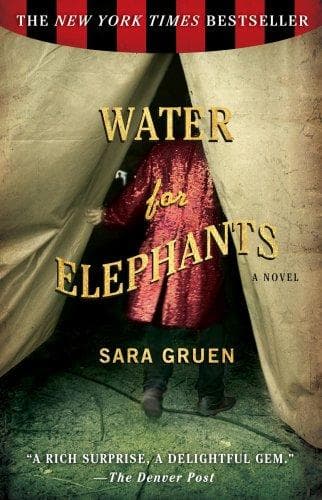
Sara Gruen (2006)
Genre
Historical Fiction / Romance
Reading Time
360 min
Key Themes
See below
Sign in to track this book
Amidst the dust and desperation of a Depression-era circus, an orphaned veterinary student finds forbidden love with the star equestrian and an an unlikely bond with an 'untrainable' elephant, all while navigating the volatile whims of her charismatic, cruel husband.
Ninety-year-old Jacob Jankowski, living in a nursing home, recounts his youth. In 1931, twenty-three-year-old Jacob is a Cornell veterinary student about to graduate when he learns his parents have been killed in a car accident. The bank forecloses on their house, and Jacob, now an orphan with no money or home, impulsively jumps onto a passing train. He soon discovers it's the Benzini Brothers Most Spectacular Show on Earth, a second-rate circus struggling during the Great Depression. Unsure of what to do, Jacob is taken in by the rough crew and eventually meets the owner, August Rosenbluth, who is also the head animal trainer.
Because of his unfinished veterinary degree, Jacob is put to work caring for the circus animals. He quickly learns the brutal realities of circus life, including the harsh treatment of animals and the circus's shaky financial state. He is introduced to Marlena Rosenbluth, the beautiful equestrian star and August's wife, who is only a few years older than Jacob. He is immediately drawn to her grace and kindness. Jacob also meets the various animals, including Silver Star, Marlena's lead horse, all under the care of August, whose methods are often cruel.
The circus, needing a new act to draw crowds, buys an elephant named Rosie. Rosie seems clumsy, untrainable, and unresponsive to commands, particularly from August. Jacob observes August's increasing frustration and violent temper, especially towards Rosie and at times, even towards Marlena. August frequently beats Rosie with a bullhook, but the elephant shows no improvement. Jacob feels a growing protectiveness towards both Marlena and Rosie, seeing August's unpredictable shifts between charming generosity and terrifying brutality. Jacob also discovers that August often gets drunk and becomes aggressive.
While caring for Rosie, Jacob notices her unusual behavior and, by chance, discovers she understands commands given in Polish. He realizes Rosie isn't untrainable, but rather had been trained in Polish, likely from a previous owner. This discovery allows Jacob to communicate with Rosie, and she quickly learns complex tricks under his guidance, performing them flawlessly when given Polish commands. This secret shared between Jacob and Rosie strengthens his bond with the elephant and also brings him closer to Marlena, who is thrilled by Rosie's transformation and the potential for a new, star act for the circus.
As Rosie's act becomes a success, Jacob and Marlena spend more time together, rehearsing and caring for Rosie. Their mutual admiration and attraction grow into a forbidden love. Jacob witnesses August's increasing paranoia and jealousy, and his abuse towards Marlena becomes more frequent and severe, though often hidden from public view. Marlena tells Jacob about August's manipulative and violent nature, revealing that he once threw her out of a moving car. The danger around them intensifies, as August's temper is unpredictable, and he has a reputation for 'red-lighting' (throwing off the train) people he dislikes or suspects.
Following a particularly brutal beating from August, Marlena flees. Jacob finds her injured and takes her to his bunk on the train, hiding her from August. This act of defiance and care strengthens their relationship. Marlena stays with Jacob, and their love becomes an open secret among some of the sympathetic circus workers, who are wary of August but also fear his retribution. This period gives Marlena a brief break from August's control, but it also places Jacob in extreme danger, as August's fury is now fully directed at him.
During a performance, a tent pole mysteriously collapses, causing a panic among the audience and a stampede of animals. In the chaos, August confronts Jacob and Marlena. As August tries to attack Marlena with a bullhook, Rosie, who has been quietly observing, intervenes. She picks up August with her trunk and slams him against the ground, killing him. The incident is quickly covered up by the circus management, who say August's death was due to the stampede, fearing legal problems and more scrutiny during the Depression.
After August's death, many of the circus workers, including the 'roustabouts' and 'bullhands' (who were often targeted by August for red-lighting), disappear, implying they were responsible for the tent pole collapse and August's death. Jacob, Marlena, and Rosie leave the Benzini Brothers circus. They eventually join the Ringling Bros. and Barnum & Bailey Circus, where Jacob continues to care for Rosie, and Marlena resumes her equestrian act. They marry and build a new life together, away from the constant fear and brutality of their past.
The story returns to ninety-year-old Jacob in the nursing home. He reflects on his long and happy marriage to Marlena, their children, and the life they built together after the circus. He fondly remembers Rosie, who lived a full life with them. Jacob finds comfort in his memories, often reliving the dangerous, and loving world of the circus. He feels a deep connection to that part of his past, acknowledging that despite the hardships, it was where he found his true family and love.
Still in the nursing home, Jacob feels increasingly isolated and unseen. He longs for the camaraderie and purpose he once had. When the current circus comes to town, Jacob expresses a desperate desire to join it, even if just to sell tickets. His family and the nursing home staff dismiss his idea, seeing it as the ramblings of an old man. However, Jacob, refusing to be confined by his age, secretly plans to leave the nursing home and join the circus, seeking a final connection to the world that defined his youth and brought him love.
The Protagonist
Jacob evolves from a grieving, aimless young man into a determined and loving husband and father, finding his true family and purpose within the unconventional world of the circus.
The Protagonist/Love Interest
Marlena transitions from a victim of abuse to a woman who finds freedom, love, and happiness through her relationship with Jacob and her eventual escape from August.
The Antagonist
August's character remains largely static in his cruelty, serving as the primary obstacle to Jacob and Marlena's happiness, ultimately leading to his violent demise.
The Supporting
Rosie transforms from an abused, misunderstood creature into a beloved and celebrated performer, ultimately acting as a protector for those she cares about.
The Supporting
Camel serves as an initial mentor and friend to Jacob, illustrating the harsh realities of circus life before his eventual, tragic removal from the troupe.
The Supporting
Kinko evolves from a suspicious observer to a loyal friend and confidant, playing a crucial role in protecting Jacob and Marlena.
The Supporting
Uncle Al remains consistently pragmatic and self-serving, embodying the harsh business realities of the circus.
The Supporting
Rosemary serves as a brief source of comfort and friendship for Jacob, highlighting the varied personalities within the circus.
The Protagonist (frame narrative)
Old Jacob's arc involves finding peace and a renewed sense of identity by fully embracing and sharing the memories of his past.
The novel explores the dangerous nature of love, particularly between Jacob and Marlena. Their love grows in a world of brutality and fear, making them make sacrifices and take great risks to be together. Jacob risks his life by defying August, and Marlena chooses an uncertain future with Jacob over the security (however violent) of her marriage. The love extends to the bond between Jacob and Rosie, where care and understanding overcome cruelty. This theme shows that true love requires courage and a willingness to fight for it, even against great odds.
“"He's a beautiful man, Jacob. But he's not good. He's not good at all."”
A main theme is the contrast between human cruelty and compassion, especially in the treatment of animals and vulnerable people. August shows cruelty, inflicting physical and emotional abuse on both animals and Marlena. The 'red-lighting' of employees and the harsh living conditions of the circus roustabouts further show this. In contrast, Jacob's kindness and veterinary knowledge represent compassion, as he tries to lessen suffering and connect with animals on a deeper level. This duality highlights the moral choices individuals face in a harsh world and the lasting power of empathy.
“"The world is a beast, you can try to tame it, but it will always be a beast."”
Jacob, orphaned and adrift, struggles with his identity and sense of belonging. He initially jumps onto the circus train with no clear purpose, finding himself among a group of misfits. The circus, despite its hardships, becomes his unexpected family and home, giving him a new identity as a veterinarian and a lover. Marlena, too, finds her true self and belonging with Jacob and Rosie, escaping the suffocating identity of August's wife. The novel suggests that family and belonging can be found in unexpected places, among those who share a common struggle and a deep connection.
“"I was a ghost, a drifter, and then I found my place among the freaks."”
The entire story is framed by old Jacob's memories, showing the subjective and often selective nature of memory. His recollections are vivid and detailed, but he acknowledges the passage of time and the way memory can shape one's understanding of the past. Telling his life story becomes a way for him to find meaning, cope with loneliness, and assert his identity in his old age. The contrast between his present frail state and the past he describes highlights the lasting power of personal history.
“"My mind is a kaleidoscope, and the pieces shift and form new patterns every day."”
Set during the Great Depression, the novel critiques the illusion of the American Dream during a period of widespread economic hardship. The circus itself is a symbol of fleeting entertainment and a desperate attempt to provide escape, while also struggling to survive. The characters, many of whom are outcasts or economically disadvantaged, are trying to make a living in a world that offers few opportunities. This backdrop highlights the desperation, resilience, and ingenuity needed to navigate such a challenging era, where even basic survival is a daily struggle.
“"We're all just trying to get by, kid. Some of us just do it with a little more flair."”
The story of young Jacob is told through the memories of old Jacob.
The novel employs a frame narrative, with the present-day story of ninety-year-old Jacob Jankowski in a nursing home enclosing his vivid recollections of his youth with the Benzini Brothers circus. This device allows for a reflective and nostalgic tone, providing insights into Jacob's emotional state and the lasting impact of his past. It also creates a sense of foreboding and suspense, as the elderly Jacob's fragmented memories hint at past tragedies and triumphs before they are fully revealed in the main narrative.
The story is told from Jacob's perspective as both a young man and an old man.
The narrative is primarily told from Jacob Jankowski's first-person point of view, but it effectively uses two distinct voices: the young, impressionable Jacob experiencing the circus for the first time, and the elderly, reflective Jacob looking back on his life. This dual perspective allows the author to explore themes of memory, regret, and the passage of time, while also immersing the reader directly into the immediate dangers and excitements of the circus world. The older Jacob's voice often interjects with commentary, adding depth and emotional resonance to the past events.
Rosie symbolizes innocence, resilience, and unexpected power.
Rosie, the 'untrainable' elephant, serves as a powerful symbol throughout the novel. Initially, she represents the vulnerability and exploitation of animals in the circus, and by extension, the vulnerable people like Marlena. Her ability to understand Polish symbolizes hidden depths and the importance of true communication and understanding. Ultimately, Rosie becomes a symbol of quiet resilience and unexpected power, delivering justice against August and protecting those she loves, embodying the idea that even the most unassuming can have a profound impact.
The circus serves as a condensed representation of society's struggles and hierarchies.
The Benzini Brothers Most Spectacular Show on Earth functions as a microcosm of society during the Great Depression. It is a world with its own strict hierarchies (owners, performers, roustabouts), its own rules, and its own forms of justice and injustice. It highlights themes of survival, economic hardship, and the desperation that drives people to extremes. The circus acts as a stage where human nature, in all its cruelty and compassion, is dramatically played out, reflecting the broader social and economic struggles of the era.
“I am ninety. Or ninety-three. One or the other.”
— Opening line of the novel, reflecting the narrator's age and memory.
“When two people are meant to be together, they will be together. It's fate.”
— Jacob reflects on his relationship with Marlena.
“Life is the most spectacular show on earth.”
— Jacob's observation about the circus and life itself.
“You know, you're not the only one with problems.”
— Marlena to Jacob during a tense moment.
“I don't know if I picked that time because that's when everything changed, or if everything changed because I picked that time.”
— Jacob musing on the pivotal moments of his life.
“The more I think about it, the more I realize that the only thing that matters is love.”
— Jacob's reflection in his old age.
“Sometimes I think if I had to choose between an ear of corn or making love to a woman, I'd choose the corn.”
— Jacob's humorous remark about hunger during the Depression.
“You can't live your life for other people. You've got to do what's right for you, even if it hurts some people you love.”
— Jacob advising a friend about personal choices.
“The circus arrives without warning.”
— Description of the circus's mysterious and sudden appearance.
“I am not a liar. I am a storyteller.”
— Jacob defending his way of recounting his past.
“There's no such thing as a mistake. There's only what you do and what you don't do.”
— Jacob's philosophy on life decisions.
“The world is full of obvious things which nobody by any chance ever observes.”
— Jacob quoting Sherlock Holmes, reflecting on perception.
“You can't run away from who you are, but what you can do is run toward who you want to be.”
— Jacob's realization about self-identity and growth.
“Sometimes the thing you're looking for is right in front of you.”
— Jacob's insight about love and happiness.
Ready to see how well you understood this book? Take our interactive quiz with 10 questions.

Biography coming soon.







