“Who watches the watchmen?”
— Juvenal's phrase used as the book's epigraph, questioning oversight of those in power.


Alan Moore (2014)
Genre
Fantasy / Science Fiction
Reading Time
448 min
Key Themes
See below
Sign in to track this book
Costumed vigilantes are outlawed. A detective and his former allies uncover a conspiracy from their violent past that affects their nuclear-threatened present. They must confront the moral complexities of power and justice.
In October 1985, Edward Blake, the government-sanctioned vigilante The Comedian, is murdered, thrown from his high-rise apartment. The masked vigilante Rorschach, one of the few active costumed adventurers after the Keene Act, investigates the crime scene. He discovers that Blake was The Comedian and believes the murder is part of a larger plot targeting former masked heroes. Rorschach visits his former teammates: Daniel Dreiberg (Nite Owl II), a retired, overweight gadgeteer, and Adrian Veidt (Ozymandias), a former hero turned wealthy businessman. Both dismiss Rorschach's paranoia, believing Blake's death is an isolated incident. Rorschach then tries to warn Dr. Manhattan and Laurie Juspeczyk (Silk Spectre II), but Dr. Manhattan, a god-like being, is indifferent, and Laurie lives with him in a government facility.
During a live television interview, Dr. Manhattan faces accusations that he caused cancer in his former girlfriend, Janey Slater, and other close associates. The broadcast is interrupted by the apparent disintegration of a former colleague. Overwhelmed by the public backlash and his growing detachment from humanity, Dr. Manhattan teleports himself to Mars. This threatens global stability as the US loses its ultimate defense against the Soviet Union. Laurie Juspeczyk, already feeling isolated in her relationship with Dr. Manhattan, feels increasingly drawn to Daniel Dreiberg. She moves in with him, and they start to revive their old crime-fighting partnership, finding comfort in each other's company and their past.
Rorschach continues investigating the Comedian's death, finding details about a missing scientist named Dr. Malcolm Long and a plot involving a wealthy industrialist. He is lured into a trap and framed for the murder of Moloch, a former supervillain who was terminally ill. Rorschach is arrested and unmasked as Walter Kovacs, a disturbed individual with a rigid moral code. His capture shocks the public and restarts the debate over costumed vigilantes. Meanwhile, Daniel Dreiberg, inspired by Laurie and the escalating crisis, puts on his Nite Owl costume again. Together, they begin to investigate the conspiracy Rorschach had warned them about, starting with Moloch's death.
While imprisoned, Rorschach undergoes psychiatric evaluation by Dr. Malcolm Long. He tells Dr. Long about his horrific childhood: a prostitute mother, bullying, and witnessing the brutal murder of a young girl, which solidified his transformation into Rorschach. His confession shows a disturbing but consistent worldview. At the same time, Nite Owl and Silk Spectre, now fully embracing their vigilante identities, find evidence suggesting Rorschach was framed. They decide to break him out of prison, a daring operation amidst growing civil unrest and increasing tensions between the US and the USSR. Their escape is successful, and Rorschach immediately rejoins their investigation, convinced that Veidt is behind everything.
On Mars, Dr. Manhattan thinks about humanity and his own existence. Laurie Juspeczyk teleports herself to Mars to confront him, hoping to convince him to return to Earth. During their intense conversation, Laurie reveals her complex feelings about her mother, Sally Jupiter (the original Silk Spectre), and her strained relationship with her. Dr. Manhattan, using his non-linear perception of time, helps Laurie piece together the truth: The Comedian, Edward Blake, was her biological father, the result of a sexual assault on Sally, but also a consensual relationship later. This revelation humanizes both Blake and Sally in Laurie's eyes. Dr. Manhattan, finding renewed interest in human connection, agrees to return to Earth.
Following clues from Rorschach's journal and a symbol on a missing scientist's notes, Nite Owl, Rorschach, and Silk Spectre travel to Adrian Veidt's Antarctic sanctuary, the Karnak facility. They confront Veidt, who calmly admits to orchestrating the entire conspiracy: the murder of The Comedian, framing Rorschach, faking Dr. Manhattan's cancer, and the deaths of numerous scientists. He reveals his ultimate plan: to prevent nuclear war between the US and USSR by creating an external, common enemy. He explains that he has genetically engineered a massive, squid-like creature and is about to teleport it into New York City, causing a psychic shockwave that will unite humanity against this perceived alien threat.
Before Nite Owl, Rorschach, and Silk Spectre can stop him, Veidt activates his plan. A colossal, genetically engineered 'alien' creature, complete with a powerful psychic brain, teleports into the middle of New York City. The resulting psychic shockwave kills millions and drives many more insane, while the physical devastation is immense. The world faces chaos and terror. However, as Veidt predicted, the sheer horror and the perceived alien threat immediately stop the escalating nuclear war between the US and the Soviet Union. Global leaders, believing humanity is under attack from an extraterrestrial force, declare an immediate ceasefire and begin to unite against this new, common enemy.
Dr. Manhattan arrives at Karnak, having returned to Earth, and witnesses the aftermath. Confronted with Veidt's confession and the horrific success of his plan, the remaining heroes face an impossible moral dilemma. Revealing Veidt's truth would shatter the fragile global peace and restart the nuclear conflict, leading to billions of deaths. Nite Owl, Silk Spectre, and Dr. Manhattan reluctantly agree to keep Veidt's secret, believing the greater good outweighs the truth and the millions already sacrificed. Rorschach, however, with his absolute moral code, cannot compromise. He declares he will expose Veidt's actions to the world, saying, 'Never compromise. Not even in the face of Armageddon.'
As Rorschach prepares to leave Karnak to deliver his journal—detailing Veidt's conspiracy—to the press, Dr. Manhattan confronts him. Understanding Rorschach's commitment to truth and the catastrophic consequences of him exposing Veidt, Dr. Manhattan is forced to make a tragic choice. Despite Rorschach's pleas to be allowed to fulfill his moral duty, Dr. Manhattan disintegrates him, killing him instantly to preserve the newfound world peace. With Rorschach's death, Dr. Manhattan expresses his disillusionment with humanity and his intention to leave Earth permanently for another galaxy, perhaps to create new life, showing his final detachment from human affairs.
Afterward, the world embraces a new era of peace, united by the perceived alien threat. Adrian Veidt remains unpunished, seen as a global savior. Nite Owl and Silk Spectre, adopting new identities, continue to fight crime on a smaller scale, having found love and purpose. However, the future of this manufactured peace is uncertain. The final scene shows the editor of a right-wing newspaper, The New Frontiersman, complaining about a lack of sensational material. His assistant suggests looking through the 'crank file,' which contains Rorschach's journal. The journal, containing the full truth of Veidt's plot, sits on a pile, its potential to unravel the global lie a ticking time bomb, ending the story with ambiguity and impending doom.
The Protagonist
Rorschach begins as a solitary, uncompromising investigator and ends as a martyr for truth, refusing to abandon his moral code even when faced with global catastrophe.
The Protagonist/Supporting
Dr. Manhattan evolves from a powerful but human-connected entity to a detached, god-like being who ultimately leaves humanity behind for cosmic exploration, briefly rekindling his connection through Laurie.
The Protagonist
Daniel transitions from a nostalgic, inactive hero to an active, re-energized vigilante who finds love and a new purpose, ultimately accepting a morally ambiguous peace for the greater good.
The Protagonist
Laurie struggles with her identity and unsatisfying relationships, eventually discovering her true parentage and finding love and purpose with Daniel, accepting the difficult truths of her past and present.
The Antagonist
Veidt transforms from a celebrated intellectual and hero to a cold, calculating mastermind who sacrifices millions for his vision of peace, believing himself to be humanity's savior.
The Supporting
Though deceased at the start, The Comedian's past actions and discoveries posthumously reveal his cynical awareness of the world's flaws and Adrian Veidt's plot, making him a catalyst for the main narrative.
The Supporting
Sally struggles with her past and her relationship with her daughter, ultimately seeing her difficult history with The Comedian reframed by Laurie's understanding.
The Mentioned/Supporting
Moloch, a retired villain, is drawn back into the world of heroes through The Comedian's visits and is ultimately murdered by Veidt to serve as a scapegoat for Rorschach.
The Supporting
Dr. Long's initial clinical detachment towards Rorschach transforms into a profound, disturbing understanding of his patient's psyche, challenging his own worldview.
Watchmen looks at the traditional superhero. It shows characters as flawed, psychologically damaged individuals rather than idealized figures. The Comedian is a rapist and murderer, Rorschach is a psychopath, and Dr. Manhattan is a detached god. The story explores what real-world superheroes mean for society, questioning their morality, legality, and psychological impact. It shows how the 'heroic' impulse can lead to authoritarianism (Comedian), madness (Rorschach), or alienation (Dr. Manhattan), challenging the idea of what a 'hero' is.
“''Look, I'm not a comic book character. I'm a human being. I have to live in the real world.''”
The main moral conflict of Watchmen is about Adrian Veidt's utilitarian plan: sacrificing millions to save billions. The story makes readers confront the logic of 'the greater good' and whether such an act, no matter how noble its intent, can ever be justified. The heroes' decision to keep Veidt's secret shows the moral compromises needed to maintain peace in a complex world. Rorschach's refusal to compromise shows the importance of truth and individual morality, even if it leads to catastrophe.
“''I did it thirty-five minutes ago.''”
This theme explores how power, whether governmental, physical, or metaphysical, corrupts or isolates. The Comedian's government sanction enables his brutality. Dr. Manhattan's omnipotence leads to his detachment from humanity. Adrian Veidt's intellect and wealth allow him to manipulate global events. The story suggests that absolute power leads to either moral decay or a loss of human connection, showing the dangers of unchecked authority and capability.
“''Nothing ends, Adrian. Nothing ever ends.''”
The story is full of nostalgia, often referencing the Golden Age of superheroes (the Minutemen) and earlier, simpler days of crime-fighting. Daniel Dreiberg's longing for his Nite Owl days, Sally Jupiter's reminiscing, and the general sense of a 'bygone era' are in the story. This nostalgia is often bittersweet, even dangerous, as it can blind characters to present realities or trap them in their past glories. The difference between the idealized past and the grim present shows that progress often has a cost, and that one cannot truly go home again.
“''It's 1985. We're not in the Minutemen anymore. We're not in the good old days.''”
Watchmen explores existential questions, especially through Dr. Manhattan's perspective. His non-linear perception of time and deterministic view question free will, suggesting that all events are predetermined. However, characters like Rorschach, with his absolute moral choice, and Veidt, with his audacious plan, assert their agency against difficult odds. The story explores whether humanity controls its destiny or if it is just an observer in a pre-written cosmic drama, leaving the reader to think about choice and fate.
“''We're all puppets, Laurie. I'm just a puppet who can see the strings.''”
Interweaving past and present to build character depth and reveal backstory.
The story employs a complex non-linear narrative, frequently jumping between the present (1985) and various points in the past, often through character flashbacks, Rorschach's journal entries, or Dr. Manhattan's unique perception of time. This device is crucial for revealing the intricate backstories of the characters, the history of the Minutemen, and the political climate that led to the present crisis. It allows for a gradual unveiling of plot details and character motivations, adding layers of depth and foreshadowing.
A first-person account serving as a crucial plot driver and moral anchor.
Rorschach's journal serves as a primary narrative device, offering a first-person, unfiltered perspective on his investigation and his increasingly grim worldview. It functions as an internal monologue, revealing his psychological state and moral absolutism. Crucially, the journal becomes a physical plot device, containing the evidence of Veidt's conspiracy. Its potential publication at the end of the story creates lingering tension and represents the fragility of the 'peace' achieved through deception.
Supplemental documents that expand the world and provide deeper context.
Between chapters, the comic includes excerpts from fictional documents such as historical texts, psychological profiles, interviews, and articles. These 'backmatter' sections provide extensive world-building, offering insights into the political history, character origins, and philosophical underpinnings of the Watchmen universe. They deepen the reader's understanding of the context, motivations, and consequences of the characters' actions, often revealing details not explicitly shown in the main narrative panels.
A recurring visual motif symbolizing escalating global tension.
The Doomsday Clock, a symbolic clock face counting down to midnight (representing global catastrophe), is a recurring visual motif throughout the narrative. Its hands are consistently shown at various points, particularly at 'five minutes to midnight,' reflecting the escalating Cold War tensions between the US and the USSR. It serves as a constant reminder of the impending nuclear annihilation that drives Adrian Veidt's drastic actions and provides a visual representation of the world's precarious state.
Structural and thematic mirroring to emphasize contrasts and connections.
Moore employs extensive symmetry and parallelism in both the narrative structure and thematic elements. This includes visual mirroring in panel layouts (e.g., the opening shot of The Comedian's pin mirroring the bloodstain), thematic parallels between characters (e.g., the two Silk Spectres, the two Nite Owls), and the cyclical nature of violence and history. This device enhances the sense of predestination and often highlights the contrasts between idealism and cynicism, or between different generations of heroes.
“Who watches the watchmen?”
— Juvenal's phrase used as the book's epigraph, questioning oversight of those in power.
“I did the right thing, didn't I? It all worked out in the end.”
— Adrian Veidt (Ozymandias) justifying his plan to create world peace through mass murder.
“We're all puppets, Laurie. I'm just a puppet who can see the strings.”
— Dr. Manhattan explaining his detached perspective on human existence to Laurie Juspeczyk.
“The accumulated filth of all their sex and murder will foam up about their waists and all the whores and politicians will look up and shout 'Save us!'... and I'll look down and whisper 'No.'”
— Rorschach's journal entry, expressing his uncompromising, nihilistic worldview.
“I'm not a comic book villain. Do you seriously think I'd explain my master-stroke if there remained the slightest chance of you affecting its outcome?”
— Adrian Veidt revealing his plan after it's already been executed, highlighting his arrogance and intelligence.
“Nothing ends, Adrian. Nothing ever ends.”
— Dr. Manhattan's final words to Adrian Veidt, questioning the permanence of his engineered peace.
“We do not do this thing because it is permitted. We do it because we have to. We do it because we are compelled.”
— Rorschach explaining his rigid moral code to Dr. Manhattan.
“The world is so full of people, so crowded with these miracles that they become commonplace and we forget... I forget.”
— Dr. Manhattan reflecting on human life and his growing detachment from it.
“I'm not locked in here with you. You're locked in here with me!”
— Rorschach defiantly shouting at criminals in a prison riot.
“It's too late. Always has been, always will be, too late.”
— Dr. Manhattan expressing his fatalistic view of events to Laurie Juspeczyk.
“We're all in the gutter, but some of us are looking at the stars.”
— Oscar Wilde quote used by Adrian Veidt, reflecting his idealistic yet twisted vision.
“I leave it entirely in your hands.”
— Adrian Veidt's final line, passing the moral dilemma of his actions to the reader.
“A live body and a dead body contain the same number of particles. Structurally, there's no discernible difference.”
— Dr. Manhattan's cold, scientific observation on life and death.
“This city is afraid of me... I have seen its true face.”
— Rorschach's opening journal monologue, establishing his grim outlook on society.
Ready to see how well you understood this book? Take our interactive quiz with 10 questions.
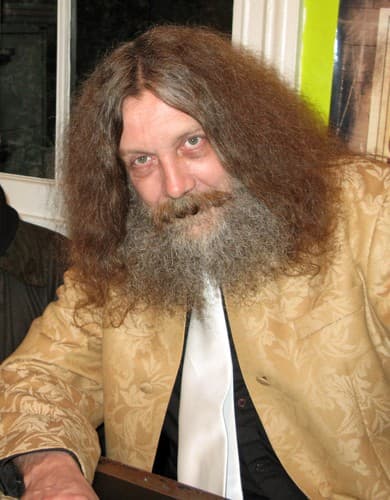
Alan Moore is an English author known primarily for his work in comic books including Watchmen, V for Vendetta, The Ballad of Halo Jones, Swamp Thing, Batman: The Killing Joke, and From Hell. He is widely recognised among his peers and critics as one of the best comic book writers in the English language. Moore has occasionally used such pseudonyms as Curt Vile, Jill de Ray, Brilburn Logue, and Translucia Baboon; also, reprints of some of his work have been credited to The Original Writer when Moore requested that his name be removed.







