“I am dead, but it's not so bad. I've learned to live with it.”
— R's opening narration, setting the tone for his existence.

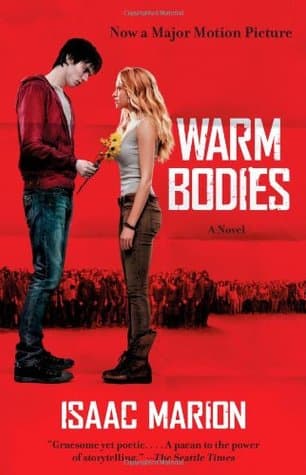
Isaac Marion (2011)
Genre
Fantasy / Science Fiction / Young Adult / Romance
Reading Time
240 min
Key Themes
See below
Sign in to track this book
A zombie who loves Frank Sinatra and human souvenirs finds his dead heart beating again when he falls for a living girl, starting an impossible romance that could save or doom humanity.
R, a zombie, tells his story from an abandoned airport, a base for other Dead. He struggles with the boredom and faint memories of his past, differing from other zombies with his inner thoughts and a collection of human items. His life is a dull cycle of shuffles and grunts until a human group, led by Julie Grigio, enters the airport. R and other zombies attack them. During the attack, R kills Julie's boyfriend, Perry Kelvin, and eats his brain, which gives R fragmented memories and emotions from Perry's life. This experience creates a new connection to Julie.
After eating Perry's brain, R feels a strange urge to protect Julie instead of eating her. He smears zombie blood on her to hide her scent from other Dead and guides her through the ruined airport. He takes her to his home, an old Boeing 747 on the runway, filled with his collected items. Julie is at first terrified, thinking R will eventually eat her, and tries to escape. R, with his limited communication and Perry's lingering feelings, tries to show his good intentions. He offers her shelter, scavenged food (though he can't eat it), and even a dress. Their interactions, though awkward and full of fear, begin to change Julie's ideas about the Dead.
Days turn into a hesitant peace inside R's plane. Julie, realizing R is not an immediate threat, begins to relax. She still fears him, but curiosity and a desperate need for human interaction overcome some of her terror. R, driven by Perry's memories and his own growing emotions, feels drawn to Julie's energy and life. He plays his old records for her, and they share quiet moments. He struggles to form words, often grunting, but Julie starts to understand his meaning. Their talks, though brief, show R's internal struggle and Julie's growing understanding that R is different from other zombies. This time marks the start of their unusual connection.
Julie, despite her growing comfort with R, wants to return to the human city, a fortified stadium protected by a wall and her father, General Grigio. She convinces R to take her, a dangerous decision since the journey goes through the Dead Zone. R, wanting to protect her and feeling a faint, almost human longing, agrees. They disguise Julie as a zombie with R's blood and begin their dangerous journey. Along the way, they meet other zombies, including R's friend M, who senses R's change but doesn't fully grasp it. The journey tests their bond, forcing them to rely on each other to survive the zombie hordes and the more advanced, skeletal 'Boneys'.
R and Julie eventually reach the tall wall protecting the human city. Their arrival is not easy; human patrols spot them. R, in a moment of panic and sacrifice, lets Julie climb over the wall, drawing the guards' attention away from her. He then has to flee back into the Dead Zone. Julie is reunited with her father, General Grigio, but her stories of a 'good' zombie are met with doubt and fear. Humans believe all zombies are evil monsters, and Julie's story is seen as a delusion or trauma. This strengthens the deep division and misunderstanding between the living and the Dead.
Back in the Dead Zone, R continues to change. His skin loses its paleness, his heart beats faintly, and his speech improves. He notices other zombies around him also showing subtle signs of change, a ripple effect of his own evolution. However, the real threat appears as the Boneys—skeletal, predatory zombies who have lost all humanity and hunt both the living and the changing Dead. The Boneys represent the last stage of decay and oppose any sign of life or healing. R realizes that his change, and that of others, directly challenges the Boneys' power, setting the stage for a fight.
Inside the human city, Julie struggles with her father's firm stance against all zombies. General Grigio, hardened by years of war, sees R as just another monster and dismisses Julie's claims. Frustrated by the humans' inability to see past their fear, and driven by her connection with R, Julie decides to return to the Dead Zone to find him. She gets help from Nora, her friend, and they plan to meet R and bring him back to the stadium, hoping to show that change is possible. This act of defiance highlights Julie's courage and her belief in R's humanity, challenging the established order.
Julie and Nora manage to find R and a growing number of 'recovering' zombies, including M. R's change is now clear; his humanity is almost fully restored. They approach the stadium, hoping to show the possibility of healing to the humans. However, General Grigio and his soldiers are ready for an attack, not a peaceful meeting. A tense standoff happens at the wall, with soldiers aiming their weapons at the approaching, seemingly unarmed Dead. The situation is unstable, with both sides on edge, ready for conflict. The presence of the Boneys, who see the changing Dead as an abomination, further complicates the scene, threatening to start a three-way battle.
As the standoff peaks, the Boneys launch a surprise attack, targeting both humans and the changing Dead. This forces an unexpected alliance: humans and the 'recovering' zombies must fight together against the common enemy. In the chaos, R proves his humanity through his actions, protecting Julie and fighting with clear purpose. General Grigio sees R's courage and the zombies' real change, forcing him to face his deep prejudices. The battle is fierce, but the combined forces manage to push back the Boneys, though with losses. This shared experience begins to break down the barriers of fear and mistrust.
After the battle, with the Boneys defeated and R's transformation clear, General Grigio makes a big decision. He orders a section of the city wall torn down, symbolizing the breaking of physical and ideological barriers between the living and the Dead. R, now almost fully human, and Julie stand together, a sign of hope for a new world. The remaining 'recovering' zombies are brought into the city, where scientists begin to study their condition, looking for a cure. The novel ends with the promise of a future where humanity and the once-dead can live together and rebuild, acknowledging the long road ahead but embracing the chance for healing and redemption.
The Protagonist
R transforms from a largely mindless, melancholic zombie into a nearly fully human individual, driven by love and a desire for connection, ultimately becoming a symbol of hope for a cure.
The Protagonist/Love Interest
Julie evolves from a fearful survivor to a courageous advocate for understanding and coexistence between humans and the changing Dead.
The Antagonist/Supporting
General Grigio transforms from an uncompromising, prejudiced leader to one who grudgingly accepts the possibility of change and coexistence, albeit slowly.
The Supporting/Mentioned
Though deceased, Perry's 'essence' experiences a posthumous arc through R, contributing to R's journey towards humanity.
The Supporting
M undergoes a subtle but significant transformation from a typical zombie to one showing nascent signs of humanity, mirroring R's journey.
The Supporting
Nora moves from skepticism and fear to becoming a key ally for Julie, embracing the possibility of a cure for the Dead.
The Antagonist
The Boneys serve as a consistent external threat, their relentless pursuit of destruction solidifying their role as the embodiment of absolute decay.
The Mentioned
Not a direct character, but his work symbolizes the ongoing human effort to find a cure and understanding.
The main theme is the power of true connection and empathy. R, a zombie, starts to regain his humanity not through a cure, but through his emotional bond with Julie. Her willingness to see past his decaying body and her kindness awaken something in him. Similarly, R's protective instincts and attempts to communicate lessen Julie's fear and prejudice. This theme is clearest in R's inner thoughts where he longs for connection, and in scenes like R playing music for Julie in his plane, creating a shared peaceful moment in the apocalypse.
“What is it about her? Her skin, the smell of her hair, the way she looks at me, no judgment, just a quiet, curious fear... I want to touch her, to tell her things. Impossible, but the urge is there, a flicker of something human.”
Warm Bodies explores the idea that even the most lost can find redemption and that change is always possible, even in the worst situations. R, a zombie, shows this theme as he slowly changes from an instinctive creature into a sentient, feeling being. His journey challenges the belief that zombies are evil monsters. This theme also applies to other 'recovering' zombies like M, and even General Grigio, who eventually rethinks his simple view of the Dead. The climax, where humans and changing zombies fight together against the Boneys, clearly shows this redemption, proving that past identities don't have to define future possibilities.
“I am a new thing. I am a new me. And I am afraid. But also… excited. Hope. That’s the word.”
The novel criticizes the dangers of dehumanization and prejudice, especially through the humans' treatment of the Dead. General Grigio and human society view all zombies as 'monsters,' unable to think or feel, which justifies killing them. This prejudice blinds them to the possibility of R's transformation and creates an unnecessary barrier to understanding. The Boneys represent the ultimate form of dehumanization, having lost all human traits. The story asks readers to question how they define 'humanity' and the results of reducing others to a single, negative label, showing that fear often drives prejudice.
“We're all just trying to survive, aren't we? Even the Dead. Maybe they're not all 'them.' Maybe some of them are just… lost.”
R's journey is a search for identity and meaning in a world without either. As a zombie, he has no memory of his past and struggles with the monotony of his un-life. His inner thoughts reveal a desire for purpose beyond eating. The memories he gets from Perry, while not his own, give him a way to understand human emotions and experiences, helping him build a new identity. This theme connects to the broader human condition, exploring how we define ourselves and find purpose when faced with existential emptiness, and how important memory is in shaping who we are.
“I don't know who I was. But I'm starting to know who I am. And who I want to be.”
The novel explores the space between life and death, blurring the lines between them. R and the 'recovering' zombies exist in this in-between, neither fully alive nor fully dead. Their transformation suggests that death is not always a complete end, and that life, or a part of it, can reappear. This theme challenges common ideas of mortality and existence, suggesting a continuous spectrum rather than a binary. The contrast between the vibrant, emotional changing Dead and the purely destructive Boneys further highlights the different stages and meanings of being 'undead.'
“I am dead, but I am also alive. A paradox. A new kind of life. And I want to live it.”
The story is told from the unique perspective of R, a zombie.
This device is crucial for humanizing R and allowing the reader to access his internal thoughts, feelings, and struggles, which would otherwise be impossible. It subverts traditional zombie tropes by giving the 'monster' a voice, fostering empathy and challenging assumptions. It allows for a deeper exploration of themes like identity, loneliness, and the yearning for connection, making R a sympathetic protagonist despite his condition. Without it, R would remain a mindless threat, and the core message of transformation would be lost.
R gains memories and emotions from the brains he consumes, particularly Perry's.
This is the primary catalyst for R's transformation. By consuming Perry's brain, R absorbs not just sustenance, but fragments of Perry's life, love, and personality. This allows R to experience human emotions and memories, jumpstarting his own dormant humanity. It provides a unique, visceral explanation for his connection to Julie and his evolving consciousness, moving beyond a purely biological or magical transformation. It also serves as a poignant reminder of the lives lost and the echoes they leave behind.
A physical barrier separating the human city from the Dead Zone.
The wall serves as a powerful symbol of division, fear, and prejudice. It physically separates the living from the Dead, mirroring the ideological wall that General Grigio and many humans erect in their minds. Its eventual demolition at the story's climax symbolizes the breaking down of these barriers – both physical and emotional – and the beginning of a new era of potential understanding and coexistence. It represents the hope that even deeply ingrained divisions can be overcome.
A more advanced, purely destructive form of zombie.
The Boneys function as the ultimate antagonist and a stark contrast to R and the changing Dead. They represent the complete loss of humanity and the irreversible decay, serving as a foil that highlights R's unique transformation. Their existence creates a common enemy that forces humans and the 'recovering' zombies to unite, thus facilitating the breaking down of prejudice and the acceptance of R's change. They embody the worst-case scenario, making the hope offered by R's transformation even more potent.
R's collection of human objects and his love for music.
These elements are external manifestations of R's internal humanity and his yearning for connection. His collection of records, snow globes, and other trinkets in his plane-home shows his desire to hold onto remnants of the past and to find beauty and meaning. Music, in particular, transcends language barriers and allows R and Julie to connect on an emotional level, symbolizing the universal power of art and shared experience in fostering empathy and understanding. They demonstrate that R is more than just a zombie; he is a curator of lost humanity.
“I am dead, but it's not so bad. I've learned to live with it.”
— R's opening narration, setting the tone for his existence.
“Being a zombie is a lot like being a teenager. You're misunderstood, you're hungry, and you have a lot of feelings you don't know what to do with.”
— R reflecting on the emotional state of zombies.
“I used to think the human brain was the most important organ. Now I know it's the heart.”
— R's realization after consuming Perry's brain and experiencing his memories.
“When we stop feeling, we die. Even if we're still walking.”
— A profound statement about the true nature of being 'alive' or 'dead'.
“The greatest weapon against the zombie apocalypse is not a gun. It's a smile.”
— R's evolving understanding of connection and hope.
“Maybe love is a process of learning to love yourself, through someone else.”
— R contemplating his feelings for Julie and his own changing nature.
“We're not just a collection of cells. We're a collection of stories.”
— R's thoughts on the richness of human experience and memory.
“The world isn't ending. It's just beginning to change.”
— A hopeful outlook on the future amidst the apocalypse.
“I want to be human. I want to feel everything.”
— R's longing for full humanity after experiencing glimpses of it.
“Fear is a choice. You can choose to be afraid, or you can choose to live.”
— Julie's perspective on overcoming the constant threat of the world.
“Sometimes the greatest acts of love are the smallest ones.”
— R observing the subtle ways connection is formed.
“We don't need to be perfect to be loved. We just need to be real.”
— A message about authenticity and acceptance.
“Even in death, there is life. And in life, there is always hope.”
— The overarching theme of the novel, emphasizing enduring optimism.
“The only way to truly live is to risk being completely open.”
— R's journey towards vulnerability and connection.
Ready to see how well you understood this book? Take our interactive quiz with 10 questions.

Biography coming soon.







