“All happy families are alike; each unhappy family is unhappy in its own way.”
— The opening line of the novel, setting a theme of domestic life.

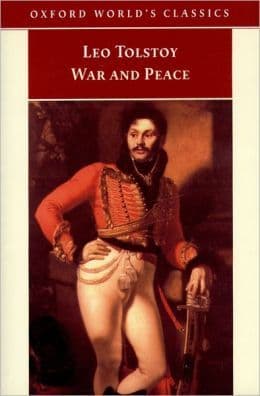
Leo Tolstoy (1967)
Genre
Historical Fiction
Reading Time
2320 min
Key Themes
See below
Sign in to track this book
Amidst Napoleon's invasion of Russia, "War and Peace" intertwines the lives of aristocratic families, showing the human experiences of love, loss, and the search for meaning in a world at war.
The novel starts in July 1805 at a party given by Anna Pavlovna Scherer in St. Petersburg. Guests include Pierre Bezukhov, the illegitimate son of a rich count; Prince Andrei Bolkonsky, a cynical but ambitious aide to Kutuzov, with his pregnant wife Lise; and the beautiful Hélène Kuragina. They talk about Napoleon's expansion and the coming war. Pierre, awkward but kind, defends Napoleon, which upsets the aristocrats. Prince Andrei wants military glory, seeing home life as a burden. This gathering sets the social and political scene, introducing the main families and their early views on the conflict.
After the party, Pierre Bezukhov learns his father, Count Kirill Bezukhov, is dying. Though illegitimate, Pierre is named the Count's sole heir, inheriting great wealth. This suddenly puts the naive Pierre at the center of St. Petersburg society. Prince Vasili Kuragin, wanting to secure his family's future, arranges a marriage between Pierre and his beautiful, manipulative daughter, Hélène Kuragina. Pierre, taken by Hélène's beauty and pressured by society, agrees to the marriage, which soon brings him great unhappiness.
Prince Andrei Bolkonsky, unhappy with his home life and wanting glory, leaves his pregnant wife Lise with his strict father, Prince Nikolai Bolkonsky, and pious sister, Princess Marya. He joins the Russian army as an adjutant to General Kutuzov. Andrei fights in the disastrous Battle of Austerlitz (1805), where he is badly wounded trying to rally his troops. Lying on the battlefield, looking at the indifferent sky, he realizes his ambitions for fame were pointless. He is captured by the French but later released, returning home to the sad news of Lise's death during childbirth, leaving him with their infant son, Nikolai.
The Rostov family, including the charming Natasha Rostova, the kind Nikolai, and the earnest Petya, are introduced as a lively, loving, but financially struggling Moscow noble family. Natasha, full of life, attends her first grand ball and captivates many. She falls in love with Boris Drubetskoy, a childhood friend, but their romance is complicated by his mother's social ambitions and the Rostovs' money problems. Later, she is drawn to her cousin, Denisov, a hussar officer, who proposes to her, but she refuses due to her age and her parents' disapproval. These early experiences show Natasha's lively nature and her changing understanding of love and society.
After years of sadness following Austerlitz and Lise's death, Prince Andrei Bolkonsky returns to society. He meets Natasha Rostova at her first grand ball in St. Petersburg. Her lively spirit and joy immediately draw him in, breaking through his cynicism. He falls in love with her, and they become engaged. However, Andrei's strict father, Prince Nikolai, disapproves and requires a one-year waiting period before they can marry. Andrei reluctantly agrees, traveling abroad, leaving Natasha open to other influences and testing their commitment.
While Prince Andrei is away, Natasha Rostova, feeling neglected and lonely, becomes infatuated with Anatole Kuragin, Hélène Bezukhova's brother. Anatole, a known womanizer, manipulates Natasha, convincing her to run away with him even though he knows she is engaged. Their plan is stopped by Sonya Rostova and Pierre Bezukhov, who intervenes, revealing Anatole's deceit and the fact that he is already secretly married. The scandal leaves Natasha devastated. When Prince Andrei returns and learns of Natasha's actions, he is heartbroken and angry, breaking their engagement and returning her letters, causing deep despair for both.
Pierre Bezukhov, increasingly unhappy in his marriage to Hélène and disillusioned with society, enters a period of spiritual crisis. He tries to change his life, divorcing Hélène, and seeks meaning in different philosophies. He is introduced to Freemasonry, finding a temporary sense of purpose in its ideas of brotherhood and charity. He dedicates himself to charity work, trying to apply Masonic ideals on his estates. However, he eventually becomes disappointed with the hypocrisy within the Masonic lodges, realizing that true change must come from within, not from outside groups.
In 1812, Napoleon invades Russia, a turning point in the novel. The war unites the Russian people. Prince Andrei Bolkonsky, wanting to forget his personal sorrows, returns to the army and fights well. Nikolai Rostov proves himself a brave cavalry officer. Pierre Bezukhov, wanting to understand the conflict and perhaps assassinate Napoleon, travels to the front lines, seeing the horrors of war. The Battle of Borodino, a brutal engagement, is shown in detail, demonstrating the war's scale and its impact on individuals.
After the indecisive Battle of Borodino, the Russian army retreats, and Moscow is evacuated. The city then burns, whether by Russian plan or French accident. Pierre Bezukhov, having stayed in Moscow, tries to assassinate Napoleon, but fails. He is captured by the French, enduring the hardships of a prisoner of war. During his captivity, he meets Platon Karataev, a simple, religious peasant soldier, whose faith, resilience, and practical wisdom deeply influence Pierre, teaching him about the human spirit and life's simple joys, shedding his intellectual pretense.
Prince Andrei Bolkonsky is mortally wounded during the Battle of Borodino. During the retreat from Moscow, he is evacuated and eventually finds himself in the same convoy as the Rostov family, who are transporting their wounded. Natasha Rostova finds Andrei among the wounded. She nurses him, and they reconcile, forgiving each other for past hurts. Andrei, through his suffering, changes spiritually, finding peace and love in his final moments. He dies in Natasha's arms, leaving her heartbroken but changed by their renewed connection.
Napoleon's forces, weakened by the Russian winter, lack of supplies, and constant harassment by Russian partisan groups and regular army units, begin their disastrous retreat from Moscow. The novel shows the immense suffering of the French soldiers, many dying from starvation, frostbite, and disease. The Russian army, led by Kutuzov, pursues them, causing heavy casualties. Petya Rostov, Natasha's younger brother, wanting glory, joins a partisan group and is killed in a skirmish during the pursuit, adding grief to the Rostov family but also highlighting the sacrifices for the Russian victory.
After the war, the Rostov family faces serious money problems. Nikolai Rostov, burdened by the family's debts, considers marrying a rich heiress for practical reasons. However, he is drawn to the kind, pious, and wealthy Princess Marya Bolkonskaya, Andrei's sister. Despite their initial differences and Marya's shyness, they fall in love and marry. This union brings happiness to Nikolai and secures the Rostov family's financial future, allowing them to rebuild their estate. Their marriage symbolizes the merging of two prominent families and the healing of past wounds.
After his release from French captivity and his experiences, Pierre Bezukhov is a changed man, shedding his earlier naivety and intellectual restlessness. Natasha Rostova, having endured the loss of Andrei and her brother Petya, has matured into a compassionate and resilient woman. Both have been shaped by the war and personal tragedy. They find comfort and understanding in each other. Pierre realizes his deep love for Natasha, and she, in turn, recognizes his goodness and strength. They marry, creating a loving and stable family, representing the novel's affirmation of life, family, and domestic happiness after the war.
The epilogue moves several years forward, showing the settled family lives of Pierre and Natasha, and Nikolai and Marya. Pierre and Natasha have children and a happy home life, with Pierre involved in talks about political reform and philosophy. Nikolai manages his estate and family with Marya, finding contentment as a landowner and father. The epilogue also includes a philosophical discussion between Pierre and Nikolai about historical forces and the role of individuals in shaping events. Tolstoy uses this section to further explain his theories of history, emphasizing the collective will and the limits of individual 'great men' in the sweep of time, ending the story with a focus on generational continuity and the human spirit.
The Protagonist
Pierre evolves from a bewildered, idealistic youth into a man of profound moral conviction and inner peace, finding meaning in family, love, and a quiet sense of purpose.
The Protagonist
Andrei transforms from an ambitious, glory-seeking officer into a man who finds peace and spiritual understanding in the face of death and love.
The Protagonist
Natasha matures from a vivacious, impetuous girl into a wise, compassionate, and devoted wife and mother, grounded in family and love.
The Supporting
Nikolai grows from an impulsive, idealistic soldier into a responsible, devoted husband and estate manager, finding happiness in domestic life.
The Supporting
Marya transforms from a submissive, self-sacrificing daughter into a confident, loving wife and mother, finding her own voice and happiness.
The Supporting
He remains largely static, a symbol of rigid tradition, but his death allows his children to forge their own paths.
The Antagonist/Supporting
Hélène remains static in her superficiality and moral emptiness, ultimately dying without genuine change or redemption, a symbol of societal corruption.
The Supporting
Anatole remains a static character, a charming but ultimately destructive force, who suffers physical loss in the war but no moral transformation.
The Supporting
Kutuzov remains a consistent figure of wisdom and quiet strength, embodying Tolstoy's ideal of leadership.
The Antagonist
Napoleon remains a static figure of ego and ambition, whose initial triumphs are ultimately undone by forces beyond his control, leading to his downfall.
Tolstoy thoroughly explores the forces that drive historical events, questioning the 'Great Man' theory. He argues that history is not shaped by 'heroes' like Napoleon, but by the collective, often unseen, will of the masses and an almost deterministic flow of events. Generals like Kutuzov, who understand and adapt to this flow, are more effective than those who try to force their will. This theme is clear in the detailed battle descriptions, where individual plans often fail, and in Pierre's philosophical discussions, especially in the epilogue, where he grapples with the relationship between necessity and freedom.
“A king is history's slave.”
Many characters, especially Pierre Bezukhov and Prince Andrei Bolkonsky, go on deep spiritual journeys throughout the novel. Pierre seeks meaning in different philosophies, Freemasonry, and ultimately in the simple truths learned from Platon Karataev during his captivity. Andrei, initially driven by ambition, finds spiritual peace and a deeper understanding of life and death after his wounding at Austerlitz and his final reconciliation with Natasha. Their quests highlight the human need for purpose beyond worldly success and societal expectations, often found through suffering and self-reflection.
“We are not masters of our own lives, but are bound by the will of Him who sent us.”
The novel's title shows this central theme. Tolstoy contrasts the grand, often chaotic, and destructive events of war with the intimate, everyday lives of families and individuals. The public world of battlefields, court intrigues, and political maneuvers is set against the private world of love, family, and personal growth. Characters like Natasha and Nikolai find their true purpose and happiness in the 'peace' of family life after experiencing 'war' firsthand. This contrast shows Tolstoy's belief that true fulfillment is found not in external glory but in internal connection and life's simple rhythms.
“There is no greatness where there is no simplicity, goodness, and truth.”
Despite the war, the novel ultimately confirms the importance of love, family bonds, and the quiet joys of home life. The Rostovs, with their warmth and strong family ties, represent an ideal family. The journeys of Pierre and Natasha, who both endure great personal suffering, lead to a loving and stable marriage and family, symbolizing the lasting power of human connection. Nikolai and Marya's marriage also signifies the healing and continuity found in domestic happiness. Tolstoy suggests that true happiness and meaning are found in these intimate relationships and the creation of new generations.
“Life is everything. Life is God. Everything changes and moves and that movement is God. And while there is life, there is joy in the consciousness of the divine. To love life is to love God.”
Tolstoy often contrasts characters who are naturally good, simple, and real with those who are artificial, vain, and pretentious. Pierre Bezukhov's initial awkwardness and genuine heart are valued over the polished but empty charm of the Kuragins. Platon Karataev, the simple peasant soldier, with his practical wisdom and faith, deeply influences Pierre, teaching him the value of an uncorrupted spirit. Natasha's natural liveliness and emotional honesty are celebrated, while the calculated social graces of characters like Hélène are shown as hollow. This theme suggests that true virtue comes from a real connection to life and the human spirit, rather than social standing or intellectual sophistication.
“He knew that the whole world was in him and that he was the whole world.”
A narrator who provides not only plot details but also extensive historical and philosophical commentary.
Tolstoy employs an omniscient third-person narrator who not only describes the events and inner lives of the characters but also frequently pauses the narrative to interject lengthy essays and philosophical treatises on history, warfare, leadership, and human nature. This device allows Tolstoy to directly present his theories on determinism, the 'Great Man' theory, and the true forces shaping history, often using the characters' experiences as illustrations. It elevates the novel beyond a mere historical chronicle to a profound work of philosophical inquiry, shaping the reader's understanding of the events and their deeper significance.
Using pairs of characters to highlight different philosophies, virtues, or flaws.
Tolstoy frequently uses contrasting character pairs to explore his themes. The most prominent is the friendship between Pierre Bezukhov and Prince Andrei Bolkonsky, whose differing approaches to life, love, and meaning provide a dynamic intellectual and emotional core. Napoleon and Kutuzov serve as foils for Tolstoy's theories on leadership and history. Hélène Kuragina and Natasha Rostova embody contrasting ideals of femininity – one superficial and manipulative, the other authentic and life-affirming. These contrasts allow Tolstoy to present a nuanced exploration of human nature and moral choices, reinforcing his philosophical arguments through character development and interaction.
Key moments where characters experience profound insights or shifts in perspective.
The novel is punctuated by several symbolic events and epiphanies that mark turning points for the characters. Prince Andrei's vision of the 'lofty, eternal sky' at Austerlitz profoundly changes his perspective on glory and ambition. Pierre's encounter with Platon Karataev during his captivity in Moscow teaches him about simplicity, faith, and the true meaning of life. Natasha's singing, dancing, or her desperate plea for forgiveness after her near-elopement are moments of intense emotional and symbolic weight. These moments serve as catalysts for character development, illustrating their spiritual growth and Tolstoy's overarching philosophical messages about life, death, and human connection.
Extensive use of historical figures, battles, and societal details to create an authentic backdrop.
Tolstoy meticulously integrates historical facts, figures, and events into his fictional narrative. Real historical personages like Napoleon, Tsar Alexander I, and General Kutuzov interact with the fictional characters, and major battles like Austerlitz and Borodino are described with painstaking detail, often based on extensive research. This device lends immense verisimilitude to the novel, making the historical setting feel alive and authentic. It allows Tolstoy to explore his philosophical theories about history within a credible, grand-scale canvas, blurring the lines between historical chronicle and fictional narrative.
“All happy families are alike; each unhappy family is unhappy in its own way.”
— The opening line of the novel, setting a theme of domestic life.
“We can know only that we know nothing. And that is the highest degree of human wisdom.”
— Spoken by Prince Andrei Bolkonsky, reflecting on his disillusionment and search for meaning.
“If everyone fought for their own convictions, there would be no war.”
— A thought from Pierre Bezukhov, pondering the nature of conflict and individual belief.
“The strongest of all warriors are these two — Time and Patience.”
— A general reflection on enduring through difficult circumstances.
“Pure and complete sorrow is as impossible as pure and complete joy.”
— A philosophical observation on the complex nature of human emotion.
“There is no greatness where there is not simplicity, goodness, and truth.”
— Tolstoy's commentary on the true qualities of a great leader or person.
“It is not the strength of the army but the strength of the spirit that conquers.”
— A key theme in Tolstoy's philosophy of war, emphasizing morale over military might.
“He was one of those people who are always convinced that they are telling the truth, and who are therefore the most dangerous.”
— A description of a character whose unwavering self-belief makes them formidable.
“Everything I know, I know because of love.”
— A profound statement on the source of understanding and wisdom, often attributed to Pierre.
“When you love someone, you love the person as they are, and not as you'd like them to be.”
— A realistic view of love, emphasizing acceptance over idealized expectations.
“Man cannot be free while he is afraid.”
— A statement on the psychological barrier that fear poses to true freedom.
“The aim of art is not to solve a problem, but to make us love life in all its countless, inexhaustible manifestations.”
— Tolstoy's broader view on the purpose and impact of art.
“Life is everything. Life is God. Everything changes and moves and that movement is God. And while there is life, there is joy in the consciousness of the divine. To love life is to love God.”
— Pierre Bezukhov's spiritual awakening and understanding of the divine.
“A man on a thousand-mile journey must first take a single step.”
— A metaphorical encouragement for beginning any large undertaking.
“There is no justice in the world, only power.”
— A cynical observation by a character, reflecting on the harsh realities of society and politics.
Ready to see how well you understood this book? Take our interactive quiz with 10 questions.

Count Lev Nikolayevich Tolstoy, usually referred to in English as Leo Tolstoy, was a Russian writer who is regarded as one of the greatest authors of all time. He received nominations for the Nobel Prize in Literature every year from 1902 to 1906 and for the Nobel Peace Prize in 1901, 1902, and 1909; the fact that he never won is a major controversy.







