“Mahatmaji's arrival was not like the coming of a political leader, but like the advent of a god.”
— Describing the profound impact and reverence for Mahatma Gandhi among the people, particularly from the perspective of the protagonist Sriram.

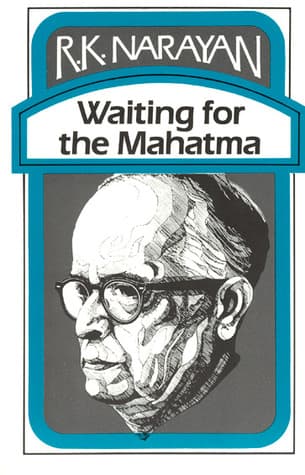
Genre
Historical Fiction
Reading Time
250 min
Key Themes
See below
Sign in to track this book
A young man's journey into love and Gandhi's independence movement is complicated by his infatuation and the appeal of radical patriotism.
Sriram, a naive young man living with his grandmother in Malgudi, comes of age and gets his inheritance. He lacks direction until he sees Mahatma Gandhi speak. In the crowd, he spots Bharati, a beautiful and spirited young woman who immediately catches his eye. He is instantly smitten by her and the sense of purpose around her involvement with Gandhi's movement. This meeting changes Sriram's life, pulling him from his comfortable existence toward the Indian independence movement, mainly because of his feelings for Bharati.
Wanting to be near Bharati, Sriram follows her and Gandhi's group. He is initially motivated more by romance than by deep political belief, but he tries to take part in non-violent resistance. He learns about Gandhi's principles of Satyagraha and begins activities like spinning khadi and joining peaceful protests. Bharati, aware of his feelings, keeps a professional distance, always putting her duty to Gandhi and the cause first. Sriram struggles to balance his personal desires with the movement's demands, often feeling awkward and out of place.
Mahatma Gandhi, seeing Sriram's potential but also his reliance on Bharati, tells him to return to Malgudi and spread the message of non-cooperation and Swaraj on his own. This separation is hard for Sriram, who feels lost without Bharati. He tries to follow Gandhi's directions, but his understanding of non-violence is often shallow. He starts pasting posters, writing slogans on walls, and trying to stir up local villagers, often with more enthusiasm than sense, leading to small clashes with authorities and a growing sense of frustration and loneliness.
During his solitary activism, Sriram meets Jagadish, a charismatic but radical nationalist who favors more aggressive and violent ways to achieve independence. Jagadish, working secretly, takes advantage of Sriram's loneliness and his desire for faster, more concrete results. Sriram, still naive and easily influenced, is drawn to Jagadish's passionate words and perceived effectiveness. He starts helping Jagadish print and distribute rebellious pamphlets, moving away from Gandhi's strict non-violence and getting involved in a more dangerous form of resistance.
Sriram's activities with Jagadish become riskier. He helps make bombs and takes part in covert operations, completely leaving Gandhi's path. British authorities increase their efforts against nationalist activities, and Sriram becomes a wanted man. He is forced to hide, living a dangerous life in the remote countryside. This time is marked by fear, isolation, and a growing disappointment with the violent path he has chosen, as he sees the harsh realities and consequences of Jagadish's methods.
While Sriram is in hiding, his grandmother in Malgudi suffers from his absence and constant worry. She falls ill, her health getting worse quickly due to stress and loneliness. Sriram, unable to return home for fear of arrest, does not know about her declining condition until it is too late. Her death, a sad result of his choices and involvement in the movement, weighs heavily on him. This loss further isolates him and deepens his inner conflict about his chosen path.
Despite trying to stay hidden, Sriram is eventually caught by the British police. His capture ends his active involvement with Jagadish's group and begins a period of imprisonment. In prison, Sriram thinks about his actions, his mistaken zeal, and the sacrifices made. The harshness of prison life and the forced inactivity give him a chance for self-reflection, allowing him to slowly accept the results of his choices and to re-evaluate his understanding of patriotism and freedom.
During his imprisonment, Bharati visits Sriram. This reunion, though in prison, is important for him, bringing back his hope and his original, purer motivations. Bharati, still dedicated to Gandhi's ideals, shares news of the outside world and the ongoing struggle. Around this time, Mahatma Gandhi is released from prison, marking a turning point in the independence movement and offering hope for a more peaceful solution. This news strengthens Sriram's belief in Gandhi's path.
After serving his sentence, Sriram is released from prison. He returns to Malgudi, only to find his home empty and his grandmother dead, a sharp reminder of the personal cost of his actions. He feels disoriented and lost, struggling to find his place in a world that has moved on. The townspeople view him with a mix of suspicion and pity. He tries to reconnect with his past, but the changes, both in himself and in Malgudi, are deep, leaving him feeling isolated and needing a new purpose.
Sriram eventually reunites with Bharati, who has continued her work with Gandhi. Their bond, formed during the struggle, deepens, and Sriram finds comfort and direction with her. However, their new hope and the chance of a future together are broken by the news of Mahatma Gandhi's assassination. This event plunges them and the nation into grief. For Sriram, it is a moment of deep personal loss, as Gandhi represented not just a political leader but a moral guide.
After Gandhi's assassination, amid national mourning and uncertainty, Sriram and Bharati decide to marry. Their marriage symbolizes a commitment to each other and to carrying forward Gandhi's ideals, though in a more personal and domestic way. This marriage, while simple, shows Sriram's final growth. He has moved past his initial infatuation and misguided zeal to a more mature understanding of love, commitment, and the spirit of the independence movement, finding a quiet hope for the future.
The Protagonist
Sriram evolves from a callow, infatuated youth into a mature man who understands the complexities of love, sacrifice, and true patriotism, having experienced both the idealism of Gandhi and the violence of radicalism.
The Supporting
Bharati remains steadfast in her dedication to Gandhi's ideals, providing a stable moral center amidst the turmoil and eventually finding personal happiness with Sriram.
The Supporting
Gandhi's arc is less about personal change and more about his unwavering commitment to his principles, culminating in his tragic assassination, which serves as a pivotal moment for his followers.
The Supporting
Her arc is one of decline, from a concerned guardian to a heartbroken and lonely figure, succumbing to the stress of Sriram's choices.
The Antagonist
Jagadish's arc is static; he remains a figure of radical opposition, serving as a foil to Gandhi's ideals and a catalyst for Sriram's misguided actions.
The Mentioned
The Inspector's arc is static, serving as a functional character to advance the plot and represent the opposition.
The novel looks at different sides of patriotism, comparing Gandhi's non-violent ideals with Jagadish's violent extremism. Sriram's journey shows that true patriotism involves personal sacrifice and a clear understanding of principles, not blind enthusiasm. His grandmother's suffering and death also highlight the often-unseen sacrifices made by ordinary people caught in a national struggle. The story questions what true freedom is and how best to achieve it, showing how personal reasons can sometimes overshadow national goals, as seen in Sriram's initial infatuation driving his involvement.
“What did it matter if one was killed in the struggle so long as the country attained freedom?”
Sriram's initial reason to join the independence movement comes almost entirely from his infatuation with Bharati. This personal desire acts as a strong force, pulling him from his ordinary life into the heart of a national struggle. His love for Bharati changes throughout the novel, growing from a boyish crush to a deeper, more committed bond that survives imprisonment and loss. The theme explores how personal relationships can mix with larger historical events, shaping individual lives and even affecting political involvement, showing love as both a distraction and a guide.
“He felt a sudden, irresistible urge to follow her wherever she went, whatever she did.”
The novel clearly shows how noble ideals, especially Gandhi's non-violence, can be misunderstood, weakened, or corrupted by people with harsher personalities or more extreme plans. Sriram's easy giving in to Jagadish's violent methods, despite his earlier exposure to Gandhi, is a good example. This theme highlights how fragile principles are when faced with impatience for results or the appeal of radical action. It also quietly suggests how followers, even well-meaning ones, can accidentally distort a leader's message, leading to unintended and often sad results for themselves and the movement.
“He found himself repeating the Mahatma's words but without their original conviction or understanding.”
Sriram's journey is a coming-of-age story, his move from naive youth to mature adulthood. He starts as an unformed character, easily influenced and lacking a strong sense of self. Through his experiences with love, political activism, imprisonment, and loss, he must face his own beliefs, make hard choices, and deal with their results. His time in prison, in particular, offers a time for thought and self-reflection, leading to a deeper understanding of himself and the world. His eventual marriage to Bharati shows his arrival at maturity and personal peace.
“He felt as if he had lived several lives in a single year.”
Characters who highlight the traits of others through contrast.
Jagadish serves as a critical foil to Mahatma Gandhi. While Gandhi advocates for non-violence, truth, and patience, Jagadish represents radicalism, violence, and immediate action. This contrast highlights the moral complexities and divergent paths within the independence movement, and more importantly, it shows Sriram's susceptibility to different influences. Bharati also acts as a foil to Sriram's initial naivety and impulsiveness, embodying unwavering dedication and principled action, thereby emphasizing Sriram's journey of maturation.
The fictional town represents stability and tradition, contrasting with national upheaval.
Malgudi, Narayan's recurring fictional town, symbolizes the ordinary, unchanging life of India, rooted in tradition and domesticity. It serves as a stark contrast to the national upheaval and political turmoil embodied by the independence movement. Sriram's departure from Malgudi signifies his entry into a larger, more dangerous world, and his return to a changed Malgudi after imprisonment underscores the irreversible impact of historical events on individual lives and communities. It represents the quiet, personal world that is inevitably swept up by grander historical forces.
The audience is aware of information that characters are not.
Dramatic irony is present in Sriram's initial involvement with the movement, as the reader understands his motivation is primarily infatuation, while Sriram himself might believe it's pure patriotism. More significantly, the reader is often aware of the escalating dangers of Jagadish's activities and the potential consequences for Sriram, while Sriram, in his youthful zeal, remains less aware. This creates tension and highlights Sriram's naivety, making his eventual capture and the tragic news of Gandhi's assassination more poignant for the reader.
Physical and emotional travel as a metaphor for character development.
Sriram's physical journey—from Malgudi to join Gandhi's camp, his solitary wanderings to spread the message, his time in hiding, and finally his imprisonment and return—mirrors his emotional and psychological development. Each stage of his journey exposes him to new experiences, challenges his beliefs, and forces him to grow. The journey is not just a geographical movement but a metaphorical passage through different phases of self-discovery, political engagement, and moral reckoning, ultimately leading him to a more mature understanding of life and commitment.
“Mahatmaji's arrival was not like the coming of a political leader, but like the advent of a god.”
— Describing the profound impact and reverence for Mahatma Gandhi among the people, particularly from the perspective of the protagonist Sriram.
“Every public worker, however small, was a miniature Mahatma.”
— Reflecting on the widespread emulation of Gandhi's ideals and methods by ordinary people involved in the independence movement.
“He knew that the Mahatma was a man of peace, but he also knew that peace could be a very disturbing force.”
— Sriram's internal conflict and confusion as he tries to reconcile Gandhi's non-violent methods with the turbulent reality of the independence struggle.
“The government was like a huge banyan tree, spreading its roots and branches everywhere, and it was difficult to know where to strike.”
— Sriram's naive understanding of political resistance and the overwhelming power of the British colonial administration.
“He felt that he was not only waiting for the Mahatma, but for a new life, a new identity.”
— Sriram's personal transformation and search for purpose, intricately linked with the national movement and his adoration for Gandhi.
“The Mahatma's words were like a mantra, repeated by millions, giving them strength and direction.”
— Highlighting the unifying and empowering effect of Gandhi's speeches and philosophy on the Indian populace.
“Love, he realized, could also be a form of patriotism.”
— Sriram's evolving understanding of his feelings for Bharati, intertwined with his commitment to the national cause.
“He had never thought that a man could be so powerful merely by refusing to fight.”
— Sriram's initial bewilderment and eventual awe regarding the efficacy of Gandhi's non-violent resistance.
“The prison walls seemed to melt away when he thought of Bharati.”
— Sriram's emotional escape from the harsh reality of imprisonment through his thoughts of Bharati.
“He understood that freedom was not just political, but also a freedom of the spirit.”
— Sriram's deeper realization about the true meaning of independence, extending beyond mere political liberation.
“The world was full of people who wanted to change things, but few knew how to do it without violence.”
— A reflection on the prevalent methods of protest and the unique challenge posed by Gandhi's non-violent approach.
“He felt a strange mixture of fear and exhilaration, like someone standing on the brink of a new world.”
— Sriram's emotional state as he fully commits to the independence movement and faces an uncertain future.
“The Mahatma's death was not an end, but a beginning, a new phase in the struggle for truth.”
— Reflecting on the enduring legacy of Gandhi after his assassination, suggesting his ideals continued to inspire.
“He had imagined the Mahatma as a sort of celestial being, but now he saw him as a man, a very great man.”
— Sriram's evolving perception of Gandhi, from an almost mythical figure to a deeply respected human leader.
“Life, he realized, was not about waiting for things to happen, but about making them happen.”
— Sriram's final personal epiphany, moving from passive admiration to active participation in shaping his own destiny.
Ready to see how well you understood this book? Take our interactive quiz with 10 questions.

Biography coming soon.







