“Sometimes the magic is there, and sometimes it's not. You just have to wait for it.”
— William telling his children about magic.

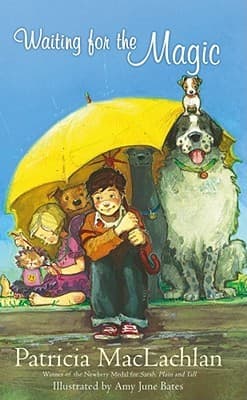
Patricia MacLachlan (2011)
Genre
Fantasy / Children's
Reading Time
120 min
Key Themes
See below
Sign in to track this book
When their parents mysteriously drift apart, four talking dogs and a philosophical cat must guide a young brother and sister to rediscover the magic of family love before it's too late.
The story opens with William and Lucy, a brother and sister, moving with their parents to a new house in the country. They bring with them their pets: four dogs named Eleanor, Penelope, Ben, and Zoey, and a cat named Sassy. The move is a fresh start, though the children sense a subtle tension between their parents. William, in particular, observes his mother's quietness and his father's preoccupation. The family tries to settle into their new rural life, exploring the old house and its surroundings. The pets, especially the dogs, seem unusually observant and connected to the family's emotional state, hinting at their deeper role to come.
One day, while the children are playing, they are astonished to discover that their pets can talk. Eleanor, the oldest dog, is the first to speak, starting a conversation that confirms the impossible. All four dogs and Sassy the cat can communicate verbally with William and Lucy, though not with their parents. The pets explain that they have always understood human language and that this ability has now extended to speech, awakened by the family's need. This revelation is a turning point, as the children realize their pets are not just companions but sentient beings with their own perspectives and advice.
The pets, particularly the dogs, express concern over the increasing emotional distance between William and Lucy's parents. They observe the parents' lack of communication, separate activities, and the quiet sadness that has settled over the household. Eleanor, Penelope, Ben, and Zoey, along with Sassy, hold 'meetings' with the children, discussing strategies to bring their parents closer. They believe that their family's love is fading, and they feel a responsibility to help rekindle it. The pets, with their unique perspectives, suggest various subtle interventions, discussing the importance of shared experiences and communication.
Under the guidance of the pets, William and Lucy begin to implement small, seemingly innocuous plans to bring their parents together. These include suggesting family walks with the dogs, encouraging shared meals, and creating opportunities for their parents to talk. For instance, the dogs might 'accidentally' lead the parents to the same spot in the garden, or Sassy might strategically place herself between them on the couch. The children feel a heavy responsibility, understanding that the pets believe the family's future depends on their success. While the parents remain oblivious to the pets' verbal abilities, they do notice the children's increased efforts to create family unity.
The pets advise William and Lucy to remind their parents of their shared history and the happy memories they once created. They believe that recalling past joys can help rekindle present affection. William and Lucy start mentioning specific anecdotes, old jokes, or past adventures their parents had together. These gentle prompts are met with mixed reactions; sometimes a flicker of a smile, other times a quiet acknowledgment. The pets discuss that love isn't just about grand gestures but about the accumulation of small, cherished moments. The children learn the power of narrative and nostalgia in reconnecting people.
Through their conversations, the pets clarify what they mean by 'magic.' They explain to William and Lucy that it isn't about spells or supernatural powers, but rather the invisible, powerful force of love, connection, and shared history that holds families together. This 'magic' is what they are trying to help the family rediscover. The pets say that while people might drift apart, this inherent 'magic' can always pull them back. This understanding empowers William and Lucy, helping them see their efforts not just as manipulation, but as an act of nurturing the fundamental bonds of their family.
One evening, William and Lucy's parents have a loud, distressing argument. The children overhear harsh words, and the tension in the house becomes strong. The pets, sensing the children's fear and sadness, gather around them, offering comfort and reassurance. This argument, while painful, is a catalyst. The pets see it as a sign that the underlying issues are finally surfacing, which, though difficult, is a necessary step towards resolution. It reinforces their urgency to help the family, making their mission feel even more critical to William and Lucy.
After the argument, the pets decide they need a more direct approach. They create a situation that forces the parents to confront each other and truly talk. This involves a series of coordinated 'accidents' or 'mishaps' that require both parents to be present and engaged. For example, Ben might 'lose' his favorite toy in a way that requires both parents to search for it together, or Sassy might 'get stuck' in a place that needs joint effort to retrieve her. These gentle manipulations are designed to create an environment where the parents are forced to communicate beyond superficial pleasantries.
The pets' efforts, combined with William and Lucy's persistent encouragement, slowly begin to work. The parents, initially wary, start to engage in longer conversations, share small laughs, and show subtle gestures of affection. There's a noticeable shift in the atmosphere of the house, from quiet tension to a more relaxed and open environment. William and Lucy observe their parents sitting closer, talking about their day, and even reminiscing together. The children feel a sense of hope and relief, seeing their family's 'magic' slowly returning, proving the pets' wisdom.
By the end of the story, William and Lucy's family is visibly reunited. Their parents are communicating, laughing, and sharing moments of affection, much to the children's and pets' joy. The 'magic' of their love has been rekindled, not through grand supernatural events, but through the patient, loving interventions of their children and their extraordinary pets. The pets' ability to speak quietly fades as the family's need lessens, a subtle sign that their mission is complete. William and Lucy understand that the true magic was always within their family, a powerful bond that, with a little help, could overcome any distance.
The Protagonist
William grows from a worried observer to an active participant in his family's healing, learning about the nature of love and connection.
The Protagonist
Lucy develops from a child observing parental conflict to an empowered agent of familial reconciliation, understanding the power of love.
The Supporting
Eleanor maintains her role as the wise matriarch, successfully guiding the children and animals to mend the family's bonds.
The Supporting
Penelope, as a key member of the animal team, contributes to the family's reconciliation and sees her efforts come to fruition.
The Supporting
Ben's playful tactics contribute to the parents' reconnection, fulfilling his role in restoring family harmony.
The Supporting
Zoey's quiet support helps facilitate the family's healing, proving her value in the collective effort.
The Supporting
Sassy, initially skeptical, contributes her unique perspective and actions to the family's reunion, affirming her deep loyalty.
The Supporting
She moves from a state of quiet withdrawal to rediscovering her connection and love for her husband and family.
The Supporting
He transitions from being preoccupied and distant to actively re-engaging with his wife and family, restoring their bond.
The central theme is that love, while sometimes challenged, is an enduring force that binds families together. The story explores how this 'magic' of love can fade when neglected but can be rekindled through conscious effort and shared experiences. The pets' mission is based entirely on the belief that William and Lucy's parents still love each other, even if they've forgotten how to show it. The children's actions, guided by the animals, demonstrate that love isn't passive but requires nurturing, communication, and a willingness to remember shared joys.
“''Love is the magic,' said Eleanor, 'and sometimes it gets lost, but it's always there, waiting to be found.'”
The lack of communication between William and Lucy's parents is a key driver of the plot. The pets explicitly identify this lack of talking and shared experience as the reason for the parents' growing distance. Conversely, the pets' ability to communicate with the children, and the children's subsequent efforts to help their parents communicate, show the vital role of open dialogue in maintaining relationships. The story says that genuine connection is built on listening, sharing, and actively engaging with one another, rather than merely coexisting.
“'They don't talk anymore,' said Penelope. 'Not real talking. Just about groceries and bills.'”
A core theme is that animals possess a deep, often unseen wisdom and perception about human emotions and relationships. The talking pets are not just a fantastical element; they are the catalysts and guides for the family's healing. They observe nuances that the children sense but cannot articulate, and they understand the fundamental needs of the human heart. Their ability to speak symbolizes their deep connection to the family's emotional state and their role as guardians of its well-being, suggesting that we often underestimate the intelligence and empathy of our animal companions.
“'We see more than you think,' said Sassy, stretching. 'And hear more, too.'”
The story offers a look at marital problems through the eyes of children. William and Lucy's worry, confusion, and determination to 'fix' their parents' relationship are central. They experience the tension and sadness that marital discord brings into a home, and their actions are driven by a desire to restore the comfort and happiness they associate with a united family. This perspective shows the impact of parental relationships on children and their innate desire for family harmony, even if they don't fully grasp the complexities of adult love.
“William felt it, that quiet, empty space between his mother and father, a space that grew bigger every day.”
The book redefines 'magic' not as supernatural spells or fantastical occurrences, but as the inherent, powerful, and sometimes intangible force of love, connection, and shared humanity. While the pets' ability to talk is magical, they themselves clarify that the 'magic' they are referring to in the family is the bond of love. This theme suggests that the most profound and impactful 'magic' in life is often found in everyday relationships and the efforts we make to nurture them, discussing that true wonder is in human connection.
“'The magic isn't a trick,' said Eleanor. 'It's what holds you together, even when you try to pull apart.'”
Animals with human-like qualities, specifically the ability to speak.
The most prominent plot device is the anthropomorphism of the family's pets, who gain the ability to speak to William and Lucy. This device serves as the primary catalyst for the plot, allowing the animals to directly guide the children in their mission to save their parents' marriage. Without this ability, the pets could only observe, but with it, they become active, intelligent agents of change, offering wisdom and strategy. It also adds a fantastical element that makes a serious topic accessible and engaging for young readers.
The story is primarily told through the experiences and observations of William and Lucy.
The narrative largely maintains the perspective of William and Lucy. While the narrator occasionally provides insights into the animals' thoughts, the core emotional and observational lens is that of the children. This allows the reader to experience the parents' marital strain as children would – with worry, a sense of helplessness, and a strong desire to fix things, without fully understanding the adult complexities. It highlights the impact of parental relationships on children and makes their efforts to mend the family feel all the more significant.
The term 'magic' symbolizes the intangible bond of love and family connection.
The word 'magic' itself functions as a powerful symbol throughout the book. Initially, it might imply a literal supernatural force, especially with the talking animals. However, the pets repeatedly redefine it, explaining that the true 'magic' is the love, shared history, and connection within the family. This symbolism elevates the everyday act of loving and nurturing relationships to something extraordinary, teaching that the most profound 'magic' isn't found in spells but in the human heart and the bonds we forge.
William and Lucy embark on a quest to restore their family's happiness.
While not a physical journey, the children and pets undertake a metaphorical quest to 'save' their family. They have a clear goal (reuniting the parents), face obstacles (the parents' emotional distance, arguments), and receive guidance (from the pets). This quest structure provides a clear narrative arc, creating suspense and investment in the outcome. It transforms the abstract problem of marital discord into a concrete mission for the children, making their efforts feel heroic and purposeful.
“Sometimes the magic is there, and sometimes it's not. You just have to wait for it.”
— William telling his children about magic.
“A house isn't a house without animals. It's just a building.”
— William's philosophy on home.
“Dogs know things. They just don't always tell you in words.”
— The narrator's observation about dogs.
“The best stories are the ones that grow in your heart.”
— Lily's reflection on storytelling.
“Sometimes you have to be quiet to hear what's important.”
— A quiet moment with the family.
“Love isn't always easy, but it's always worth it.”
— A general theme throughout the family's interactions.
“Animals are good at knowing who needs them.”
— The family's experience with their numerous pets.
“Every day is a new story waiting to be told.”
— Lily's hopeful outlook.
“You don't always need to see magic to know it's there.”
— William's subtle wisdom about the unseen.
“Family isn't just people. It's everyone and everything that belongs.”
— The expansive definition of family in the book.
“The world is full of wonders, if you just stop to look.”
— Encouragement to appreciate the small things.
“Sometimes the most ordinary things are the most magical.”
— Discovering magic in everyday life.
“A good book is like a quiet friend.”
— Lily's love for reading.
Ready to see how well you understood this book? Take our interactive quiz with 10 questions.

Biography coming soon.







