“The dead don't lie, but they don't always tell the whole truth either.”
— Eve reflects on the nature of her work and the information she gleans from victims.

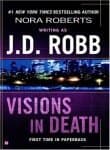
J.D. Robb (2004)
Genre
Thriller / Mystery / Science Fiction / Romance
Reading Time
354 min
Key Themes
See below
Sign in to track this book
Lieutenant Eve Dallas races against time and a chilling psychic's visions to unmask a serial killer meticulously removing victims' eyes in a scorching New York City summer.
On a sweltering July night in 2059, NYPSD Lieutenant Eve Dallas is called to Central Park where the body of Dr. Arlena Schyler, a psychiatrist, has been discovered. Schyler is found posed on the rocks above The Lake, wearing a red ribbon around her neck, her hands clasped in prayer. Her eyes have been surgically removed. Eve, with her partner Detective Delia Peabody, begins securing the scene and gathering initial evidence. The precise nature of the eye removal immediately flags the case as unusual and disturbing, setting a chilling tone. Eve's initial assessment points to a killer with medical knowledge and a ritualistic motive.
Within days, a second victim, Dr. Charlotte Anne DeBlass, a psychologist, is found in a similar way in the Bronx Botanical Gardens — posed, red ribbon, and missing eyes. The method is identical, confirming a serial killer. The media frenzy intensifies, putting pressure on Eve and the NYPSD. Amidst the chaos, a woman named Magdelana, a self-proclaimed psychic, approaches the police, claiming to have visions related to the murders. Despite her skepticism, Eve reluctantly allows Magdelana to share her insights after some shockingly accurate details emerge, including specific details about the victims and crime scenes that hadn't been publicly released. This unusual partnership begins, challenging Eve's rational worldview.
Magdelana provides Eve with vivid, often disturbing visions, describing elements like 'the garden of souls,' 'empty eyes,' and 'the healing hand.' While Eve struggles to reconcile these insights with standard police procedure, she cannot ignore their accuracy. Magdelana describes the killer's motive as 'cleansing' and 'purifying,' targeting individuals she perceives as 'tainted.' The visions also hint at a connection to the victims' professional lives, specifically their work as therapists. Eve begins to cross-reference Magdelana's cryptic clues with the victims' patient lists and professional associations, trying to find a concrete link for conventional police work. Roarke, Eve's husband, quietly supports her by researching the historical and psychological aspects of eye removal rituals.
As the investigation progresses, Detective Peabody goes to interview a potential lead, Dr. Morris, a colleague of the victims. During the interview, the killer brutally attacks her. Peabody manages to fight back and escape, but she sustains severe injuries, including a broken arm and multiple lacerations. This personal attack on her partner ignites a furious determination in Eve. The case is no longer just a professional duty; it is deeply personal. Eve's protective instincts for Peabody, coupled with her professional drive, push her to work even harder, fueled by a desire for retribution and justice. Roarke steps up his support, providing resources and comfort to both Eve and Peabody during this trying time.
Through Magdelana's increasingly specific visions and Eve's meticulous police work, a profile of the killer emerges. The killer, whom Magdelana refers to as 'the Gardener,' believes they are purifying the souls of their victims by removing their 'corrupted' eyes. The victims are all therapists who, in the killer's delusional mind, failed to 'heal' their patients or themselves. Eve and her team realize the killer has a deep-seated grievance against the therapeutic profession, possibly stemming from a personal trauma or perceived betrayal. The killer is meticulous, intelligent, and operates with a chilling sense of righteous purpose, making them incredibly dangerous and difficult to track.
Eve and her team discover a crucial link: all the victims, including Dr. Morris who attacked Peabody, had worked at a now-closed psychiatric facility called Willow Lake. This facility had a history of controversial and ethically dubious practices, particularly involving 'reparative therapy' and experimental treatments. This discovery provides a concrete, tangible connection between the victims, aligning with Magdelana's abstract visions of 'tainted' souls and 'failed healing.' Eve realizes the killer is targeting those they hold responsible for past injustices or perceived harm that occurred at Willow Lake, transforming the abstract into a concrete motive rooted in a specific institution.
Further investigation into Willow Lake's patient records and staff history, combined with Magdelana's visions of a 'damaged child' and a 'doctor's betrayal,' leads Eve to Dr. Ezra Lowell. Lowell was a patient at Willow Lake as a child, subjected to the very therapies now being targeted by the killer. He later became a respected ophthalmologist, explaining the surgical precision of the eye removals. Lowell's deep-seated trauma and psychosis, fueled by his experiences at Willow Lake, warped his mind, leading him to believe he is 'curing' the world by removing the 'windows to the soul' of those he deems responsible for his suffering and the suffering of others. The pieces of the puzzle finally fit into place.
As Eve closes in, Magdelana has a final, urgent vision: Lowell is preparing to kill his next victim, a former therapist from Willow Lake named Dr. Nora Innis, in a secluded, symbolic location. Eve, with a fully recovered Peabody and the ESU team, races against time to intercept him. They find Lowell in the midst of his ritual, having already subdued Dr. Innis. He is meticulously preparing to remove her eyes, utterly convinced of the righteousness of his actions. Eve must engage Lowell in a tense standoff, using both her tactical skills and psychological understanding to prevent another murder and bring his reign of terror to an end. The climax is a race against time and a battle of wits.
Eve successfully confronts Dr. Ezra Lowell, disarming him and rescuing Dr. Nora Innis before he can complete his ritual. Lowell is taken into custody, showing no remorse, still believing he was performing a divine service. The evidence against him is overwhelming, from the forensic links to the detailed confession he makes, outlining his twisted philosophy. With Lowell apprehended, the city breathes a collective sigh of relief. Eve reflects on the case, particularly the unsettling accuracy of Magdelana's visions, which challenged her scientific worldview. She acknowledges the valuable, if unconventional, assistance provided by the psychic, marking a shift in her understanding of intuition and perception. The trauma of Peabody's attack also leaves a lasting impact on Eve.
In the aftermath, Eve grapples with the implications of Magdelana's psychic abilities. While still a rationalist, she can no longer entirely dismiss phenomena beyond scientific explanation. Her interactions with Magdelana have opened her mind, even if only slightly. Eve also reflects on the nature of trauma and healing, seeing how Lowell's childhood experiences twisted him into a killer. She finds solace and grounding in her relationship with Roarke, whose unwavering support helps her process the darker aspects of her work. The case, while horrific, ultimately reinforces Eve's commitment to justice and her growing understanding of the complex human psyche, both rational and irrational.
The Protagonist
Eve's arc in this novel involves her grudging acceptance of the supernatural, specifically Magdelana's psychic abilities, challenging her strictly rational worldview.
The Supporting
Roarke's arc is largely supportive, demonstrating his unwavering devotion and expanding his role as Eve's intellectual and emotional partner.
The Supporting
Peabody's arc involves a significant physical and emotional challenge, demonstrating her resilience and solidifying her role as Eve's indispensable partner.
The Supporting
Magdelana's arc is one of validation, as her visions prove instrumental in solving the case, earning Eve's grudging respect.
The Antagonist
Lowell's arc is tragic and static, revealing the origins of his psychosis but ultimately showing him unrepentant in his delusional quest.
The Supporting
Feeney's arc is consistent, providing steadfast support and technological expertise to Eve.
The Mentioned
DeBlass's arc is tragically cut short, serving as a catalyst for the escalating urgency of the investigation.
The Mentioned
Dr. Morris's arc is brief but pivotal, serving as a plot device to both connect the victims and catalyze Peabody's attack.
This theme is central to Eve's internal conflict. As a rational detective, Eve initially dismisses Magdelana's psychic abilities as nonsense. However, the uncanny accuracy of Magdelana's visions forces Eve to confront the limits of her logical, scientific worldview. Scenes where Magdelana describes specific details about crime scenes or the killer's motives, which Eve later verifies, highlight this tension. The narrative explores how one can reconcile the unexplainable with the need for concrete evidence, suggesting that truth can manifest in unexpected ways, even for a hardened skeptic like Eve.
“'I don't believe in psychics,' Eve stated flatly. 'I believe in facts, evidence, and legwork.'”
The novel explores how unresolved childhood trauma can manifest in destructive ways. Dr. Ezra Lowell's horrific actions are directly rooted in the psychological abuse and unethical treatments he endured as a child at the Willow Lake facility. His adult psychosis, where he believes he is 'purifying' others, is a direct result of his own unresolved pain and perceived betrayal by the therapeutic community. Eve, herself a survivor of severe childhood trauma, understands the lasting impact of such experiences, allowing her a grim insight into Lowell's motivations, even as she condemns his actions. The theme highlights the cycle of violence and the need for genuine healing.
“'He was a child, damaged by those who were supposed to heal him. And he became the monster they feared him to be.'”
The distinction between justice and vengeance is explored through both Eve and the killer. Eve is driven by a strong sense of justice, seeking to uphold the law and protect the innocent. However, when Peabody is attacked, Eve's motivations become tinged with a desire for vengeance, highlighting the fine line between the two. Dr. Lowell, on the other hand, believes he is enacting a form of justice, but his actions are clearly rooted in personal vengeance for past wrongs. The narrative questions whether true justice can ever be achieved through such twisted means and examines the emotional toll that both justice and vengeance take on individuals.
“'Justice isn't about how you feel, Peabody. It's about what you do.'”
Amidst the darkness of the investigation, the strong bonds between characters provide crucial support and resilience. Eve's relationship with Roarke is a constant source of strength, offering her emotional stability and practical assistance. Their deep love and trust allow Eve to navigate the most horrific aspects of her job. Similarly, Eve's partnership with Peabody evolves into a deep friendship, with Peabody's loyalty and Eve's protective instincts forming a formidable team. The attack on Peabody intensifies this bond, showing the profound impact of these connections in overcoming adversity. The theme emphasizes that even in a harsh world, human connection can be a powerful force for good.
“'You're my anchor, Roarke. My calm in the storm.'”
Unconventional clues that challenge the protagonist's rational mind.
Magdelana's psychic visions serve as a crucial plot device by providing Eve with information that is otherwise unobtainable through conventional police work. These visions, initially dismissed by Eve, offer cryptic but accurate details about the killer's motives, victims, and even specific locations, forcing Eve to re-evaluate her strict rationalism. This device creates tension between the scientific and the supernatural, pushing the boundaries of the mystery genre and allowing for breakthroughs that would otherwise be impossible, ultimately leading Eve to the killer.
A macabre signature that drives the killer's motive and unnerves the investigators.
The precise, surgical removal of the victims' eyes is the killer's defining signature. This gruesome detail immediately establishes the case as deeply disturbing and ritualistic, rather than a simple act of violence. It functions as a key to unlocking the killer's twisted psychology, as the eyes are symbolically linked to the 'windows to the soul' and the killer's belief in 'purification.' This device creates a strong visual motif, heightens the horror, and provides a central mystery for Eve to unravel, leading her to investigate the killer's medical background and his warped philosophy.
A past institution that serves as the root cause of the killer's trauma and motive.
The defunct Willow Lake psychiatric facility acts as a pivotal plot device, serving as the common link between all the victims and the killer. It represents the source of Dr. Ezra Lowell's childhood trauma and the catalyst for his adult psychosis. Discovering the facility's history of unethical practices provides the concrete motive that aligns with Magdelana's abstract visions of 'tainted' healing. This device grounds the supernatural elements of the story in a tangible, institutional failure, giving the killer's actions a tragic, albeit horrifying, origin story and allowing Eve to connect the disparate pieces of the puzzle.
“The dead don't lie, but they don't always tell the whole truth either.”
— Eve reflects on the nature of her work and the information she gleans from victims.
“You can't arrest a feeling, Dallas. And you can't prosecute a premonition.”
— Commander Whitney reminds Eve about the limitations of the law when she's dealing with psychic visions.
“Roarke wasn't just a man; he was an experience, a force of nature, and sometimes, a damn inconvenience.”
— Eve's internal thoughts about her husband, Roarke, and his powerful presence.
“Ignorance is not bliss when it’s wrapped around a murder.”
— Eve's cynical view on people's unwillingness to face harsh realities.
“Sometimes the monster isn't under the bed, it's in the mirror.”
— A chilling thought Eve has about the hidden darkness within people.
“You can't outrun your past, but you can choose not to let it define your future.”
— Eve's personal struggle with her traumatic past and her efforts to move forward.
“It’s not about what you see, but what you choose to believe.”
— A philosophical point made about perception and conviction, especially regarding psychic phenomena.
“Grief was a tricky beast. It could claw you apart or make you stronger, depending on how you wrestled it.”
— Eve observing how different characters cope with loss and tragedy.
“There’s a fine line between genius and madness, and sometimes, they hold hands.”
— Eve contemplating the mind of the killer and their motivations.
“Trust isn't given; it's earned, one broken promise at a time.”
— Eve's jaded perspective on trust, stemming from her difficult upbringing.
“Just because you have a vision doesn't mean you have all the answers.”
— Eve's frustration with the incomplete and often cryptic nature of her psychic insights.
“Sometimes the most dangerous weapon isn't a knife or a gun, but a twisted mind.”
— A realization Eve has about the true source of evil in many of her cases.
“Love isn't a bandage; it's the foundation you build on.”
— Eve's evolving understanding of her relationship with Roarke and its profound impact on her.
“Justice isn't always about what's legal. Sometimes it's about what's right.”
— Eve's internal conflict between the letter of the law and her personal moral compass.
Ready to see how well you understood this book? Take our interactive quiz with 10 questions.

Biography coming soon.







