“He who looks too long into an abyss, the abyss also looks into him.”
— A reflection on the corrupting influence of prolonged exposure to evil or moral void.

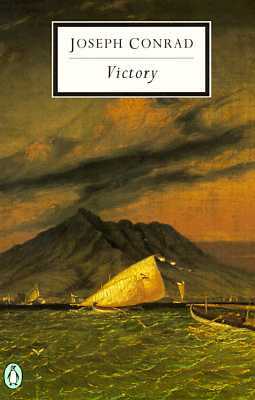
Joseph Conrad (2021)
Genre
Literary Fiction
Reading Time
9-10 hours
Key Themes
See below
Sign in to track this book
A reclusive idealist's quest for detached peace on a remote island shatters when his rescue of a vulnerable woman from a predatory world inadvertently summons a maelstrom of human evil and forces him to confront the very emotions he sought to escape.
Axel Heyst, a Swedish baron, lives a solitary and detached life in the Malay Archipelago, guided by his father's philosophy of non-involvement. He first settles on Samburan as a partner in the Tropical Belt Coal Company, which ultimately fails. After the company's collapse, Heyst retreats to a desolate bungalow on a remote island, keeping only a distant connection with the outside world through the settlement of Surabaya. His deliberate isolation and enigmatic past lead to rumors and a reputation as a mysterious figure among the European trading community, especially the resentful innkeeper Schomberg, who despises Heyst's aloofness and perceived moral superiority.
On a rare visit to Surabaya, Heyst meets Lena, a young English woman playing in Zangiacomo's Ladies' Orchestra at Schomberg's hotel. Lena is vulnerable, exploited by Zangiacomo and harassed by the lecherous Schomberg, who is infatuated with her. She feels trapped and desperate. Heyst, observing her quiet suffering and the predatory behavior around her, feels an uncharacteristic stir of compassion, a crack in his carefully built wall of detachment, though he struggles with this feeling and his long-held principles.
Heyst, moved by Lena's situation and Schomberg's aggressive advances, makes a sudden, uncharacteristic decision. He offers Lena an escape, inviting her to his isolated island. Lena, seeing this as her only chance for freedom, accepts. Their departure is hasty and secret, further fueling Schomberg's rage and resentment, as he believes Heyst has stolen 'his' woman. This rescue is a significant departure from Heyst's philosophy of non-involvement, marking the start of his reluctant re-engagement with humanity.
Heyst brings Lena to his remote island, where they live in the abandoned bungalow of the Tropical Belt Coal Company. Lena is initially overwhelmed by the solitude and Heyst's emotional reserve. Despite their physical intimacy, Heyst struggles to fully connect with Lena, maintaining a mental and emotional distance rooted in his father's teachings. Lena, grateful for her rescue, senses Heyst's inner conflict and yearns for a deeper emotional bond, feeling the weight of his detachment and the unspoken past that haunts him. She tries to break through his defenses, sensing his vulnerability beneath his indifferent exterior.
Back in Surabaya, Schomberg's obsession with Lena and his hatred for Heyst turn into a dangerous plot. He meets a trio of disreputable characters: Mr. Jones, a gentlemanly but sinister nihilist; Ricardo, Jones's brutal and animalistic secretary; and Pedro, a silent, ape-like servant. Schomberg, believing Heyst is wealthy, invents stories of Heyst's supposed fortune hidden on his island and Lena's forced imprisonment. He cunningly convinces the criminals that Heyst is an easy target, manipulating their greed to raid Heyst's island, intending for them to exact his revenge and steal Heyst's supposed riches.
The criminal trio, guided by Schomberg's malicious directions, arrives at Heyst's secluded island. Their sudden appearance shatters the fragile peace Heyst and Lena had established. Heyst, initially believing them to be shipwrecked mariners, offers cautious hospitality, giving them shelter in the abandoned company buildings. However, he quickly sees their true, sinister intentions. The dynamic on the island changes dramatically, as Heyst is forced to confront the direct consequences of his past actions and his attempt to escape human entanglement, while Lena's instincts immediately alert her to the danger.
Heyst finds himself paralyzed by his ingrained philosophy of non-involvement, struggling to take decisive action against the invaders. He tries to reason with Jones, believing intellectual discussion can resolve the situation, but Jones's nihilistic worldview makes him impervious. Lena, however, is driven by a strong instinct for self-preservation and a growing love for Heyst. She recognizes the immediate and brutal threat posed by Ricardo, who is dangerously attracted to her. Lena resolves to protect Heyst, even if it means sacrificing herself, understanding that Heyst's detachment makes him vulnerable to such ruthless men.
Ricardo, the most physically dangerous of the invaders, becomes intensely fixated on Lena, making advances that she skillfully deflects while subtly encouraging his interest. She realizes that her only chance to save Heyst is to disarm Ricardo, literally and figuratively. Lena engages in a dangerous game of manipulation, using her allure to get close to Ricardo, planning to steal his knife, his main weapon and symbol of his brutal power. This act is risky, but Lena's determination to protect Heyst overcomes her fear, showing her courage and resourcefulness.
Lena successfully takes Ricardo's knife, hiding it, but her plan takes an unforeseen turn. Ricardo, enraged by the loss of his weapon and Lena's perceived betrayal, confronts her. Meanwhile, Jones, who despises women, discovers Ricardo's interest in Lena, which further fuels his contempt. In a chaotic sequence, Jones, believing Ricardo has betrayed him for a woman, shoots Ricardo. Heyst, witnessing the unfolding tragedy and the direct result of his inaction, finally breaks from his detachment. However, in the ensuing confusion, Lena, trying to protect Heyst from a perceived threat from Jones, is accidentally shot by Jones, who mistakes her for a man in the dim light.
Lena dies in Heyst's arms, her last words expressing her love for him and her triumph in having saved him from his isolation. Her death shatters Heyst's remaining detachment, revealing the depth of his love for her and his profound regret for his inability to fully embrace life and love. Overwhelmed by grief, guilt, and the realization of his philosophy's destructive consequences, Heyst carries Lena's body into the bungalow. In a final, desperate act of self-annihilation, he sets the building ablaze, perishing with her in the flames, a tragic end to his life of deliberate non-involvement.
The Protagonist
Heyst begins as a detached observer, slowly drawn into human connection by Lena, ultimately breaking from his philosophy but tragically too late to prevent catastrophe.
The Protagonist/Love Interest
Lena transforms from a passive victim into a courageous and self-sacrificing woman, finding her strength and purpose in protecting Heyst.
The Antagonist
Schomberg remains static in his malice, his actions consistently driven by resentment and a desire for revenge, leading directly to tragedy.
The Antagonist
Jones remains a consistent embodiment of pure evil and misanthropy, leading to the tragic climax through his actions and beliefs.
The Antagonist
Ricardo's primal desires and violent nature drive much of the immediate conflict, ultimately leading to his demise due to his obsession with Lena.
The Supporting/Mentioned
Pedro remains a background figure, a silent threat, whose role is to serve his masters without significant personal development.
The Mentioned
His influence is constant, pushing Heyst towards isolation, though Heyst ultimately defies it through his love for Lena.
The Mentioned
A static character whose brief appearance establishes Lena's initial plight.
This is the central theme of 'Victory.' Heyst deliberately chooses a life of isolation, believing it offers protection from suffering and disillusionment, a philosophy inherited from his father. However, his encounter with Lena forces him to confront the limits and futility of such a life. His inability to fully embrace connection, even with Lena, leaves him vulnerable to the predatory forces of the world. Lena, in contrast, actively seeks connection and finds strength in it, ultimately sacrificing herself to save Heyst from his self-imposed detachment. The novel argues that true 'victory' is not avoiding life, but engaging with it, despite the inherent risks of pain and loss, as seen when Heyst's final, desperate act results from his failure to fully connect and act decisively.
“''Look on--make no sound.' A man should just look on, and say nothing.'”
The novel vividly portrays the insidious and destructive power of human malice, shown mainly by Schomberg, Mr. Jones, and Ricardo. Schomberg's petty jealousy and vindictiveness, fueled by a personal slight, start the entire tragic chain of events. Mr. Jones represents a more intellectual and nihilistic evil, driven by misanthropy and a desire to prey on others. Ricardo embodies brutal, animalistic evil, motivated by greed and lust. These characters are not redeemed or reasoned with; their malevolence is a force that Heyst, with his detached philosophy, is ill-equipped to handle. Their actions ultimately lead to the violent destruction of Heyst's world and Lena's life, showing that evil, however it appears, inevitably brings suffering.
“'There are depths of horror in a man's heart that can't be plumbed.'”
Despite the tragic ending, the novel highlights the transformative and redemptive power of love, particularly through Lena's character. Lena, initially a victim, finds purpose and immense courage through her growing love for Heyst. She actively fights for their survival, using her wits and ultimately sacrificing her life to protect him from the invaders. Her love forces Heyst to confront his own emotional barrenness and ultimately breaks through his detachment, even if it is too late. Her sacrifice is a 'victory' in its own right, as it allows Heyst to experience genuine human connection and emotion, albeit tragically. It suggests that love, even in the face of overwhelming evil, can provide meaning and purpose.
“'I was saving you, Heyst, saving you.'”
Many characters in 'Victory' operate under various illusions. Heyst lives under the illusion that isolation can shield him from life's pain, only to find that it leaves him vulnerable to greater suffering. Schomberg holds the illusion that Lena belongs to him and that Heyst is a wealthy man, leading him to orchestrate a futile revenge. Mr. Jones lives under the illusion of his own intellectual superiority and invulnerability. The novel consistently exposes these illusions, revealing the harsh realities of human nature and the unpredictable forces of the world. The stark contrast between Heyst's intellectual detachment and the brutal reality of the invaders' intentions shows the danger of living in a self-constructed fantasy.
“'Heyst was a man whom no one knew; a man who had never been heard of before and was not likely to be heard of again.'”
While not the main focus, the colonial setting of the Malay Archipelago provides a backdrop of moral decay and exploitation. The failed Tropical Belt Coal Company, the transient and often questionable European residents, and the casual disregard for local populations (implied by the setting and characters' interactions) reflect the darker aspects of colonial enterprise. Characters like Schomberg and the criminal trio exploit the remote and unregulated nature of the region for their own nefarious purposes. Lena herself is a victim of exploitation within this environment, first by Zangiacomo and then by Schomberg. The island's desolation after the company's failure symbolizes the empty promises and destructive consequences of such ventures.
“'The world of affairs, in which he had been so reluctantly involved, had been nothing but a vast, appalling joke.'”
A remote, abandoned island serving as a physical and symbolic refuge and trap.
Heyst's island retreat is more than just a location; it's a powerful symbol of his chosen isolation. Initially, it represents a sanctuary from the complexities and dangers of human society, a place where he can enact his philosophy of non-involvement. However, it gradually transforms into a trap, a confined space where the external evils Heyst sought to escape finally converge. The island's desolation, once a comfort, becomes a stark reminder of his emotional barrenness and ultimately, the site of his and Lena's tragic demise, demonstrating that no physical barrier can fully protect one from human nature.
Heyst's guiding principle, inherited from his father, which dictates emotional and social detachment.
This philosophical doctrine, 'Look on—make no sound,' is Heyst's primary motivation and, ultimately, his tragic flaw. It dictates his every action (or inaction) and shapes his character. The device functions to create the central conflict, as Heyst's adherence to this principle prevents him from fully connecting with Lena or decisively confronting the threats from Schomberg's gang. It highlights the intellectual's struggle with the demands of the real world and serves as a constant internal barrier that Heyst must overcome, or succumb to, throughout the narrative. Its failure is central to the novel's tragic message.
The discrepancy between what characters know or believe and what the audience knows to be true.
Dramatic irony is prevalent, particularly concerning Schomberg's perception of Heyst and the criminals' motives. Schomberg believes Heyst is a wealthy man, a belief that drives the criminals to the island, whereas the audience knows Heyst is impoverished and has no hidden treasure. This creates a tension where the audience is aware of the impending doom based on false pretenses. Similarly, Heyst's initial belief that he can intellectually resolve the conflict with Jones, while the audience understands the true, brutal nature of the invaders, underscores his tragic naiveté and the limitations of his philosophy.
Character names carrying symbolic weight that reflects their nature or role.
Conrad uses character names to subtly hint at their personalities or functions. 'Heyst,' for instance, can be interpreted as 'hoist' or 'haze,' suggesting someone lifted above or obscured from human affairs. 'Lena' (derived from Helen) evokes a sense of beauty and a woman who causes conflict or is fought over. 'Ricardo' sounds like 'rich-heart' but is ironically a brutal, 'animalistic' character. 'Mr. Jones' is a common name, making his villainy more chillingly universal. These names add layers of meaning, reinforcing the characters' roles and the novel's themes of isolation, malice, and human connection.
“He who looks too long into an abyss, the abyss also looks into him.”
— A reflection on the corrupting influence of prolonged exposure to evil or moral void.
“A man's most splendid actions are those of which he is unconscious.”
— A general observation on the nature of heroism or significant actions, often performed without self-awareness.
“Life is a dream—a horrible, fascinating dream.”
— Heyst's cynical view on existence, reflecting his detachment and disillusionment.
“The world is a bad dog and will bite you if you don't keep it on a chain.”
— Ricardo's violent and predatory worldview, revealing his perception of human nature and society.
“No man is ever a stranger to the sea.”
— A statement reflecting the universal connection or profound impact of the ocean on individuals, particularly those who live by it.
“It is not good for a man to be too much alone.”
— A theme central to the novel, highlighting the dangers of Heyst's self-imposed isolation.
“There are no perfectly safe things in this world.”
— A pragmatic and somewhat fatalistic observation on the inherent risks and uncertainties of life.
“Woe to the man whose heart has not learned while young to hope, to love—and to put its trust in life!”
— Heyst's father's advice, which Heyst himself failed to follow, leading to his detachment.
“The greatest joy in life is to be loved.”
— Lena's simple yet profound understanding of happiness, contrasting with Heyst's intellectual detachment.
“Action is the last refuge of the unfortunate.”
— A cynical view suggesting that action is often a desperate measure rather than a noble choice.
“All roads lead to the same grave.”
— Another fatalistic sentiment, emphasizing the ultimate end of all human endeavors.
“The very air of this place seems to be heavy with dead hopes.”
— A description of the oppressive atmosphere of the remote island, reflecting its past failures and isolation.
“There is no escape from the world, my friend.”
— A realization that one cannot truly escape human interaction and its consequences, despite attempts at isolation.
“One must not only be silent, but also be clever at it.”
— Part of Heyst's father's philosophy, advocating for a strategic and intellectual detachment from life.
Ready to see how well you understood this book? Take our interactive quiz with 10 questions.
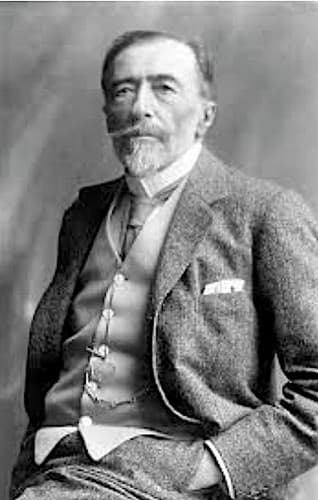
Joseph Conrad was a Polish-British novelist and short story writer. He is regarded as one of the greatest writers in the English language; though he did not speak English fluently until his twenties, he came to be regarded a master prose stylist who brought a non-English sensibility into English literature. He wrote novels and stories, many in nautical settings, that depict crises of human individuality in the midst of what he saw as an indifferent, inscrutable and amoral world.







