“"How can you tell if someone loves you?" Victoria asked. "When they let you be yourself, I suppose," Mrs. Abernathy replied.”
— Victoria asks Mrs. Abernathy for relationship advice.

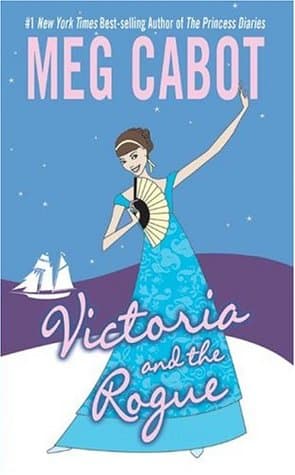
Meg Cabot (2003)
Genre
Children's / Historical Fiction / Young Adult / Romance
Reading Time
180 min
Key Themes
See below
Sign in to track this book
A spirited heiress, sent from India to London to marry, finds her engagement upended by a meddling ship captain who might be saving her from a charming rogue.
Sixteen-year-old Lady Victoria Arbuthnot, an independent heiress, travels from India to England on the 'Sea Serpent.' Her guardian, the Duke of Averstoke, sent her to find a husband, but Vicky, ever resourceful, has already arranged a betrothal to Lord Hugo Rothschild, the Ninth Earl of Malfrey, through letters. She tells her companion, Miss Millicent, her plans and is confident in her choice. However, her journey is complicated by Captain Jacob Carstairs, the ship's owner and a known rogue, who seems to take an immediate, disliking interest in Vicky and her business, much to her annoyance. He questions her judgment and her engagement, hinting at unknown dangers.
Upon arriving in London, Victoria goes to the Duke of Averstoke's grand home. She quickly joins the social scene, preparing for her formal debut and the announcement of her engagement to Lord Malfrey. Despite her confidence, she faces society's critical gaze, especially from the Duke's formidable wife, the Duchess. Jacob Carstairs, to Victoria's surprise and irritation, reappears in London society, now revealed to be a wealthy gentleman and a friend of the Duke. He continues to subtly challenge her view of Lord Malfrey, making veiled remarks about the Earl's character and finances, which Victoria dismisses as mere jealousy.
Victoria finally meets Lord Hugo Rothschild, her fiancé. He is charming, handsome, and seems to meet all her expectations, further confirming her belief that she made an excellent choice. However, Jacob Carstairs continues to cast a shadow over her happiness, making it clear he does not approve of Malfrey. He even suggests Malfrey is after Victoria's fortune, an idea Victoria finds preposterous and insulting. Despite her growing affection for Malfrey, Jacob's persistent warnings, though vague, begin to plant small doubts in Victoria's otherwise confident mind, making her increasingly wary of both men.
Victoria starts receiving anonymous letters hinting at Lord Malfrey's true character and dire financial situation. At first, she dismisses them as malicious gossip, possibly started by Jacob. However, as she looks deeper, she discovers that Malfrey's family estate, Malfrey Park, is in disrepair, and his supposed vast fortune is a lie. She learns he has a history of gambling debts and relies heavily on the dowry from his marriage. These revelations deeply trouble Victoria, forcing her to consider that Jacob's warnings were not unfounded and that her carefully made plans might be falling apart.
Determined to find the truth, Victoria insists on visiting Malfrey Park. What she finds there is a dilapidated estate, far from the grand residence Malfrey described. The staff are few and unpaid, and the entire property shows neglect and financial ruin. It becomes clear that Malfrey has been deceiving her about his wealth and status. This visit shatters Victoria's illusions about her fiancé and her own judgment. She realizes the extent of his manipulation and the precarious situation she would be entering, confirming Jacob's earlier, unwelcome insights.
Armed with clear evidence, Victoria confronts Lord Malfrey. She exposes his lies about his fortune and the state of his estate, accusing him of trying to marry her solely for her wealth. Malfrey, initially defensive, eventually admits to his desperate financial situation, confirming her worst fears. Victoria, despite her initial embarrassment and hurt pride, firmly breaks off the engagement. The public scandal is significant, but Victoria prioritizes her independence and integrity over maintaining a false image, solidifying her reputation as a woman who cannot be easily fooled.
Following the broken engagement, Jacob Carstairs finally reveals the full extent of his concern and his true reasons. He confesses that he is a distant relative of the Rothschilds, and out of a sense of family duty and genuine concern for Victoria's well-being, he had been trying to protect her from Malfrey's deceit. He explains that Malfrey had ruined his previous fiancée and that he could not stand by and watch the same happen to Victoria. This revelation changes Victoria's view of Jacob from an annoying meddler to a caring, honorable man, and she begins to see him in a new light.
With the truth about Malfrey exposed and Jacob's honorable intentions clear, Victoria spends more time with him. They engage in witty banter and share deeper conversations, finding mutual respect and an intellectual connection. Victoria, initially resistant to Jacob's charms, begins to appreciate his intelligence, humor, and genuine care for her. Their interactions are filled with a playful antagonism that slowly turns into undeniable affection. Victoria, for the first time, experiences a romantic interest not based on superficial appearances or calculated arrangements.
The Duke of Averstoke, still intent on finding a suitable match for Victoria, proposes another eligible bachelor, Lord Ashworth. Despite Ashworth being a perfectly respectable choice, Victoria, having learned from her experience with Malfrey and now recognizing her feelings for Jacob, is unwilling to be merely a pawn in society's games. She politely but firmly declines the Duke's suggestion, asserting her right to choose her own future and her own husband. This marks a significant step in Victoria's personal growth, showing her newfound independence and determination.
Jacob Carstairs, having proven his loyalty and affection, finally proposes to Victoria. He does not offer a grand title or vast estates, but rather a partnership based on mutual respect, understanding, and love. Victoria, having shed her earlier illusions about what makes an ideal husband, accepts his proposal wholeheartedly. She realizes that Jacob, the 'rogue' she initially disliked, is the man who truly sees and values her independent spirit. Their engagement promises a future built on genuine connection rather than societal expectations, a stark contrast to her previous misguided betrothal.
The Protagonist
Victoria transforms from a self-assured but naive girl who relies on appearances and logic to a mature woman who trusts her intuition and values genuine connection over societal expectations.
The Love Interest / Supporting
Jacob's arc involves revealing his true nature and intentions, moving from a perceived meddler to Victoria's trusted protector and eventual beloved.
The Antagonist
Malfrey's arc is one of exposure, as his carefully constructed deception unravels, leading to his downfall and the broken engagement.
The Supporting
The Duke remains largely static, representing the societal norms Victoria ultimately defies.
The Supporting
Miss Millicent's arc is minor, primarily serving as a foil and confidante for Victoria.
The Supporting
The Duchess's role is primarily to represent societal pressure and judgment, remaining a static character.
This theme is central to the novel, as Victoria initially judges people and situations based on outward appearances and social status. Lord Malfrey shows this theme, presenting a charming facade of wealth and respectability while secretly being in dire financial straits. Victoria's journey involves seeing past these deceptions, first with Malfrey and then re-evaluating her initial judgments of Jacob Carstairs, who appears to be a 'rogue' but proves to be honorable. The dilapidated state of Malfrey Park, contrasting with Malfrey's grand descriptions, is a key example.
“"She had been so certain, so utterly convinced of her own infallible judgment, that it had never occurred to her to look beneath the polished surface."”
Victoria, from the start, asserts her independence by trying to arrange her own marriage. Despite societal pressures to conform, she eventually takes control of her own destiny by breaking off her engagement to Malfrey and later choosing Jacob based on genuine affection and respect, rather than wealth or title. Her refusal to be a pawn in the Duke's matchmaking schemes shows her growing self-reliance and determination to forge her own path, challenging the limited roles available to women in her era. Her journey is about finding her voice and making her own choices.
“"I am not a prize to be won, nor a fortune to be claimed. I am Victoria Arbuthnot, and I shall choose my own future."”
The story explores the complexities of trust, especially how easily it can be misplaced or earned. Victoria initially trusts Malfrey based on his charming demeanor and social standing, only to discover his elaborate deception. Conversely, she distrusts Jacob Carstairs, viewing him as a meddling rogue, only to learn that his interference comes from genuine concern and honorable intentions. The anonymous letters and Jacob's persistent warnings help Victoria question her initial judgments and learn whom to truly trust, leading to her personal growth.
“"It was a bitter lesson, this, to discover that a man's words could be as hollow as his promises."”
The novel contrasts the societal expectation of marriage for status and financial gain with the possibility of finding love and genuine partnership. Victoria's initial engagement to Malfrey is largely a practical decision, following social norms. However, her relationship with Jacob develops outside these conventions, based on intellectual sparring, mutual respect, and deep affection. Her ultimate choice to marry Jacob, a man who does not offer a grand title but offers honesty and love, signifies a rejection of superficial societal pressures in favor of a more meaningful connection.
“"She had sought a title, a fortune, a position. She had found, instead, a heart."”
Characters are initially judged incorrectly based on their appearance or reputation.
This device is crucial to the plot. Victoria initially perceives Lord Malfrey as the ideal gentleman, handsome and wealthy, leading her to accept his proposal. Conversely, she views Jacob Carstairs as an annoying, meddling rogue. The entire conflict and Victoria's journey of self-discovery revolve around these mistaken first impressions being gradually dismantled, revealing Malfrey's true deceit and Jacob's honorable intentions. This device highlights the theme of appearance versus reality and teaches Victoria a valuable lesson in discernment.
Unsigned messages provide crucial information that exposes deception.
The anonymous letters Victoria receives serve as a pivotal plot device. They introduce doubt and suspicion about Lord Malfrey's character and financial situation, acting as the first concrete evidence that something is amiss. These letters push Victoria to investigate further, ultimately leading her to uncover Malfrey's deception. They function as a catalyst for the plot's progression, forcing Victoria out of her complacent certainty and into active inquiry, proving that truth can come from unexpected sources.
A physical setting that starkly reveals a character's true financial state.
Malfrey Park, Lord Malfrey's ancestral estate, is a significant plot device. Malfrey describes it as grand and prosperous, but Victoria's visit reveals it to be in a state of extreme disrepair and neglect. This physical setting serves as undeniable proof of Malfrey's financial ruin and his attempts to deceive Victoria. The contrast between his description and the reality of the estate is a powerful visual metaphor for his overall deception, solidifying Victoria's understanding of his true character and enabling her to break off the engagement with certainty.
“"How can you tell if someone loves you?" Victoria asked. "When they let you be yourself, I suppose," Mrs. Abernathy replied.”
— Victoria asks Mrs. Abernathy for relationship advice.
“"It isn't about being perfect. It's about being brave enough to try, even when you're scared."”
— Victoria reflects on her own courage and her fears.
“"A proper young lady does not run around in trousers, chasing after boys!"”
— Mrs. Abernathy scolds Victoria for her unladylike behavior.
“"Sometimes, the most important adventures are the ones you find right in your own backyard."”
— Victoria realizes that excitement can be found close to home.
“"He saw me, truly saw me, not just the daughter of the Duke, or a girl in a pretty dress."”
— Victoria thinks about how the rogue perceives her.
“"Being a lady isn't about what you wear, but how you carry yourself, and what's in your heart."”
— Victoria's internal monologue about true ladylike qualities.
“"Even rogues have hearts, you know. Sometimes, they're just a little more guarded than others."”
— Victoria muses about the true nature of the rogue.
“"You can't always choose your family, but you can choose who you let into your heart."”
— Victoria considers the people she cares about.
“"The world is much bigger than a ballroom, Victoria. Don't forget to look outside the windows once in a while."”
— A character advises Victoria to broaden her horizons.
“"A little mischief never hurt anyone, as long as your intentions are good."”
— Victoria justifies some of her less conventional actions.
“"It's astonishing what secrets people keep, even from those they claim to love."”
— Victoria uncovers hidden truths about those around her.
“"Sometimes, the biggest risks lead to the greatest rewards."”
— Victoria contemplates taking a significant leap of faith.
“"True happiness isn't about finding a prince, but finding yourself."”
— Victoria's evolving understanding of what makes her truly happy.
“"A quick wit is far more valuable than a perfect curtsey, in my opinion."”
— Victoria values intelligence and cleverness over strict social graces.
Ready to see how well you understood this book? Take our interactive quiz with 10 questions.

Biography coming soon.

Dan Gemeinhart
4.5

Kate O'Hearn
4.4

Jeanne Birdsall
4.4

Jen Wang
4.4

Wendelin Van Draanen
4.3

John Marsden
4.3

Chris Van Allsburg
4.3
Jennifer A. Nielsen
4.2