“Every cop has a breaking point. Every human being has one. It’s a matter of when, not if, and what pushes you over the edge.”
— Eve considers the psychological toll of police work.

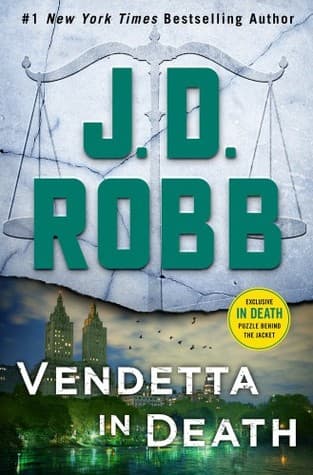
J.D. Robb (2019)
Genre
Thriller / Mystery / Science Fiction / Romance
Reading Time
356 min
Key Themes
See below
Sign in to track this book
In a futuristic New York, Lieutenant Eve Dallas hunts Lady Justice, a vigilante who seduces and executes men for their hidden crimes, blurring the lines between right and wrong.
The story begins with Nigel McEnroy, a wealthy and predatory businessman, being lured to a secluded spot by a mysterious woman. This woman, 'Lady Justice,' seduces McEnroy before brutally murdering him in a way that reflects his past abuses. She leaves a carefully arranged scene, with no easily traceable evidence, and a clear message: this is retribution for his unpunished crimes against women. Homicide Lieutenant Eve Dallas and her team arrive, immediately recognizing the calculated nature of the killing. The investigation quickly uncovers McEnroy's history of sexual harassment and assault, which his company had covered up with settlements. This provides a motive for the vigilante.
Lieutenant Eve Dallas, with her sharp instincts, leads the McEnroy murder investigation. Her initial assessment points to a highly organized and motivated killer. With help from Detective Delia Peabody and her husband, Roarke, Eve investigates McEnroy's life, finding a hidden compartment in his office containing incriminating data chips. These chips show McEnroy's many victims and his habit of recording his assaults. The evidence paints a clear picture of a man who preyed on vulnerable women, strengthening Eve's resolve to catch his killer, Lady Justice, despite the victim's despicable character.
Roarke, a billionaire businessman with a vast network and tech skills, immediately helps Eve's investigation. He analyzes the data chips, identifies McEnroy's victims, and helps uncover connections. Meanwhile, McEnroy's widow, Corinne McEnroy, becomes an obstacle. She reacts to the investigation with denial, fury, and threats, defending her husband's reputation and refusing to cooperate. Her aggressive behavior and lack of empathy for his victims complicate Eve's efforts to gather information and understand the full scope of McEnroy's illegal activities.
Before Eve's team can fully unravel McEnroy's network, Lady Justice strikes again. Her second target is Victor Kincaid, a prominent plastic surgeon with a hidden past of preying on his patients. Kincaid is found murdered in a similar brutal fashion, confirming the vigilante's pattern and method. The killing method, tailored to reflect the victim's specific transgressions, reinforces the idea of personal, vengeful justice. This second murder increases the urgency of the investigation, putting pressure on Eve to identify and apprehend Lady Justice before she claims another victim.
With two victims showing similar patterns of abuse and retribution, Eve and her team intensify their search for a common thread. They meticulously analyze the backgrounds of both McEnroy and Kincaid, looking for shared connections, past associations, or circumstances that might link them to each other or to their killer. The team interviews victims of both men, trying to find someone with a strong motive for revenge or who might know the vigilante. Finding a link becomes crucial, as it is the key to understanding Lady Justice's selection process and possibly predicting her next move.
Through police work, Roarke's tech analysis, and victim interviews, Eve and her team begin to profile Lady Justice. They discover the vigilante is organized, tech-savvy, and understands her targets' weaknesses and routines. The investigation points to a woman directly or indirectly affected by men like McEnroy and Kincaid. She has suffered trauma and now seeks a violent form of justice. The pieces slowly come together, leading Eve to a specific individual with a compelling motive.
In a shocking turn, it is revealed that Dr. Charlotte Mira, the police psychiatrist who often consults on Eve's cases, has a personal connection to the vigilante. The vigilante is Mira's daughter, who, years ago, was a victim of sexual assault. This event traumatized her and her family. Mira, wanting to protect her daughter and understanding her pain, had subtly provided her with information and guidance, inadvertently enabling her vigilante actions. This revelation creates a profound moral dilemma for Eve, torn between her duty to uphold the law and her empathy for Mira and her daughter's suffering.
Eve faces an unprecedented moral dilemma. While she understands the pain and injustice that fueled Lady Justice's actions, she cannot condone murder. She confronts Dr. Mira, who, despite her professional composure, reveals her anguish and desperate attempt to protect her daughter, even if it meant blurring ethical lines. The conversation is emotionally charged, as Eve tries to reconcile her professional duty with her personal understanding of the circumstances. Mira's confession highlights the complexity of justice, trauma, and the lengths a parent will go for their child.
With Lady Justice's identity known, Eve and her team race to prevent more murders. They know the vigilante is driven by a deep desire for justice, but her methods are escalating, and innocent lives could be caught in the crossfire. Eve plans to apprehend Lady Justice without lethal force, recognizing the complex motivations behind her actions. The goal is to bring her to justice through legal means, even as public opinion, and even some within the police force, might quietly sympathize with her cause.
Eve and her team track down Lady Justice, leading to a tense confrontation. Eve uses her psychological insights and understanding of the vigilante's motivations to de-escalate the situation and apprehend her without further violence. The arrest is a bittersweet victory for Eve, who acknowledges the deep pain that drove the vigilante while upholding the rule of law. The case concludes with Lady Justice facing legal consequences for her actions, but the story leaves a lingering question about the nature of justice and the societal failures that can drive individuals to take the law into their own hands.
The Protagonist
Eve confronts the complexities of justice when facing a vigilante whose motives are rooted in profound trauma, challenging her own rigid adherence to the law while deepening her understanding of human pain.
The Supporting
Roarke continues to provide unwavering support and insight to Eve, using his unique skills to navigate the morally ambiguous landscape of the vigilante case.
The Antagonist
Driven by past trauma, Lady Justice escalates her violent crusade for retribution, ultimately being apprehended and forced to confront the legal consequences of her actions.
The Supporting
Dr. Mira is forced to confront the ethical ramifications of her actions, torn between her professional duty and her deep maternal love and shared trauma with her vigilante daughter.
The Supporting
Peabody continues to grow as a detective, offering vital support to Eve and deepening her understanding of the complexities of justice and human nature.
The Mentioned
McEnroy's life ends abruptly as the first target of Lady Justice, becoming a symbol of unpunished abuse.
The Mentioned
Kincaid's seemingly respectable life is cut short by Lady Justice, exposing his hidden abuses.
The Supporting
Corinne remains in denial and obstructs justice, serving as a foil to Eve's pursuit of truth.
This theme explores the blurred lines between legal justice and personal retribution. Lady Justice's actions, though motivated by a desire to punish unpunished predators, ultimately involve vigilantism and murder. Eve Dallas, despite her empathy for the victims, must uphold the law, creating a central conflict. The novel makes readers question whether the legal system adequately serves victims of sexual abuse and at what point personal suffering justifies taking the law into one's own hands. Conversations between Eve and Roarke, and later with Dr. Mira, often discuss the ethical questions of this distinction.
““Justice isn’t always neat, sometimes it’s messy. But it has to be done by the book, or it’s just another crime.””
The lasting impact of trauma, especially sexual assault, is a pervasive theme. Lady Justice's motivations are rooted in her past victimization, showing how unresolved trauma can fester and become destructive. The novel also touches on the secondary trauma experienced by loved ones, as seen in Dr. Mira's desperate attempts to protect her daughter. Eve Dallas's own past trauma often informs her empathy for victims, even as she pursues their avenger. The book highlights the long-lasting psychological scars left by abuse and the desperate measures people might take to cope or find closure.
““Some wounds never heal, they just… scar over. And some scars are so deep they affect everything.””
The novel critiques societal structures and attitudes that enable predators and silence victims. Nigel McEnroy's company repeatedly covered up his abuses, and his widow, Corinne, denies his crimes, showing how wealth and social standing can protect abusers. The initial lack of legal consequences for McEnroy and Kincaid is precisely what drives Lady Justice. This theme highlights the frustration and despair felt by victims when the system fails them, implicitly asking what responsibility society bears for the rise of vigilantes when conventional justice is seen as inadequate or corrupt.
““How many more just like him, walking free, because money and power bought silence?””
This theme examines the principles of law and order and the challenges of maintaining them when injustice is perceived. Eve Dallas strongly supports the legal system, even with its flaws, believing that abandoning it leads to chaos. Her struggle to apprehend Lady Justice, whose actions are understandable emotionally, shows the difficulty of upholding objective justice. The novel explores the idea that while the law may not always deliver perfect retribution, it provides a necessary framework for a civilized society, distinguishing between legal judgment and personal revenge.
““You don’t get to pick and choose which laws apply. That’s what separates us from the animals.””
A character who takes the law into their own hands to deliver justice.
Lady Justice serves as the primary antagonist, a vigilante whose actions drive the plot. This device creates moral ambiguity, as her victims are undeniably deserving of punishment, yet her methods are illegal and violent. It challenges Eve Dallas's unwavering commitment to legal justice and forces the reader to consider the failures of the system that might create such a figure. The vigilante also allows for exploration of themes like justice versus vengeance and the impact of trauma, as her motivations are deeply personal and rooted in past suffering.
The initial victim's true nature is revealed to be far more sinister, complicating the case.
Nigel McEnroy initially appears as a murder victim, but his true character as a serial sexual abuser is quickly revealed. This device immediately complicates the reader's and Eve's emotional response to his death. It blurs the line between victim and perpetrator, making it difficult to sympathize with him and creating a degree of understanding for Lady Justice's motives. This twist highlights the theme of societal complicity and the hidden lives of powerful individuals, setting a morally complex stage for the entire investigation.
Advanced technology and private resources are crucial for solving the crimes.
Roarke's vast technological expertise and access to cutting-edge equipment are instrumental in advancing the investigation. From analyzing encrypted data chips to tracking digital footprints, his resources provide capabilities beyond standard police procedures. This device not only showcases the futuristic setting of the series but also acts as a convenient plot accelerator, allowing Eve to gain critical information quickly. It also emphasizes the unique partnership between Eve and Roarke, where his wealth and skills complement her investigative prowess, making them an unbeatable team.
A trusted ally is revealed to have a direct, ethically compromised link to the antagonist.
The revelation that Dr. Charlotte Mira, Eve's trusted police psychiatrist, is the mother of Lady Justice is a significant plot device. This twist creates a profound personal and ethical dilemma for Eve, forcing her to confront a trusted friend's complicity. It heightens the emotional stakes of the investigation and adds layers of complexity to the theme of justice and trauma. This device also allows for an exploration of a mother's desperation and the blurred lines between protecting a child and enabling criminal behavior, making the antagonist more human and sympathetic.
“Every cop has a breaking point. Every human being has one. It’s a matter of when, not if, and what pushes you over the edge.”
— Eve considers the psychological toll of police work.
“Justice wasn't a perfect machine, but it was the best one they had. And it needed good people to run it.”
— Eve reflects on the justice system's imperfections and the need for dedicated individuals.
“The past wasn't dead. It was just waiting for the right moment to reach out and grab you.”
— Eve realizes an old enemy has resurfaced.
“Some people just want to watch the world burn. Others want to be the ones holding the match.”
— Eve contemplates the motivations of criminals.
“He was her anchor, her safe harbor in a storm that never quite seemed to end.”
— Eve's thoughts on Roarke's unwavering support.
“You can't outrun your demons. Eventually, you have to turn around and face them.”
— Eve prepares to confront a personal threat.
“Revenge is a dish best served cold, but the taste is always bitter.”
— A character discusses the nature of vengeance.
“Sometimes, the biggest monsters wear the most charming faces.”
— Eve considers the deceptive nature of the killer.
“Fear was a tool. It could paralyze you, or it could sharpen your edges.”
— Eve processes her own fear during a dangerous investigation.
“The city never slept, and neither did its shadows.”
— A description of New York City and its hidden dangers.
“You don't get to choose your family, but you get to choose who you let into your heart.”
— Eve reflects on her chosen family with Roarke and her friends.
“Every victim leaves a whisper. It's a cop's job to listen.”
— Eve focuses on the details left behind at a crime scene.
“There was a fine line between justice and obsession, and some people just couldn't see it.”
— Eve observes the motivations of someone taking matters into their own hands.
“Even in the darkest times, there was always a flicker of light. You just had to look for it.”
— Eve finds hope amidst the grim realities of her job.
Ready to see how well you understood this book? Take our interactive quiz with 10 questions.

Biography coming soon.







