“Sif was a Valkyrie, and Valkyries didn’t cry. They fought.”
— Sif's internal struggle with emotion and her duty as a Valkyrie.

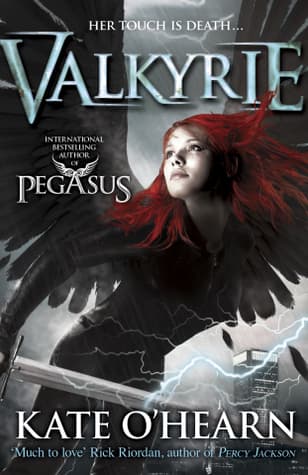
Kate O'Hearn (2013)
Genre
Fantasy / Children's / Young Adult
Reading Time
450 min
Key Themes
See below
Sign in to track this book
A teenage Valkyrie, tasked with reaping souls, defies her destiny to embrace humanity and forge a new legend on a perilous quest in the mortal world.
Freya, a fourteen-year-old Valkyrie in Asgard, fears her upcoming birthday. This day means she will officially become a full Valkyrie, responsible for collecting the souls of fallen warriors from the human world, Midgard. Unlike her peers, Freya sees no honor in this duty. She is interested in humanity, often watching them through the Bifrost, wanting a normal human life with simple pleasures like friendship and laughter, free from her touch, which can kill mortals. Her mentor, the strict Valkyrie General, Mimir, reminds her of her duty and the old laws, but Freya feels conflicted, making her an outsider among her kind.
On her fourteenth birthday, Freya goes on her first solo mission to a battlefield in Midgard. She finds a dying soldier, a young man named Nathaniel, in the chaos. As she prepares to reap his soul, Nathaniel resists, his spirit holding onto life with a strong sense of unfinished business. He asks Freya to help him, specifically to protect his younger sister, Daisy, who is in danger. Moved by his request and her own feelings, Freya makes an unheard-of decision: she lets Nathaniel's soul stay connected to her, instead of guiding it to the afterlife. This breaks old Valkyrie laws, starting a series of events that will change her destiny.
When Freya returns to Asgard, her mistake is immediately noticed. The General and the other Valkyries are angry, calling her actions a serious offense to their sacred duty. As punishment, Freya loses her Valkyrie powers, except for her ability to interact with Nathaniel's soul, and is sent to Midgard. Her mission is to complete Nathaniel's unfinished business – to find and protect his sister, Daisy – only then can Nathaniel's soul find peace, and Freya possibly return to Asgard. She has limited time, and failure means being stuck in Midgard forever, a mortal among mortals. Freya finds herself in an unfamiliar human city, vulnerable and alone, with Nathaniel's ghost as her only companion.
In Midgard, Freya struggles to get used to human customs and not having her powers. Nathaniel's ghost guides her, helping her find his younger sister, Daisy, who lives in a foster home. Daisy, a lively and independent girl, is at first wary of Freya. While trying to protect Daisy, Freya meets Alex, a street-smart boy with a mysterious past who often gets into trouble. Alex, noticing Freya's unusual nature and the danger around Daisy, offers to help, curious about Freya's otherworldly presence. Despite her initial hesitation, Freya realizes she needs help navigating the human world and the growing threats, forming an uneasy alliance with Alex.
Freya quickly learns that Daisy is in great danger. Nathaniel reveals through his ghostly communication that Daisy has a unique ability to sense and control certain old energies, making her a target for a shadowy group called the Marauders. This group, led by the ruthless Commander, wants to use Daisy's abilities for their own bad plans, believing she holds the key to immense power. Freya, Alex, and Daisy are constantly on the run, avoiding the Marauders' chase. Freya realizes the stakes are much higher than she first thought, going beyond just protecting Daisy to stopping a dangerous misuse of power.
As the Marauders get closer, Freya, Alex, and Daisy try to understand Daisy's powers. Nathaniel remembers bits of memories and clues, leading them to old texts and forgotten places that suggest a deeper link between Daisy's abilities and old Norse mythology. They discover that Daisy comes from a powerful family, and her abilities are not random but are connected to specific, powerful artifacts called Runestones, which were spread across Midgard long ago. These Runestones, when activated by someone with Daisy's gift, can unleash destructive forces. The Commander wants to collect these Runestones, using Daisy as his key, to control the world.
During their journey, a shocking betrayal happens. Alex, who had become a trusted friend, reveals he is an informant for the Marauders, having been forced to help them track Daisy. His actions lead to Freya and Daisy being ambushed and captured by the Commander's forces. Freya feels great despair, not just from the betrayal but also from failing to protect Daisy and fulfill Nathaniel's wish. However, Alex, feeling guilty, changes his mind. He creates a distraction, giving Freya and Daisy a desperate chance to escape. The escape is dangerous, pushing Freya's resourcefulness to its limits as she fights to protect Daisy without her Valkyrie powers.
During the chaotic escape, cornered and facing many dangers, Freya feels a surge of her sleeping Valkyrie power. Though not fully back, she manages to show a flicker of her abilities, enough to create a shield or deliver a strong blow, giving them an advantage against the Marauders. Alex, now fully committed to helping them, uses his street smarts and knowledge of the Marauders' operations to guide Freya and Daisy to temporary safety. This moment is a turning point for Freya, as she realizes that her Valkyrie identity is not just about collecting souls but also about protection and justice, even without all her powers.
Nathaniel's memories become clearer, showing the location of the final, most powerful Runestone and the Commander's plan: to activate it at a specific old site to unleash its full destructive power. Freya, Daisy, and the now-helpful Alex race against time to reach the site before the Commander. They know this will be their last fight. The journey has many challenges, as they travel through difficult land and avoid the remaining Marauder forces. Freya is determined to stop the Commander from succeeding, understanding that Midgard's fate, and her own, depends on them.
At the old site, Freya, Daisy, and Alex confront the Commander and his remaining forces. The Commander tries to make Daisy activate the Runestone, but Freya, using her reawakened Valkyrie essence, fights fiercely to protect her. In a battle, Freya fully embraces her unique Valkyrie identity, using not only her new control over her powers but also her feelings and understanding of humanity. She stops the Commander's plan, preventing him from using the Runestone's power. The Commander is defeated, and the threat of the Marauders is gone. Nathaniel's soul, seeing Daisy safe and good winning, finally finds peace and goes to the afterlife.
With the Commander defeated and Nathaniel's soul at peace, Freya faces a choice. The General appears, offering Freya the chance to return to Asgard, her banishment lifted. However, Freya, changed by her experiences in Midgard, realizes her place is no longer only among the traditional Valkyries. She chooses to stay in Midgard, dedicating herself to protecting humanity and stopping similar threats. She creates a new kind of Valkyrie legend, one that includes not just collecting souls but also active guardianship and help. Daisy, now safe, begins to understand and control her unique abilities, with Freya as her mentor and protector. Alex remains a loyal friend and ally, helping Freya in her new role. Freya, no longer a reluctant Valkyrie, becomes a powerful force for good, bridging the gap between worlds.
The Protagonist
From a conflicted, rule-averse Valkyrie, Freya evolves into a powerful, empathetic protector who forges a new path for herself and redefines the role of a Valkyrie.
The Supporting
Nathaniel's soul finds peace only after Freya successfully protects his sister, allowing him to finally move on to the afterlife.
The Supporting
Daisy evolves from a vulnerable target to a young woman beginning to understand and control her latent powers, mentored by Freya.
The Supporting
Alex transitions from a coerced informant to a loyal friend and ally, driven by a sense of justice and guilt.
The Antagonist
The Commander's relentless pursuit of power leads to his ultimate defeat at the hands of Freya.
The Supporting
Mimir's rigid adherence to tradition softens as she witnesses Freya's success and redefines her understanding of a Valkyrie's true purpose.
The Mentioned
Their collective perspective remains largely unchanged, serving as a backdrop against which Freya's personal growth is highlighted.
The novel explores Freya's struggle with her identity as a Valkyrie. She is torn between her kind's old, strict duties and her own feelings and interest in humanity. Her banishment to Midgard forces her to face who she is without her powers, leading her to find a new purpose. By the end, she not only accepts her Valkyrie nature but redefines it, choosing to be a protector rather than just a reaper, creating an identity that connects two worlds.
“"She was a Valkyrie, yes, but not like the others. Her heart beat with a different rhythm, one that echoed the fragile lives she was meant to simply collect."”
A main conflict in the story is Freya's struggle to balance her deep feelings for mortals with her duty as a Valkyrie to simply reap souls without emotion. Her decision to help Nathaniel, driven by compassion, breaks old laws but leads her to a greater purpose. This theme shows that true strength can be in understanding and connection, not just following strict rules. It questions whether duty should always come before what the heart wants.
“"How could she simply take a soul, when the life it left behind was so full of unfulfilled dreams and unspoken goodbyes?"”
Through Freya's observations and experiences in Midgard, the book explores what it means to be human. Freya first idealizes human life, wanting its simple pleasures. But her time on Earth shows her both the beauty of human connection (friendship with Daisy and Alex) and the darker parts (the Commander's greed and ruthlessness). She learns that humanity is complex, capable of both great good and great evil, eventually appreciating its strength and ability to love, which differs from the Valkyries' detached existence.
“"Humans were so fragile, so fleeting, yet their lives burned with a fire that even the gods could envy."”
This theme is seen in many characters. Nathaniel's soul seeks redemption by making sure his sister is safe. Alex, first forced to betray Freya and Daisy, finds redemption by actively helping them escape and defeat the Commander. Freya herself, banished for her mistake, gets a second chance to prove her worth and redefine her purpose. The story suggests that even big mistakes can lead to opportunities for growth and a more meaningful path, showing the power of choice and the chance for change.
“"Sometimes, the greatest mistakes lead you to the most unexpected truths."”
The story blends old Norse mythology with a modern setting. Valkyries and Asgard exist, but their duties bring them to modern battlefields and cities. Daisy's powers and the Runestones are based on old magic, yet they threaten the modern world. This theme explores the lasting power and importance of old legends and magic in a seemingly normal world, suggesting that the old gods and their realms are never truly separate from humanity, and their influence can still shape modern destinies.
“"The old magic, it doesn't just fade. It sleeps, waiting for the right hand to wake it."”
A magical bridge connecting Asgard to Midgard, used for observation and travel.
In the book, the Bifrost serves as the primary means of travel and observation for the Valkyries between their realm of Asgard and the human world, Midgard. It is a shimmering, rainbow-colored bridge that allows Freya to secretly observe human life before her banishment. Symbolically, it represents the connection, albeit often one-sided, between the divine and mortal realms. For Freya, it initially represents the barrier between her duty and her desires, and later, the path she must take into an unfamiliar world.
A forbidden act that serves as the catalyst for Freya's banishment and her quest.
Freya's decision to allow Nathaniel's soul to remain tethered to her, rather than guiding it to the afterlife, is the central plot device that sets the entire story in motion. It is a direct violation of Valkyrie law and the immediate cause of her banishment to Midgard. Nathaniel's spectral presence acts as Freya's initial guide, providing crucial information and motivation. The resolution of this tether – Nathaniel finally finding peace – signifies the successful completion of Freya's primary mission and marks a significant turning point in her character arc.
Ancient artifacts that hold immense power and are central to the antagonist's plan.
The Runestones are ancient, powerful artifacts rooted in Norse mythology, scattered across Midgard. They are central to the Commander's nefarious plan, as he seeks to gather and activate them using Daisy's unique abilities. These stones serve as macguffins, driving much of the plot's urgency and the characters' quest to understand and prevent their misuse. They symbolize the latent power of ancient magic and the danger it poses when wielded by those with corrupt intentions, highlighting the conflict between preservation and exploitation.
The temporary loss and gradual reawakening of Freya's Valkyrie abilities.
Upon her banishment, Freya is stripped of most of her Valkyrie powers, forcing her to rely on her wits and human allies. This device creates significant challenges and vulnerability for Freya in Midgard, making her relatable to human characters. The gradual reawakening and re-learning of her powers, especially during moments of extreme danger, signifies her growth and her acceptance of her true self. It emphasizes that her strength isn't solely in her divine abilities but also in her courage and compassion, which ultimately allows her to wield her powers more effectively.
“Sif was a Valkyrie, and Valkyries didn’t cry. They fought.”
— Sif's internal struggle with emotion and her duty as a Valkyrie.
“The gods were not always fair, but they were always powerful.”
— Sif reflecting on the nature of the gods and their influence.
“Sometimes, the greatest battles are fought within yourself.”
— Sif's personal growth and challenges she faces.
“A true warrior protects the innocent, not just the strong.”
— Sif's evolving understanding of what it means to be a hero.
“Even a goddess can be afraid. It’s what you do with that fear that matters.”
— Sif confronting her own fears and doubts.
“Destiny is not a road you follow, but one you forge.”
— Sif's agency in shaping her own future.
“The whispers of the past can be louder than the shouts of the present.”
— Sif uncovering secrets and history that impact her.
“Loyalty isn't just about who you serve, but who you believe in.”
— Sif questioning allegiances and finding her true loyalties.
“Not all monsters look like monsters. Some wear smiles.”
— Sif learning to discern true threats from deceptive appearances.
“Hope is a fragile thing, but it is also the strongest.”
— Sif holding onto hope in dire circumstances.
“Sometimes the greatest strength is knowing when to ask for help.”
— Sif learning the value of collaboration and trust.
“The world of mortals was far more complicated than any of the gods had ever truly understood.”
— Sif gaining perspective on human life and its complexities.
“A true hero doesn't seek glory, but justice.”
— Sif's motivations for her actions and quests.
“Even the smallest spark can ignite a revolution.”
— Sif's actions having far-reaching consequences.
Ready to see how well you understood this book? Take our interactive quiz with 10 questions.

Biography coming soon.







