“Our Dragon doesn't want a Princess, he wants a girl who can stand on her own two feet.”
— Agnieszka reflecting on the Dragon's true intentions for the chosen girl.

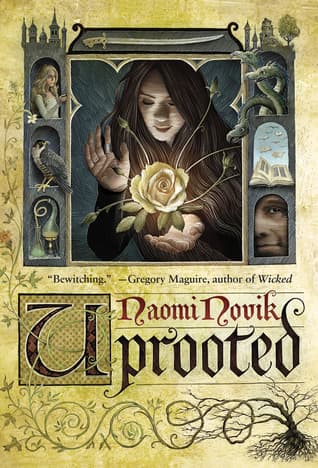
Naomi Novik (2015)
Genre
Fantasy / Young Adult / Romance
Reading Time
9-12 hours
Key Themes
See below
Sign in to track this book
A clumsy village girl, unexpectedly chosen by a reclusive, curmudgeonly wizard, must master untamed magic to fight a creeping, malevolent forest that threatens to devour her homeland.
Every ten years, the Dragon, a powerful, reclusive wizard, comes to the village of Dvernik to choose a girl to serve him for a decade. The villagers believe this tribute protects them from the corrupted Wood that borders their valley. Agnieszka, a clumsy, often disheveled girl, expects her beautiful, capable best friend, Kasia, to be chosen, as Kasia embodies all the qualities the Dragon typically favors. The village prepares for Kasia’s departure, but to everyone's shock, especially Agnieszka's, the Dragon points to Agnieszka, selecting her to come live in his tower. This unexpected choice upends Agnieszka's life and the village's expectations, setting her on a path she never imagined.
Agnieszka is brought to the Dragon's austere tower, a place filled with ancient magic and guarded by enchanted creatures. She finds the Dragon, whose real name is Sarkan, to be demanding, meticulous, and often exasperated by her untidy habits and lack of decorum. He attempts to teach her proper etiquette and the intricacies of his ordered, scholarly magic, but Agnieszka finds his methods stifling. She soon discovers that she has a raw, instinctual form of magic, vastly different from Sarkan's structured approach. Her magic manifests in bursts, often chaotic but surprisingly effective, much to Sarkan's initial annoyance and eventual intrigue. This discovery marks the beginning of her magical education, albeit an unconventional one.
During her time in the tower, Agnieszka's village is attacked by a creature corrupted by the Wood. Sarkan, always vigilant against the Wood's encroaching influence, goes to confront it, and Agnieszka, against his explicit instructions, follows. She witnesses firsthand the terrifying power of the Wood's corruption, which transforms living beings into monstrous, malevolent entities. In the ensuing battle, Agnieszka's intuitive magic is crucial, complementing Sarkan's more controlled spells. This encounter solidifies her magical potential in Sarkan's eyes and reveals the severity of the threat the Wood poses, suggesting that its power is growing and becoming more insidious than ever before.
The Wood's corruption reaches a new level of audacity when it takes Kasia, Agnieszka's best friend, transforming her into one of its twisted thralls. Sarkan, resigned to the Wood's power, believes Kasia is beyond saving and advises against a rescue attempt, fearing the corruption will spread. However, Agnieszka, driven by her deep love for Kasia, refuses to accept this. Defying Sarkan's warnings, she ventures into the Wood, using her growing magical abilities to navigate its treacherous paths. This act of rebellion highlights Agnieszka's fierce loyalty and her growing confidence in her own unique magical path, even if it means clashing with her mentor.
Deep within the corrupted Wood, Agnieszka finds the source of its malevolent power: a massive, ancient tree, deeply intertwined with the Wood's magic, that has been twisted and poisoned. She realizes that simply fighting the Wood's creatures is futile; the corruption must be addressed at its root. Using her unique, organic magic, which seems to resonate with the life force of the Wood itself, Agnieszka attempts to cleanse the tree. This is a dangerous, draining endeavor, as the corruption fights back fiercely. Her efforts demonstrate her innate connection to nature and her growing understanding of how to wield her power effectively against the Wood's darkness.
As Agnieszka explores the Wood's mysteries, Sarkan, seeing her potential and recognizing her unique connection to the Wood, begins to open up about its history. He reveals that the Wood's corruption is an ancient curse, passed down through generations, and that many wizards before him, including his own master, have tried and failed to stop it. He explains the nature of the curse, how it feeds on despair and twists life, and the sacrifices made to keep it at bay. This shared history helps Agnieszka understand the gravity of their task and Sarkan's seemingly detached demeanor, creating a deeper, if still complex, bond between them.
Through a combination of her intuitive magic and ancient texts in Sarkan's library, Agnieszka uncovers the tragic origin of the Wood's corruption. She learns that the curse stems from a previous wizard, Polnya, who, in a desperate attempt to save her people from a devastating plague, inadvertently twisted the Wood's magic, turning herself into the 'Witch of the Wood' and becoming the source of its malevolence. This revelation changes Agnieszka's perception of the Wood from a mindless evil to a deeply wounded entity, imbued with a powerful, sorrowful magic. It also hints at a deeper, more personal solution than mere brute force.
Seeking allies and ancient knowledge, Agnieszka and Sarkan travel to the King's court in the capital city. Here, Agnieszka is introduced to a world of political machinations, lavish customs, and superficiality that contrasts sharply with her rustic upbringing and the grim reality of the Wood. They encounter several powerful figures, including a seemingly revered court wizard, Lord Kareth, who Agnieszka quickly discerns is a fraud, using tricks and illusions rather than true magic. Her blunt honesty and unique magical abilities disrupt the court's carefully constructed facade, causing both amusement and consternation among the nobility, but also earning her some unexpected allies.
At the royal court, Agnieszka and Sarkan discover the King's desperate plan to contain the Wood: a massive, destructive fire meant to burn a wide swath of forest and create a permanent barrier. Agnieszka, understanding the Wood's true nature, vehemently opposes this, knowing it will only worsen the curse. During their time at court, they also face betrayal from within. Lord Kareth, the false wizard, conspires against them, attempting to discredit their warnings and undermine their efforts, seeing their genuine magic as a threat to his own position. This political maneuvering adds another layer of danger to their mission, highlighting the human element of corruption.
Returning to the Wood, Agnieszka, now with a deeper understanding of its history and the curse, prepares for a final confrontation with the Witch of the Wood. Sarkan, despite his initial skepticism, supports her, recognizing that her unique magic is their only hope. They delve into the deepest, most corrupted parts of the Wood, facing its monstrous creations and the Witch's powerful, sorrowful magic. Agnieszka uses her connection to nature, not to fight, but to communicate with the Witch, attempting to unravel the centuries-old curse through empathy and understanding rather than destruction. This climactic encounter tests the limits of both their powers and their bond.
In a climactic struggle, Agnieszka manages to connect with the Witch of the Wood, not as an enemy, but as a victim of her own twisted magic. Using her intuitive, nurturing magic, Agnieszka pours her essence into the corrupted heart of the Wood, cleansing the ancient tree and, in turn, the Witch herself. The curse is broken, and the Wood begins to heal, transforming from a malevolent entity into a wild, benevolent force. The Witch, freed from her torment, is reborn, regaining her humanity, though forever changed. This act requires immense sacrifice and nearly consumes Agnieszka, but ultimately brings peace to the valley.
With the curse broken, the Wood slowly begins to recover, no longer a source of terror but a wild, magical place. Agnieszka, now recognized as a powerful wizard in her own right, chooses to remain in the valley. She and Sarkan, their relationship deepened and transformed by their shared ordeal, forge a new kind of partnership. Sarkan, softened by Agnieszka's influence, becomes more open, and Agnieszka, more confident, embraces her unique magical style. Together, they work to understand and guide the newly awakened Wood, protecting the valley not through fear, but through a symbiotic relationship with nature. Their bond solidifies into a deep love, bridging their disparate worlds.
The Protagonist
Agnieszka transforms from an unassuming, self-doubting village girl into a powerful, confident wizard who saves her valley and reshapes the understanding of magic.
The Supporting/Love Interest
Sarkan learns to embrace chaos and emotion, becoming more human and less isolated through his relationship with Agnieszka, and re-evaluates his understanding of magic.
The Supporting
Kasia endures the corruption of the Wood and, upon rescue, becomes a strong, independent woman who helps rebuild their community.
The Antagonist/Tragic Figure
Polnya, after centuries of torment, is finally freed from her curse and finds peace through Agnieszka's intervention.
The Supporting/Antagonist
Lord Kareth attempts to maintain his facade of power but is ultimately exposed and humiliated by the genuine magic of Agnieszka and Sarkan.
The Supporting
The King is forced to confront the limitations of his conventional understanding of magic and the true extent of the Wood's power, eventually trusting Agnieszka's unconventional approach.
The novel explores two distinct forms of magic: the Dragon's structured, academic, often rigid magic, and Agnieszka's wild, intuitive, organic magic. Sarkan's magic relies on precise incantations, ancient texts, and meticulous control, while Agnieszka's flows from her connection to nature, emotion, and instinct. The story suggests that true power is not in one form over the other, but in their synergy and a deeper understanding of magic's inherent connection to life itself. This is evident when Agnieszka's raw magic is the only force capable of cleansing the Wood, while Sarkan's knowledge helps her refine it.
“He wanted me to prune my magic, to make it neat and tidy and useful for his purposes, but I wanted it to grow wild and strong and be useful for mine.”
The primary conflict revolves around the corrupted Wood, which twists life and feeds on despair. The novel explores the origins of this corruption, revealing it to be a tragic magical accident rather than inherent evil, embodied by Polnya, the Witch of the Wood. This nuanced portrayal allows for the possibility of redemption, not through destruction, but through understanding, empathy, and healing. Agnieszka's ability to cleanse the Wood by connecting with its pain, rather than fighting it, highlights this theme, suggesting that even the deepest corruption can be transformed.
“The Wood wasn't evil. It was just hurt, and it was hurting everyone else in turn.”
Agnieszka begins the story feeling ordinary, overshadowed by her friend Kasia, and often clumsy. Her journey with the Dragon forces her to confront her true nature and embrace her unique, unconventional magical abilities. She struggles with Sarkan's attempts to mold her into his ideal of a wizard, ultimately choosing to forge her own path. This theme is also reflected in the broader clash between the structured expectations of society (represented by the court and Sarkan's initial teachings) and the wild, authentic self. By accepting her 'messy' magic, Agnieszka finds her greatest strength.
“I was never going to be graceful, or neat, or tidy. I was going to be me, and I was going to be powerful.”
Love, in its various forms, is a driving force in the narrative. Agnieszka's deep platonic love for Kasia compels her to defy the Dragon and risk her life to rescue her friend from the Wood. The developing romantic love between Agnieszka and Sarkan is complex, born out of shared danger, mutual respect, and a clash of personalities that ultimately brings them closer. Furthermore, the Wood's corruption itself stems from a form of twisted love – Polnya's desperate attempt to save her people. The story explores the sacrifices made for love, both selfless and destructive, and how love can be a source of immense power and healing.
“I would have gone into the Wood for her, for Kasia, and I would have stayed there if it meant she was safe.”
The central premise of the Dragon taking a girl every ten years highlights the high cost of protection from a greater evil. The villagers accept this 'tribute' as a necessary evil, showing how fear can rationalize difficult choices. The story explores whether such a price is truly necessary or if alternative, more compassionate solutions exist. Agnieszka's actions ultimately challenge this established system, suggesting that true protection comes from understanding and healing the threat, rather than simply paying a toll to keep it at bay. It questions the ethics of sacrificing individuals for the perceived greater good.
“Our Dragon doesn't eat the girls he takes, no matter what stories they tell outside our valley.”
The ritualistic selection of a girl to serve the wizard, driving the initial plot.
The Dragon's Choice is the inciting incident of the novel, a ten-year ritual where the wizard selects a young woman to serve him. This device establishes the central conflict and immediately upends Agnieszka's life, thrusting her into the magical world. It also serves to build tension and mystery around the Dragon's true nature and the purpose of the 'tribute.' The unexpected choice of Agnieszka, rather than Kasia, subverts reader expectations and sets the stage for her unique journey, highlighting her inherent magical potential from the outset.
A malevolent, sentient forest that serves as the primary antagonist and source of conflict.
The Corrupted Wood is more than just a setting; it is a living, breathing antagonist that actively threatens the valley. Its malevolence is a constant presence, driving much of the plot and forcing characters to react to its encroachment. As a plot device, it provides both external conflict (monsters, attacks) and internal mystery (the source of its corruption). Its unique nature, later revealed to be a cursed entity rather than pure evil, allows for a resolution through healing and understanding, rather than simple destruction, reinforcing the novel's themes of redemption and the nature of magic.
A unique, raw, and organic form of magic that contrasts with traditional wizardry.
Agnieszka's magic is a plot device that allows her to solve problems in unconventional ways that Sarkan's structured magic cannot. It manifests as a deep connection to nature, an ability to heal and cleanse, and a chaotic, often explosive, power. This device highlights the theme of different magical approaches and validates a non-traditional path to power. It's crucial for understanding and ultimately breaking the Wood's curse, as her magic resonates with the Wood's own life force, enabling a connection that Sarkan's more forceful methods would never achieve.
The Dragon's reclusive home, filled with magical artifacts and ancient knowledge.
The Ancient Tower serves as a sanctuary, a school, and a repository of knowledge. As a plot device, it provides the setting for Agnieszka's initial magical training and her clashing with Sarkan. Its vast library and magical defenses offer clues about the Wood's history and the nature of magic. The tower symbolizes Sarkan's isolation and his rigid approach, but also becomes a place where Agnieszka's presence slowly brings warmth and life, reflecting their evolving relationship and the blending of their magical styles. It's a place of both confinement and discovery.
“Our Dragon doesn't want a Princess, he wants a girl who can stand on her own two feet.”
— Agnieszka reflecting on the Dragon's true intentions for the chosen girl.
“Magic was not a game. Magic was a tool, a weapon, a shield, a life raft. And sometimes, magic was a curse.”
— Agnieszka's evolving understanding of magic's nature.
“There was a wildness in me, and it answered to the wildness in the Wood.”
— Agnieszka realizing her inherent connection to the corrupted Wood.
“The Wood was not evil; it was merely itself, and it was too powerful for humans to easily understand or control.”
— Agnieszka's nuanced view of the malevolent Wood.
“He didn't want to make me into something I wasn't. He wanted me to be more of what I already was.”
— Agnieszka's perspective on the Dragon's mentorship.
“Sometimes you have to break things to make them right.”
— Agnieszka's pragmatic approach to solving magical problems.
“It was not a matter of learning the right words, but of finding the right feeling.”
— Agnieszka contrasting her intuitive magic with the Dragon's structured approach.
“The Wood was a wound, and it was bleeding corruption into the world.”
— A vivid description of the Wood's harmful influence.
“He was a river, and I was a stream, and we flowed together.”
— Agnieszka's metaphor for her magical connection with the Dragon.
“Courage was not the absence of fear, but the triumph over it.”
— Agnieszka's internal reflection on facing danger.
“We were not meant to be pretty, we were meant to be useful.”
— Agnieszka's internal thought about the purpose of her and her magic.
“There was a kind of magic in simply knowing what you wanted, and reaching for it with both hands.”
— Agnieszka's developing confidence and agency.
“The world was not a story, it was a garden, and it was growing wild.”
— Agnieszka's perspective on the unpredictable nature of reality.
Ready to see how well you understood this book? Take our interactive quiz with 10 questions.
Biography coming soon.







