“Stupid dreams. Even the good ones are bad, because they remind you how poorly reality measures up.”
— Connor's thoughts on the night before his scheduled unwinding.

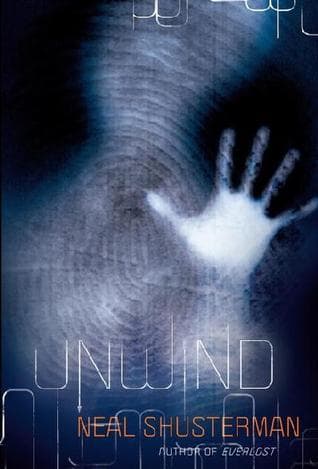
Neal Shusterman (2007)
Genre
Thriller / Fantasy / Science Fiction / Young Adult
Reading Time
360 min
Key Themes
See below
Sign in to track this book
In a future where unwanted teens are harvested for their body parts, three fugitives—a rebel, a musician, and a true believer—must unite to survive being 'unwound'.
Connor Lassiter, a troubled teen from Akron, Ohio, finds his Unwind order hidden in his parents' dresser. In anger, he tries to flee, crashing his parents' car. At the same time, Risa Ward, a pianist from a state home, is scheduled for unwinding due to budget cuts. She is being transported when Connor causes a bus accident. Amid the crash, Lev Calder, a tithe raised to be unwound as a religious offering, is also being transported by his pastor, Pastor Dan. Connor grabs Lev, thinking he is saving him, and pulls him into the woods, starting their reluctant flight. Risa, pretending injury from the bus crash, joins them, seeing it as her only chance to live.
Connor, Risa, and Lev run, their first interactions marked by tension. Lev, taught by his family and Pastor Dan, believes unwinding is sacred and tries to escape his 'rescuers,' even trying to alert authorities. They meet a trucker who gives them a ride and tells them to find the 'Graveyard,' a safe haven for Unwinds. On their journey, they learn to depend on each other. Risa's medical knowledge helps them with injuries, and Connor's impulsiveness often causes trouble but also helps them escape. They avoid a Juvie-Cop patrol by hiding in an antique shop, where they steal clothes and supplies, making them more like fugitives.
The three hide in a high school classroom during the day. They meet other Unwinds, including Hayden, Mai, and Roland, a dangerous boy who immediately argues with Connor. Roland tries to assault Risa, but Connor stops him, earning Risa's trust and increasing the bad feelings between him and Roland. During their stay, Lev contacts Pastor Dan, who, instead of helping him return for unwinding, tells him to run and live. This destroys Lev's faith. When Juvie-Cops raid the school, the group scatters. Lev, reeling from his disillusionment, separates from Connor and Risa and joins a radical anti-unwinding group led by a bomber named CyFi.
Lev goes with CyFi, a runaway Unwind who received a temporal lobe from an unwound boy. CyFi is driven by fragmented memories and emotions of the unwound boy, leading him to his former home in Joplin, Missouri. During their journey, CyFi experiences emotional distress and kleptomania, often stealing shiny objects. Lev, seeing CyFi's struggle and the psychological effects of unwinding, starts to understand the horror of the process and the humanity of those unwound. He learns about the emotional and identity issues faced by recipients of unwound parts. This experience changes Lev's view, solidifying his decision to fight against unwinding and protect others.
Connor and Risa, after narrowly escaping several close calls, reach The Graveyard, a large airplane junkyard in the Arizona desert. It is a self-sufficient community run by a former military man known as the Admiral. Hundreds of Unwinds live there, working to maintain the airplanes and the community, under the Admiral's strict rules and his loyal 'Gold Star' Unwinds. The Graveyard operates on trust and rules, providing shelter and anonymity for those awaiting their eighteenth birthday. Connor quickly gains a reputation for bravery, while Risa uses her medical skills to help the community. However, the number of Unwinds and the constant threat of discovery create a tense environment.
Life at The Graveyard has challenges. Overcrowding, dwindling resources, and distrust among the Unwinds lead to internal conflict. Roland, who also made it to The Graveyard, continues to create discord, especially against Connor. A series of mysterious disappearances of parts from Unwinds who 'escaped' The Graveyard causes paranoia and leads to a mutiny. Roland incites other Unwinds, accusing the Admiral of unwinding them. During the chaos, the Admiral has a heart attack. Connor and Risa help save him, and as he recovers, the Admiral reveals his identity and the story of his son, Harlan, who was unwound, and whose parts were scattered among seven recipients, making the Admiral an opponent of unwinding.
Fueled by Roland's manipulation and panic about the 'disappeared' Unwinds, the mutiny becomes a full riot. The angry mob, believing the Admiral is unwinding them, destroys The Graveyard. They set fire to the planes and living quarters, dismantling their safe haven. As the chaos peaks, Juvie-Cops, alerted by the smoke, arrive. Hundreds of Unwinds, including Connor, Risa, and Roland, are captured. They are rounded up and transported to harvest camps, their desperate flight seemingly over. The destruction of The Graveyard is a turning point, as the Unwinds are now directly in the hands of authorities.
Connor, Risa, and Roland are taken to a harvest camp, a sterile facility for unwinding teenagers. Here, the horror of the process is clear. They see the psychological manipulation, medical procedures, and scale of the operation. Roland, despite his bravado, is terrified. Connor wants to fight, while Risa tries to stay calm. The camp is a place of despair, where Unwinds are processed efficiently. They get last meals, psychological evaluations, and are prepared for the Chop Shop, where their bodies will be disassembled for parts.
Meanwhile, Lev, having joined a group of radical anti-unwinding activists called 'clappers' (who inject their blood with explosives), infiltrates the same harvest camp where Connor and Risa are held. His plan is to detonate himself and create a diversion, hoping to save other Unwinds. He meets Mai and Blaine, two other clappers from The Graveyard. As Roland is led to the Chop Shop, Lev, Mai, and Blaine start their plan. They cause a large explosion, creating chaos and a diversion. In the panic, many Unwinds try to escape. Risa, caught in the blast, is paralyzed, while Connor is badly hurt. Lev, despite being caught in the explosion, survives, but his actions have consequences.
After the explosion, Roland is unwound, and his arm is transplanted onto Connor, who lost his own. Risa, paralyzed, refuses an unwound spine, choosing to live with her disability rather than participate in the system. Lev, injured but alive, is taken into custody, but his actions draw national attention to the anti-unwinding cause. The Admiral, recovering from his heart attack, uses his influence to support the movement. Connor, now with Roland's arm, takes over the new Graveyard, a more organized safe haven. The ending suggests that while the fight is not over, the actions of Connor, Risa, and Lev have started a resistance against unwinding, offering hope for a future where children are not seen as disposable.
The Protagonist
Transforms from an angry, impulsive runaway into a compassionate and strategic leader of the anti-unwinding movement.
The Protagonist
Evolves from a quiet, practical survivor into a strong, principled individual who actively defies the unwinding system through her choices.
The Protagonist
Transforms from a religiously indoctrinated tithe into a disillusioned, radical activist fighting against unwinding.
The Supporting
Reveals his tragic past, inspiring trust and becoming a pivotal figure in the growing resistance.
The Antagonist
Remains largely static, driven by fear and aggression, ultimately becoming a victim of the system he inadvertently helps to expose.
The Supporting
Serves as a living testament to the psychological impact of unwinding, guiding Lev's transformation.
The Supporting
Undergoes a crisis of faith, moving from a supporter of tithing to an advocate for Lev's survival.
The Mentioned
His unwinding serves as the catalyst for the Admiral's anti-unwinding efforts.
The main theme asks when life truly ends and the ethical questions of a society that deems certain lives 'unworthy.' The book challenges the idea that 'unwinding' is not death, by showing the psychological and emotional impact on the unwound and their families. Characters like Risa refusing a new spine and the Admiral's quest to reassemble his son's parts show the value of an individual's complete body and identity. The story makes readers confront the dehumanization in the system, where children are reduced to their parts.
““You can't be an unwind if you're already dead.””
The Unwinds' journey is one of self-discovery as they are stripped of their societal roles and forced to define themselves outside of their parents' or the state's expectations. Connor sheds his 'troubled teen' label to become a leader, Risa finds strength beyond her musical talent, and Lev reconstructs his entire belief system. CyFi's struggle with Tyler's memories explores the fragmented nature of identity in a world where body parts are exchanged. The characters' fight for survival is a fight to keep their individual identities against a system designed to erase them.
““A life isn't worth saving if all you're doing is waiting for it to end.””
The book explores various forms of rebellion against an oppressive system. Connor's initial flight is an impulsive act of defiance, while The Graveyard is a more organized, though fragile, form of resistance. Lev's transformation into a clapper means a radical, self-sacrificial protest. The growing movement against unwinding, fueled by the protagonists' actions, shows how individual acts of resistance can become a larger force for change. The story shows the courage needed to challenge deeply set societal norms and the sacrifices made for freedom.
““If we're gonna die, let's die on our feet, not on our knees.””
The concept of family is explored in complex ways, from the difficult relationship between Connor and his parents to Lev's family's religious beliefs. The Unwinds form new, chosen families and communities in their shared struggle for survival, such as the bonds between Connor, Risa, and Lev, and the group at The Graveyard. The Admiral's story shows the lasting pain of losing a child to unwinding, emphasizing the family ties that unwinding breaks. The book suggests that true family is not always biological but is found in those who offer support, protection, and a sense of belonging in a world that seeks to discard them.
““Home is where your family is. I may not have a family, but I have you guys.””
The novel has moral ambiguity, from the premise of the 'Bill of Life' that allows unwinding. Characters like Pastor Dan struggle with their beliefs when confronted with the reality of the system. The 'tithes' show the extreme end of this moral paradox. The Admiral, despite opposing unwinding, runs a system that, for a time, allows 'disappearances' to maintain order. The book makes readers question how such a system could arise and be maintained, exploring ethical compromises and the dangers of dehumanizing any part of the population.
““It's not about right or wrong, it's about what is.””
The legal framework that permits unwinding, creating the central conflict.
The Bill of Life is the foundational legal document that emerged from the Second Civil War, dictating that life is inviolable from conception to age thirteen, but between thirteen and eighteen, parents can choose to have their child unwound. This legislative act is the ultimate plot device, as it establishes the dystopian society, the core conflict, and the motivation for every character's actions. It creates the 'unwind' status, driving the protagonists' flight and the entire narrative. It's a chilling example of how societal compromise can lead to horrific ethical outcomes, framing the entire world of the novel.
A symbolic safe haven and a temporary community for Unwinds.
The Graveyard, a massive junkyard of decommissioned airplanes, serves as both a literal and symbolic plot device. Literally, it's a secret, self-sufficient community and safe haven for hundreds of Unwinds, providing a temporary reprieve from capture. Symbolically, it represents a place where discarded things (both planes and children) find a temporary purpose and community. Its eventual destruction by the Unwinds themselves, orchestrated by Roland, is a pivotal moment that forces the protagonists back into the direct threat of unwinding, highlighting the fragility of their freedom and the internal challenges of building a resistance movement.
A radical group of Unwinds who use self-detonation as a form of protest.
Clappers are a radical faction of Unwinds who inject their blood with a chemical that makes them explode when they clap their hands. This plot device introduces an extreme form of rebellion and sacrifice. It raises the stakes significantly, demonstrating the desperation and fervor of those fighting against unwinding. Lev's transformation into a clapper is a major character arc, and the clapper attack at the harvest camp is the climax of the novel, creating the chaos necessary for the protagonists' fates to be irrevocably altered and drawing national attention to the anti-unwinding cause.
A living demonstration of the psychological and ethical consequences of unwinding.
CyFi's character, with his transplanted temporal lobe from an unwound boy named Tyler, serves as a powerful plot device to illustrate the profound and disturbing psychological consequences of unwinding. His fragmented memories, urges, and emotional shifts directly challenge the notion that unwinding is not death, suggesting instead a form of fragmented existence. His journey with Lev provides a tangible, human connection to the unwound, serving as a catalyst for Lev's change of heart and educating both Lev and the reader about the complex ethical dilemmas surrounding the use of human parts.
A symbolic transfer of identity and a physical consequence of the unwinding system.
Roland's arm, transplanted onto Connor after the harvest camp explosion, is a significant symbolic plot device. It represents the physical consequences of the unwinding system, where body parts are freely exchanged. More deeply, it symbolizes the complex and sometimes disturbing integration of identities. Connor, now bearing the arm of his rival, is forced to confront the humanity of someone he despised and literally carries a part of the system's victims with him. This physical reminder serves as a constant motivation for his continued fight against unwinding and a testament to the interconnectedness of all lives.
“Stupid dreams. Even the good ones are bad, because they remind you how poorly reality measures up.”
— Connor's thoughts on the night before his scheduled unwinding.
“You can't change laws without first changing human nature.”
— Nurse Greta's cynical remark about the Unwind Accord.
“A body divided against itself cannot stand.”
— Roland quoting the Unwind Accord to justify his actions.
“I'd rather be partly great than entirely useless.”
— Lev's realization about his purpose as a tithe.
“The measure of a man is not his mistakes, but what he does to correct them.”
— Connor reflecting on his past actions and growth.
“They say that parents don't unwind their kids out of hate; they do it out of love.”
— Risa explaining the twisted logic behind unwinding.
“You can't unwind a memory.”
— Connor's defiant statement to an unwind officer.
“Sometimes you have to lie to protect the truth.”
— Risa's justification for hiding their identities.
“The heart is just a muscle. It's the soul that matters.”
— A discussion among Unwinds about what makes a person.
“Freedom is just another word for nothing left to lose.”
— Connor's bitter thought after escaping.
“We are all just parts waiting to be reassembled.”
— A chilling observation by an unwind surgeon.
“Hope is the most dangerous thing of all. It keeps you fighting when you should give up.”
— Roland taunting Connor about their situation.
“The only way to survive is to stop being human.”
— Lev's dark thought as he embraces his role as a clapper.
“Every life is a story. Make yours worth telling.”
— A graffitied message in the Graveyard, inspiring the Unwinds.
Ready to see how well you understood this book? Take our interactive quiz with 10 questions.

Biography coming soon.







