“I'm not gifted. I'm just... me.”
— Donovan Curtis reflects on his identity after being mistakenly placed in the gifted program.

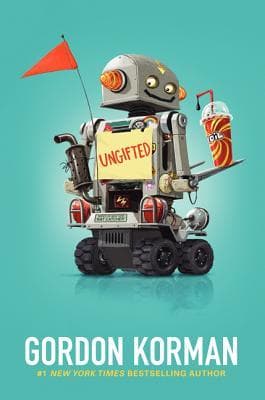
Gordon Korman (2012)
Genre
Children's / Young Adult
Reading Time
280 min
Key Themes
See below
Sign in to track this book
A middle school prankster's accidental enrollment in a gifted academy reveals that true genius might just be the unexpected spark he brings to a world of high IQs.
Donovan Curtis, a known troublemaker, tries to hit a globe with a wrestling dummy, Atlas, during a school assembly. The prank fails when the dummy's arm swings up, knocks the globe off its stand, and sends it down the auditorium steps, through the gym doors, and into an old bronze Atlas statue. The statue breaks, causing much damage. While hiding from punishment, Donovan's name is accidentally added to a list of students transferring to the Academy of Scholastic Distinction (ASD) by Dr. Schultz, the superintendent, who misreads a note. Donovan, seeing a way to avoid punishment, goes along with the mistake.
Donovan arrives at ASD, a school with very smart students like Noah Youkilis, an eccentric genius, and Abigail Lee, a competitive student. He quickly realizes he is out of his depth, struggling with advanced concepts in every class. To keep his secret, he uses his quick wit and charm, often avoiding questions or getting others to do the work. He tries to avoid attention, but his unusual presence makes him stand out among the focused, academic students. He becomes close with Noah, who finds Donovan's unpredictability interesting.
Donovan joins the robotics team, mostly to avoid other classes. He quickly helps the team, not with engineering, but with creative problem-solving and connecting with others. He names their robot 'Tin Man'. For a human development class, Donovan suggests a project watching his pregnant older sister, Katie, who is due soon. He starts filming her, documenting her pregnancy, which at first annoys her but fascinates his ASD classmates. This project becomes a main point of interest for the ASD students, who are more used to theory than real-world observation.
As Katie's pregnancy continues, the ASD students, especially Abigail and Noah, become more involved in Donovan's 'human development' project. They offer medical advice, track her symptoms, and help Donovan organize the footage. This real-life use of their knowledge creates a new kind of engagement for them. At the same time, the robotics team, led by Chloe Garfinkle and Noah, has trouble building 'Tin Man'. Donovan, despite not having technical skill, helps by suggesting different solutions and improving team spirit. He often helps the intellectual but socially awkward members talk to each other.
Donovan's old middle school, Hardcastle, has a mid-year dance. He goes with some ASD friends, including Chloe and Abigail. There, he sees his former principal, Dr. Schultz, who still does not know about Donovan's accidental transfer. The meeting is tense, and Donovan tries to stay hidden. Later, during some funny events at the dance, Donovan's friend, James, accidentally backs a forklift, meant to move the robotics team's robot, 'Tin Man', into the school's gym, causing more damage to the already weak floor. This incident adds to Donovan's worry about his secret being found out.
Dr. Schultz finally learns the truth about Donovan's accidental transfer to ASD. The superintendent is angry, realizing the extent of the mistake and Donovan's lie. Donovan is immediately expelled from the Academy. Also, because of the gym damage at Hardcastle and the general trouble around Donovan, Dr. Schultz decides to end the ASD robotics team and cancel their entry in the upcoming national competition. This decision upsets the ASD students, especially Chloe and Noah, who had put so much time and effort into 'Tin Man' and found a special friendship through the team.
After Donovan's expulsion and the robotics team's cancellation, Katie, Donovan's sister, unexpectedly goes into labor. Donovan, feeling lost, calls his ASD friends for help. The smart students, despite their academic ability, are at first overwhelmed by the real-life intensity of the situation. However, their combined knowledge and problem-solving skills activate, and they support Katie, helping her get to the hospital and giving emotional support to Donovan. This event brings them closer, beyond their usual academic pursuits.
Katie gives birth to a healthy baby girl, named Tina. The ASD students, who had only read about human development in books, are moved by seeing birth firsthand. This emotional and human experience changes their view, making them see there is more to life than just academics and competition. Inspired by the new life and Donovan's strength, they decide to fight Dr. Schultz's decision to cancel the robotics team. They want to show that their different gifts and hard work deserve recognition.
Despite Dr. Schultz's attempts to stop them, the ASD robotics team, with support from their teacher Ms. Bevelaqua and a determined Donovan, finds a way to enter the national competition. Donovan, though expelled, secretly helps the team by giving his unique ideas and encouraging them. During the competition, 'Tin Man' faces many difficulties. However, through the ASD students' smart engineering, Donovan's quick thinking and unexpected ideas, and a surprising showing of the robot's abilities (including a last-minute, improvised move from Donovan), 'Tin Man' wins in an amazing comeback, showing their cleverness and teamwork.
After the robotics team's win, Dr. Schultz must recognize the talents of the ASD students and Donovan's valuable, if different, contributions. Donovan does not return to ASD as a student, but his role in inspiring and uniting the team is clear. The experience changes the ASD students, teaching them about empathy, teamwork, and how to use their knowledge in the real world. Donovan, for his part, gains confidence and purpose, understanding that his 'ungifted' qualities—his creativity, social skills, and ability to connect with people—are gifts themselves, important for success and happiness beyond school grades.
The Protagonist
Donovan learns to value his own unique 'gifts' beyond academic intelligence and realizes his ability to inspire and unite people is a powerful asset. He matures from a prank-driven kid to someone who understands the impact of his actions.
The Supporting
Noah begins to understand human emotions and the value of non-academic intelligence through his friendship with Donovan and the experience of Katie's pregnancy and birth. He learns empathy and the importance of real-world interactions.
The Supporting
Abigail learns that there's more to life than academic achievement and competition, developing empathy and appreciating diverse forms of intelligence through her interaction with Donovan and his family.
The Supporting
Chloe learns to value different types of intelligence and leadership, recognizing that a team's strength comes from diverse talents, not just academic prowess.
The Supporting
Katie goes through the journey of pregnancy and childbirth, becoming a mother and indirectly facilitating the personal growth of the ASD students.
The Antagonist
Dr. Schultz grudgingly acknowledges the value of unconventional talents and the positive impact Donovan had, though his fundamental views on education remain largely unchanged.
The Supporting
Ms. Bevelaqua continues to champion her students and their diverse talents, reinforcing her belief in unconventional learning and growth.
The Supporting
James remains a steadfast friend, representing Donovan's roots and the 'normal' world outside of ASD.
The novel questions common ideas of what 'gifted' means. While ASD students are academically smart, Donovan shows that creativity, social intelligence, empathy, and the ability to inspire others are just as valuable 'gifts.' The book says that true giftedness includes many talents beyond IQ scores, as seen when Donovan's different ideas lead to the robotics team's win and his presence helps the ASD students grow emotionally.
“Maybe 'gifted' meant something else entirely. Maybe it meant being able to make a connection, to solve a problem that wasn't on a test, to make people feel like they belonged.”
The story shows how bringing together people with different strengths and ways of thinking can lead to better success and personal growth. The ASD students, with their high IQs, at first lack real-world experience and social skills. Donovan, with his practical knowledge and emotional intelligence, fills this gap, helping them use their knowledge in practical ways (like the human development project) and encouraging teamwork. The robotics team's final win comes directly from combining intellectual brilliance with Donovan's 'ungifted' creativity and leadership.
“It turned out that a world full of geniuses still needed someone to tell a good joke, or to know how to fix a broken heart, or to just be plain ol' Donovan.”
A main theme is the growth of empathy among the academically focused ASD students. Donovan's 'human development' project, about his sister Katie's pregnancy, makes the students deal with a real-life emotional event. Seeing a birth and supporting Donovan through his family's experience helps them move from theoretical understanding to true emotional connection and care. This deeply changes their views on what matters in life.
“They were geniuses, but they were also kids, and for the first time, they were seeing something truly miraculous, something that couldn't be found in any textbook.”
Donovan's journey is about finding where he belongs and accepting who he is. At first, he feels like he does not fit in at ASD, but through his help with the robotics team and his friendships, he realizes that his 'ungifted' qualities are valuable and needed. The ASD students also find a sense of belonging and purpose within their unique team, learning to value each other's differences and forming real connections that go beyond academic competition.
“He didn't fit in at Hardcastle, and he certainly didn't fit in at ASD. But maybe, just maybe, fitting in wasn't the point. Maybe the point was to find the people who fit with you.”
The central premise driving the entire plot.
Donovan's accidental enrollment in the Academy of Scholastic Distinction due to a clerical error by Dr. Schultz is the foundational plot device. This mistake creates the initial conflict and sets up all subsequent interactions between Donovan and the gifted students. It's the catalyst that forces a 'normal' kid into an extraordinary environment, leading to comedic situations, character development, and the exploration of the book's central themes about giftedness.
A unifying goal and source of external conflict.
The national robotics competition serves as a major plot driver, providing a common goal for the ASD students and Donovan. It creates external conflict through the challenges of building 'Tin Man' and the threat of cancellation by Dr. Schultz. The competition allows the characters to demonstrate their diverse talents, learn teamwork, and ultimately serves as a stage for their collective triumph, proving the value of their unconventional approach.
A real-world catalyst for emotional growth.
Donovan's project to observe his pregnant sister, Katie, for his human development class is a unique plot device. It brings a deeply personal, real-world experience into the highly academic environment of ASD. This project forces the gifted students to engage with emotions, biology, and human connection in a way their textbooks never could, fostering empathy and broadening their perspectives beyond pure intellect. It culminates in the profound experience of Tina's birth.
A recurring symbol of burden and the world.
The statue of Atlas, first destroyed by Donovan's prank and later damaged again at the Hardcastle dance, serves as a recurring symbol. Atlas, carrying the world on his shoulders, represents the burdens and expectations placed on individuals, particularly the 'gifted' students. Its repeated damage, caused by Donovan's chaotic influence, symbolizes how his presence disrupts established order but ultimately leads to a new, more balanced understanding of what it means to carry the 'world' of talent and responsibility.
“I'm not gifted. I'm just... me.”
— Donovan Curtis reflects on his identity after being mistakenly placed in the gifted program.
“Sometimes the smartest thing you can do is admit you don't know everything.”
— A lesson Donovan learns from his experiences in the Academy of Scholastic Distinction.
“Gifted isn't about what you know; it's about how you think.”
— A teacher or student discussing the true nature of being gifted.
“We're all a little bit gifted in our own way.”
— A realization among the characters about their unique strengths.
“It's not about being perfect. It's about being curious.”
— Encouraging a growth mindset in the gifted program.
“Sometimes the best ideas come from the most unexpected places.”
— Donovan contributes a creative solution that the gifted students hadn't considered.
“Labels are for jars, not people.”
— A critique of how society categorizes students as 'gifted' or 'ungifted'.
“You don't have to be a genius to make a difference.”
— Highlighting Donovan's impact on the gifted program despite his average academic skills.
“The real test isn't on paper; it's in how you handle life.”
— A broader perspective on what truly measures a person's abilities.
“We're all just trying to find our place in the world.”
— A moment of connection between Donovan and the gifted students.
“Mistakes are just opportunities in disguise.”
— Learning from the chaos Donovan causes in the gifted program.
“It's okay to be different. That's what makes you special.”
— A message of acceptance among the diverse group of characters.
“The heart of a school isn't in its test scores, but in its people.”
— Reflecting on the community and relationships at Hardcastle Middle School.
“You can't measure a person's worth by a single number.”
— Critiquing standardized testing and academic labels.
Ready to see how well you understood this book? Take our interactive quiz with 10 questions.

Biography coming soon.

Dan Gemeinhart
4.5

Kate O'Hearn
4.4

Jeanne Birdsall
4.4

Jen Wang
4.4
Wendelin Van Draanen
4.3

John Marsden
4.3

Chris Van Allsburg
4.3
Jennifer A. Nielsen
4.2