“A man’s most critical moments are not those that he thinks are so, but those that he is unaware of.”
— Razumov reflecting on his circumstances after the assassination.

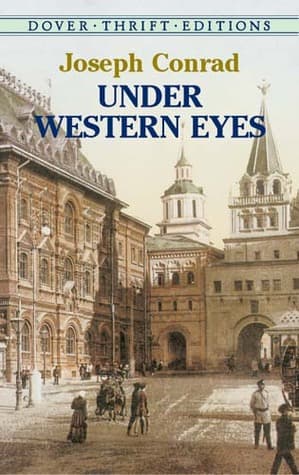
Joseph Conrad (2020)
Genre
Historical Fiction
Reading Time
360 min
Key Themes
See below
Sign in to track this book
In 19th-century Russia, a student's betrayal of a revolutionary forces him to spy on the condemned man's family, all while struggling with his own conscience.
Victor Haldin, a fellow student and known revolutionary, enters Razumov's St. Petersburg apartment. He confesses to assassinating the repressive Minister of State, Mr. de P—-. Haldin needs a place to hide and a way to escape. He trusts Razumov, a bright but apolitical philosophy student. Razumov, who wants a respectable career in the Russian government, is horrified. He feels his future is unfairly threatened by Haldin's act. Overwhelmed and fearing involvement, Razumov agrees to help Haldin, though he worries about what this means for his own life.
Razumov cannot find a reliable coachman for Haldin. In a state of moral conflict, he seeks advice from Prince K—-, a high-ranking official he hopes will protect his career. However, K—- is not available, leaving Razumov feeling alone. In a moment of panic and wanting to clear his name and secure his future, Razumov decides to go to General T—-, the head of the secret police. He reveals Haldin's location, leading to Haldin's quick arrest. Razumov immediately feels a deep sense of unease and guilt, a heavy burden that will stay with him.
Haldin is executed. This deeply troubles Razumov, even though his betrayal remains unknown to revolutionary groups. Razumov's academic career, which he had carefully built, is subtly undermined by the authorities, who now see him as a useful tool rather than a promising scholar. General T—- tells Razumov he is now 'marked' by the state, not as a suspect, but as an asset. He is given a new, secret mission: to join the Russian revolutionary exile community in Geneva and report on their activities, specifically to gather information about Haldin's family and his revolutionary associates.
Razumov travels to Geneva and quickly becomes part of the Russian exile community. He meets Peter Ivanovitch, a respected but self-serving revolutionary, and Sophia Antonovna, an older, more practical revolutionary. His main target, however, is Natalia Haldin, Victor's sister, and their mother, who live in Geneva and mourn Victor's death. Razumov must gain their trust, knowing he is responsible for Victor's death. His inner conflict grows as he sees Natalia's genuine grief and her belief in her brother's cause.
Razumov skillfully joins the revolutionary groups, presenting himself as a sympathetic student who knew Victor Haldin in St. Petersburg. He visits the Haldin home often, drawn to Natalia's intelligence and integrity, which contrasts with his own deceit. Natalia, still seeking answers about her brother's last days, finds comfort in Razumov's presence, believing him to be a true friend of Victor. Razumov's guilt weighs heavily as he listens to Natalia talk about her brother's ideals and the injustice of his death, knowing he caused it.
General Mikulin, the Russian Consul-General in Geneva, oversees Razumov's mission. Mikulin is a clever and experienced intelligence officer who quickly realizes Razumov is not a true revolutionary. He notices Razumov's discomfort and small inconsistencies. While he does not fully uncover Razumov's past betrayal, he understands that Razumov is a man with a secret, a state tool rather than a genuine convert to the revolutionary cause. Mikulin's watchful presence adds more pressure and anxiety to Razumov's already difficult life.
The arrival of Nikita Necator, a violent revolutionary known as 'the killer of spies,' frightens the exile community. Necator is the man who executed the coachman Razumov tried to contact for Haldin, making him a direct link to Razumov's past actions. His presence is a constant threat, as Razumov fears Necator might discover his role in Haldin's capture. This new danger increases Razumov's paranoia and inner pressure, making his double life even more risky.
Razumov's inner struggle reaches its breaking point. The hypocrisy of his situation, his growing feelings for Natalia, and the weight of his secret become too much. In an emotional scene, Razumov confesses everything to Natalia Haldin: his betrayal of her brother, Victor, and his role as a spy for the Russian government. He gives her a written confession, detailing the events that led to Victor's arrest and execution. Natalia is devastated, her world shattered by the truth about the man she trusted.
After confessing to Natalia, Razumov gives his written confession to the assembled revolutionary exiles. He stands before them, without his lies, and publicly admits his role in Victor Haldin's capture and death. The revolutionaries, especially Nikita Necator, are furious. As Razumov leaves the meeting, Necator confronts him. In a brutal act of revenge, he strikes Razumov with a pickaxe, rupturing his eardrums and making him deaf. This violent act is the revolutionaries' swift judgment for his betrayal.
Razumov, now permanently deaf and physically broken, returns to Russia. He is no longer useful to the authorities and is abandoned by them. Despite his physical suffering and the ruin of his ambitions, a strange peace settles over him. He has shed the burden of his lies and faced the results of his actions. He finds some redemption in his final act of truth-telling, even though it cost him everything. He lives out his remaining days quietly, cared for by a kind older woman, reflecting on the moral choices that shaped his life.
The Protagonist
Razumov transforms from an ambitious, self-preserving student into a morally tormented individual who ultimately seeks redemption through confession, even at the cost of his life.
The Catalyst/Supporting
Haldin's arc is brief but impactful; he acts decisively for his beliefs and faces the ultimate consequence, becoming a martyr figure whose memory haunts the protagonist.
The Supporting
Natalia evolves from a grieving sister seeking truth to a woman deeply wounded by betrayal, yet she retains her capacity for understanding and perhaps even forgiveness.
The Supporting
General T—- remains a static character, representing the unchanging, cynical face of the state's power and manipulation.
The Supporting
Mikulin remains a static character, a perceptive observer of human weakness and state power.
The Supporting
Peter Ivanovitch remains a static character, a symbol of revolutionary self-importance and superficiality.
The Supporting
Sophia Antonovna remains a static character, embodying the steadfast and often unsung dedication of the revolutionary cause.
The Antagonist
Necator remains a static force of violent retribution, serving as a direct instrument of revolutionary justice.
The main theme is Razumov's initial betrayal of Victor Haldin and its lasting effects on his mind and life. This betrayal comes from self-preservation and a fear of political involvement, but it leads to a crushing guilt that isolates him. The novel shows how one moral compromise can ruin a life, forcing Razumov into a web of deceit that becomes unbearable. The confession, though physically damaging, offers a kind of freedom from this inner pain, showing that betrayal's effects are not just external but deeply internal.
“A man's most important possession is his conscience.”
Conrad explores the complexities of both the Tsarist government and the revolutionary movement. The government is shown as oppressive, cynical, and manipulative, using people like Razumov as tools (General T----, General Mikulin). The revolutionaries are shown with idealism (Victor, Natalia) but also flaws: Peter Ivanovitch's vanity, Nikita Necator's brutal fanaticism. The novel suggests that both extremes, without limits, cause suffering and moral compromise. It questions the idea that either side has a monopoly on truth or justice, showing the human cost of political extremism.
“All Europe is a black pit of treachery and revolt.”
Razumov's journey deeply explores identity. He first defines himself by his academic success and his desire for a respectable career, trying to stay out of political turmoil. However, his betrayal forces him to create a false identity as a revolutionary supporter. This deception leads to severe inner conflict, blurring who he truly is. His final confession is an attempt to reclaim his real self, even if it means destroying the fabricated one. The novel suggests that living a lie ultimately corrupts and fragments a person, making true peace impossible.
“He was a man who had lost his way in life and was looking for it in his own soul.”
Razumov is always shown as a solitary person, an orphan who relies only on himself. His act of betrayal pushes him into even deeper moral isolation. He cannot confide in anyone, neither the authorities who exploit him nor the revolutionaries he deceives. This isolation is both a result and a cause of his suffering, as he carries the heavy burden of his secret alone. Even when he forms connections, especially with Natalia, the underlying deception prevents true closeness, highlighting the deep loneliness that comes with a life built on lies. His eventual confession, while exposing him, paradoxically offers a way out of this deep solitude.
“He was a man whom no one knew.”
A framing device that filters the story through a detached, Western European perspective.
The entire story is presented through the perspective of an unnamed, elderly English 'Teacher of Languages' in Geneva. He is not a direct participant in most events but reconstructs Razumov's story from his diary and conversations with Natalia Haldin and other émigrés. This creates a layer of distance and interpretation, influencing how the reader perceives the 'Russian soul' and the events. The teacher's 'Western eyes' provide a lens through which the complex and often alien (to him) Russian political landscape and moral dilemmas are viewed, adding a critical, sometimes judgmental, but ultimately empathetic perspective.
Razumov's personal journal, serving as a primary source of his internal torment and eventual truth.
Razumov's diary is a crucial plot device, serving both as a narrative tool and a symbol of his internal struggle. It is through these writings that the 'Teacher of Languages' gains insight into Razumov's true thoughts, fears, and the agonizing process of his moral reckoning. The diary is not just a record; it becomes Razumov's confidant, a space where he grapples with his guilt. Ultimately, a part of it transforms into his written confession, a tangible manifestation of his decision to embrace truth, making it the instrument of his redemption and downfall.
The cruel twist of destiny that forces an apolitical man into the heart of political intrigue.
The 'irony of fate' is a recurring device, particularly in Razumov's initial entanglement. He is an apolitical student, meticulously planning a life of order and stability, only to have a revolutionary literally burst into his room and shatter his world. His desperate attempt to preserve his future through betrayal ironically leads him directly into the very political intrigue he sought to avoid, forcing him to become a spy. This device highlights the capriciousness of destiny and how seemingly small decisions can have monumental, unforeseen consequences, trapping individuals in circumstances beyond their control.
Razumov's physical deafness after his confession symbolizes his detachment and internal peace.
Razumov's loss of hearing after being struck by Nikita Necator is a powerful symbolic act. On one level, it is a brutal punishment for his betrayal. On another, it symbolizes his detachment from the chaotic and often deceptive 'noise' of the world – both the political machinations of the state and the revolutionary rhetoric. His deafness, ironically, brings him a strange form of internal peace and clarity. Having confessed and faced the consequences, he no longer needs to listen to the lies or the demands of others; he is finally free to exist within the quietude of his own truth, albeit a painful one.
“A man’s most critical moments are not those that he thinks are so, but those that he is unaware of.”
— Razumov reflecting on his circumstances after the assassination.
“The most successful crime is that which is never discovered. The most successful life is that which is never questioned.”
— Razumov's internal monologue about success and scrutiny.
“The moral problem of an event is not in the event itself, but in the mind confronting it.”
— The narrator's philosophical observation on moral interpretation.
“History is a tale, for the most part, of men who were not good enough.”
— Razumov's cynical view of historical figures.
“Words, as is well known, are the great foes of reality.”
— The narrator commenting on the deceptive nature of language.
“Action is the first great teacher of the world.”
— Razumov considering the impact of events.
“The greatest joy of a man is to find himself in a position where he has to do something.”
— A reflection on the compulsion to act, even under duress.
“He who looks too long into an abyss, the abyss also looks into him.”
— Razumov's descent into moral compromise, echoing Nietzsche.
“There are no perfectly safe confidences.”
— Razumov's realization about trust and betrayal.
“The world is a bad place, but it is not bad enough to be hopeless.”
— A character expressing a tempered view of the world's state.
“To be perfectly truthful, one must be perfectly alone.”
— Razumov's struggle with honesty in a world of political intrigue.
“A man’s most secret thoughts are not his own, but belong to the spirit of his time.”
— The narrator's observation on the influence of historical context.
“The thought of a man’s brain is a thing of the past; the feeling of his heart is a thing of the future.”
— A philosophical contrast between intellect and emotion.
“Every act of betrayal is a confession of weakness.”
— Razumov's internal justification or condemnation of his actions.
Ready to see how well you understood this book? Take our interactive quiz with 10 questions.
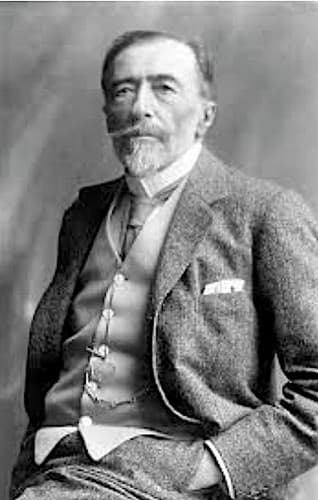
Joseph Conrad was a Polish-British novelist and short story writer. He is regarded as one of the greatest writers in the English language; though he did not speak English fluently until his twenties, he came to be regarded a master prose stylist who brought a non-English sensibility into English literature. He wrote novels and stories, many in nautical settings, that depict crises of human individuality in the midst of what he saw as an indifferent, inscrutable and amoral world.







