“How can I be a success at anything when I am a failure in my own eyes?”
— The Consul's internal struggle with his self-worth.

Malcolm Lowry (2007)
Genre
Literary Fiction / Historical Fiction
Reading Time
1200 min
Key Themes
See below
Sign in to track this book
On the Day of the Dead in 1938, a British consul struggles with his estranged wife's attempt to win him back in Mexico, while he descends into his own self-destructive spiral.
It is the Day of the Dead, November 2, 1938, in Quauhnahuac, Mexico. Yvonne Firmin, Geoffrey's estranged wife, returns after a year, hoping to revive their marriage and save her husband from his alcoholism. She finds Geoffrey, the former British Consul, already drunk and his house a mess. Their reunion is tense, with unspoken resentments, especially about Yvonne's past affair with Hugh, Geoffrey's half-brother, and Geoffrey's own unclear relationship with Maria, a local prostitute. Yvonne's hopes for a new start are immediately challenged by Geoffrey's habits and his deliberate self-destruction, setting a grim mood for the day.
Hugh Firmin, Geoffrey's half-brother, arrives for breakfast, adding to the tense atmosphere. Hugh, a journalist and former merchant sailor with socialist views, has a complicated history with both Geoffrey and Yvonne, having had an affair with Yvonne during her separation from Geoffrey. The three try to eat breakfast, but the conversation is awkward and full of unspoken meanings. Geoffrey continues drinking, and his sarcastic remarks and philosophical thoughts often hide his pain and resentment. Yvonne tries to talk about a future away from Mexico, while Hugh tries to mediate, though his presence only highlights the unresolved issues between the couple. The morning has moments of quiet and thinly veiled hostility.
Geoffrey, in one of his unpredictable moves, suggests they all go to Tomalín, a nearby village, supposedly to see a bullfight. Yvonne and Hugh reluctantly agree, hoping to humor Geoffrey and perhaps find a shared experience. The bus ride is chaotic, showing various aspects of Mexican life, further disorienting Yvonne, who struggles to understand Geoffrey's interest in the country's darker sides. Geoffrey's drinking continues, and his behavior becomes more erratic, with moments of clarity mixed with deep despair. The journey symbolizes their collective wandering, heading toward an unknown destination without clear purpose.
In Tomalín, the group finds a lively but unsettling Day of the Dead fair in full swing. Geoffrey is drawn to a cantina, where he keeps drinking heavily, ignoring Yvonne's pleas and Hugh's attempts to intervene. The festive atmosphere contrasts with an underlying sense of danger, shown by a dead pariah dog and the general squalor. Geoffrey's interactions with locals, including a brief, mysterious encounter with an official, are fueled by alcohol and a growing detachment. Yvonne, increasingly desperate, tries to engage him, but he remains distant, his mind seemingly lost in his inner struggles. The fair becomes a small version of Geoffrey's internal chaos, a place where joy and death mix.
The bullfight in Tomalín is not the grand event Hugh and Yvonne might have expected, but a brutal, disorganized affair. Geoffrey, increasingly drunk, watches with detached interest. During the event, a horse tied outside the arena is accidentally gored and left to die, a disturbing incident that deeply affects Yvonne. Geoffrey, however, seems unaware, his attention elsewhere. The gored horse becomes a strong symbol of destroyed innocence and the casual cruelty of their day. This event further shows Geoffrey's inability to connect with the suffering around him, or perhaps, his strong connection to it. The incident leaves Yvonne feeling more isolated and helpless.
After the bullfight, Geoffrey and Hugh split from Yvonne, who goes to look for a specific bus. They end up at El Farol, a notoriously rough cantina. Here, Geoffrey's drinking increases, and he gives increasingly fragmented and self-pitying monologues. Hugh, despite his discomfort, tries to keep an eye on Geoffrey. Inside, they meet a group of local fascists, including the Chief of the secret police, and a man Geoffrey recognizes as having previously taken a peasant's land. The atmosphere is charged with political tension and implied violence. Geoffrey's drunken state makes him oblivious to the growing danger, while Hugh senses the increasing threat.
At El Farol, the situation quickly worsens. Geoffrey, drunk, makes several unwise remarks and gestures, especially about a lost horse and a peasant's land, accidentally angering the local fascists. He is mistaken for a communist agitator. Despite Hugh's attempts to pull him away, Geoffrey remains defiant. The Chief of Police and his men confront Geoffrey, accusing him of various offenses. The scene quickly turns violent. Geoffrey is brutally beaten and dragged outside the cantina. In his last moments, he is thrown into a barranca (ravine), falling to his death, a chaotic and undignified end to his tormented life.
While Geoffrey and Hugh are at El Farol, Yvonne, unable to find the bus she was looking for, becomes increasingly worried about Geoffrey. She walks through the darkening streets of Quauhnahuac, her hope fading. She sees several unsettling scenes, including a man being beaten, and the general atmosphere of the Day of the Dead, once lively, now feels threatening. Her search is a lonely and increasingly desperate journey, mirroring her internal struggle to save her marriage and her husband. She is a figure of tragic futility, unknowingly moving closer to, yet always just missing, Geoffrey's unfolding tragedy.
Hugh, seeing Geoffrey's brutal murder and fearing for his own life, escapes El Farol in the chaos. He is deeply shaken by the events and overwhelmed by guilt, believing he could have done more to prevent Geoffrey's death. He wanders aimlessly, trying to process the horror he witnessed, the image of his half-brother's violent end burned into his mind. His escape is not a relief, but a deep trauma and the burden of survival, leaving him to deal with the consequences and the question of his own involvement or failure. He eventually finds his way back towards Quauhnahuac, a changed man.
As night falls, Yvonne, still desperately looking for Geoffrey, accidentally stumbles towards the barranca where Geoffrey died. In the dark, disoriented and distressed, she is attacked by a wild horse, possibly the same gored horse from the bullfight, which bolts from the ravine. She falls into the same ravine, suffering a fatal injury. Her death is as sudden and random as Geoffrey's, a final, tragic irony that she dies where her husband perished, never having found him, her search for reconciliation ending in shared oblivion. Her last moments are filled with a desperate longing for Geoffrey, a yearning that remains unfulfilled.
The novel ends with the deaths of both Geoffrey and Yvonne, leaving Hugh as the sole survivor to witness the day's tragedies. Their bodies are likely consumed by the barranca, reflecting Geoffrey's earlier symbolic statement about being thrown into the abyss. The ending is bleak, offering no easy answers or redemption. The political tensions, personal failures, and despair that filled the day lead to a final, irreversible descent. The reader is left with a sense of waste and the mystery of human suffering and self-destruction, reflecting the novel's themes of damnation and the impossibility of escape.
The Protagonist
Geoffrey's arc is one of steady, deliberate descent into complete self-destruction, culminating in his violent death.
The Supporting
Yvonne's arc is a tragic journey from hopeful reunion to desperate futility, ending in her accidental death.
The Supporting
Hugh's arc involves a growing awareness of his own complicity and the limits of his idealism, culminating in his traumatized survival.
The Supporting
Laruelle's arc is primarily observational, as he reflects on the past, providing a retrospective lens on the tragedy.
The Supporting
Dr. Vigil's arc is static; he is a consistent source of concern and advice for Geoffrey.
The Mentioned
Maria's role is static, serving as a symbolic representation of Geoffrey's decline.
The Antagonist
The Chief's role is to act as the instrument of Geoffrey's destruction.
The novel explores alcoholism, not just as a physical addiction but as a sign and tool of self-destruction. Geoffrey's drinking is shown as a choice, a way to escape his past guilt, his marital failures, and his despair. Alcohol acts as a destructive force, blurring his perception, isolating him, and ultimately leading to his death. Scenes like Geoffrey's constant drinking at El Farol, ignoring Yvonne's pleas, clearly show this theme, demonstrating how his pursuit of oblivion becomes an active, almost deliberate, form of suicide. The volcano itself can symbolize his internal, explosive self-destruction.
“How, unless you drink as I do, could you hope to understand the beauty of an old woman's soul?”
Guilt runs through the narrative, driving the characters' actions and inactions. Geoffrey is haunted by his perceived failures as a husband and his past deeds, which he drowns in alcohol. Yvonne carries the burden of her infidelity with Hugh, seeking redemption through reconciliation. Hugh, too, is burdened by his affair with Yvonne and his inability to save Geoffrey. The characters constantly struggle with their past mistakes, but true redemption remains out of reach, especially for Geoffrey, who seems to reject any path to it. The entire day is Yvonne's attempt to offer Geoffrey a chance at redemption, which he tragically wastes.
“No, it is not a question of 'being in love' as she had been in love once with Hugh. It is a question of being in hell.”
The novel questions how much characters control their destinies. Geoffrey's death feels both fated by his alcoholism and a result of his choices. The repeated symbols of the barranca, the Pariah dog, and the Maguey worms suggest an inescapable, almost cosmic, doom. Yet, Geoffrey makes choices throughout the day that directly lead to his death, such as his insistence on going to Tomalín and his provocations at El Farol. The narrative creates tension between the idea of an inevitable fate, perhaps influenced by Mexico's mystical and diabolical atmosphere, and the characters' individual free will, particularly Geoffrey's 'will to destruction'.
“He had passed the point of no return. It was no longer a question of whether he would drown, but when.”
The complex interaction of love and betrayal forms the emotional center of the novel. Geoffrey loves Yvonne deeply, yet his alcoholism and jealousy lead him to betray her and himself. Yvonne's love for Geoffrey is tested by his destructive behavior and her own past betrayal with Hugh. Hugh, caught between loyalty to his brother and his feelings for Yvonne, also embodies this theme. The characters are stuck in a cycle of loving, hurting, and seeking forgiveness, often unsuccessfully. The intensity of their emotional bonds is matched only by the pain they cause, making their relationships both passionate and deeply destructive.
“She loved him, she knew that now, as she had never loved anyone before.”
Mexico is more than a setting; it is a living entity that reflects and intensifies the characters' internal states. The vibrant, chaotic, and often violent landscape of Quauhnahuac and Tomalín, with its Day of the Dead celebrations, ancient ruins, and political unrest, mirrors Geoffrey's tormented mind. It is both beautiful and terrifying, offering moments of deep spiritual insight and overwhelming despair. The natural elements – the volcano, the barranca, the jungle – symbolize the elemental forces at play within Geoffrey and the universe itself. The country's spiritual and political turmoil acts as a trigger for the characters' personal crises, blurring the line between external reality and internal experience.
“This was the land of death, the land of the living dead.”
The dormant volcano represents Geoffrey's suppressed turmoil and impending eruption.
The ever-present volcano, Popocatepetl, looming over Quauhnahuac, is a powerful symbol throughout the novel. It represents Geoffrey's internal state – a dormant, yet volatile force, capable of immense destruction. Its 'smoking' is often linked to Geoffrey's mental and emotional turmoil, a constant reminder of the explosive potential within him. The volcano also symbolizes the simmering political and spiritual unrest of Mexico itself, mirroring the personal chaos of the characters. It is a metaphor for the destructive forces, both internal and external, that ultimately consume Geoffrey.
The deep ravine symbolizes the abyss of despair, hell, and the final resting place.
The barranca, a deep ravine or gully, is a recurring and potent symbol. It represents the abyss, both literal and metaphorical, into which Geoffrey is constantly falling due to his alcoholism and despair. It is a place of refuse, death, and spiritual emptiness. Geoffrey often speaks of being 'thrown into the barranca,' foreshadowing his ultimate fate. It also symbolizes hell and the final, inescapable destination for the damned. The fact that both Geoffrey and Yvonne meet their deaths in the barranca underscores its role as a powerful symbol of their shared, tragic descent into oblivion.
The suffering, dead dog symbolizes innocence destroyed and the indifference of the universe.
The pariah dog, encountered in various states of suffering and ultimately dead, serves as a recurring symbol of innocent suffering, neglect, and the pervasive cruelty in the world. Its presence, particularly its death at the fair, deeply affects Yvonne but seems to barely register with Geoffrey. It highlights the theme of compassion (or lack thereof) and the arbitrary nature of fate. The dog's plight mirrors the human condition in the novel, suggesting that suffering is an inescapable part of existence, often met with indifference. It foreshadows the meaningless deaths of the main characters.
Numerous subtle and overt hints predict the tragic fates of the characters.
The novel is rife with foreshadowing and omens, creating a pervasive sense of impending doom. Geoffrey's frequent allusions to being 'thrown into the barranca,' the recurring imagery of death (Day of the Dead, the gored horse, the pariah dog), and the oppressive political atmosphere all serve to hint at the tragic conclusion. Even seemingly mundane events or casual remarks take on a sinister significance in retrospect. This device intensifies the novel's tragic atmosphere, making the characters' fate feel both inevitable and tragically self-inflicted, as if they are marching towards a predetermined end they cannot escape.
“How can I be a success at anything when I am a failure in my own eyes?”
— The Consul's internal struggle with his self-worth.
“The Consul raised his glass. 'To the will, then! The indomitable human will!'”
— A moment of ironic toast amidst his drinking.
“He saw that the world was not a place, but a condition.”
— The Consul's philosophical reflection on existence.
“No se puede vivir sin amar.”
— A Spanish phrase meaning 'One cannot live without loving,' echoing a central theme.
“Hell is not a place, but a state of mind.”
— The Consul's contemplation of his own torment.
“What is man, when you come to think upon him, but a minutely organized mass of maggots?”
— A dark, cynical reflection on human nature.
“He felt that he was living in a world which had already been destroyed.”
— The Consul's sense of post-war desolation and personal ruin.
“She was like a lighthouse, the light of which had gone out.”
— The Consul's perception of Yvonne, his estranged wife.
“The past is a country from which there is no return.”
— The Consul's struggle with his past actions and regrets.
“But a man can't live without hope. A man can't live without love.”
— A rare moment of vulnerability and longing from the Consul.
“He stood there for a moment, an infinitely sad, infinitely lonely figure, against the backcloth of the stars.”
— A poignant description of the Consul's isolation.
“This was the end. There was no more to say.”
— The Consul's grim realization of his impending fate.
“How, unless you drink as I do, can you hope to understand the beauty of an old Spanish town?”
— The Consul's self-justification for his alcoholism.
“The Consul thought, it is impossible to be alive and not to be afraid.”
— A reflection on the pervasive nature of fear in human existence.
Ready to see how well you understood this book? Take our interactive quiz with 10 questions.
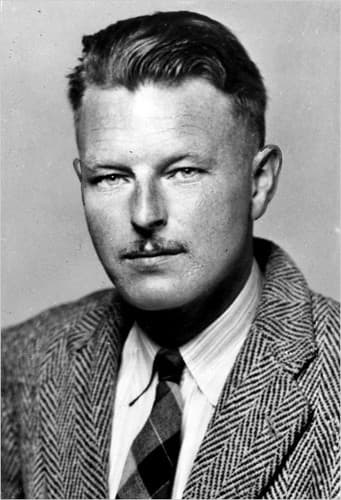
Clarence Malcolm Lowry was an English poet and novelist who is best known for his 1947 novel Under the Volcano, which was voted No. 11 in the Modern Library 100 Best Novels list.







