“The problem with immortality isn’t that you live forever; it’s that everyone else doesn’t.”
— A reflection on the challenges of being an immortal scythe.

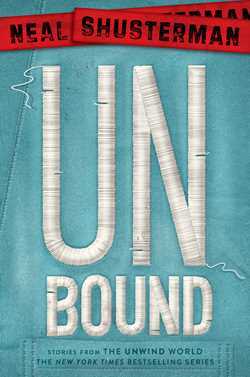
Neal Shusterman (2015)
Genre
Fantasy / Science Fiction / Young Adult
Reading Time
305 min
Key Themes
See below
Sign in to track this book
In a world where teenagers are harvested for parts, 'UnBound' explores the ethics and stories of a society that has normalized the sacrifice of its youth.
Connor Lassiter, now a leader in the Unwind resistance, visits a hospital where conjoined twins, one named Argent, have been separated. Argent, previously fused to his brother, now lives without his brother's half of their shared body. He feels phantom limb sensations and the trauma of his separation, a sense of loss. Doctors are impressed by the medical advance, but Argent's internal struggle shows the ethical and emotional cost of such procedures. He questions if he is truly 'alive' or just a part of what once was.
Risa Ward, a nurse, sees something disturbing: a group of patients who received unwound parts from the same donor. These recipients, despite different original bodies, start showing shared memories and traits of the donor, a girl named Lily. Risa sees their collective grief and confusion, as Lily's consciousness seems to live on in them. This experience bothers Risa, strengthening her resolve to fight unwinding, as she sees the unsettling spiritual effects of taking a person apart and distributing their essence.
Lev Garrity, now a Clapper, is in a community where abandoned babies, 'storks,' are common. He and other teens must take part in the 'storking' ritual, deciding whether to keep or abandon infants left at their doors. The story follows a girl named Maya who, despite their harsh survival, tries to care for a storked baby. This highlights the desperation and moral problems faced by those outside society, showing how the system's cruelty extends beyond unwinding teens, affecting the most vulnerable.
Hayden, an Unwind who escaped the process, struggles with his new identity and fragmented memories. He joins a support group for other escapees, where they try to rebuild their lives and understand their shared trauma. Hayden feels like a 'patchwork' person, made of different parts, and fears being found. His journey explores the psychological scars from the threat of unwinding and the difficulty of rebuilding a self in a world that tried to erase him.
A chase happens as a group of unwound teens, led by Jax, tries to escape Juvy-cops in a large, ruined city. Jax, a skilled parkour practitioner, guides his friends through dangerous rooftops and hidden alleys, showing their resilience and cleverness. The pursuit is constant, showing the authorities' efficiency and the desperate measures unwound teens must take to survive. This scene emphasizes the constant danger and the strong bonds formed among those fighting for their lives.
A girl named Grace gets a heart transplant from an unwound teen. Grateful at first, Grace starts having vivid dreams and emotional changes she believes are linked to her donor's memories and personality. She feels a strong connection to the unknown donor, making her question unwinding's morality and the true meaning of life and death. Grace's internal conflict explores the spiritual and psychological effect of receiving unwound organs, blurring the lines between recipient and donor and showing the lingering presence of those unwound.
This section looks at the history of the Unwind Accord, tracing its beginnings to the 'Heartland War' and society's desperate measures to deal with overpopulation and resource scarcity. It describes the political moves and ethical compromises that led to the solution of unwinding. The story gives insight into the societal pressures and propaganda that normalized the practice, showing how a population can accept the unacceptable. It is a warning about moral compromise and the devastating long-term effects of short-sighted solutions.
In a future where unwinding is outlawed, a historian named Anya researches the last Unwind facility. She finds records and personal accounts of those who went through the process, showing the lasting trauma and scars left by the unwinding era. Anya's investigation reminds readers of the atrocities and the importance of remembering history to prevent its repeat. The story explores the challenges of healing a broken society and the ongoing fight for justice and reconciliation in a post-unwind world.
Dr. Eleanor Vance, a scientist, tries to prove that a 'soul' or consciousness exists after an individual is unwound. She does secret experiments, using technology to detect residual neural activity or energy in unwound parts. Her work faces skepticism and ethical challenges, but she believes unwinding is more than a medical procedure—it's spiritual destruction. Her story explores the philosophical and scientific debate about the human soul in the context of unwinding.
This chapter gives a disturbing first-person account of a teen undergoing the unwinding process. It details the sterile environment, the detached medical staff, and the horror of being systematically taken apart. The narrative focuses on the donor's internal experience, their fading consciousness, and fragmented thoughts and emotions as their body is harvested. It is a raw portrayal of the ultimate violation of human autonomy and dignity, meant to evoke empathy and horror at unwinding's mechanics.
A secret group called 'The Red Herrings' works to protect unwinds through deception. They create fake identities, stage fake deaths, and change records to make unwinds disappear. The story follows a young Red Herring operative named Clio as she plans to save a group of teens from unwinding. This shows the cleverness and courage of the resistance movement, new tactics, and the constant game between those who enforce unwinding and those who fight it.
A former employee of an Unwind facility, known as 'The Scythe,' thinks about their past actions and moral compromises within the system. Haunted by the faces of the teens they processed, The Scythe struggles with guilt. The narrative explores the psychological cost of being part of an immoral system and the difficulty of seeking redemption. It offers a rare look into the perspective of someone who was part of the unwinding machinery, revealing internal conflict and the lasting burden of their choices.
The Protagonist/Supporting
From a rebellious runaway to a strategic leader, Connor's arc is about transforming personal survival into a movement for societal change.
The Protagonist/Supporting
Risa evolves from a pragmatic survivor to a dedicated healer and moral anchor for the unwound movement.
The Protagonist/Supporting
Lev's arc is a journey from religious fanaticism and self-sacrifice to independent thought and genuine altruism.
The Supporting
Argent's arc is a search for self and wholeness after a physically transformative and emotionally traumatic event.
The Supporting
Grace's arc involves coming to terms with the moral weight of her new heart and the life it came from.
The Supporting
Dr. Vance's arc is a relentless pursuit of scientific validation for a spiritual concept, challenging societal norms.
The Supporting
Jax's arc is about honing his survival skills to become a protector and guide for other unwound individuals.
The Supporting
Clio's arc is about mastering the art of deception to become an effective savior for the unwound.
The collection asks what it means to be human, especially with unwinding. Is a person defined by their body, memories, or something more? The story of Argent, the separated conjoined twin, questions a person's completeness after physical change. Grace, with an unwound heart, experiences lingering consciousness from her donor, suggesting a spiritual essence beyond the physical. Dr. Eleanor Vance's scientific quest to find the 'soul' in unwound individuals directly challenges the idea that unwound teens stop existing as whole beings. The stories make readers consider the ethical limits of life and death, and where human identity truly lies.
“How can I be whole when half of me is gone, and the other half remembers a life that wasn't entirely mine?”
The psychological effect of the unwinding system on its victims and those who enable it is a common theme. Characters like Hayden, an Unwind escapee, deal with fragmented identities and constant fear. Risa's disturbing experience of seeing multiple recipients share a donor's memories shows the trauma inflicted on those unwound and those who receive their parts. 'The Scythe,' a former facility worker, shows the theme of complicity and the lasting guilt of participating in such a system. The stories explore how individuals cope with, and are changed by, the threat and reality of unwinding, from resistance to internal struggle.
“We are not just parts; we are the ghosts of lives unfinished, haunting those who dared to take us apart.”
The collection explores the moral complicity that allows unwinding to continue, as well as the different forms of resistance. 'The Unwind Accord' looks at how society rationalized and put the practice in place, showing the dangers of political compromise and propaganda. In contrast, 'The Red Herring' introduces a new, clever form of resistance focused on deception, showing human defiance. Even characters like 'The Scythe' who were complicit deal with their past, illustrating the internal conflict of those caught in the system. The theme emphasizes that while evil can become normal, individuals can always resist and fight for justice, openly and secretly.
“Silence is the sound of complicity. To speak out is to reclaim your humanity.”
The ethical effects of advanced medical technology are central to the Unwind Dystology, and 'UnBound' explores this further. The successful separation of conjoined twins, while a medical achievement, creates a new psychological burden for Argent. The widespread practice of unwinding, presented as a solution to societal problems, is the ultimate ethical problem. Stories like 'The Human Heart' make readers re-evaluate organ transplantation when the donor is a forcibly unwound teen. The collection consistently asks where the line should be drawn in medical intervention, especially when it involves the use and dismemberment of human beings, and if technological progress always means moral progress.
“Just because we can, does it mean we should? The line between miracle and monster is often blurred.”
Shifting viewpoints to explore various facets of the Unwind world.
The collection utilizes multiple first-person and third-person perspectives from different characters, including unwinds, recipients of unwound parts, former facility workers, and scientists. This allows for a comprehensive exploration of the emotional, ethical, and societal impacts of unwinding from various angles, providing a richer, more nuanced understanding of the dystopian world and its inhabitants. It prevents a singular, biased interpretation and fosters empathy for a wider range of experiences.
Self-contained narratives offering focused insights into specific aspects of the world.
Instead of a single overarching plot, 'UnBound' is structured as a series of interconnected short stories and vignettes. This format allows the authors to delve into specific ethical dilemmas, character backstories, or unexplored corners of the Unwind world without being constrained by a linear narrative. Each story functions as a magnifying glass, highlighting a particular theme, character arc, or plot point, collectively building a more detailed and immersive universe.
A historical document providing context for the origins of unwinding.
The inclusion of a historical document, 'The Unwind Accord,' serves as a crucial plot device. It provides in-universe exposition, explaining the political and societal events that led to the establishment of unwinding. This device grounds the dystopian reality in a believable historical context, making the horrific practice seem like a logical (albeit morally reprehensible) outcome of societal pressures, adding depth and a cautionary tale aspect to the narrative.
Sensory and psychological phenomena indicating lingering consciousness.
This device manifests in characters like Argent, who feels phantom sensations from his separated twin, and Grace, who experiences memories from her unwound heart donor. It serves to underscore the idea that unwinding does not truly erase a person, but rather fragments their essence across multiple recipients. This device creates a haunting, unsettling atmosphere and strengthens the theme of the enduring human spirit and the ethical ambiguities of the unwinding process.
“The problem with immortality isn’t that you live forever; it’s that everyone else doesn’t.”
— A reflection on the challenges of being an immortal scythe.
“Every human being is a universe unto themselves. And every universe, no matter how small, deserves to be explored.”
— Scythe Curie's perspective on the value of individual lives.
“The greatest fear is not death, but the fear of not having lived.”
— A philosophical musing on the purpose of life.
“There are no monsters in this world, only people who have forgotten how to be human.”
— Scythe Faraday's belief in the redeemable nature of humanity.
“Hope is a dangerous thing. It can drive you mad, or it can save your life.”
— A reflection on the dual nature of hope.
“The only way to truly understand the value of life is to be faced with its end.”
— A scythe's unique perspective on appreciating life.
“We are all just stories in the end. Make yours a good one.”
— A reminder of the legacy one leaves behind.
“Ignorance is not bliss. It is merely a lack of information, and information is power.”
— A statement on the importance of knowledge.
“To be truly alive, one must be willing to die.”
— A paradox about embracing life's full spectrum.
“The world doesn't need more laws; it needs more justice.”
— A critique of legal systems and a call for true fairness.
“Even in the darkest of times, there is always a flicker of light.”
— A message of enduring hope.
“The greatest weapon against despair is connection.”
— Highlighting the importance of human relationships in difficult times.
“Truth is not always what we want it to be, but it is always what we need it to be.”
— A statement on the sometimes harsh but necessary nature of truth.
“Sometimes the greatest act of rebellion is simply to exist.”
— A powerful statement about defiance in the face of oppression.
Ready to see how well you understood this book? Take our interactive quiz with 10 questions.

Biography coming soon.







